Commuting Expenses: Public Transport vs Car
Navigating Italian cities requires balancing convenience with cost. This guide explores the financial trade-offs between utilizing Italy’s extensive public transit networks and the expenses of car ownership, helping expats optimize their daily travel budget for life in the Mediterranean.
Disclosure: This post may contain affiliate links. We may earn a commission at no extra cost to you if you make a purchase through these links. Read full disclosure.
The Financial Landscape of Public Transportation
Moving to Italy brings a lifestyle change that extends far beyond the kitchen. For many expatriates, one of the most immediate adjustments involves how to get from point A to point B. Italy is a land of geographic contrasts, where the hyper-connected metro lines of Milan stand in stark opposition to the winding, narrow coastal roads of Amalfi or the rolling hills of Tuscany. Consequently, the “correct” way to commute is rarely a universal answer; it is a financial and practical calculation based on your specific location, lifestyle, and professional needs.
The economic landscape of transportation in Italy is influenced by fluctuating fuel prices, increased investment in sustainable transit, and the persistent charm (and cost) of the iconic Italian automobile. Whether you are a digital nomad based in a metropolitan center or a professional working in an industrial hub, your commuting choice will be one of the largest recurring items in your monthly budget. Understanding the true cost of these options is a fundamental component of Budgeting for Italy: Cost of Living by City variations. This comprehensive analysis breaks down the hidden fees, tax implications, and daily realities of choosing between the “treno” and the “macchina.”
Italy’s public transportation network is generally regarded as one of the most affordable in Western Europe. For residents in major metropolitan areas, the system is designed to discourage car use through high-frequency service and subsidized monthly passes.
Urban Transit: Metro, Bus, and Tram
In cities like Rome, Milan, Turin, and Naples, the urban network is the lifeblood of the city. A standard monthly pass (abbonamento mensile) in these cities typically costs between €35 and €50. This usually provides unlimited travel on all forms of city transit. For students and seniors, these rates are often slashed further, making it an unbeatable deal for those on a fixed income.
The efficiency of these systems varies. Milan’s ATM network is famously punctual and clean, while Rome’s ATAC system often requires a bit more patience. Regardless of the speed, the cost remains low. If you are living in a city center, the financial argument for a car is difficult to make when compared to a €330 annual transit pass. For those just arriving, Settling In Italy: Daily Life Tips for Expats often includes advice on downloading local transit apps like MooneyGo or Citymapper to navigate these networks with ease.
Regional and High-Speed Rail
For those living in one city and working in another—a common scenario in the “Bologna-Florence” or “Milan-Turin” corridors—regional trains are the standard. Trenitalia and Italo offer high-speed connections that are far faster than driving. A regional monthly pass for a 30-minute commute might cost €60 to €90. While more expensive than urban transit, it eliminates the stress of traffic and the high cost of highway tolls.
The True Cost of Car Ownership in Italy
While public transit is cheap, it does not offer the total freedom that a car provides, especially for those living in the suburbs or rural areas. However, owning a car in Italy is a high-maintenance financial commitment that goes far beyond the monthly loan payment.
Purchase Price and Depreciation
Italy is home to some of the world’s most famous automotive brands, but whether you buy a Fiat or a Ferrari, the initial outlay is significant. New car prices in Italy are comparable to the rest of the EU, but used car prices have remained high due to supply chain factors in recent years. Furthermore, Importing a Car to Italy: Duties and Taxes can be a prohibitively expensive route for expats, often making it more logical to buy locally.
Mandatory Annual Costs: Bollo and Insurance
Every car registered in Italy is subject to the Bollo (road tax). This annual fee is calculated based on the engine’s power (kilowatts) and its environmental impact (Euro 4, 5, 6, etc.). A standard family car might cost between €150 and €300 per year.
Worse for the budget is the RC Auto (mandatory third-party insurance). Italy has some of the highest insurance rates in Europe, particularly for new residents who cannot transfer their “no-claims” bonus from their home country. A first-year policy for an expat in a major city can easily exceed €800 to €1,200 annually.
Fuel and Highway Tolls (Autostrade)
Fuel in Italy is heavily taxed. In 2026, prices for gasoline (benzina) and diesel remain significantly higher than in North America. Furthermore, if your commute involves the Autostrada (highways), you must pay tolls. These are not flat fees; they are calculated by distance. A daily 40km highway commute can easily add €150 per month to your travel expenses.
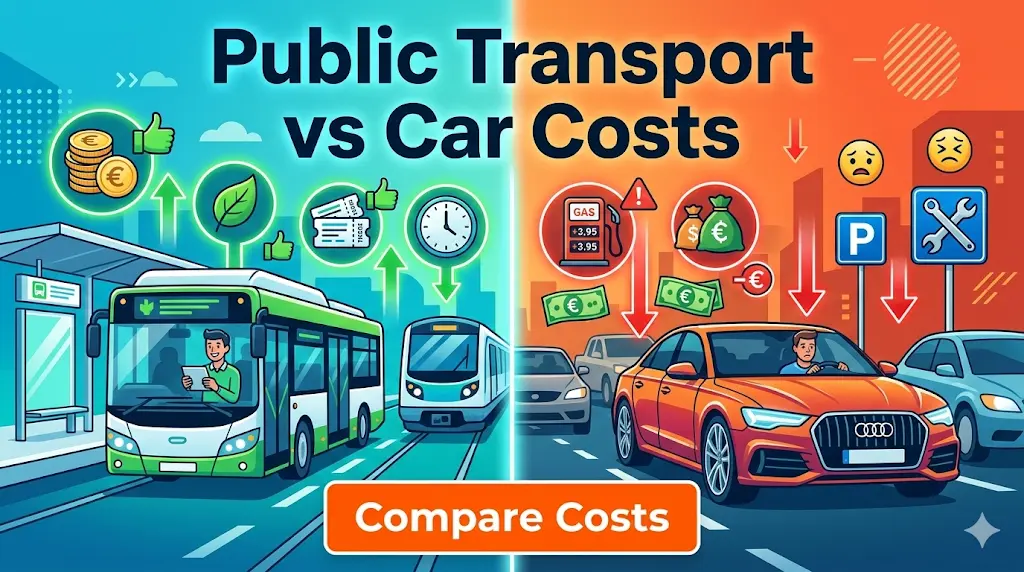
Comparing Commuting Expenses: Monthly Estimates
The following table provides a side-by-side comparison of the estimated monthly costs for a standard 15km commute in a mid-to-large Italian city.
| Expense Category | Public Transport (Abbonamento) | Private Car (Mid-sized) |
| Monthly Pass / Loan Payment | €35 – €55 | €250 – €400 |
| Fuel / Electricity | €0 | €120 – €180 |
| Insurance (RC Auto) | €0 | €70 – €100 |
| Maintenance / Revisions | €0 | €30 – €50 |
| Parking Fees | €0 | €50 – €150 |
| Highway Tolls | €0 | €0 – €100 |
| Annual Road Tax (Bollo) | €0 | €15 – €25 |
| Total Monthly Estimate | €35 – €55 | €535 – €1,005 |
Hidden Costs of Driving: Parking and ZTLs
One of the most frustrating and expensive aspects of driving in Italy is the “ZTL” (Zona a Traffico Limitato). Most historic city centers are restricted zones where only residents with special permits can drive.
The ZTL Penalty Trap
If you accidentally drive your car into a ZTL without a permit, cameras will capture your plate, and a fine of approximately €80 to €120 will be mailed to your home (or your rental agency). For a new expat, three wrong turns can equal a month’s rent.
Parking Challenges
In cities like Naples or Rome, parking is a blood sport. If your apartment does not come with a “box” (garage), you will spend hours looking for “blue lines” (paid parking) or “white lines” (free/resident parking). Private garage rentals in Milan can cost upwards of €200 per month, a figure that often settles the “car vs. transit” debate for many city dwellers.
When a Car is Non-Negotiable
Despite the high costs, there are scenarios where a car is the only viable option.
- Rural Living: If you’ve moved to a villa in the countryside, the nearest train station might be 15km away with a bus that runs twice a day.
- Family Needs: Transporting multiple children to different schools and activities can be a logistical nightmare on public transit, especially in cities where the “last mile” connectivity is poor.
- Professional Requirements: If you are a sales representative or work in a sector that requires frequent visits to industrial zones (Zone Industriali), which are typically poorly served by trains, a vehicle is a tool of the trade.
Sustainable Alternatives: E-Bikes and Car Sharing
The gap between “bus” and “car” is being filled by innovative micro-mobility and sharing services.
Electric Scooters and Bikes
Cities like Florence and Milan have paved the way for e-bike sharing. For a small annual subscription (around €50), you can have unlimited short rides. Many expats are now purchasing their own e-bikes for commutes under 10km, combining the speed of a car with the low cost of a bus pass.
Car Sharing (Enjoy, Share Now)
For those who only need a car for the weekly grocery run or a trip to IKEA, car-sharing apps are a budget lifesaver. You pay by the minute or the hour, and the price includes fuel, insurance, and—crucially—entry into ZTL zones and free parking on blue lines. This “hybrid” approach allows many expats to live car-free while still having access to a vehicle when needed.
Tax Implications and Deductions
The Italian government occasionally offers incentives to encourage public transit use.
The “Bonus Trasporti”
In various budget cycles, the government has offered the Bonus Trasporti, a €60 voucher toward the purchase of a transit pass for those under certain income thresholds (calculated via the ISEE). While not always active, it is worth checking with your local Comune.
Conclusion
The financial choice between a car and public transport in Italy is rarely a close race. For the vast majority of urban and suburban dwellers, public transportation offers a level of savings that a private vehicle simply cannot match. By opting for a monthly pass, an expat can save upwards of €5,000 to €8,000 per year—funds that can be better spent on travel, dining, or long-term savings. However, the “macchina” remains a symbol of independence for those in the provinces.
The key to a successful Italian budget is to choose your home location based on your transport preferences. If you want the savings of a bus pass, prioritize living near a “stazione” or “fermata.” If you need the car, prepare for the Bollo, the ZTLs, and the high price of Italian fuel.
References
Primary sources (official)
- Ministero delle Infrastrutture e dei Trasporti: The official ministry providing regulations on road taxes, ZTL guidelines, and national transit funding. https://www.mit.gov.it/
- Automobile Club d’Italia (ACI): The national authority for vehicle registration, road tax (Bollo) calculation, and driving statistics. https://www.aci.it/
Other helpful sources
- Facile.it – Car Insurance Comparison: A leading independent tool for comparing RC Auto insurance rates and fuel cost trends in Italy. https://www.facile.it/
Disclaimer
The information provided in this article is for general informational and educational purposes only and does not constitute professional financial or legal advice. Commuting costs, fuel prices, and municipal transit rates in Italy are subject to frequent changes based on geopolitical factors and local government decisions. Always verify current transit fares, parking regulations, and car insurance requirements in your specific Italian municipality before making significant financial commitments.