Saving for Retirement: Pensions vs Private Savings in Italy
Planning for your golden years in Italy requires a strategic balance between mandatory state contributions and flexible private investments. This guide explores the Italian pension pillars, tax-advantaged savings options, and essential financial planning tips for expatriates.
Disclosure: This post may contain affiliate links. We may earn a commission at no extra cost to you if you make a purchase through these links. Read full disclosure.
The Landscape of Retirement in Italy
For many, the dream of retiring to Italy involves sun-drenched afternoons in a Tuscan vineyard or quiet mornings by the Lake Como shore. However, the financial reality of sustaining that lifestyle requires a deep understanding of the local retirement infrastructure. Italy’s pension system is one of the most robust yet complex in Europe, characterized by a heavy reliance on state-managed funds and a growing emphasis on supplementary private savings.
As an expatriate, your retirement strategy must account for your residency status, your employment history across different borders, and the local tax implications of your investments. The Italian government continues to encourage residents to look beyond the state safety net, offering various tax incentives for those who utilize private pension funds. Navigating these choices is a cornerstone of Financial Planning for Expats: Savings, Retirement, and Pensions in Italy to ensure long-term stability in the Mediterranean.
The Three Pillars of the Italian Retirement System
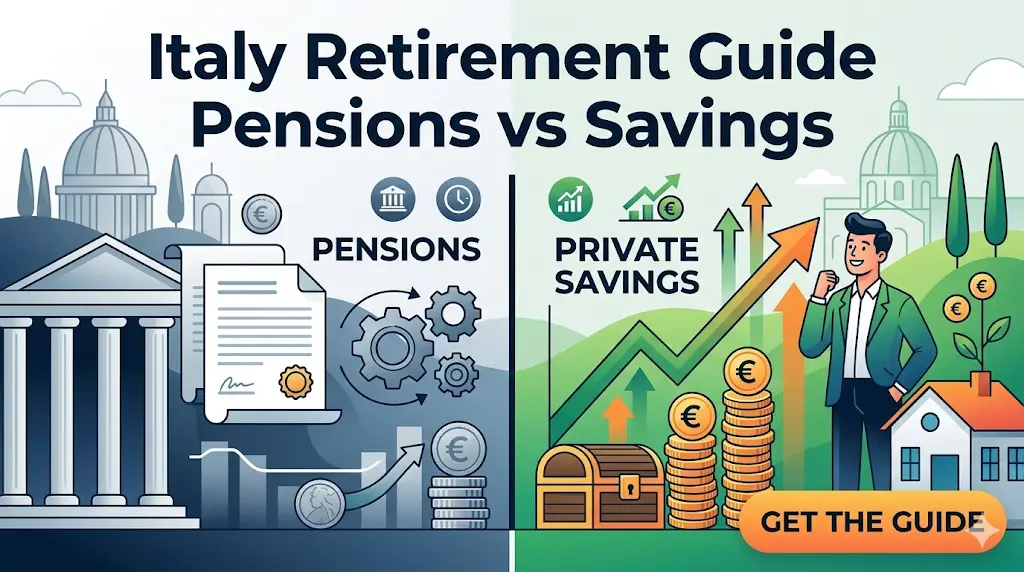
Italy’s retirement framework is often described as a “three-pillar” system. Understanding where your money goes—and where it should go—requires a breakdown of these categories.
Pillar 1: The Mandatory State Pension (INPS)
The first pillar is the public pension system managed by INPS (Istituto Nazionale Previdenza Sociale). If you are legally employed or self-employed in Italy, contributions to this pillar are mandatory.
- Employees: Contributions are deducted directly from your gross salary.
- Self-Employed: You are responsible for paying your own contributions through the Gestione Separata or a specific professional fund (Cassa).
For many expats, Working in Italy: Income, Taxation, and Social Security provides the foundational income that builds this first pillar. However, the “replacement rate” (the percentage of your working income that the state pension provides) is expected to decline for younger generations, making the next two pillars essential.
Pillar 2: Occupational Pension Funds
These are supplementary funds linked to specific employment sectors or collective bargaining agreements. They are often “closed” funds (fondi chiusi) available only to workers in certain industries. Employers often match a portion of the employee’s contribution, making this a highly efficient way to save.
Pillar 3: Individual Private Pensions
The third pillar consists of voluntary private savings. This includes “Open Pension Funds” (fondi aperti) and Individual Pension Plans (PIP). These are essential for freelancers or those whose primary pension may not be sufficient to maintain their desired Cost of Living in Italy 2026: Budgeting for Expats lifestyle.
Comparing Public Pensions and Private Savings
Choosing where to allocate your surplus income is a balancing act between security and flexibility.
The Security of INPS
The state pension is inflation-linked and guaranteed by the Italian government. It provides a safety net that is difficult to replicate with private investments alone. Furthermore, for expats, Italy has bilateral social security agreements with many countries (including the USA, UK, and Canada), allowing you to “totalize” your years of work across different nations to meet the minimum requirements for a pension.
The Flexibility of Private Savings
Private savings, such as Individual Pension Plans (PIP) or standard investment portfolios, offer several advantages over the state system:
- Portability: If you leave Italy, your private savings move with you more easily than state credits.
- Investment Choice: You can choose your risk profile, moving between aggressive equity funds or conservative bond funds.
- Inheritance: Private funds can be passed on to heirs more easily than certain public pension rights.
Tax Incentives for Private Retirement Savings
The Italian state incentivizes the use of supplementary pension funds (Pillars 2 and 3) through significant tax deductions.
Contributions Deduction
As of 2026, you can deduct contributions made to a supplementary pension fund from your total taxable income up to a maximum of €5,164.57 per year. This effectively reduces your income tax (IRPEF) bracket, providing an immediate financial return on your savings.
Taxation on Gains and Payouts
- Investment Gains: Pension funds are taxed at a substitute rate of 20% (or 12.5% for government bonds), which is lower than the standard 26% capital gains tax applied to traditional stock investments.
- Final Payout: When you retire and start drawing from the fund, the tax rate on the pension is generally 15%, which decreases by 0.3% for every year of participation over 15 years, down to a minimum of 9%. This is significantly lower than the standard income tax brackets.
For high-net-worth individuals, understanding these rates is as important as knowing the Requirements for Italy’s Special 100k Flat Tax Regime when planning a move.
Table: Comparison of Retirement Savings Options in Italy
| Feature | Mandatory Pension (INPS) | Private Pension (PIP/Open Fund) | Traditional Investments (Stocks/RE) |
| Mandatory? | Yes, if working | No, voluntary | No, voluntary |
| Tax Deduction | From gross salary | Up to €5,164.57/year | None |
| Tax on Returns | N/A | 12.5% – 20% | 26% |
| Access to Funds | Only at legal retirement age | Restricted until retirement | Anytime (Liquid) |
| Risk Level | Low (State-backed) | Variable (Market-based) | High (Market-based) |
| Management Fee | None | 0.5% – 2.5% | Varies by platform |
Managing the TFR: The “Liquidazione” as a Retirement Tool
Unique to Italy is the TFR (Trattamento di Fine Rapporto), often called severance pay. It is a portion of your salary (roughly 6.91%) that the employer sets aside every year.
Keeping TFR in the Company vs. Pension Fund
When you start a job, you must choose:
- In the Company: The money stays with the employer and is paid out as a lump sum when you leave the job. It is adjusted annually by a fixed rate plus a portion of inflation.
- In a Pension Fund: The TFR is transferred to your chosen supplementary pension fund.
For most expats planning for retirement, moving the TFR into a pension fund is the superior choice due to the potential for higher market returns and the lower taxation at the time of payout (9-15% vs. standard income tax rates).
Retirement for the Self-Employed and Digital Nomads
If you are Freelancing in Italy: Registering for Partita IVA, your retirement planning is entirely in your hands. Self-employed workers must pay into the Gestione Separata INPS, but these contributions are often lower than those for employees, leading to a smaller eventual pension.
For digital nomads and freelancers, private savings aren’t just a “supplement”—they are the primary pillar. Utilizing a PIP or a diverse portfolio of international ETFs is essential to ensure that your flexible lifestyle today doesn’t lead to a precarious retirement tomorrow.
Investment Strategies for an Italian Retirement
Beyond specific pension products, many expats utilize the broader financial market to build their nest egg.
- Real Estate: Italy’s “bricks and mortar” culture remains strong. Purchasing a property to rent out can provide a steady “inflation-proof” income in retirement.
- Government Bonds (BTP): Italian sovereign debt often offers higher yields than other Eurozone peers and is taxed at the favorable 12.5% rate.
- Diversified ETFs: For those with a long time horizon, low-cost index funds provide exposure to global growth while being easily manageable from an Italian bank account.
Conclusion
Saving for retirement in Italy is a multi-faceted endeavor that requires balancing the security of the state system with the tax advantages and growth potential of private funds.
For expatriates, the key is early action: maximizing the €5,164 tax deduction, making an informed choice about your TFR, and supplementing your public credits with flexible private investments. By understanding the interplay between INPS, occupational funds, and personal savings, you can build a robust financial future that allows you to enjoy the best of Italian life for decades to come.
References
Primary sources (official)
- INPS (Istituto Nazionale Previdenza Sociale): The official body for the Italian public pension system. https://www.inps.it/it/it.html
- COVIP (Commissione di Vigilanza sui Fondi Pensione): The administrative authority regulating all pension funds in Italy. https://www.covip.it/
Other helpful sources
- PwC Global Tax Summaries – Italy: A detailed technical guide on retirement taxes and social security. https://taxsummaries.pwc.com/italy/individual/taxes-on-personal-income
Disclaimer
The information provided in this article is for general informational and educational purposes only and does not constitute professional financial, tax, or investment advice. Retirement laws, pension contribution rates, and tax deduction limits in Italy are subject to frequent changes based on the national Budget Law and European Union directives. Every individual’s financial situation is unique; therefore, it is highly recommended to consult with a certified Italian financial planner or a Commercialista before making significant long-term savings decisions.