Social Security Contributions: Employee vs Self-Employed in Italy
Navigating the Italian social security system is a critical step for anyone working in the Bel Paese. This guide explores the differences in contribution rates, benefits, and obligations between salaried employees and self-employed professionals to help you plan your finances.
Disclosure: This post may contain affiliate links. We may earn a commission at no extra cost to you if you make a purchase through these links. Read full disclosure.
Understanding the Italian Social Security System
Italy possesses a robust social security framework designed to protect workers against various life risks, including old age, disability, sickness, and unemployment. The primary body managing these services is the INPS (Istituto Nazionale Previdenza Sociale). Whether you are moving to Milan for a corporate role or settling in Tuscany as a digital nomad, understanding how much you must contribute to this system is essential for accurate financial planning.
The Italian system is based on a “pay-as-you-go” model, where current workers fund the benefits of current retirees. For expats, these contributions are not just a tax; they are an investment in future rights, such as an Italian pension or access to maternity and paternity benefits. However, the way these contributions are calculated and paid differs significantly depending on your employment status.
The complexity of the Italian welfare state often surprises newcomers. Unlike systems that rely heavily on private insurance, Italy integrates health, pension, and disability protections into a single social security umbrella. This high level of protection comes with a higher price tag in terms of gross-to-net salary deductions, but it offers a safety net that remains one of the most comprehensive in the European Union.
Social Security for Employees in Italy
For those under a standard employment contract (lavoro subordinato), the process of social security contribution is largely automated. The employer takes on the bulk of the administrative and financial burden, making this the most straightforward path for many expatriates. Understanding Types of Italian Employment Contracts (Contratti di Lavoro) is crucial to knowing exactly which rules apply to your position.
Contribution Rates for Salaried Workers
In Italy, the total social security contribution for an employee typically amounts to approximately 33% to 40% of their gross salary. However, the employee does not pay this entire amount out of pocket. Instead, the cost is split between the employer and the employee:
- Employer Share: Usually around 28% to 32% of the gross salary.
- Employee Share: Usually around 9% to 10% of the gross salary.
The employee’s portion is deducted directly from their monthly payslip (busta paga). This means that the “Net Salary” you receive has already accounted for these social security obligations. For most standard office roles, the employee is only vaguely aware of the massive amount the employer is paying into the system on their behalf.
The Role of the CCNL
The specific percentage can vary based on the CCNL (Contratto Collettivo Nazionale di Lavoro), which is the national collective bargaining agreement for your specific industry (e.g., Commerce, Metalworking, Tourism). These agreements define not only the salary but also the specific insurance protections for the sector, such as additional disability or life insurance.
Beyond the basic pension contributions, the CCNL often dictates contributions to sectoral healthcare funds (fondi sanitari integrativi) and supplementary pension funds. These additions provide a secondary layer of protection that goes beyond the basic INPS offerings. For an expat, this means that your total social security “package” is actually a combination of state mandates and industry-specific negotiations.
Social Security for the Self-Employed
If you decide to work for yourself, the responsibility for social security shifts entirely to you. In Italy, self-employed individuals generally fall into two categories: those with a dedicated professional fund (Cassa) and those registered in the Gestione Separata.
The Gestione Separata INPS
Most freelancers, consultants, and “digital nomads” without a specific professional order (like lawyers or engineers) must register with the Gestione Separata. This is a special branch of INPS designed for flexible workers.
- Contribution Rate: For 2026, the rate for those not covered by other pension forms is approximately 26% to 27% of their net income.
- Payment Method: Unlike employees, self-employed workers pay these contributions through the “F24” tax payment system, usually in installments throughout the year alongside their income tax.
The burden here is both financial and administrative. Because you are paying the full amount yourself, your “take-home” pay can feel significantly lower than your gross revenue. It is essential for freelancers to calculate their daily or hourly rates with this 26% deduction in mind, alongside their standard income tax.
Professionals with a Cassa
Architects, doctors, lawyers, and accountants have their own dedicated social security funds. These funds have their own rules, but they often require a minimum annual contribution regardless of income, plus a percentage of the total revenue. This is a vital This is a vital consideration, as the costs can be significant in the early years of a business.
Each Cassa has different benefits. For example, the lawyers’ fund (Cassa Forense) might offer different disability protections than the engineers’ fund (Inarcassa). If you belong to one of these regulated professions, you are generally excluded from the Gestione Separata and must adhere strictly to your professional order’s rules.
Comparing Employee vs Self-Employed Obligations
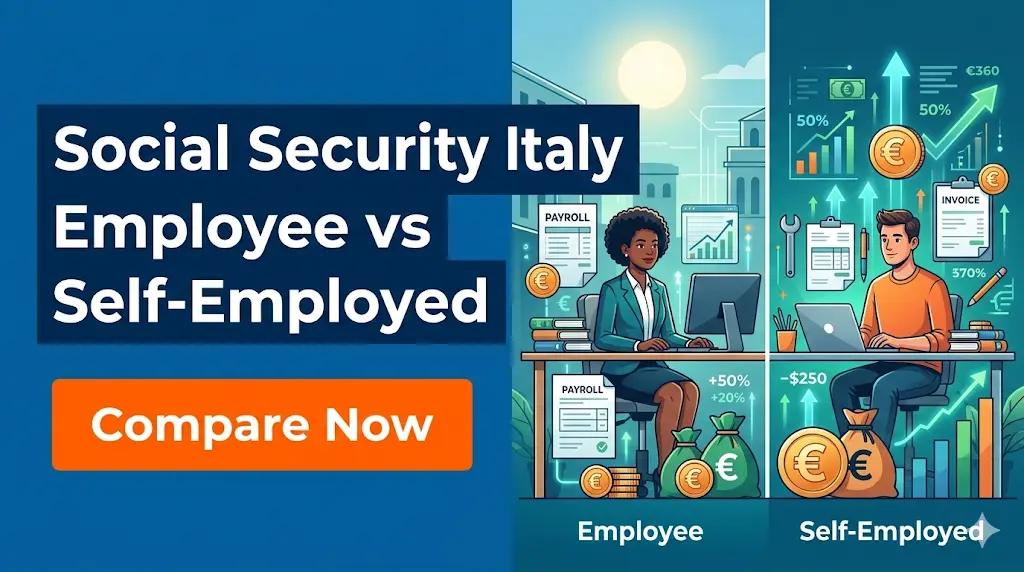
The choice between being an employee or a freelancer in Italy often hinges on these social security nuances. While the employee pays a lower percentage personally, the self-employed person often has more flexibility in how they manage their tax deductions.
| Feature | Salaried Employee | Self-Employed (Gestione Separata) |
| Who Calculates? | The Employer | The Worker / Accountant |
| Who Pays? | Split (Employer ~30%, Employee ~9%) | The Worker (100% of the ~26% rate) |
| Payment Frequency | Monthly (Deducted from salary) | Installments (F24 system) |
| TFR (Severance) | Yes (Accrued annually) | No |
| Sick Pay | Guaranteed by INPS/Employer | Limited (linked to contributions) |
| Pension Credits | High (Based on 33% total rate) | Moderate (Based on 26% rate) |
This table highlights the “protection gap.” Employees accrue a higher pension credit because the total amount entering their “virtual pot” is roughly 33% of their salary, whereas a freelancer only puts in about 26%. Over a 30-year career, this difference in the “pot” can result in a significantly different monthly pension check.
Benefits Linked to Contributions
Your social security contributions grant you access to several vital services in Italy. These are not just “taxes” but insurance premiums for the various stages of your life.
Health and Medical Coverage
A portion of social security contributions goes toward the SSN (Servizio Sanitario Nazionale). For employees, this is automatic. For the self-employed, registration is often linked to your residency and tax status. This is the mechanism that allows you to obtain the Tessera Sanitaria (Italian health card), which is your key is your key to visiting doctors and hospitals.
In Italy, health coverage is a right for residents, but the “registration” with a family doctor (medico di base) is facilitated by your social security standing. If you are an employee, your company handles the communication that ensures you are active in the system. If you are a freelancer, you must ensure your Partita IVA is active and your contributions are up to date to maintain seamless access to specialist referrals.
Maternity and Paternity Support
Italy offers generous leave policies compared to many non-EU nations. Employees receive 80% of their salary during mandatory maternity leave, funded by INPS. Self-employed workers also have rights to maternity and paternity allowances, provided they have a minimum number of months of contributions recorded in the Gestione Separata.
The “Bonus Mamma” and other family-centric incentives are also managed through the INPS portal. These benefits are designed to support the declining birth rate in Italy and are accessible to expats who are legally registered and contributing to the system. For many, this social safety net is one of the primary reasons to prefer Italian employment over “offshore” remote work where such benefits are non-existent.
Unemployment Protections (NASpI vs ISCRO)
Employees who lose their jobs are entitled to NASpI, a monthly allowance based on their previous salary. For the self-employed, a similar (though more limited) benefit called ISCRO was introduced recently to support those facing significant revenue drops. These protections are essential for maintaining your income during career transitions.
NASpI is relatively robust, offering a percentage of your average salary for a duration proportional to how long you worked. ISCRO, on the other hand, is a newer experimental benefit for the self-employed, requiring specific proof of a decline in income. For an expat, having these buffers can mean the difference between staying in Italy during a rough patch or being forced to return home.
The TFR: Italy’s Unique Severance Pay
One aspect of social security that is unique to Italian employment is the TFR (Trattamento di Fine Rapporto). This is effectively a “deferred salary” that the employer sets aside every month (roughly 6.91% of the gross salary).
When an employee leaves a company—whether they quit or are fired—they receive this accumulated sum as a lump payment. It is a significant financial cushion that freelancers do not have. Freelancers must build their own “TFR” by setting aside a portion of their revenue into private savings or investment accounts. For many expats, receiving a TFR check after five years of employment provides the down payment for a home or the capital to start their own business in Italy.
Pension Totalization for Expats
A major concern for expats is whether their Italian contributions will “disappear” if they move back to their home country. Italy has bilateral social security agreements with many countries, including the USA, Canada, and the UK.
These agreements allow for Totalization, which means the years you worked in Italy can be added to the years you worked in your home country to help you qualify for a pension. However, the actual money stays in Italy. When you retire, you would receive a “pro-rata” pension from Italy for the years you contributed there, and a separate pension from your home country. This makes the mandatory INPS contributions much more palatable for international professionals.
Conclusion
Whether you choose the stability of employment or the freedom of self-employment, social security contributions will be a major part of your Italian financial life. Employees benefit from lower personal contributions and automated management, while the self-employed enjoy more flexibility but must manage their own “F24” payments and higher personal contribution rates. By understanding these nuances, you can better negotiate your contracts or set your freelance rates to ensure a comfortable life in Italy.
Navigating these rules in 2026 requires attention to the latest updates in the Decreto Flussi and other labor laws. As the Italian government continues to modernize, the gap between employee and self-employed protections is slowly closing, but the financial mechanics remain distinct.
References
Primary sources (official)
- INPS (Istituto Nazionale Previdenza Sociale): The official portal for social security rates, pensions, and benefits. https://www.inps.it/it/it.html
- Ministero del Lavoro e delle Politiche Sociali: Information on labor rights and social security legislation. https://www.lavoro.gov.it/
Other helpful sources
- PwC Italy Tax Summary: Technical breakdown of social security contributions for employees and employers. https://taxsummaries.pwc.com/italy/individual/other-taxes
Disclaimer
The information provided in this article is for general informational purposes only and does not constitute professional financial, tax, or legal advice. Social security rates and regulations in Italy are subject to frequent changes based on national budget laws and EU directives. Every worker’s situation is unique; therefore, it is highly recommended to consult with a certified Italian accountant (commercialista) or a labor consultant (consulente del lavoro) before making significant employment or business decisions in Italy.