Elective Residence Visa in Italy: The Retirement Visa Guide
This comprehensive guide details the requirements and application process for Italy’s Elective Residence Visa, the premier option for retirees and individuals with substantial passive income. Learn about financial thresholds, housing criteria, and the path to permanent residency in the Bel Paese.
Disclosure: This post may contain affiliate links. We may earn a commission at no extra cost to you if you make a purchase through these links. Read full disclosure.
Navigating Elective Residence Visa in Italy
For many, the ultimate dream is to spend their golden years under the Tuscan sun, sipping Chianti in a medieval piazza, or waking up to the sound of waves crashing on the Amalfi Coast. Italy offers a lifestyle that is hard to rival: world-class healthcare, incredible food, rich history, and a pace of life that prioritizes well-being over the hustle. However, turning this dream into a reality requires navigating the complex Italian immigration system.
If you are a non-EU citizen looking to move to Italy without the need to work, the Elective Residence Visa (Residenza Elettiva) is likely your golden ticket. Often referred to as the “Retirement Visa,” this specific visa category is designed for individuals who have the financial means to support themselves entirely without relying on employment in Italy.
While it is one of the most popular visa routes, it is also one of the most strictly scrutinized. Consulates are rigorous in their assessment of “passive income,” and the definition of financial stability goes far beyond a simple bank balance. Understanding the nuances of this visa is more critical than ever as Italy continues to refine its immigration policies.
This guide will walk you through every step of the process, from calculating your eligible income to securing your permit to stay once you arrive. Whether you plan to buy a farmhouse in Umbria or rent a seaside apartment in Sicily, this article will serve as your roadmap to a new life in Italy.
What is the Elective Residence Visa?
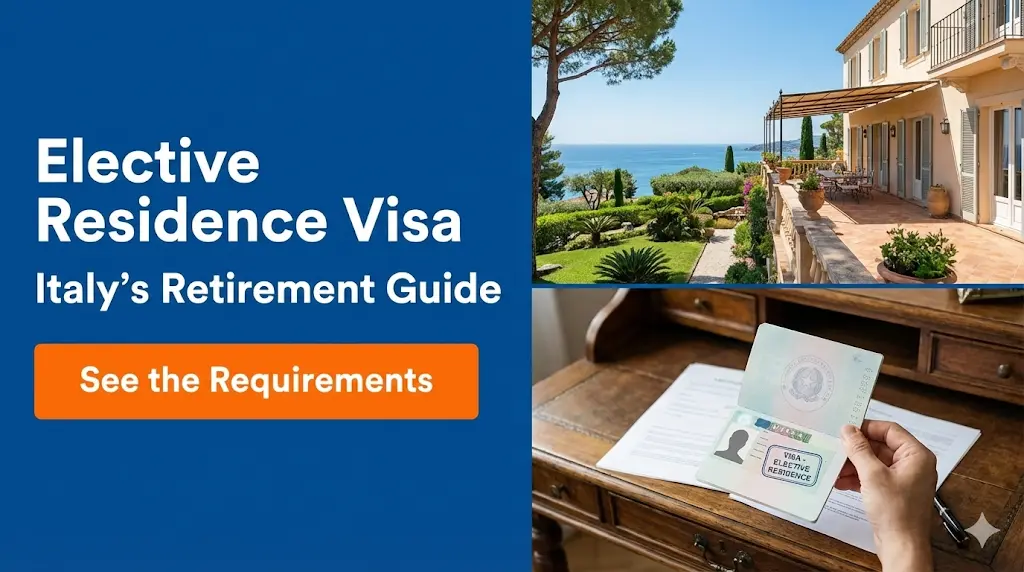
The Elective Residence Visa (ERV) is a long-stay visa (Type D) that allows non-EU/EEA citizens to reside in Italy. It is specifically intended for foreign nationals who are able to support themselves autonomously without pursuing any employment or professional activity in Italy.
The “No Work” Rule
The defining characteristic of the ERV is the absolute prohibition on work.
- You cannot hold a job in Italy.
- You cannot be hired by an Italian company.
- You cannot actively run a business in Italy.
- You cannot work remotely for a foreign company (this is a common misconception; for remote work, you should look into the Digital Nomad Visa).
This strict “no work” policy makes the ERV the ideal solution for retirees, independently wealthy individuals, and those with significant investments who simply want to enjoy the Italian lifestyle. If your plan involves any form of active labor to generate the income needed to live, this visa is not for you.
For a broader overview of other visa options that do allow work, such as the Investor Visa or the new Digital Nomad route, refer to our Ultimate Guide to Visas and Immigration in Italy.
Eligibility Requirements for the ERV
To successfully apply for the Elective Residence Visa, you must meet a specific set of criteria that prove your financial independence and your intent to reside in Italy permanently.
1. Non-EU Citizenship
This visa is for citizens of countries outside the European Union and European Economic Area. EU citizens do not need a visa to retire in Italy; they simply need to register their residency at the local town hall.
2. Substantial Passive Income
This is the most critical requirement. You must demonstrate that you have a steady, guaranteed stream of income that will continue regardless of your location or activity.
- Minimum Threshold: While the strict legal minimum is often cited as roughly €31,000 per year for a single applicant, consulates have significant discretion. In practice, many consulates (especially in the US and UK) look for substantially higher amounts—often closer to €35,000 – €40,000 per year for a single applicant to ensure financial stability against inflation and exchange rate fluctuations.
- Couples and Families: If you are applying with a spouse, the income requirement typically increases by at least 20%. For each dependent child, add another 5%.
What Counts as Passive Income?
- Pensions: Social Security, private pensions, or annuities.
- Rental Income: Documentation of verified rental property income.
- Dividends and Royalties: Income from stocks, bonds, or intellectual property (provided it is stable).
- Trust Funds: Distributions from a trust.
What Does NOT Count?
- Salaries: Even if the job is remote or the company is your own.
- Savings alone: Having a large savings account is usually insufficient on its own. You need recurring income. A pile of cash can run out; a pension theoretically does not.
3. Suitable Accommodation
You must prove that you have a place to live in Italy. This cannot be a hotel booking or an Airbnb. You need a permanent address.
- Owned Property: A deed (Rogito Notarile) proving you have purchased a home.
- Long-Term Lease: A signed, registered rental contract, typically for at least one year.
If you are considering purchasing a home to satisfy this requirement, be sure to understand the additional costs involved by reading about Buying Property in Italy: Notary Fees and Taxes.
The Application Process: Step-by-Step
Securing the Elective Residence Visa is a multi-stage process that begins in your home country and ends in Italy.
Step 1: Prepare Your Documentation
The documentation phase is where most applicants fail. You must present a “watertight” case to the consulate.
- Visa Application Form: Completed for a National Visa (Type D).
- Valid Passport: Must be valid for at least 3 months past the visa expiration date (usually 1 year).
- Passport Photos: Recent, passport-sized biometric photos.
- Cover Letter: A detailed letter explaining why you want to live in Italy. Be specific—mentioning your desire to integrate, learn the language, or simply enjoy retirement in a specific region helps humanize the application.
- Proof of Income: The most substantial part of your dossier. Include bank statements (last 6-12 months), pension letters, tax returns, and letters from financial advisors.
- Proof of Accommodation: Your lease agreement or property deed.
- Health Insurance: You must have a health insurance policy valid in Italy that covers all risks with a minimum coverage of €30,000. This is required before you can access the national system.
- Vital Records: Marriage certificates (if applying with a spouse) and birth certificates. These often need to be apostilled and translated into Italian.
- Criminal Background Check: A clean FBI or police record check from your current country of residence.
Step 2: The Consular Interview
You must apply at the Italian Consulate or Embassy that has jurisdiction over your current place of residence.
- Appointment: Book your appointment well in advance. Slots can fill up months ahead.
- The Interview: Consular officers will review your documents and ask questions about your income and lifestyle. They are assessing whether you are genuinely retiring or if you might be tempted to work under the table. Honesty and clarity about your “passive” income are key.
Step 3: Arrival in Italy and the 8-Day Rule
Once your visa is approved and affixed to your passport, you can travel to Italy.
- Important: You must apply for your Residence Permit (Permesso di Soggiorno) within 8 working days of your arrival in Italy.
- The Kit: Go to a local Post Office (Poste Italiane) and pick up the “Kit Giallo” (Yellow Kit). Fill out the forms and submit them along with photocopies of your visa, passport, and financial documents.
For a detailed walkthrough of what happens during this crucial post-arrival phase, check out our guide on Italian Residence Permit (Permesso di Soggiorno) Explained.
Step 4: Residency Registration
After submitting your permit application, you will eventually receive your residence card. Once you have the receipt of application or the card itself, you must register as a resident with your local municipality (Comune). This step allows you to get an Italian ID card and, eventually, apply for national healthcare.
Financial Planning: Cost of Living and Taxes
Getting the visa is just the beginning. Living in Italy on a fixed income requires careful budgeting and tax planning.
Cost of Living
While Italy can be affordable compared to the US or UK, costs vary wildly by region.
- North vs. South: Living in Milan or Florence is significantly more expensive than living in Abruzzo, Puglia, or Calabria.
- Rent/Utilities: Energy costs in Italy can be high. If you are renting, ensure you understand the terms of your lease and utility bills.
Tax Implications
This is the area most often overlooked by ERV applicants.
- Worldwide Income: Once you become a resident of Italy (spending more than 183 days a year there), you are tax-liable on your worldwide income. This means your US/UK pension, your investment income, and your rental income from abroad are subject to Italian taxes.
- Double Taxation Treaties: Italy has treaties with many countries to prevent you from paying full tax twice, but you usually still have to file in both countries and pay the difference to Italy if Italian rates are higher.
- Wealth Tax: Italy applies a tax on financial assets held abroad (IVAFE) and real estate held abroad (IVIE).
Tip: Italy offers a specific tax regime for new residents (the 7% flat tax for pensioners moving to certain southern regions). Consulting with an international tax specialist before you move is highly recommended.
Healthcare in Italy
One of the major benefits of becoming an Italian resident is access to the Servizio Sanitario Nazionale (SSN), Italy’s national healthcare system.
- Mandatory Private Insurance: For your visa application and your first year, you generally need private insurance.
- Voluntary Registration: As an ERV holder, you are usually not working and paying social security taxes. Therefore, to access the public system, you must “voluntarily register” (Iscrizione Volontaria) by paying an annual fee based on your income (typically a percentage, with a minimum floor).
- Coverage: Once registered, you have the same access to doctors, hospitals, and prescriptions as an Italian citizen.
Renewing Your Visa and Permanent Residency
The Elective Residence Visa is not a one-time approval; it is the start of a journey toward permanent integration.
Renewal
- Duration: The initial visa is usually valid for 1 year. Your first Residence Permit will also typically be valid for 1 year (sometimes 2).
- The Process: You must renew your Residence Permit at the Questura (Police Headquarters) every year.
- Requirements: You must prove you still meet the income and housing requirements. You must also show that you have actually lived in Italy (usually at least 6 months of the year).
Permanent Residency (Long-Term EU Permit)
After 5 years of legal residence in Italy, you can apply for the Permesso di soggiorno UE per soggiornanti di lungo periodo.
- Language Test: You must pass an A2 level Italian language test.
- Benefits: This permit does not expire (though the card is updated every 10 years) and grants you rights nearly identical to Italian citizens, including the ability to move more easily within the EU.
Citizenship
After 10 years of legal residence, you are eligible to apply for Italian citizenship by naturalization. This grants you an Italian passport (one of the strongest in the world) and full voting rights.
Comparison Table: Elective Residence vs. Other Visas
| Feature | Elective Residence Visa (ERV) | Digital Nomad Visa | Investor Visa |
| Primary Requirement | Passive Income (~€31k+) | Remote Work Income (~€28k+) | €250k – €2m Investment |
| Can You Work? | No (Strictly Forbidden) | Yes (Remote only) | Yes |
| Source of Funds | Pensions, Rentals, Dividends | Salary, Freelance Income | Capital Investment |
| Housing Required | Yes (Before application) | Yes | No (Initially) |
| Processing Time | 3 – 6 Months | 2 – 4 Months | 30 Days (Fast Track) |
| Path to Citizenship | Yes (10 Years) | Yes (10 Years) | Yes (10 Years) |
Common Reasons for Rejection
Understanding why others fail can help you succeed.
- Insufficient Income: The most common reason. If your income fluctuates or relies on “active” work (like consulting), it will be rejected.
- Lack of “Passive” Proof: Submitting bank statements that show lump sum deposits without explaining the source (e.g., selling a house) is often not accepted as recurring income.
- Poor Housing Documentation: A handshake deal or a short-term Airbnb booking is insufficient. You need a registered contract (Contratto di Affitto).
- Incomplete Application: Missing a translation or an apostille on a birth certificate can stall the process indefinitely.
Conclusion
The Elective Residence Visa is a gateway to a life of leisure, culture, and beauty in Italy. It is designed for those who have worked hard to build their wealth and are now ready to enjoy the fruits of their labor in one of the world’s most desirable destinations.
However, the path is paved with bureaucracy. Success requires meticulous financial planning, a clear understanding of the “no work” rules, and a patience for Italian administration. By preparing a robust application that clearly demonstrates your financial independence and your commitment to residing in Italy, you can turn the dream of La Dolce Vita into your everyday reality.
Start gathering your documents early, consult with tax and legal professionals, and get ready for the adventure of a lifetime. Italy is waiting for you.
References
Primary sources (official)
- Ministry of Foreign Affairs and International Cooperation (Visto per Italia): https://vistoperitalia.esteri.it/home/en
- Polizia di Stato (Residence Permits): https://www.poliziadistato.it/articolo/10617
Other helpful sources
- Italian Trade Agency (Invest in Italy): https://www.ice.it/en/invest/invest-in-italy
Disclaimer
The information provided in this article is for educational and informational purposes only and does not constitute official legal, tax, or immigration advice. Visa income thresholds, application fees, and processing procedures are subject to change by the Italian government and individual consulates. Always consult with the Italian Consulate in your jurisdiction or a qualified immigration lawyer and tax advisor before submitting any applications or making financial decisions.