Health and Safety Regulations in Italian Workplaces
Being handed a 50-page workplace safety manual entirely in bureaucratic Italian on my first day at a Milanese tech firm was utterly overwhelming. I remember thinking it was a joke when human resources told me I needed a medical eye exam just to legally type emails. This guide breaks down exactly how health and safety regulations work in Italian workplaces, ensuring you understand your rights, responsibilities, and the local bureaucracy.
Disclosure: This post may contain affiliate links. We may earn a commission at no extra cost to you if you make a purchase through these links. Read full disclosure.
Navigating the Legislative Framework (Testo Unico)
The Backbone of Workplace Safety Laws
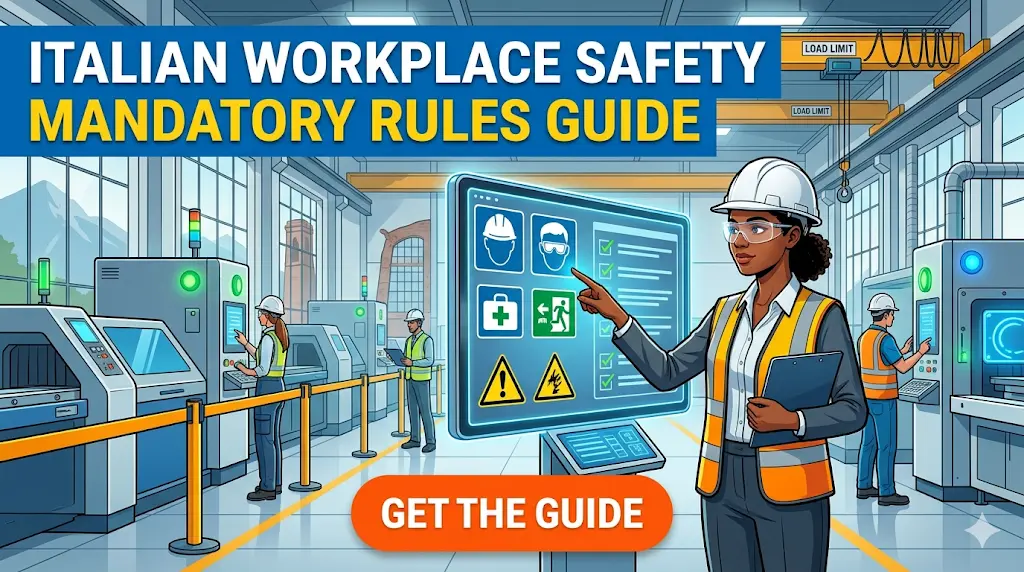
Italy takes workplace safety with a level of seriousness that often shocks newly arrived expats, particularly those coming from countries with more relaxed, decentralized corporate cultures. The absolute backbone of all safety regulations in the country is the Testo Unico sulla Salute e Sicurezza sul Lavoro, officially known as Legislative Decree 81/2008 (D.Lgs. 81/08). This massive, comprehensive piece of legislation dictates everything from the ergonomic angle of your office chair to the exact decibel levels permitted on a construction site. It is designed to be universally applicable, meaning it covers private corporations, public administration, freelancers operating on company premises, and even unpaid interns.
The core philosophy of the Testo Unico is preventative risk assessment. Every single employer, regardless of whether they employ two people in a quiet bookshop or two thousand in a manufacturing plant, is legally mandated to create a Documento di Valutazione dei Rischi (DVR). This document meticulously details every conceivable risk associated with the workplace and outlines the specific measures the company has implemented to mitigate them. As a new employee, you are legally entitled to know the contents of this risk assessment relevant to your specific role.
Understanding this framework is vital because it explains why Italian companies are so rigid about protocols that might seem trivial. The fines for non-compliance levied against employers by the National Labor Inspectorate (Ispettorato Nazionale del Lavoro) are astronomical, and severe negligence can lead to criminal charges for company directors. If you want a deeper dive into the overall corporate environment you are entering, review our guide on Work Culture in Italy: What Expats Should Expect.
Mandatory Medical Visits for Employees
One of the most surprising elements of the Italian safety framework for foreign workers is the visita medica preventiva (preventative medical visit). Depending on the risks outlined in the company’s DVR, you may be required to undergo a physical examination before you are even allowed to sit at your desk on your first day. This is completely standard practice and is entirely paid for by the employer.
For a standard office worker, this usually involves an examination by an occupational health physician to check your vision, posture, and back health, as staring at a computer screen for more than 20 hours a week is legally classified as a workplace hazard under Italian law. For more physically demanding jobs, the visit might include spirometry, audiometry, or even drug screening. It is important to understand that this is not a general health check-up, and the doctor is strictly evaluating your physical fitness for the specific tasks outlined in your employment contract.
If the doctor determines you have a pre-existing condition—for example, severe myopia—they will issue a “fitness certificate with prescriptions,” meaning the employer is legally obligated to provide you with specific accommodations, such as an anti-glare screen or mandatory 15-minute breaks away from the monitor every two hours. You cannot opt out of these medical visits; refusing to attend them is grounds for immediate contract termination.
Bureaucratic Hurdles for Non-Italian Speakers
The sheer volume of documentation, acronyms, and legal jargon associated with Italian workplace safety is a massive hurdle. You will constantly hear terms like RSPP (Head of Prevention and Protection Service), RLS (Workers’ Safety Representative), and DPI (Personal Protective Equipment) thrown around in rapid-fire Italian during your onboarding week.
If you do not speak the language fluently, signing documents acknowledging that you understand these roles and responsibilities can feel like a massive liability. Employers are supposed to provide safety documentation in a language the worker understands, but in practice, unless you work for a massive multinational corporation, the English translations are often poorly auto-translated or completely non-existent.
To protect yourself, you must be proactive about learning the language of your workplace. I highly recommend using ItalianPod101 to study formal business and legal vocabulary before you start your new job. Taking targeted corporate language courses on ItalianPod101 can help you decipher the mountain of safety acronyms, ensuring you actually understand the legally binding safety declarations you are being asked to sign. For more context on navigating professional documentation, check out our piece on Certifications and Professional Qualifications in Italy.
Training and Certifications Required on the Job
The Mandatory General Safety Training
According to the State-Regions Agreement (Accordo Stato-Regioni), every single worker in Italy must undergo mandatory safety training, usually within the first 60 days of employment. The foundational tier of this requirement is the General Safety Training (Formazione Generale). This is a strictly regulated 4-hour course that covers the broad concepts of risk, damage, prevention, and the legal responsibilities of the various safety figures in the company.
For many expats taking on office roles, this training is delivered via a notoriously dry e-learning platform. You will have to watch hours of animated videos or slide decks explaining the legal history of Italian labor laws before taking a multiple-choice quiz. The platform tracks your active viewing time, so you cannot simply skip to the end.
While it may seem like a tedious bureaucratic exercise, this certificate is yours to keep. It is permanently tied to your Codice Fiscale (tax code), meaning if you change jobs in the future, you do not have to repeat the 4-hour general training. Understanding how this ties into your overall employment profile is crucial, and you can learn more about the administrative side of job transitions in our guide on Types of Italian Employment Contracts (Contratti di Lavoro).
Role-Specific Hazard Certifications
Beyond the general training, you are also required to complete Specific Risk Training (Formazione Specifica). The length and intensity of this training depend entirely on the ATECO code (industry classification code) of your employer and your specific daily duties. Italian law categorizes workplaces into Low, Medium, and High-risk environments, and the training hours scale accordingly.
A graphic designer in an advertising agency (Low Risk) will only need an additional 4 hours of training focusing on ergonomics, stress, and screen time. However, a chemical engineer or a construction site manager (High Risk) will require 12 hours of intensive specific training covering hazardous materials, heavy machinery, and severe injury protocols. Furthermore, companies must legally designate and train specific employees for First Aid (Primo Soccorso) and Fire Prevention (Antincendio).
These advanced certifications require in-person attendance, practical exams (such as demonstrating CPR or using a fire extinguisher), and periodic refresher courses every few years. Possessing these active certifications actually makes you highly employable in the Italian market, as it saves a prospective employer the time and money required to train you from scratch.
| Risk Classification | General Training Required | Specific Training Required | Total Initial Hours | Refresher Frequency |
| Low Risk (Offices, Retail, IT) | 4 Hours | 4 Hours | 8 Hours | Every 5 Years (6 Hours) |
| Medium Risk (Agriculture, Education, Transport) | 4 Hours | 8 Hours | 12 Hours | Every 5 Years (6 Hours) |
| High Risk (Construction, Chemicals, Manufacturing) | 4 Hours | 12 Hours | 16 Hours | Every 5 Years (6 Hours) |
Translating Safety Protocols
The reality of these mandatory training sessions is that they are almost always conducted entirely in Italian. If your company hires an external safety consultant to deliver the Medium or High-Risk in-person training, they will lecture, demonstrate, and test in the local language. Failing the final quiz means you cannot legally perform your job duties, putting your employment status at severe risk.
Relying on a bilingual colleague to whisper translations during a 12-hour technical safety course is neither practical nor fair to your coworker. You must build your technical comprehension. Spending time on ItalianPod101 to study industrial vocabulary and specific workplace hazard terminology is a strategic career move. Passing these quizzes requires understanding the nuances of terms like infortunio (accident) versus incidente (near miss), and ItalianPod101 provides the contextual audio practice needed to differentiate these critical safety concepts. If you are an employer trying to manage these rules for foreign staff, read Italian Employer Obligations When Hiring Non-EU Workers.
Responsibilities of Employers vs Employees
What the Employer Must Provide
Under Italian law, the financial and organizational burden of workplace safety falls squarely on the employer (il Datore di Lavoro). They cannot deduct the cost of safety equipment, medical visits, or training from your salary. If your job requires Personal Protective Equipment (PPE)—known in Italy as Dispositivi di Protezione Individuale (DPI)—such as steel-toed boots, high-visibility jackets, or specialized ergonomic keyboards, the employer must purchase them, ensure they meet EU safety standards (CE marking), and replace them when they wear out.
Furthermore, the employer must maintain the physical safety of the environment. This includes ensuring proper ventilation, scheduling regular maintenance for elevators and machinery, checking fire extinguishers, and marking emergency exits clearly. They are also responsible for designating the RSPP (Prevention and Protection Service Manager) and organizing the election of the Workers’ Safety Representative.
If an employer fails to provide these mandated protections and an accident occurs, they face devastating consequences. The Italian judicial system treats workplace negligence extremely harshly, often resulting in massive financial compensation payouts, the forced closure of the business, and criminal manslaughter charges if a worker is fatally injured.
Employee Obligations and Liabilities
A common misconception among expats is that because the employer holds the primary responsibility, the employee is immune to safety liability. This is entirely false under the Testo Unico. Employees have strict legal obligations, and failing to adhere to them can result in disciplinary action, formal written warnings, suspension without pay, or even termination for just cause (giusta causa).
As an employee, you are legally mandated to correctly use all machinery, apparatus, and DPI provided to you. If your employer provides you with safety goggles for a laboratory task and a safety inspector catches you working without them because they “fog up,” you—the employee—can be personally fined by the authorities alongside your employer.
You are also legally obligated to immediately report any defects in safety equipment or any dangerous conditions you observe to your immediate supervisor. You cannot simply ignore a frayed electrical wire in the breakroom because it is “not your department.” Silence in the face of an observable hazard is considered a breach of your contractual duties.
Refusing Unsafe Work Conditions
Italian labor law provides strong protections for workers who refuse to work in conditions they believe pose an immediate and grave danger to their health or life. In the event of imminent danger, you have the right to leave your workstation or the dangerous area, and you cannot be reprimanded, demoted, or fired for doing so, provided your assessment of the danger was reasonable.
Navigating this situation requires a delicate balance of firmness and professional communication. Refusing a direct order from a supervisor due to safety concerns can quickly escalate into a heated labor dispute. Having the linguistic tools to express your rights calmly and legally is paramount. Practicing conflict resolution scenarios with ItalianPod101 will give you the exact phrasing needed to politely but firmly refuse an unsafe task, using the correct legal terminology to protect yourself from claims of insubordination. For more details on your overarching rights in these conflicts, consult our guide on Labor Laws in Italy: Worker Rights and Unions.
Handling Workplace Accidents and Injuries
Immediate Steps Following an Incident
If you are injured on the job in Italy, the procedure is vastly different from a standard illness. Even if the injury is minor, such as a deep paper cut requiring a bandage or a mild sprain from tripping in the hallway, you must report it to your employer or HR department immediately. Failing to report an injury the moment it happens can jeopardize your right to specialized worker’s compensation.
If the injury requires medical attention, you should go directly to the nearest hospital emergency room (Pronto Soccorso). When you arrive, it is absolutely critical that you explicitly state to the triage nurse that this is an infortunio sul lavoro (workplace accident). You must provide the name of your employer and their legal address. The hospital will treat you and open a specific medical-legal file that triggers the national worker’s compensation protocol. For a breakdown of how the emergency system operates, read Emergency Medical Services in Italy: 112 and Hospitals.
INAIL Compensation and Reporting
In Italy, standard sick leave (like catching the flu) is managed by INPS (the national social security institute). However, workplace accidents and occupational diseases are managed by a completely separate, powerful entity called INAIL (Istituto Nazionale per l’Assicurazione contro gli Infortuni sul Lavoro).
When the hospital issues your medical certificate for a workplace injury, they transmit it electronically to INAIL. You must give the certificate number and copies of the paperwork to your employer immediately. By law, the employer has exactly 48 hours to formally submit the accident report to INAIL via their corporate portal.
INAIL covers the cost of your medical treatment, rehabilitation, and a percentage of your salary for the days you are unable to work. If the accident results in permanent disability, INAIL provides a lump-sum payout or a lifelong pension. The financial protection is incredibly robust, but the bureaucratic machine runs on strict deadlines. Missing the reporting window can result in INAIL denying the claim, leaving you financially liable for the medical bills. For a broader look at how this impacts your long-term finances, see Public Liability and Workers’ Compensation in Italy.
Navigating Sick Leave and Return to Work
Recovering from an INAIL-classified injury requires constant communication with both the medical authorities and your human resources department. You cannot simply return to your desk when you feel better. You must undergo a follow-up visit, and the doctor must issue a formal certificate closing the injury file, declaring you fit to resume your duties.
If the absence is prolonged (typically over 60 days), your employer’s Medico Competente must re-evaluate you before you can legally step foot back in the office to ensure you are genuinely ready to handle your specific tasks again.
Managing this administrative back-and-forth while recovering from an injury is incredibly stressful, especially when dealing with Italian HR departments that require formal written updates. Using ItalianPod101 to learn how to craft formal, polite emails to HR regarding your medical status and expected return dates will ensure you maintain a professional image and comply with all internal company reporting rules during your absence. For a deeper understanding of standard absence rules, review Sick Leave Policies for Foreign Workers in Italy.
The Role of the Company Doctor and Safety Reps
The Medico Competente
As briefly mentioned earlier, the Medico Competente (Occupational Health Physician) is a specialized doctor appointed and paid by your employer. It is crucial to understand that this doctor is entirely separate from your Medico di Base (your personal family doctor assigned by the public health system). You cannot use your personal doctor to sign off on workplace fitness certificates, and you cannot use the company doctor to get a prescription for a common cold.
The Medico Competente operates on behalf of the company’s compliance requirements. They physically inspect the workplace alongside the safety manager, contribute to the writing of the risk assessment (DVR), and maintain the confidential medical records of all employees regarding occupational health.
When you have your mandatory visits with this doctor, it is important to accurately describe your daily physical realities—such as wrist pain from typing or lower back aches from a poor chair. However, communicating complex physical ailments in a second language is difficult. I strongly advise dedicating time to the health and anatomy modules on ItalianPod101 so you can accurately describe your symptoms and secure the ergonomic accommodations you need. If you need help finding a personal doctor for non-work issues, read Registering with an Italian Family Doctor (Medico di Base).
The RLS (Workers’ Safety Representative)
The Rappresentante dei Lavoratori per la Sicurezza (RLS) is one of the most important, yet often overlooked, figures in the Italian workplace. The RLS is an employee elected by their peers to represent the workers’ interests concerning health and safety. In companies with more than 15 employees, this representative is usually elected from within the ranks of the internal trade union representatives (RSU).
The RLS has significant legal rights. They have access to the risk assessment document, they must be consulted prior to the appointment of the safety manager or the company doctor, and they have the right to request interventions from the national labor authorities if they believe the employer is ignoring safety protocols.
As a foreign worker, the RLS is your greatest ally. If you notice a hazard, or if you feel your safety concerns are being dismissed by your manager, you should take the issue directly to the RLS. Because they are protected by law, they can confront the employer on your behalf without fear of retaliation or job loss.
Raising Concerns Without Retaliation
Italian workplace culture is inherently hierarchical. Bypassing your immediate supervisor to complain about a safety issue to upper management is generally viewed as a severe breach of professional etiquette and can permanently damage your working relationships.
If you need to raise a safety concern, the proper protocol is to document the issue, approach your direct supervisor first in a collaborative tone, and if unresolved, escalate the matter to the RLS or the RSPP. The goal is to frame the issue not as a personal complaint, but as a shared compliance risk that needs to be addressed for the good of the company.
Mastering this specific tone of diplomatic, hierarchical communication is difficult for expats used to “flat” corporate structures. Listening to business etiquette audio lessons on ItalianPod101 will teach you how to use the conditional tense and formal address (Lei) to raise serious concerns respectfully and professionally. This ensures your safety issues are heard and addressed without accidentally alienating your new Italian colleagues or coming across as an overly aggressive foreigner.
References
Primary sources (official)
- Ministero del Lavoro e delle Politiche Sociali – Salute e Sicurezza nei luoghi di lavoro – https://www.lavoro.gov.it/temi-e-priorita/salute-e-sicurezza/focus-on/sistema-prevenzione/pagine/default
- INAIL (Istituto Nazionale per l’Assicurazione contro gli Infortuni sul Lavoro) – https://www.inail.it/
Other helpful sources
- Ispettorato Nazionale del Lavoro (INL) – https://www.ispettorato.gov.it/
Disclaimer
The information provided in this article is for educational and informational purposes only and does not constitute legal, medical, or professional safety advice. Workplace health and safety regulations in Italy, governed by Legislative Decree 81/2008 and subsequent amendments, are highly complex and subject to change. Always consult with your company’s designated RSPP (Prevention and Protection Service Manager), the local Ispettorato Nazionale del Lavoro, or a qualified Italian employment lawyer regarding specific workplace hazards, injuries, or compliance issues.