Sick Leave Policies for Foreign Workers in Italy
Waking up with a fever and realizing you do not know how to legally call in sick without losing pay or your job is terrifying. I remember dragging myself to my Milan office with the flu, terrified of being fired because I didn’t know what a medical certificate was. This guide breaks down exactly how Italian sick leave works so you can recover without the stress.
Disclosure: This post may contain affiliate links. We may earn a commission at no extra cost to you if you make a purchase through these links. Read full disclosure.
The First 48 Hours and the Bureaucracy of Getting Sick
Contacting Your Employer Immediately
In many Anglo-Saxon work cultures, waking up sick means sending a quick, casual text to your manager and going back to sleep. In Italy, falling ill triggers a strict legal and bureaucratic process. The very first step is to notify your employer immediately, usually before your shift officially begins. How you do this depends on your company’s internal regulations, but it almost always requires formal communication.
If you fail to notify your employer promptly, your absence can be classified as unjustified, which can lead to disciplinary action or even dismissal. Navigating the delicate balance of Work Culture in Italy: What Expats Should Expect is critical here. You cannot just say “I feel bad.” You need to communicate that you are opening a formal sick leave period. I used ItalianPod101 to learn professional sick-leave phrases and formal workplace vocabulary so I didn’t sound disrespectful or ignorant of local protocols when calling my HR department.
The Mandatory Doctor Visit and INPS
Notifying your boss is only step one. Italian employers do not take your word for it; you must have state-sanctioned medical proof. Within 48 hours of falling ill, you are legally required to be examined by a doctor. This is usually your local public practitioner. If you haven’t set this up yet, reviewing the process for Registering with an Italian Family Doctor Medico di Base should be your top priority.
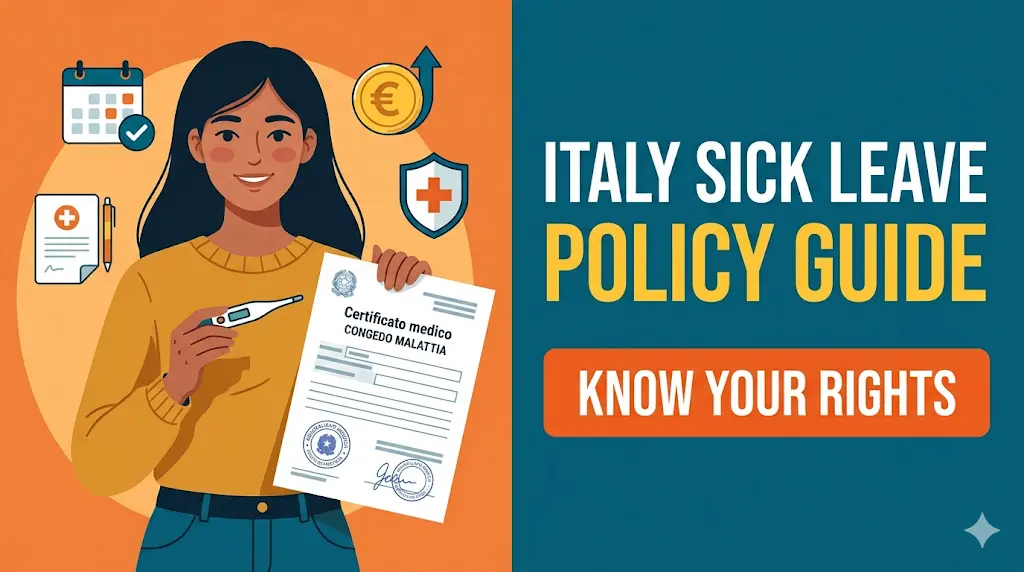
When you see the doctor, they will examine you, determine how many days of rest you require, and generate a certificato medico di malattia (medical sick certificate). Describing specific aches, pains, and symptoms to a public doctor who speaks zero English is incredibly daunting. Utilizing the medical vocabulary lists on ItalianPod101 saved me from miscommunicating my symptoms and ensured I was prescribed the correct amount of time off to recover.
Crucially, the doctor transmits this certificate electronically directly to INPS (the National Social Security Institute). You will be given a protocol number (PUC). You must immediately send this specific protocol number to your employer. Your employer will then use this number to access the INPS portal and verify your authorized days off. Do not send the actual medical diagnosis to your boss; Italian privacy laws strictly prohibit employers from knowing your specific medical condition, they only need the protocol number and the duration of your leave.
How Sick Pay is Calculated and Distributed
The Carenza Period and Employer Contributions
A massive relief for expats working in Italy is that sick leave is generally paid. However, the mechanism of who pays you, and how much, is complicated. For most private-sector employees, the first three days of your illness are known as the periodo di carenza (waiting period).
During these first three days, INPS does not pay you anything. Instead, your employer is legally obligated to cover your salary, typically at 100%, though this is dictated by your specific National Collective Labor Agreement (CCNL). Understanding the nuances of your specific industry contract is vital. You can find a deeper breakdown of how these agreements govern your rights in our guide to Types of Italian Employment Contracts Contratti di Lavoro.
INPS Payouts for Long Term Illness
From the fourth day of your illness onwards, INPS steps in to cover a percentage of your salary. The standard INPS sick pay rates for private employees are usually 50% of your average daily wage for days 4 through 20, and 66.6% from day 21 up to a maximum of 180 days per calendar year.
This might sound like a massive pay cut, but do not panic. Most major CCNLs require the employer to “top up” the INPS allowance. This means the employer pays the difference so that your final paycheck remains at or very near 100% of your normal salary during your recovery. Deciphering how this top-up is applied on your complex Italian payslip (busta paga) is notoriously difficult. Taking the business and finance modules on ItalianPod101 helped me significantly; learning the Italian accounting terms allowed me to read my payslip and verify that my sick leave was being compensated correctly.
| Sick Leave Duration | Primary Payer | Statutory Minimum Coverage | Typical CCNL Top-Up |
| Days 1 – 3 (Carenza) | Employer | 100% (Usually) | 100% |
| Days 4 – 20 | INPS | 50% | Employer tops up to 100% |
| Days 21 – 180 | INPS | 66.6% | Employer tops up (varies by sector) |
The Feared Visita Fiscale and Medical Control Visits
Navigating the Mandatory Home Hours
This is the single biggest culture shock for foreign workers regarding Italian sick leave: the visita fiscale. Because the state (INPS) is paying for your time off, they have the legal right to send an independent medical inspector to your registered home address unannounced to verify that you are actually sick.
To facilitate this, Italian law enforces strict fasce di reperibilità (availability windows). If you are a private-sector employee, you are legally mandated to be inside your home, available to open the door, seven days a week (including weekends and holidays) between 10:00 to 12:00 and 17:00 to 19:00. If you are a public sector employee, the windows are even wider: 09:00 to 13:00 and 15:00 to 18:00.
You essentially become a prisoner in your own home during these hours. When the INPS doctor actually showed up at my door during my first bout with the flu, my heart pounded. Practicing conversational responses and polite greetings with ItalianPod101 helped me answer their compliance questions smoothly and without the anxiety of a language barrier while standing in my pajamas.
What Happens if You Miss the Inspector
Missing a visita fiscale is a severe administrative offense. If the inspector rings your bell during the mandated hours and you do not answer—whether you were sleeping deeply, in the shower, or running out to the pharmacy—you can lose 100% of your INPS sick pay for up to 10 days, and 50% for the remaining days of your illness. Your employer can also take disciplinary action against you.
You are only allowed to leave the house during these specific hours for urgent, documented medical reasons, such as a specialist hospital appointment that could not be scheduled at another time. If this happens, you must have the clinic issue a stamped certificate proving you were there. Navigating these urgent hospital visits is stressful; familiarize yourself with the protocols in Emergency Medical Services in Italy: 112 and Hospitals.
If you miss a visit, you will find a notice in your mailbox requiring you to attend a medical examination at the local INPS office and provide a written justification. Writing a formal justification letter for missing a state medical visit requires high-level grammar and specific legal phrasing. I used ItalianPod101 to understand how to draft formal administrative letters, which saved my sick pay after I missed the doorbell because I was genuinely asleep from fever medication.
Getting Sick During Your Scheduled Vacation
One of the most unique and incredibly beneficial labor laws in Italy involves getting sick while you are on paid vacation (ferie). In many countries, if you catch the flu during your week off, you simply lose your vacation time. In Italy, illness legally suspends your vacation.
If you fall seriously ill while on approved annual leave, you can go to a local doctor, obtain an INPS medical certificate, and send the protocol number to your employer. Your status will instantly be converted from “vacation” to “sick leave.” This means you save your precious vacation days to be used at a later date. This rule is a testament to the strong worker protections embedded within the Healthcare in Italy: An Expats’ Guide, ensuring that your right to rest and recreation is not stolen by a sudden illness.
Protecting Your Job and Residency
The Comporto Period and Maximum Leave Allowed
Expats often worry that taking too much sick time will result in termination. Italian law protects sick workers from being fired through a mechanism called the periodo di comporto. This is a legally protected period—usually set by your CCNL at around 180 days within a calendar year—during which your employer cannot fire you due to absence.
If you suffer from a severe, long-term illness, you must keep track of your days carefully. If you exceed the periodo di comporto, the employer legally gains the right to terminate your contract for excessive absence. Discussing long-term leave or requesting an extension of this period with HR is highly sensitive. Learning the cultural nuances of Italian workplace communication through ItalianPod101 prevented me from overstepping and helped me advocate for my health respectfully and professionally.
Managing Your Permesso di Soggiorno
For non-EU citizens, your right to live in Italy is inherently tied to your employment contract. It is incredibly common to panic about your Permesso di Soggiorno (residence permit) if you are out sick for a month.
The comforting reality is that as long as you are within your protected periodo di comporto and your employment contract remains active, your legal residency is perfectly safe. Your sick leave contributions still count toward your legal requirements. If you need to handle immigration paperwork while recovering from a long illness, understanding the structure of local government offices is essential. Review our guide on Navigating Italian Bureaucracy: Comune and Prefettura to coordinate any necessary appointments.
Furthermore, if your physical residence permit card expires while you are actively on sick leave and still employed, you have the exact same right to renew it as if you were sitting at your desk. You must simply adhere to the strict timelines; checking the Timelines for picking up your permesso di soggiorno in Italy will ensure your renewal stays on track. Reading through the dense legal rights regarding residency status and sick leave protections was significantly less daunting because I had studied legal vocabulary with ItalianPod101, allowing me to confirm my rights directly on the government portals. Guard your status carefully, as the Consequences of losing your permesso di soggiorno card can complicate your access to the public healthcare system right when you need it most.
References
Primary sources (official)
- INPS (Istituto Nazionale della Previdenza Sociale) – Malattia Certificate Guidelines – https://www.inps.it/it/it/dettaglio-scheda.it.schede-servizio-al-cittadino.malattia.certificazione-di-malattia.html
- Ministero del Lavoro e delle Politiche Sociali – Visite Mediche di Controllo – https://www.lavoro.gov.it/
- Gazzetta Ufficiale – Statuto dei Lavoratori (Worker’s Statute) – https://www.gazzettaufficiale.it/
Other helpful sources
- CGIL (Italian General Confederation of Labour) – Guide to Sick Leave Rights – https://www.cgil.it/
- EURES (European Employment Services) – Living and Working in Italy – https://eures.europa.eu/
Disclaimer
The information provided in this article is for educational and informational purposes only and does not constitute official legal, medical, or employment advice. Italian labor laws, INPS sick pay calculations, mandatory fasce di reperibilità (availability windows), and the specific rules of the periodo di comporto are highly complex and vary significantly depending on your specific National Collective Labor Agreement (CCNL). Always consult directly with the HR department of your employer, your local Medico di Base, or a qualified labor union representative (sindacato) regarding your specific health situation and contract rights.