Selling a Car in Italy: Taxes and Transfer Procedures
Handing over the keys to a buyer in Italy is the easy part; ensuring you aren’t legally liable for their future speeding tickets is the true nightmare. I nearly paid an extra year of vehicle taxes because my buyer “forgot” to register the title transfer. This guide breaks down the exact administrative and tax procedures required to sell your car safely in Italy.
Disclosure: This post may contain affiliate links. We may earn a commission at no extra cost to you if you make a purchase through these links. Read full disclosure.
The Administrative Reality of Selling a Vehicle
The Passaggio di Proprieta Transfer of Ownership
When you sell a car in the United States or the United Kingdom, the process is beautifully simple: you sign the back of the physical title, hand it to the buyer, and walk away. In Italy, selling a depreciating asset is treated with the exact same level of bureaucratic scrutiny as selling real estate. You cannot simply hand over the keys and the registration book.
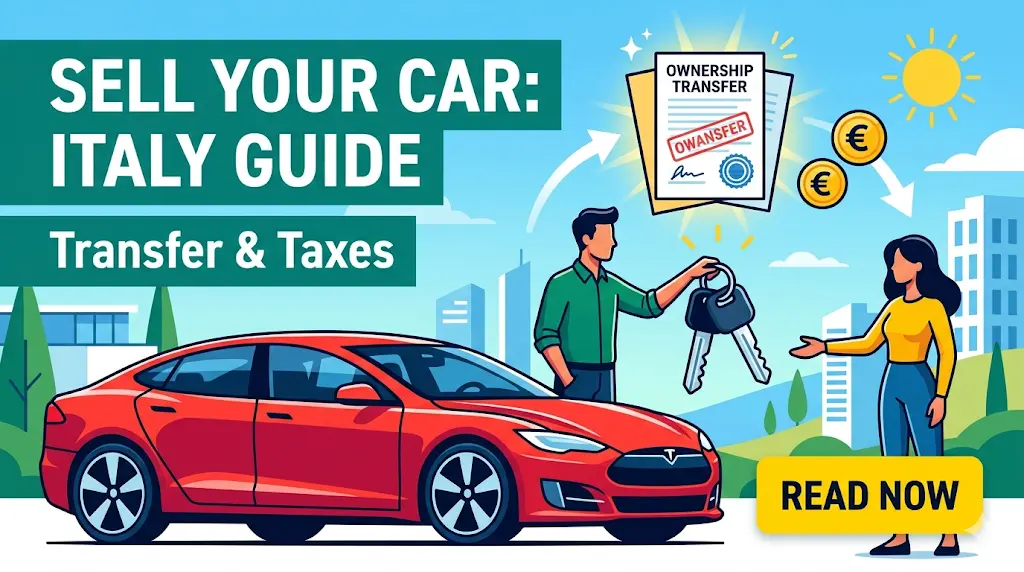
The Italian state requires a formal, authenticated transfer of ownership known as the passaggio di proprietà. Until this legal transfer is officially registered in the Pubblico Registro Automobilistico (PRA), the car remains entirely in your name. If the buyer runs a red light, causes an accident, or racks up unpaid highway tolls before the transfer is registered, the Italian government will send every single fine directly to your house. You remain entirely civilly and criminally liable.
Furthermore, the old physical certificate of ownership has recently been phased out in favor of the Documento Unico di Circolazione e di Proprietà (DU), which merges the registration and the title into one digital document. To execute the transfer, the seller’s signature must be authenticated in the presence of a public official. Navigating this initial friction is exactly why mastering the Navigating Italian Bureaucracy Comune and Prefettura process is a mandatory expat survival skill.
Where to Complete the Transfer ACI and Agenzia Pratiche Auto
Technically, you can authenticate your signature for free at your local town hall (Comune), but this is a terrible strategy. Even after the mayor’s office authenticates your signature, you and the buyer still have exactly sixty days to physically go to the PRA or the Motorizzazione Civile to register the transfer and pay the state taxes. If the buyer procrastinates, you remain liable.
Veteran expats never leave this to chance. We exclusively use a private agenzia pratiche auto (private vehicle administration agency) or a specialized branch of the Automobile Club d’Italia (ACI) called the Sportello Telematico dell’Automobilista (STA).
By walking into an agenzia pratiche auto with the buyer, the agency authenticates your signature, processes the payment from the buyer for the state taxes, and registers the transfer directly into the PRA database in real-time. Within twenty minutes, the vehicle is entirely out of your name, and you are handed a digital receipt proving you are no longer the owner. While the agency charges a premium for this service, the absolute peace of mind is worth every single euro. Before you even walk into the agency, ensure your personal identification details are perfectly aligned by reviewing Checking Your Italian Tax Code Codice Fiscale Status.
Negotiating the IPT Imposta Provinciale di Trascrizione
While the seller does not technically pay for the passaggio di proprietà, the cost of the transfer will heavily dictate your final negotiation. The vast majority of the transfer cost is the Imposta Provinciale di Trascrizione (IPT). This is a provincial tax that scales aggressively based on the engine power of the vehicle, measured in Kilowatts (kW).
If you are selling a tiny 50 kW city car, the buyer might only pay €200 for the entire transfer. However, if you are selling a 150 kW high-performance SUV, the buyer might be hit with an €800 transfer tax depending on which specific Italian province they reside in. When a buyer realizes how expensive the state tax is, they will instantly attempt to negotiate your asking price down to compensate. You must hold your ground and understand that the IPT is strictly the buyer’s legal burden. If they complain about the high costs of ownership, you can refer them to our comprehensive breakdown in Leasing vs Buying a Car in Italy Financial Impact, which proves why buying high-powered cars is mathematically punishing in Italy.
Handling Taxes and Legal Liabilities
The Bollo Auto Trap
The most common financial dispute between private sellers and buyers in Italy is over the Bollo Auto (the annual vehicle ownership tax). As an expat, you must understand exactly how the state views this tax liability during a mid-year sale.
The Bollo Auto is strictly tied to whoever is registered as the legal owner on the very last day of the payment window. It is not prorated. If the tax expires in April, and you sell the car in May before paying the renewal, the Agenzia delle Entrate expects you to pay for the entire upcoming year, even though you no longer own the car. You cannot ask the state for a refund for the remaining ten months.
To avoid giving the buyer a free year of taxes at your expense, you must time the sale perfectly, ideally executing the passaggio di proprietà right before your ownership tax expires. You can calculate your exact liabilities and deadlines by reading our exhaustive guide on the Annual Car Registration Fee Bollo Auto in Italy.
Traceable Payments and Capital Gains
Many expats worry that selling a vehicle for a large lump sum will trigger massive capital gains taxes. Fortunately, if you are a private individual selling a personal vehicle, Italy does not tax the capital gain from the sale of a used car.
However, if you originally purchased the car through a corporate entity or operated under a freelance VAT number (Partita IVA) where you deducted the vehicle’s depreciation and operating expenses, selling the car will absolutely trigger tax implications. Your commercialista must calculate the plusvalenza (capital gain) on the sale, which gets added to your corporate taxable income. If you are operating under these complex corporate frameworks, you must review the Types of Italian Employment Contracts Contratti di Lavoro and consult your accountant before listing the vehicle.
Even for private sales, the Italian Revenue Agency strictly monitors large cash transactions to combat tax evasion. You cannot legally accept a brown paper bag full of cash for a €10,000 vehicle. If the state sees a massive, unexplained cash deposit hit your bank account, they can trigger an audit under the presumption of undeclared income.
Payment Logistics and Protecting Your Capital
Accepting Safe Payments Assegno Circolare vs Bonifico
Because cash is legally restricted and traditional personal checks bounce entirely too often, you must dictate exactly how the buyer pays you. Never sign the transfer paperwork until the payment is secured.
The gold standard in Italy for selling a vehicle is the assegno circolare (cashier’s check). This is a guaranteed check issued directly by the buyer’s bank, proving the funds have already been sequestered. However, forged cashier’s checks are a booming industry in Italy. If a buyer hands you an assegno circolare, you must insist on going to the bank with them, or at the very least, calling the issuing bank to verify the serial number before you sign the deed at the ACI.
The modern, highly preferred alternative is the bonifico istantaneo (instant bank transfer). While sitting at the agenzia pratiche auto, the buyer executes the transfer on their smartphone. Within seconds, the money appears in your account, providing absolute, irreversible proof of payment. If you have previously navigated Getting an Auto Loan in Italy as a Foreigner, you know exactly how heavily local banks scrutinize large, sudden wire transfers.
Managing the Proceeds as an Expat
When you sell a vehicle for €15,000 or €20,000, you are suddenly faced with a massive influx of liquid capital. If you leave that lump sum sitting in a traditional Italian retail bank account, it will earn exactly zero percent interest while slowly being eroded by high monthly maintenance fees and European inflation.
Veteran expats do not let their capital stagnate locally. Once the sale clears, we immediately sweep the proceeds into Interactive Brokers. By keeping your core wealth parked in a highly regulated, global platform like Interactive Brokers, you can invest the cash from your car sale into diversified international equities or high-yield global bonds. Interactive Brokers allows you to shield your capital from localized banking inefficiencies and extortionate Italian mutual fund fees. Furthermore, Interactive Brokers generates clean, standardized tax reports, making your annual wealth declarations significantly easier—a crucial strategy we detail deeply in Declaring a Foreign Property in Italy’s Quadro RW.
If you are selling the car to another expat, or if you are leaving the country and need to repatriate the funds back to your home country, the logistics become even more dangerous. If you ask your Italian bank to execute an international SWIFT wire to send the €20,000 car proceeds to your US or UK account, they will hit you with predatory exchange rate markups and massive intermediary fees.
To bypass this financial trap, you must route your proceeds through Wise. Have the buyer send the euros directly to the localized European IBAN provided by Wise. Once the euros are safely in your Wise account, you can instantly convert the entire lump sum to your native currency exactly at the true mid-market exchange rate. Utilizing Wise guarantees that the equity you held in the vehicle actually makes it back to your pocket, completely avoiding the hidden spreads of traditional banking. This precise cross-border strategy is the core lesson of our guide on Exchange Rates Sending Money to Italy Smartly.
Exporting or Scrapping via Radiazione
Selling to a Foreign Buyer or Leaving Italy
If you are moving back to your home country and want to take your car with you, or if you sell your car to a foreign buyer who intends to drive it back to Germany or France, you cannot simply do a standard passaggio di proprietà. You must execute a formal procedure known as radiazione per esportazione (deregistration for export).
This process legally removes the vehicle from the Italian Pubblico Registro Automobilistico (PRA). To execute this, the vehicle must have a currently valid state inspection. You must physically surrender the Italian license plates and the Documento Unico to the ACI or an agenzia pratiche auto.
Once the ACI processes the radiazione, they issue a digital Certificate of Deregistration. This is the exact moment the Italian government stops billing you for the Bollo Auto and stops holding you liable for the vehicle. The buyer then applies for temporary transit plates (targa provvisoria) to physically drive the car across the border. If you are importing a vehicle instead, reviewing the reverse process in Taxation of Gifted Cars Imported to Italy is incredibly helpful to understand the customs barriers involved.
| Transfer Method | Average Cost | Speed of Registration | Risk Level for Seller |
| Comune (Town Hall) + PRA | Low (~€100 – €150 + IPT) | Slow (Buyer has 60 days to register) | High (Seller remains liable during gap) |
| Motorizzazione Civile | Low (~€100 – €150 + IPT) | Immediate if done together | Low |
| ACI / Agenzia Pratiche Auto | High (~€200 – €300 + IPT) | Instantaneous (Real-time database update) | Zero (Absolute best option for expats) |
| Radiazione (Export) | Moderate (~€150) | Immediate removal from Italian registry | Zero (Vehicle no longer exists in Italy) |
References
Primary sources (official)
- Automobile Club d’Italia (ACI) – Costi del passaggio di proprietà – https://www.aci.it/servizi/costi-del-passaggio-di-proprieta/
- Automobile Club d’Italia (ACI) – Moduli per il passaggio di proprietà – https://www.aci.it/servizi/moduli-per-il-passaggio-di-proprieta/
Other helpful sources
- Automobile Club Novara – Esportare un veicolo (Radiazione) – https://novara.aci.it/Esportare-un-veicolo
- Studio Bocca – How to Sell a Car in Italy as an Expat – https://www.studiobocca.it/en/
Disclaimer
The information provided in this article is for educational and informational purposes only and does not constitute official legal, tax, or financial advice. The administrative costs for the passaggio di proprietà, the Imposta Provinciale di Trascrizione (IPT), and the exact procedures for a radiazione per esportazione are highly complex and subject to frequent updates by the Automobile Club d’Italia (ACI) and the Agenzia delle Entrate. Always consult directly with a registered agenzia pratiche auto or a certified Italian accountant (commercialista) before finalizing any vehicle sale, accepting large cash transfers, or deregistering a vehicle for export.