Budget Supermarkets in Italy: Saving on Groceries
Wandering into a charming city-center market for daily ingredients feels incredibly romantic until you see the final receipt. I spent my entire first week’s budget at a tiny neighborhood grocery store before realizing I was paying double for basic pasta and eggs. This guide breaks down the best budget supermarkets in Italy so you can eat well without destroying your wallet.
Disclosure: This post may contain affiliate links. We may earn a commission at no extra cost to you if you make a purchase through these links. Read full disclosure.
The Premium Trap and the Hard Discount Reality
Avoiding the City Center Convenience Stores
When you first arrive in Italy, especially in major hubs like Rome, Milan, or Florence, the most visible grocery options are usually small “Express” or “Local” format stores. Brands like Carrefour Express, Conad City, or PAM Local dominate the historic centers. While incredibly convenient, these are premium convenience stores. They pay exorbitant central rent and pass those costs directly onto the consumer.
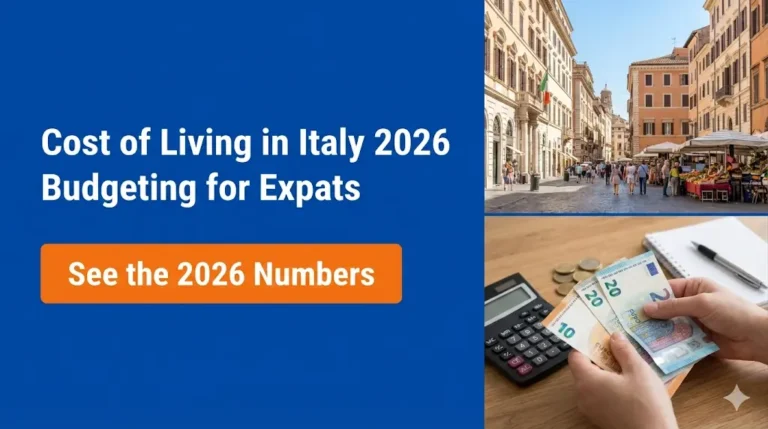
Expats often default to these stores because they are within walking distance of temporary accommodations. If you buy your weekly groceries at an Express store, you will easily inflate your food budget by 30% to 40%. You are paying a premium for the location, the pre-packaged convenience, and the extended opening hours. Furthermore, the romanticized independent alimentari (small local grocers) are wonderful for picking up a highly specific regional cheese or high-quality cured meats, but using them for your household staples like laundry detergent, toilet paper, and bulk pasta is financial self-sabotage. Accurately projecting your Cost of Living in Italy 2026 Budgeting for Expats requires you to abandon the convenience store habit immediately and learn to shop where the locals shop.
How Italian Discount Supermarkets Operate
To actually save money, you must venture out of the historic center and enter the world of the discount (pronounced with an Italian accent as “dis-count”). In Italy, the budget supermarket sector is massive and fiercely competitive. These stores operate on a “hard discount” model, similar to what you might expect from a warehouse store, but on a smaller scale.
Instead of stocking ten different brands of penne pasta, a discount supermarket will stock one or two private-label brands. By aggressively cutting out the middlemen, minimizing store aesthetics, and relying heavily on store-brand goods, they keep prices incredibly low. Many expats initially turn their noses up at private-label Italian goods, assuming they are inferior. This is a massive mistake. Italy has incredibly strict food quality laws. A private-label jar of pesto at an Italian budget supermarket is often manufactured in the exact same facility as the premium brand, just packaged with a different label. Embracing the marca privata (store brand) is the ultimate secret to slashing your grocery bills.
Top Budget Supermarket Chains in Italy
Eurospin and Lidl
If there is an undisputed king of the Italian budget grocery market, it is Eurospin. Eurospin is a 100% Italian-owned discount chain with over a thousand locations across the country. It is legendary among locals for its “La Spesa Intelligente” (The Smart Shop) motto. Eurospin sells almost exclusively its own brands, meaning you will not find Coca-Cola or Nutella on the shelves, but rather their highly affordable proprietary equivalents. Their deli counter (banco taglio) and fresh produce sections are surprisingly robust for a discount store, offering excellent regional cheeses and cured meats at a fraction of the cost of a standard supermarket.
Lidl, the German discount giant, is the other major player. Lidl operates slightly differently than Eurospin by offering a mix of their own private labels and a small, rotating selection of name brands. Lidl is incredibly popular with expats for two reasons: their freshly baked goods section is unmatched in the discount tier, and they frequently run “theme weeks” (e.g., American week, Asian week, Greek week). If you are homesick and desperately looking for peanut butter, cheddar cheese, or tortillas, tracking Lidl’s promotional calendar is essential.
To take full advantage of Lidl, you need to download the Lidl Plus app for digital coupons. If you are standing in the aisle trying to figure out how to activate a digital coupon, relying on Airalo ensures you have instant mobile data. Grabbing a regional eSIM from Airalo keeps you connected so you can translate food labels and scan digital loyalty cards without desperately searching for a free Wi-Fi network.
Aldi and MD Discount
Aldi entered the Italian market more recently but has expanded aggressively, particularly in Northern Italy. They bring their trademark extreme efficiency and incredibly low prices, focusing heavily on fresh, locally sourced Italian produce to win over skeptical local shoppers.
MD Discount is another massive, native Italian player, particularly dominant in the southern regions. MD is excellent for bulk staples and consistently runs “sottocosto” (below cost) flyer promotions. When an item goes sottocosto in Italy, the supermarket is legally selling it at a loss to drive foot traffic. Stocking up on olive oil, coffee, and pasta during a sottocosto event can save you hundreds of euros a year.
To sign up for the loyalty programs at many of these stores, you will eventually need your official Italian tax code. If you haven’t secured yours yet, you should review our guide on Checking Your Italian Tax Code Codice Fiscale Status so you can unlock the deepest loyalty discounts.
| Supermarket Chain | Origin | Brand Strategy | Best Known For |
| Eurospin | Italy | 100% Private Label | Excellent regional Italian deli items, lowest overall basket cost |
| Lidl | Germany | Mix of Private & Name Brand | In-store bakery, international “theme” weeks |
| MD Discount | Italy | Mostly Private Label | Aggressive sottocosto sales, strong southern presence |
| Aldi | Germany | Mostly Private Label | Streamlined shopping, high-quality fresh produce |
| Penny Market | Germany | Mix of Private & Name Brand | Loyalty card discounts, good central/northern presence |
Survival Guide for Italian Grocery Shopping
The Produce Weighing Rules
The single fastest way to get yelled at by an Italian cashier is failing to weigh your own produce. In most Italian supermarkets (discount and premium alike), the cashiers do not weigh your fruits and vegetables at the register.
When you are in the produce section, you must follow a strict ritual. First, you must put on the provided disposable plastic glove (guanto) before touching any fresh produce; handling fruit bare-handed is considered highly unhygienic. Second, you place your items in the plastic bag, note the number on the price tag for that specific item, take the bag to the digital scale (bilancia), and press the corresponding number. The scale will print a barcode sticker. You must place this sticker on the bag. If you arrive at the checkout line with unweighed, un-stickered apples, the cashier will loudly halt the line and send you walking back to the produce section in shame.
Cart Coins and Checkout Speed
Before you even enter the store, you need a physical coin. Italian shopping carts are locked together. To release a cart, you must insert a €1 or 50-cent coin into the slot on the handle. When you return the cart and lock it back into the chain, your coin pops back out. If you are a newly arrived expat who only uses cards, this is a nightmare. Always keep a spare €1 coin in your wallet specifically for the supermarket. If you need to figure out how to get local cash without getting gouged, read up on Avoiding ATM Withdrawal Fees in Italy.
The checkout experience at an Italian budget supermarket is an extreme sport. The cashiers are timed on their scanning speed, and they will throw your groceries down the ramp at an alarming rate. You are entirely responsible for bagging your own groceries, and you must do it incredibly fast. Furthermore, plastic bags are not free in Italy. By law, supermarkets must charge you a few cents for every bag you use, including the compostable bags in the produce section. You should always bring your own reusable canvas bags.
When it comes time to pay, contactless cards and digital wallets are universally accepted. If you want to integrate smoothly into the local payment culture and process your transactions instantly, familiarizing yourself with local digital wallets is highly recommended, as detailed in Using Mobile Payment Apps Satispay etc in Italy. Keep in mind that unlike the US, cashiers do not expect or accept tips for bagging your groceries, a rule that aligns perfectly with the broader No Tipping Culture Tipping or Not in Italy.
Supplementing Your Grocery Runs as an Expat
Buying Non Perishables and Household Goods
While budget supermarkets are incredible for fresh food and basic pantry staples, they are surprisingly expensive and limited when it comes to household goods. Items like laundry detergent, dishwasher tablets, paper towels, and specific cleaning supplies are often marked up or only available in small, inefficient sizes at local grocery stores.
To solve this, veteran expats outsource their non-perishable shopping entirely. I buy all my heavy cleaning supplies, bulk coffee pods, and paper products on Amazon Italy. Having these bulky items delivered by Amazon Italy directly to my door means I do not have to drag heavy bags of detergent onto a crowded city bus. If you do not have a vehicle, relying on Amazon Italy is an absolute necessity for household management. If you are tired of carrying groceries on public transit and are considering buying a vehicle just for these errands, you must calculate the costs heavily using our guide on Getting an Auto Loan in Italy as a Foreigner.
Navigating Temporary Housing and Logistics
Your ability to budget for groceries is entirely dependent on your housing situation. If you are living in a tiny temporary room with a mini-fridge, you cannot buy food in bulk at Eurospin. You will be forced to make daily trips to the expensive city-center convenience stores, draining your budget.
When I first relocated, I secured my mid-term housing through Spotahome. Because Spotahome sends “homecheckers” to verify the properties, I specifically filtered for an apartment with a fully equipped kitchen and a full-sized refrigerator. Securing a proper kitchen via Spotahome allowed me to immediately start doing massive, budget-friendly weekly grocery runs at Lidl instead of eating out or buying daily micro-meals. Having the right infrastructure in place from day one makes adhering to your budget infinitely easier, keeping you financially stable while you wait to finalize a permanent Signing an Italian Rental Contract.
By combining the low prices of Italian hard discounts, the digital connectivity of Airalo to manage apps and translations, and the logistical heavy lifting of e-commerce for non-perishables, you can feed yourself incredibly well in Italy on a very tight budget.
References
Primary sources (official)
- Altroconsumo – Inchiesta Supermercati: Dove conviene fare la spesa – https://www.altroconsumo.it/alimentazione/fare-la-spesa/inchieste/supermercati-piu-economici
- Eurospin Italia – Official Corporate Site – https://www.eurospin.it/
- Lidl Italia – Official Corporate Site – https://www.lidl.it/
Other helpful sources
- The Local Italy – The ultimate guide to grocery shopping in Italy – https://www.thelocal.it/20220304/the-ultimate-guide-to-grocery-shopping-in-italy
- Italy Magazine – Navigating the Italian Supermarket – https://www.italymagazine.com/featured-story/navigating-italian-supermarket
Disclaimer
The information provided in this article is for educational and informational purposes only and reflects general pricing trends and cultural norms in the Italian retail grocery sector. Specific prices, promotional strategies (like sottocosto sales), and loyalty program requirements vary by region and supermarket chain. The legal requirement to charge for biodegradable produce bags and the ban on free single-use plastic carrier bags are strictly enforced under Italian environmental law. Always check local store policies and current Euro conversion rates when calculating your personal household budget.