Dealing with Humidity and Mold in Italian Homes
Pulling your favorite leather jacket out of the closet only to find it covered in a thick layer of fuzzy green mold is a devastating expat initiation. I had to throw away half my winter wardrobe during my first damp Roman winter. This guide provides exact strategies to defeat the relentless humidity and mold thriving inside Italian homes.
Disclosure: This post may contain affiliate links. We may earn a commission at no extra cost to you if you make a purchase through these links. Read full disclosure.
Why Italian Homes Are So Damp
The Stone and Concrete Trap
When expats complain about the freezing, damp chill inside their Italian apartments, they are usually fighting a losing battle against the structural reality of local architecture. Most traditional apartments, even post-war 1960s buildings, were constructed using massive stone, hollow brick, or solid concrete walls with absolutely zero internal insulation or modern drywall.
When the freezing winter air hits the exterior of these solid walls, and the warm, moist air from your interior radiator hits the inside, a massive temperature clash occurs. This phenomenon is called a thermal bridge (ponte termico). Condensation forms directly on the interior walls, much like water droplets on the outside of a cold glass of water. Because electricity and gas are notoriously expensive in Europe, a reality explored in Setting Up Utilities in Italy, many expats attempt to save money by turning their heating entirely off while at work. Letting the apartment drop to a freezing temperature and then blasting the heat in the evening accelerates this condensation cycle, guaranteeing that mold (muffa) will colonize your walls. You must maintain a steady, moderate ambient temperature to keep the walls warm and dry.
The Indoor Laundry Reality
In Anglo-Saxon countries, extreme dampness is usually the result of a structural failure, like a leaking roof. In Italy, dampness is often a behavioral inevitability due to how laundry is managed. Tumble dryers are incredibly rare in Italian homes due to their massive electricity draw and the sheer lack of physical space in historical apartments. Everyone relies on a folding drying rack (stendino).
During the brilliant Italian summers, you simply put the rack on the balcony. However, during the freezing, rainy winters, you are forced to bring that rack indoors. Hanging a full load of wet clothes inside a sealed, uninsulated concrete box releases liters of liquid directly into the ambient air. This sudden, violent spike in relative humidity has nowhere to escape. If you are actively calculating your Cost of Living in Italy 2026 Budgeting for Expats, you must mathematically factor in the cost of running radiators a bit higher on laundry days just to combat the intense moisture load you are introducing into your living space.
Actionable Strategies to Prevent Mold
Airflow and the Art of Airing Out
If you ask any Italian nonna how to deal with a damp house, she will immediately tell you to open the windows. This is not an old wives’ tale; it is the fundamental defense mechanism of Italian domestic life. The concept of arieggiare (airing out the house) is absolutely mandatory.
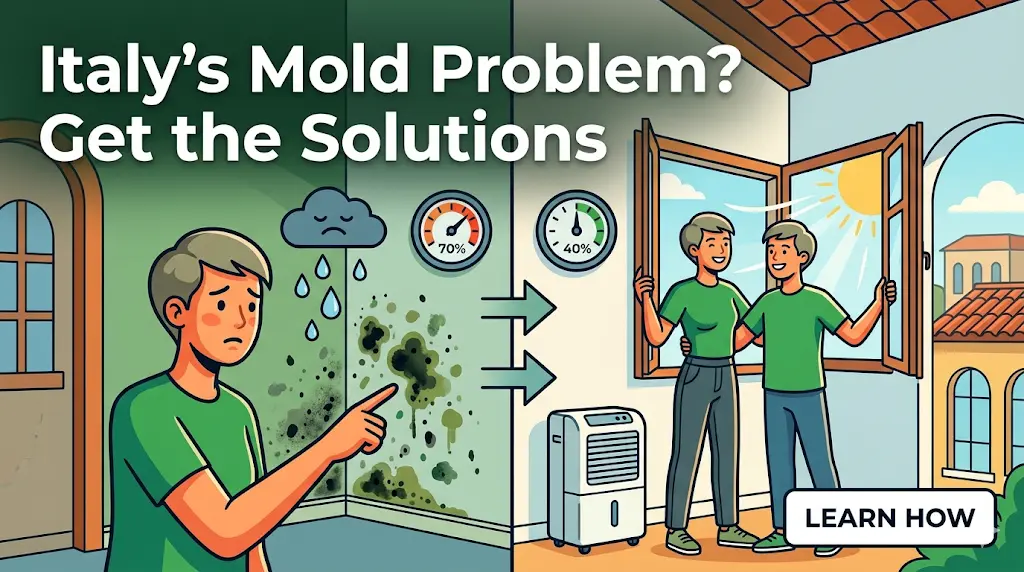
Every single morning, regardless of whether it is sunny, pouring rain, or snowing outside, you must open your windows wide for at least 10 to 15 minutes. This purges the stale, moisture-heavy air generated by your breathing and sweating overnight, replacing it with fresh, crisp outside air. Stagnant air is the ultimate breeding ground for fungal spores. You should deliberately create a cross-breeze by opening windows on opposite sides of the apartment. Furthermore, you must never push your heavy furniture completely flush against the exterior walls. Leave a two-inch gap behind your closets, headboards, and bookshelves so air can flow. Trapped, unmoving air behind a massive wardrobe will turn into a black mold farm within a single month.
Investing in Dehumidifiers and Absorbers
Airing out the house is step one, but in regions like the Po Valley, Milan, or coastal cities, the outside air is often just as humid as the inside air. You cannot survive an Italian winter relying on open windows alone; you need hardware.
Do not waste your money on those tiny, cheap plastic boxes that use chemical tabs to absorb moisture. They will fill up in three days and barely make a dent in a humid bedroom. You must purchase a serious, electric compressor dehumidifier (deumidificatore). These units actively pull 10 to 20 liters of water out of the air per day. Because carrying a 30-pound electric dehumidifier home on a crowded city bus or metro is an agonizing experience, I strongly recommend ordering one immediately on Amazon Italy. Having a heavy compressor unit delivered directly to your front door via Amazon Italy saves you a massive logistical headache.
I also highly suggest purchasing cheap digital hygrometers on Amazon Italy to place in different rooms. A hygrometer measures the relative humidity of the air. Your goal is to keep your indoor humidity tightly controlled between 40% and 55%. The exact moment the screen creeps past 60%, you must turn on your dehumidifier.
How to Kill Mold Once It Appears
Local Cleaning Solutions
Despite your absolute best efforts, you will likely wake up one day and see a constellation of black dots blooming in the upper corner of your bedroom or across your bathroom ceiling. You must act instantly. Mold is a living organism that releases airborne spores. Breathing these spores in a confined space can trigger severe asthma and respiratory distress, complicating your physical wellbeing before you even figure out your Healthcare in Italy An Expats Guide.
The traditional, old-school Italian method to kill muffa is raw bleach (candeggina). You put it on a rag and attack the spots. However, the Italian Ministry of Health warns that aggressive, dry scrubbing can actually scatter the live spores further into the ambient air, drastically increasing indoor pollution. Instead of raw bleach, which can also ruin colored wall paint, you should use a dedicated anti-mold spray (spray antimuffa). You spray the area, let the active biocides sit for 20 minutes to kill the root of the fungus, and then gently wipe it away with a damp microfiber cloth. Always wear an N95 mask and gloves when doing this, and keep the windows wide open to ventilate the harsh chemical fumes.
| Treatment Method | Italian Term | Efficacy | Best Use Case | Risk Factor |
| Bleach | Candeggina | High | Severe, deep black mold stains | High (Toxic fumes, ruins colored paint) |
| Commercial Anti-Mold Spray | Spray Antimuffa | Very High | Recurring patches on white walls | Medium (Chemical smell, requires ventilation) |
| Vinegar & Baking Soda | Aceto e Bicarbonato | Low to Medium | Light, early-stage surface mildew | Low (Natural, safe for pets and kids) |
| Hydrogen Peroxide | Acqua Ossigenata | Medium | Bathroom grout and window sealant | Low to Medium |
Long-Term Fixes and Landlord Negotiations
If the mold keeps aggressively returning week after week despite proper ventilation and heavy dehumidification, you are dealing with a structural problem—usually rising damp (umidità di risalita) from the ground or a leaking pipe hidden inside the masonry.
This immediately triggers a legal battle with your landlord. According to Italian rental law, behavioral mold (caused by you drying clothes indoors and never opening windows) is strictly the tenant’s responsibility to clean and fix. Structural mold is the landlord’s responsibility. Be warned: landlords will almost always blame you first. You must firmly document the issue with photographs and formally notify them via registered mail (PEC or Raccomandata), a vital bureaucratic escalation process outlined in Signing an Italian Rental Contract.
If the landlord refuses to fix the structural infiltration, you might need to hire an independent technician out of pocket. Navigating this conflict, paying local tradesmen, and documenting repairs requires local banking tools, making Using Mobile Payment Apps Satispay etc in Italy highly useful for executing transparent, traceable payments to handymen. If you happen to own the home yourself, you should immediately investigate whether structural insulation upgrades qualify for state subsidies, as detailed heavily in Eco Bonus and Superbonus Tax Incentives for Home Upgrades.
Expat Hacks for a Dry and Healthy Home
Pre-Screening Your Apartment from Day One
The absolute easiest way to deal with mold is to never rent a moldy apartment in the first place. Newly arrived expats frequently fall for the “charming, rustic” ground-floor apartments or basements (seminterrato) in historic city centers. These are essentially ancient stone caves that relentlessly trap rising damp from the earth below.
To avoid these traps, I exclusively used Spotahome when looking for my mid-term housing. Spotahome sends professional homecheckers to verify their listings, meaning you can actually see the quality of the windows and the heating radiators in the video tours. By using Spotahome, I specifically filtered out all ground-floor units and verified that the apartment had decent double-paned windows and modern centralized heating. Booking your initial landing pad through Spotahome provides a massive layer of security, ensuring you aren’t walking blind into a basement that smells like a wet dog.
Connectivity and Supply Deliveries
When you first walk into a new apartment, you have a million things to check. If you spot a patch of mold on day one, you need to document it, email your landlord immediately, and start ordering anti-mold supplies before you even unpack your suitcases.
Often, your home Wi-Fi will not be activated yet. This is why having an eSIM from Airalo is an absolute lifesaver. By downloading an Airalo data pack before your plane even touches down, you have the instant internet connectivity required to Google local hardware stores, translate chemical cleaning labels from Italian to English, and email your landlord high-resolution photos of the wall damage. Airalo ensures you aren’t completely helpless and digitally disconnected during your most vulnerable first days.
With your Airalo connection active, you can immediately open the Amazon Italy app and order your antimuffa sprays, heavy-duty cleaning gloves, and your compressor dehumidifier. Getting a massive Amazon Italy delivery scheduled for your very first week means you have the entire chemical and hardware arsenal you need to protect your wardrobe and your lungs, saving you from having to navigate the chaotic local retail bureaucracy described in Navigating Italian Bureaucracy Comune and Prefettura.
References
Primary sources (official)
- Ministero della Salute – Inquinamento Indoor e Muffe – https://www.salute.gov.it/portale/temi/p2_6.jsp?lingua=italiano&id=4241&area=Stili%20di%20vita&menu=indoor
- Agenzia delle Entrate – Guida alle agevolazioni fiscali per il risparmio energetico – https://www.agenziaentrate.gov.it/
Other helpful sources
- Fanpage.it – Muffa in casa, l’esperto ISS avverte sui rischi – https://www.fanpage.it/stile-e-trend/benessere/muffa-in-casa-lesperto-iss-avverte-sui-rischi-pulizia-fatta-male-aumenta-inquinamento-indoor/
- Leroy Merlin Italia – Come togliere la muffa dai muri prima di imbiancare – https://www.leroymerlin.it/domande-e-risposte/vernici/come-togliere-muffa-dai-muri-prima-di-imbiancare.html
Disclaimer
The information provided in this article is for educational and informational purposes only and does not constitute official medical, legal, or housing advice. Chronic exposure to black mold can cause severe respiratory issues; always consult a medical professional if you experience persistent symptoms. Disputes between tenants and landlords regarding structural dampness (umidità di risalita) versus behavioral condensation are governed by the Italian Civil Code. If a landlord refuses to remediate a structurally compromised, unhealthy living environment, you must consult a registered Italian real estate attorney or a local tenants’ union (SUNIA) before withholding your rent or prematurely breaking your lease agreement.