Registering Rental Contracts with Agenzia Entrate
Moving into your dream Italian apartment feels amazing until you realize your signed lease is legally useless without a government stamp. I spent my first three weeks taking cold showers because I could not activate my utilities without an officially registered contract. This guide explains how to register your rental agreement with the Italian tax agency so you can legally establish your life here.
Disclosure: This post may contain affiliate links. We may earn a commission at no extra cost to you if you make a purchase through these links. Read full disclosure.
Why Registration is Your Italian Lifeline
The Legal Reality of the Agenzia delle Entrate
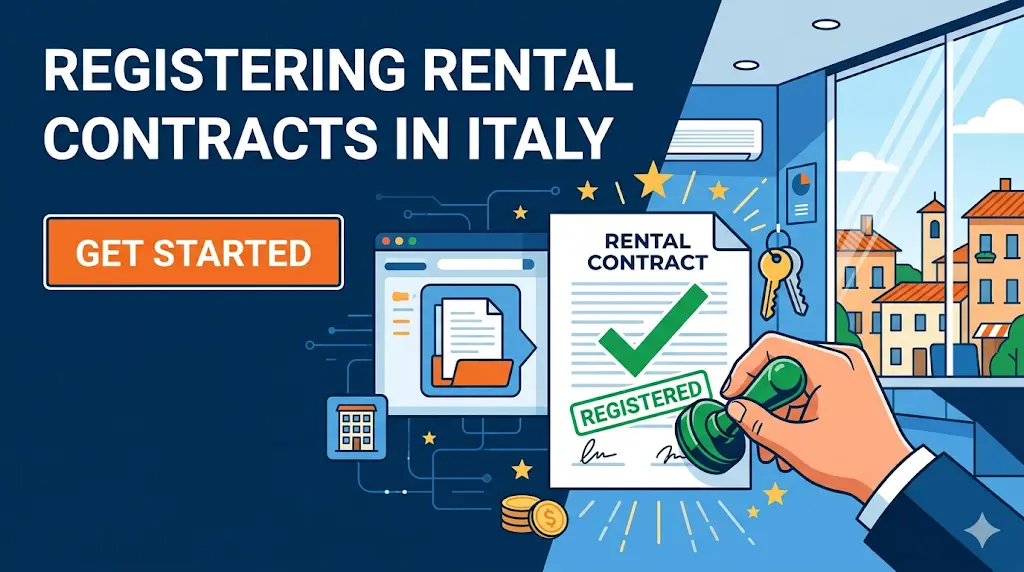
When you finally find an apartment and sign your name on the dotted line, you likely feel a massive wave of relief. You have the keys, you have a physical piece of paper, and you assume the housing hunt is over. However, in the eyes of the Italian government, a private lease signed between two individuals is completely invisible. It is merely a private writing (scrittura privata) until it is officially processed by the state.
To make your lease legally binding and recognized by the government, it must be registered with the Agenzia delle Entrate (the Italian Revenue Agency). This registration is primarily a tax compliance measure. It proves to the state that your landlord is declaring their rental income and not operating on the black market. Without this official government stamp, your contract offers you absolutely zero legal protection.
Understanding this dynamic is the most critical lesson of your relocation. Many naive expats assume that signing the paper is enough, only to realize months later that their landlord intentionally never filed the paperwork to evade income taxes. If you are preparing to finalize a housing agreement, you must treat the subsequent tax registration as an integral part of Signing an Italian Rental Contract. If the landlord balks at the idea of registering the lease, you are walking into a massive trap that will inevitably lead to the conflicts detailed in Common Tenant vs Landlord Issues in Italy.
Unlocking Residency and Utilities
The registration of your contract is not just a landlord’s tax issue; it is the master key that unlocks your entire expat life. The most immediate roadblock you will hit without a registered lease is the inability to establish your official Italian residency (Residenza Anagrafica). When you go to the local town hall to register your address, the clerk will demand to see the official registration receipt from the tax office.
Without your Residenza, your life in Italy stalls completely. You cannot access the public healthcare system (Tessera Sanitaria), you cannot buy a vehicle, and your long-term visa renewal could be severely jeopardized. The government uses the registered lease as hard proof that you are not just a transient tourist but a legal, tax-paying resident contributing to the local community. The registration receipt is the most heavily scrutinized document when Navigating Italian Bureaucracy Comune and Prefettura.
Furthermore, you cannot even turn on the lights or the gas in your new home without this document. When you contact local utility providers like Enel or A2A to transfer the meters into your name, they will legally require you to provide the registration details of your lease. This anti-squatting law ensures that only legitimate tenants can access the power grid. If your landlord delays the registration, you will literally be left in the dark, a logistical nightmare we explain heavily in Setting Up Utilities in Italy.
The Financials of Registration Taxes and Stamps
Understanding Cedolare Secca
When it comes to the financial mechanics of registering the lease, the costs depend entirely on which tax regime your landlord chooses. The most popular option, and the best possible scenario for you as an expat tenant, is the Cedolare Secca. This is an optional flat-tax regime that landlords can apply to residential leases.
If your landlord opts for the Cedolare Secca, they agree to pay a flat 21% tax on the rental income (or 10% for subsidized canone concordato leases) instead of adding the rent to their progressive income tax bracket. To incentivize landlords to use this transparent system, the Agenzia delle Entrate entirely waives the registration fees and the expensive stamp duties. This means registering the contract costs absolutely nothing upfront for either you or the landlord.
The Cedolare Secca provides a massive secondary benefit for you as the tenant: it legally freezes your rent. By choosing this flat tax, the landlord legally waives their right to adjust your rent annually based on the ISTAT national inflation index. Your monthly payment is locked in for the entire duration of the lease. Because this saves you significant money year over year, you should always ask potential landlords if they plan to use this regime.
Standard Regime and the RLI Form
If your landlord operates under the standard tax regime (Regime Ordinario), the registration process suddenly becomes highly bureaucratic and expensive. Under this regime, the state levies an Imposta di Registro (Registration Tax) equal to 2% of the total annual rent. By law, this 2% tax is split equally between the landlord and the tenant, meaning you will have to pay your 50% share upfront.
Additionally, the physical contract must be stamped with a Marca da Bollo (revenue stamp). The state requires a €16 stamp for every four pages of the contract, or every 100 lines of text. You must buy these physical stamps at a licensed tobacco shop (tabaccaio) before submitting the paperwork. To officially submit the contract and calculate these taxes, the landlord must fill out a dense, multi-page bureaucratic document called the Modello RLI (Registrazione Locazioni Immobili).
To even be listed on the Modello RLI, you must possess an official Italian tax identifier. The Agenzia delle Entrate system will physically reject the registration if your tax code is missing or invalid. If you have not secured this document, you must halt your housing plans and immediately review Checking Your Italian Tax Code Codice Fiscale Status.
| Feature | Cedolare Secca (Flat Tax) | Regime Ordinario (Standard Tax) |
| Registration Tax (Imposta di Registro) | Exempt (€0) | 2% of annual rent (Split 50/50 with landlord) |
| Stamp Duty (Marca da Bollo) | Exempt (€0) | €16 for every 4 pages / 100 lines |
| Rent Increases (ISTAT) | Legally frozen | Landlord can increase rent annually |
| Required Form | Modello RLI | Modello RLI + F24 Form for tax payment |
How to Ensure Your Lease Actually Gets Registered
The Thirty Day Deadline and Joint Liability
Once you sign the lease and hand over your security deposit, the clock starts ticking. Under Italian law, the landlord (locatore) has exactly 30 days from the date of signature (or the move-in date, whichever is earlier) to officially register the contract with the Agenzia delle Entrate.
Within the following 60 days, the landlord is legally obligated to provide you with the official registration receipt (ricevuta di registrazione). This document proves the taxes have been paid and the lease is active in the government database. However, expats frequently fall into the trap of assuming that if the landlord misses this deadline, it is solely the landlord’s problem. This is a dangerous misconception.
In Italy, the landlord and the tenant are bound by responsabilità in solido (joint and several liability) regarding the registration tax. If the landlord decides to simply pocket your rent and never files the Modello RLI, the Agenzia delle Entrate can legally pursue both of you for the unpaid taxes, plus heavy compounding fines. You cannot simply claim ignorance. It is your financial and legal responsibility to aggressively follow up with your landlord and demand the registration receipt.
Avoiding the Contratto in Nero
The most severe manifestation of this issue is the contratto in nero (the black-market contract). Many landlords, particularly those renting to foreign students or newly arrived expats, will offer a “discount” on the monthly rent if you agree to pay in cash and skip the official registration entirely.
Accepting this unregistered arrangement is a catastrophic mistake. Without a registered contract, you have zero legal rights. The landlord can evict you overnight, refuse to fix a broken boiler, or withhold your deposit without any legal repercussions. Furthermore, participating in an off-the-books lease actively implicates you in tax evasion. If you are struggling with a landlord demanding untraceable payments, you must urgently read Cash Rent Payments in Italy Is It Allowed.
If you find yourself trapped in an unregistered lease and the landlord refuses to legitimize your presence, you have the right to report them to the Guardia di Finanza (the financial police) or the Agenzia delle Entrate. The state will heavily penalize the landlord and often forcibly register the contract on your behalf at a severely reduced rate. Navigating this hostile escalation is deeply stressful, but understanding your rights is the core focus of Filing a Complaint Italian Landlord or Agency.
Expat Hacks for a Smoother Housing Transition
Temporary Solutions to Bureaucratic Delays
Fighting with local landlords over the Modello RLI and begging them to register your contract so you can get your residency is an exhausting way to start your life in Italy. The paranoia of the traditional private rental market can completely drain your energy before you even unpack your suitcases.
To completely bypass this intense administrative friction, veteran expats rely heavily on Spotahome for their initial relocation phase. By utilizing Spotahome, you secure a mid-term apartment through a verified digital intermediary. The landlords operating on Spotahome are accustomed to renting to international professionals and are highly transparent about providing legitimate, registered transitional contracts. Booking your initial landing pad through Spotahome provides a massive administrative shield, allowing you to secure your residency paperwork legally without facing the predatory black-market demands of unverified local landlords. Utilizing this platform is the smartest way to sidestep the exhausting traps detailed in Avoiding Rental Scams on Italian Housing Websites.
Managing Logistics on the Ground
If you are required to accompany your landlord to the local Agenzia delle Entrate office to sign the registration paperwork in person, you must be prepared for chaos. You will likely be handed dense Italian tax forms that you do not understand, and you will need to rapidly translate legal clauses while standing at the clerk’s desk.
You absolutely cannot do this if you are relying on spotty public Wi-Fi. Before I attend any bureaucratic appointment in Italy, I download a data eSIM from Airalo. Keeping Airalo active on your smartphone ensures you have immediate, high-speed mobile internet to translate the Modello RLI on the fly, access your digital banking app to pay tax stamps, or pull up your passport PDFs. Relying on Airalo guarantees you are never digitally stranded when an impatient tax clerk asks you for a missing document.
Once the bureaucracy is finally cleared, the lease is registered, and your utilities are successfully activated, you will face the final challenge: furnishing the apartment. Even “furnished” Italian apartments often lack basic comforts like proper winter duvets, microwaves, or dehumidifiers. Instead of dragging heavy boxes onto a crowded city bus, I outsource everything to Amazon Italy. Having essential home goods delivered straight to your newly registered, legal address via Amazon Italy is a massive relief. Utilizing Amazon Italy allows you to quickly transform your empty, highly-taxed apartment into a comfortable home without leaving your couch.
References
Primary sources (official)
- Agenzia delle Entrate – Registrazione telematica di un nuovo contratto – https://www.agenziaentrate.gov.it/portale/schede/fabbricatiterreni/registrazione-di-un-nuovo-contratto/registrazione-telematica-regime-ordinario
- Agenzia delle Entrate – Informazioni sulla Cedolare Secca – https://www.agenziaentrate.gov.it/portale/schede/fabbricatiterreni/cedolare-secca/scheda-informativa-cedolare-secca
Other helpful sources
- SoloAffittiPAY – Registrazione del contratto di locazione: guida completa – https://www.soloaffittipay.it/wikiaffitto/registrazione-del-contratto-di-locazione-guida-completa
Disclaimer
The information provided in this article is for educational and informational purposes only and does not constitute official legal, tax, or real estate advice. The registration of rental contracts, the calculation of the Imposta di Registro, and the eligibility criteria for the Cedolare Secca flat-tax regime are strictly governed by the Agenzia delle Entrate and are subject to frequent legislative updates. Both the landlord and the tenant are held jointly liable (responsabili in solido) for the payment of the registration tax under Italian law. Always consult a certified Italian tax advisor (commercialista) or a registered real estate attorney to ensure your lease is fully compliant before transferring funds.