ETIAS visa waiver: What it means for traveling to Italy
Arriving at the airport for a long-awaited Italian vacation, only to be denied boarding because of a missing online form, is a new fear unlocking for expats and travelers alike. I remember the sheer panic of almost missing a flight to Rome because I didn’t realize entry rules had changed overnight. This guide breaks down the ETIAS visa waiver so you never get stranded.
Disclosure: This post may contain affiliate links. We may earn a commission at no extra cost to you if you make a purchase through these links. Read full disclosure.
The End of Spontaneous Travel to Italy
What is ETIAS and Why is it Happening
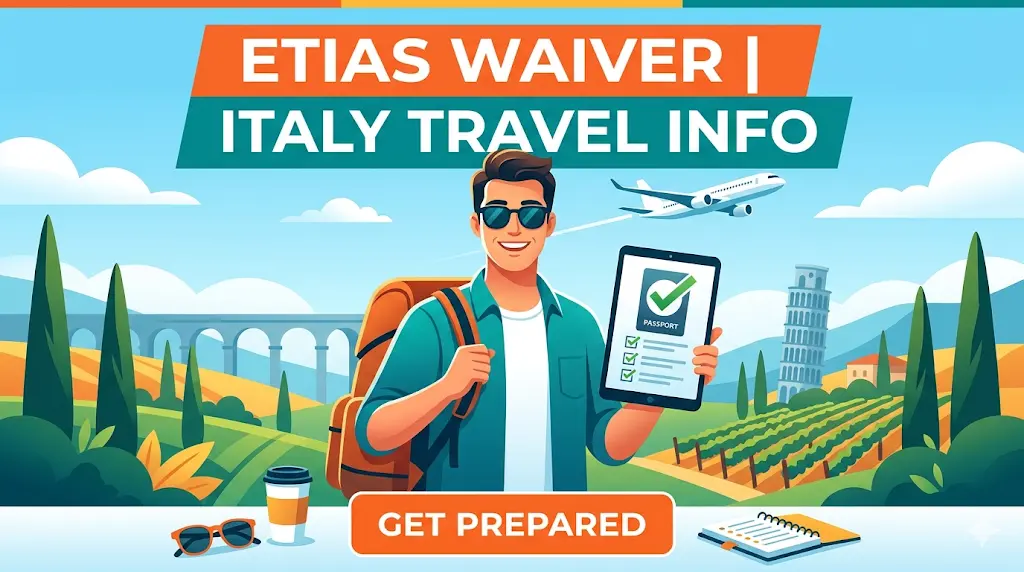
For decades, citizens of countries like the United States, the United Kingdom, Canada, and Australia enjoyed the ultimate travel privilege: packing a bag, showing up at Rome-Fiumicino, and walking right through passport control. Those days of truly spontaneous travel are ending. The European Union is officially rolling out the European Travel Information and Authorisation System (ETIAS). Currently scheduled to launch in the final quarter of 2026, this system fundamentally alters how visa-exempt foreign nationals enter Italy and the broader Schengen Area.
ETIAS is explicitly not a visa. It is an electronic travel authorization, highly comparable to the ESTA system utilized by the United States. The European Union is implementing this system primarily to close a massive security blind spot. Until now, visa-free travelers arrived at European borders without any prior background checks. ETIAS forces travelers to undergo automated security, criminal, and migration screening before they are legally allowed to board a plane, train, or ferry bound for Italy.
While the European Commission promises the system will be fast and largely automated, the reality for expats is that it adds another layer of bureaucratic anxiety. You can no longer just grab your passport and go. You must secure this digital clearance beforehand, and if the automated system flags your name against an Interpol or Europol database, your vacation or family visit will instantly grind to a halt.
Who Needs It and Who is Exempt
ETIAS is mandatory for citizens of roughly 60 countries who currently enjoy visa-free access to the Schengen Area. If you hold a passport from the US, UK, Canada, Australia, Japan, or New Zealand, you will be legally required to possess an approved ETIAS to enter Italy. This requirement applies to travelers of all ages, meaning you must fill out separate applications for your toddlers and elderly parents.
However, there is a crucial exemption for the expat community living in Italy. If you already hold a valid Italian residence permit (Permesso di Soggiorno) or a long-stay National D Visa, you are completely exempt from ETIAS. Your residence permit acts as your ultimate border clearance. You simply present your physical permit card alongside your passport at the border.
If you are currently navigating the complex transition from a temporary visa to a permanent status, understanding how to maintain that exemption is critical, a reality we cover deeply in Renewing Your Italian Permesso di Soggiorno. Furthermore, if you hold dual citizenship and possess a passport from an EU member state (like an Irish or Italian passport), you do not need an ETIAS when traveling on your European passport.
Navigating the Application Process and Requirements
The Digital Application and Fees
When the official portal (europa.eu/etias) goes live, the application process will be entirely digital. The form will ask for your basic biographic data, passport details, current occupation, and the first Schengen country you intend to visit. Crucially, it will also ask uncomfortable background questions regarding your criminal history, past travel to conflict zones, and any previous instances where you were deported or asked to leave an EU country.
The application fee is €7, payable via credit or debit card. The authorization is valid for three years or until your current passport expires, whichever comes first. Once approved, the ETIAS is digitally linked to your passport’s microchip. There is no physical sticker or paper to carry, though veteran expats always recommend keeping a printed PDF confirmation in your carry-on bag just in case the airline’s verification system crashes.
You must be hyper-vigilant about scam websites. The internet is already flooded with unofficial, third-party intermediaries pretending to be the official European Union portal. While it is legal for third parties to apply on your behalf, predatory sites will charge you €50 to €100 for a €7 form, and you risk handing your passport data to identity thieves. Always ensure you are on the official .europa.eu domain.
Passport Validity and Document Translation
Your passport must be valid for at least three months beyond your intended departure date from the Schengen Area, and it must not be older than 10 years. If your passport expires soon, the ETIAS system will either reject your application or limit your ETIAS validity strictly to your passport’s expiration date.
The most terrifying scenario for a traveler is when the automated ETIAS system issues a refusal. If you are flagged due to a past legal issue—even a minor offense from decades ago—or a mistaken identity match in the Schengen Information System, your application will be manually reviewed or outright denied. If you are denied, you will receive an email stating the reasons and outlining your right to appeal directly to the Italian consulate.
This appeals process is where countless travelers get trapped. The Italian consulate will demand physical proof that you are not a security threat, which often requires submitting extensive criminal background checks, court records, and vital certificates from your home country. Because the Italian government operates strictly in Italian, these dense legal documents are completely useless if submitted in English.
Getting your complex legal records translated quickly for an ETIAS appeal is exactly why you must rely on RushTranslate. By utilizing RushTranslate, you ensure that the Italian consular officer receives certified, legally accurate documents formatted to the government’s exact stringent standards. Do not attempt to translate court records yourself. A single mistranslated legal term can cause the consulate to uphold your ETIAS refusal permanently. Relying on RushTranslate guarantees full compliance with the strict standards of the Italian Ministry of Foreign Affairs. Having your pristine RushTranslate files properly organized is the most effective way to overturn a refusal and save your trip.
| Entry Authorization | Who Needs It | Duration of Stay | Primary Purpose |
| ETIAS | Visa-exempt nationals (US, UK, AUS, etc.) | Max 90 days out of 180 | Short-term tourism, business, transit. |
| Schengen Visa (Type C) | Nationals from countries requiring a visa (India, China, etc.) | Max 90 days out of 180 | Short-term tourism, business. |
| National Visa (Type D) | Anyone planning to move to Italy | Over 90 days | Work, study, family reunification, retirement. |
Travel Realities and Border Enforcement
The 90 180 Day Rule Remains Unchanged
A massive misconception spreading through expat communities is that an approved ETIAS resets your travel clock or grants you a new type of visa. It does not. ETIAS does absolutely nothing to alter the strict Schengen 90/180-day rule.
Even with a valid, three-year ETIAS, you are legally restricted to spending a maximum of 90 days within any rolling 180-day period inside the Schengen Area. If you spend 90 days at your vacation home in Tuscany, you must leave the entire Schengen zone (not just Italy) for a full 90 days before you can return. Your ETIAS approval will not save you from severe fines, deportation, or a multi-year entry ban if border guards catch you overstaying by even a single day.
If you want to stay in Italy longer than 90 days, an ETIAS is useless. You must navigate the intense bureaucracy of securing a long-stay visa, a process heavily dictated by annual quotas that we explain deeply in Understanding the Decreto Flussi in Italy and the complex rules detailed in Schengen Visa Requirements Italy.
Health Insurance and Border Checks
The harshest reality of ETIAS is that it does not guarantee entry into Italy. It only guarantees your right to board the plane. When you land at Rome-Fiumicino or Milan-Malpensa, the Italian border police (Polizia di Frontiera) retain the absolute, final authority to deny you entry.
Even with an approved ETIAS, border guards are legally mandated by the Schengen Borders Code to verify that you have sufficient financial means to support yourself, a return flight ticket, and valid travel health insurance. If a border guard pulls you aside and asks how you plan to pay for a medical emergency, handing them a generic, low-coverage credit card insurance pamphlet will likely result in an interrogation or a denied entry.
To completely protect your entry rights, you should secure a robust policy through Cigna Global before you fly. Using Cigna Global is a bulletproof way to satisfy the strict health insurance demands of European border officials. Because Cigna Global is an internationally recognized expat insurance provider, their certificates of coverage instantly prove to the border police that you are not a financial liability to the Italian state. Presenting a Cigna Global PDF on your smartphone immediately satisfies the border health checklist.
Securing Cigna Global not only guarantees a smoother interaction with aggressive border guards, but it also ensures you are safely covered from the exact moment you land. This premium safety net protects your physical health and your savings while you navigate the country, a crucial survival tactic we cover heavily in Healthcare in Italy An Expats Guide. You must maintain this private coverage until you officially move to Italy and successfully navigate Registering with the Italian Public Healthcare System SSN.
Understanding exactly which documents the airport police check versus what the local immigration office demands later on is a massive learning curve. You can master this distinction by reviewing Italy Border police vs immigration office who checks documents.
References
Primary sources (official)
- European Union – Official ETIAS Website – https://travel-europe.europa.eu/etias_en
- European Commission – Revised timeline for EES and ETIAS – https://home-affairs.ec.europa.eu/news/revised-timeline-ees-and-etias-2025-03-06_en
- Ministero degli Affari Esteri – Il Visto per l’Italia – https://vistoperitalia.esteri.it/home/en
Other helpful sources
- EEAS – Information on the European Travel Information and Authorisation System – https://www.eeas.europa.eu/eeas/coming-visa-free-country-and-travelling-europe_en
- The Local Italy – How the new ETIAS visa waiver will affect travel to Italy – https://www.thelocal.it/
Disclaimer
The information provided in this article is for educational and informational purposes only and does not constitute official legal or immigration advice. The implementation timeline for the European Travel Information and Authorisation System (ETIAS) is managed by the European Commission and is currently scheduled for the final quarter of 2026, subject to operational readiness. ETIAS is a travel authorization, not a visa, and does not override the strict 90/180-day Schengen stay limit. An approved ETIAS does not guarantee entry into Italy; the Polizia di Frontiera retains absolute discretion to deny entry if travelers fail to provide proof of onward travel, financial subsistence, or adequate health coverage at the border.