Two eSIMs at Once: Running an Italy Plan Alongside a Europe Plan
Navigating the beautiful chaos of Italy as an expat or a frequent traveler often means grappling with connectivity issues. You're trying to keep your home number active for important calls, but you also need reliable, affordable data for mapping out that tiny trattoria in Florence or translating a train announcement. Then, the travel bug bites, and suddenly you're hopping a quick flight to Paris or Berlin, wondering if your Italian data plan will stretch that far without racking up exorbitant roaming charges. This guide is here to untangle that very knot, showing you how to seamlessly manage two eSIMs at once – one dedicated to your time in Italy and another for your wider European adventures – ensuring you're always connected, without the usual headaches.
Disclosure: This post may contain affiliate links. We may earn a commission at no extra cost to you if you make a purchase through these links. Read full disclosure.
Understanding eSIMs and Why Two Might Be Better
Ah, the humble SIM card. Remember the days of tiny plastic chips, fiddly ejector tools, and the panic of losing yours? Well, those days are increasingly behind us, thanks to eSIM technology. For anyone living or traveling through Italy and beyond, understanding eSIMs is game-changing, and figuring out why a dual approach can be a lifesaver is truly the key to unlocking hassle-free connectivity.
What Exactly is an eSIM?
In its simplest form, an eSIM, or embedded SIM, is a digital SIM card that's built directly into your phone or device. Instead of a physical card you insert, your phone downloads a "profile" that contains all the necessary network information. This little technological marvel means no more messing with tiny trays, no more worrying about losing your physical SIM in transit, and no more searching for local SIM card vendors the moment you land. Most modern smartphones, including recent iPhone models (like the iPhone 11 and newer) and many Android flagships (such as the Samsung Galaxy S20 series and Google Pixel 3 and up), are eSIM compatible. It’s essentially a software-defined SIM that allows you to activate a cellular plan from a provider without needing a physical card. Imagine having your data plan delivered directly to your phone via a QR code or an app – that's the magic of eSIM.
The Convenience Factor for Travelers
For anyone with wanderlust or the need to travel frequently for work, the convenience of eSIMs is paramount. Think about it:
- Instant Activation: You can purchase an eSIM plan online before you even leave home or while waiting for your luggage, and activate it with a few taps. No more searching for a phone store after a long flight, dealing with language barriers, or presenting your passport to register a local SIM, which can be a real bureaucratic hurdle in Italy.
- No Swapping: Your physical SIM (your home number) can stay right where it is. You can continue to receive calls and texts on your primary number while using the eSIM for data. This is huge for maintaining contact with banks, family, or work back home without relying on spotty Wi-Fi.
- Multiple Plans: This is where the dual eSIM strategy really shines. Most eSIM-compatible phones allow you to store several eSIM profiles, and actively use two at a time (one for calls/texts, one for data, or two for data, switching as needed). This flexibility is what we're really digging into today.
Why a Dual eSIM Strategy for Italy and Europe Makes Sense
Now, why complicate things with two eSIMs when one Europe plan seems to cover it all? The answer, my friends, often comes down to cost, coverage, and optimized usage.
Let's imagine you're spending three months living and working in Milan, but you plan on taking weekend trips to Switzerland, Germany, and France.
- Cost Efficiency: A dedicated Italy eSIM plan, like those offered by providers such as Airalo, often provides a larger data allowance for a lower per-gigabyte cost when you're primarily within Italy. Local plans are designed for local consumption. If you're using a lot of data daily for navigation, video calls, and streaming while exploring the nooks and crannies of Italy, a country-specific plan is typically more economical.
- Optimal Local Coverage and Speed: While many Europe-wide plans offer decent coverage, a country-specific eSIM is often optimized for the local networks, potentially giving you better signal strength and faster speeds in specific regions of Italy. It taps directly into the local infrastructure with priority, which can make a noticeable difference in smaller towns or more remote areas compared to a generic EU roaming agreement.
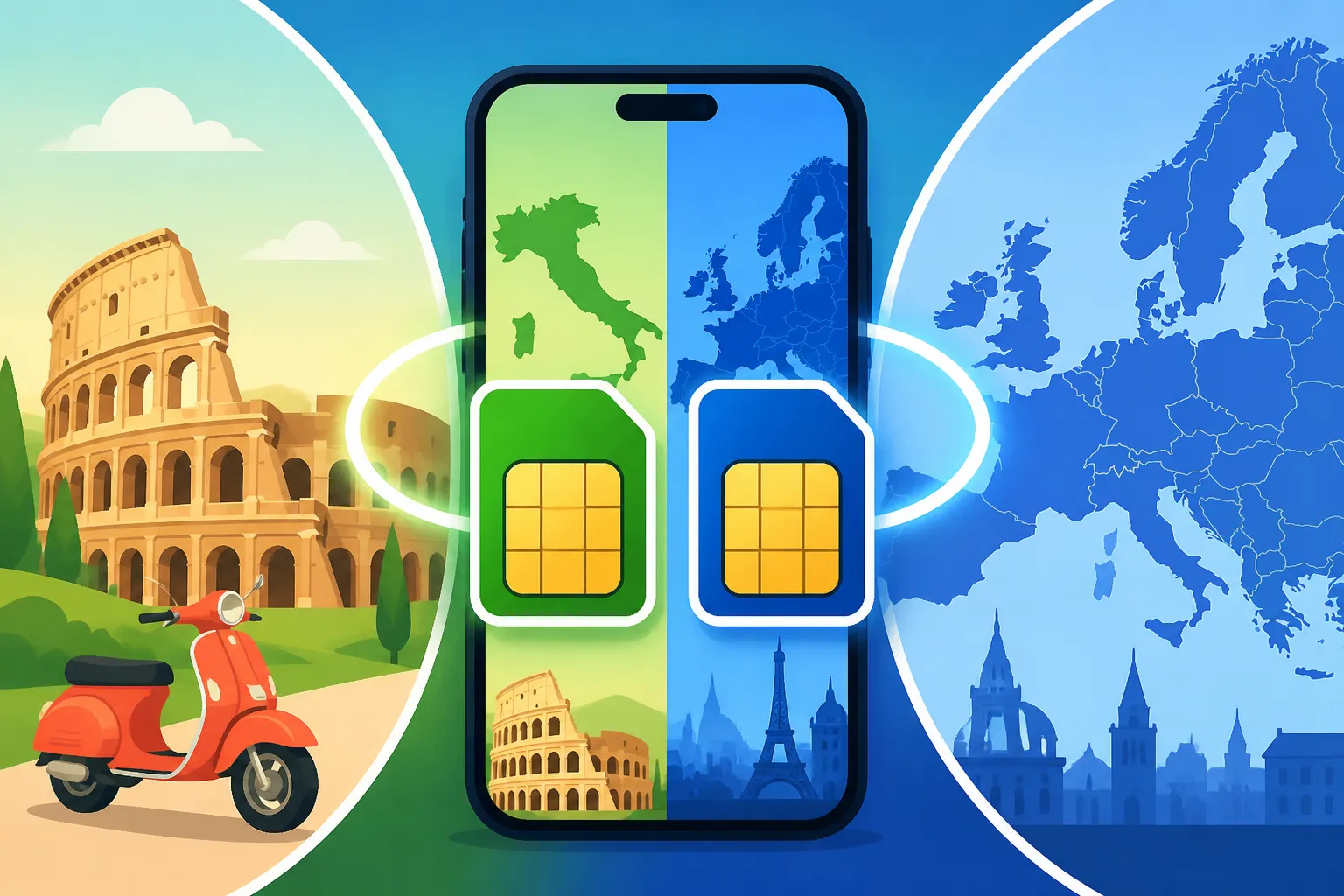
- Flexibility for Cross-Border Jaunts: When you then decide to hop on a high-speed train from Rome to Paris, switching to a Europe-wide eSIM becomes incredibly convenient. You avoid international roaming charges that your Italy-specific plan might incur outside of the EU, and you don't need to buy a whole new local SIM for just a few days in another country. It’s about having the right tool for the right job – maximum value in Italy, maximum convenience and breadth for other European destinations. This hybrid approach gives you the best of both worlds without the administrative hassle.
Choosing between the myriad of data plans can be overwhelming, but knowing your travel patterns helps immensely. Will you mainly be in Italy, with occasional trips elsewhere, or are you constantly moving between countries? For those making Italy their temporary home base, leveraging a specialized Italy plan for daily use and a Europe plan for those spontaneous getaways is a smart, budget-friendly move.
Setting Up Your Dual eSIM Strategy with Airalo
Alright, so you're convinced that running two eSIMs is the way to go for your Italian adventures and broader European escapades. Now comes the practical part: how do you actually set this up? I've seen countless expats struggle with this, but it's genuinely simpler than it sounds, especially with a user-friendly platform like Airalo. They really have streamlined the process, which is a blessing when you're already juggling so much moving to a new country.
Choosing Your Italy-Specific eSIM
When you're mostly based in Italy, your Italy-specific eSIM should be your workhorse. This is the plan you'll rely on for your daily data needs: finding the nearest farmacia, checking train times for your Getting Around Italy: Trains, Buses, Flights, and Car Hire, video calls with family, and endlessly scrolling through delicious recipes.
- Data Allowance: Consider how much data you actually use. Are you a heavy streamer, or just a casual browser? Airalo offers various data packages for Italy, from a few gigabytes for a short trip to larger bundles for extended stays. For example, you might find a 10GB plan for 30 days that's perfect for your month in Tuscany.
- Validity Period: Match the plan's validity to your expected stay in Italy. There's no point in buying a 7-day plan if you're there for a month, or vice-versa.
- Network Coverage: Airalo partners with major local networks in Italy, ensuring good coverage. You might see names like Vodafone IT, Windtre, or TIM mentioned, which are all reliable providers across the country.
Once you’ve selected your Italy plan through the Airalo app or website, the process is straightforward. You'll receive clear instructions, usually involving scanning a QR code or entering a few details directly into your phone settings. It's often so quick you'll wonder why you ever bothered with physical SIMs.
Choosing Your Europe-Wide eSIM
This is your safety net, your freedom pass for those moments you decide to spontaneously cross a border. Maybe you're driving up to Switzerland for a weekend in the Alps, or taking a quick flight for a Day Trips From Milan. Your Europe-wide eSIM is there to keep you connected without interruption.
- Regional Coverage: Airalo’s regional eSIMs, like their "Eurolink" or "Discover" plans, cover multiple countries across Europe. This is crucial. Make sure the plan you pick includes all the countries you anticipate visiting, not just a select few. Most will cover the main EU destinations and often others like Switzerland or the UK.
- Data Allowance: Since this might be for more intermittent use, you might opt for a smaller data package here, or one with a longer validity. Perhaps a 5GB plan valid for 30 days or even longer, designed for lighter, occasional use outside Italy.
- Cost-Benefit: Compare the cost of this regional plan against buying separate local SIMs for each country you visit. For short stints in multiple places, the regional eSIM almost always comes out on top for sheer convenience and often cost.
With Airalo, you can purchase and install this second eSIM profile right alongside your Italy one. Your phone will then have two active eSIM profiles (plus potentially your home physical SIM), giving you ultimate flexibility.
Step-by-Step Guide to Installing and Activating Both eSIMs on Your Device
This is where the magic happens. Don't be intimidated; your phone is smarter than you think!
- Purchase Your eSIMs: Download the Airalo app. Browse and purchase both your Italy-specific eSIM and your Europe-wide eSIM. You'll get instant confirmation and installation instructions.
- Install the First eSIM (e.g., Italy):
- Go to your phone’s Settings (for iPhone, it's typically "Cellular" or "Mobile Data"; for Android, it's often "Network & Internet" then "SIMs" or "Mobile Network").
- Select "Add eSIM" or "Add Data Plan."
- Choose your preferred installation method:
- QR Code (Easiest): Scan the QR code provided by Airalo with your phone's camera.
- Manual Entry: If you can't scan, you can manually enter the SM-DP+ Address and Activation Code.
- Follow the on-screen prompts. You'll likely be asked to label this plan (e.g., "Italy Data" or "Airalo Italy") – do this, it makes management much easier!
- Install the Second eSIM (e.g., Europe): Repeat the exact same steps for your Europe-wide eSIM. Label this one clearly, perhaps "Europe Data" or "Airalo Eurolink."
- Managing Data Usage Between the Two:
- Once both are installed, go back to your "Cellular" or "Mobile Data" settings.
- You'll see your various plans listed. You can designate one as your "Primary" or "Default" data line.
- When you're in Italy, you'll select your "Italy Data" eSIM for cellular data.
- When you cross into France, simply go into these settings and switch your active cellular data line from "Italy Data" to "Europe Data."
- Important Note: Your home physical SIM card can remain active for calls and texts. In your settings, ensure your home number is selected for "Voice" or "Default Voice Line" if you want to continue receiving calls on it. You can almost always use one line for calls and a different line for data simultaneously.
Managing Data Usage Between the Two (Primary/Secondary Data Lines)
This is a critical step for maximizing your dual eSIM strategy. Your phone is designed to handle multiple lines, but you need to tell it which one to use for what.
- Designating Data Source: Within your cellular settings, you'll have an option to select which SIM/eSIM is used for "Cellular Data" or "Mobile Data." In Italy, you'll tap on "Italy Data." When you're in Germany, you'll tap on "Europe Data." It's that simple. You don't need to remove or deactivate the other eSIM; it just sits there, ready to be activated for data when needed.
- Smart Switching: Some phones even offer "Allow Cellular Data Switching," which might switch to your other line if your primary has poor coverage. However, for cost control with two distinct plans, it's usually better to manually switch your data source when you travel between Italy and other European countries.
- Home Number for Calls & Texts: Keep your physical SIM active for voice calls and SMS. This means anyone calling your home number will still reach you, and you can receive important verification codes (like for banking). This line won't use data if you've designated an eSIM for that purpose, so you won't incur roaming data charges on your home plan. You're simply using it for its primary function: voice and text communication. This setup allows you to truly feel connected, no matter where your Italian journey or European adventure takes you.
Table: Comparing Airalo Italy vs. Europe eSIM Plans
| Feature | Airalo Italy eSIM Plan (e.g., "Ciao Mobile") | Airalo Europe eSIM Plan (e.g., "Eurolink") |
|---|---|---|
| Primary Use Case | Daily data in Italy; optimal for extended stays | Travel across multiple European countries (incl. Italy) |
| Cost per GB | Generally lower (e.g., €2-€4/GB for larger packs) | Slightly higher (e.g., €3-€6/GB for larger packs) |
| Coverage | Italy only, often with specific local network preference | 39+ countries in Europe, including Italy |
| Data Amounts | Typically up to 20GB+ for 30 days | Up to 20GB+ for 30/90 days |
| Validity | 7, 15, 30 days | 7, 15, 30, 90 days |
| Ideal User | Expats living in Italy, long-term tourists | Frequent multi-country travelers, weekend trippers |
| Benefits | Maximize data value when primarily in Italy | Seamless connectivity across borders, ultimate flexibility |
(Note: Prices and data amounts are illustrative and subject to change; always check the Airalo app for the most current offers.)
Real-World Scenarios: When and How to Use Each eSIM
This dual eSIM setup isn't just about having options; it's about being strategic. Once you've got your Italy-specific and Europe-wide eSIMs installed, knowing when to leverage each one can save you money and headaches. It's like having two different travel adapters – you use the one that fits best for where you are, but you don't have to carry a whole new suitcase of them.
Primarily in Italy: Using the Italy-Specific Plan for Optimal Local Rates and Coverage
Let's say you've just landed at Fiumicino Airport in Rome, fresh off a long flight, and your first priority is finding your Airbnb in Trastevere. You've already installed your Airalo Italy eSIM, like their "Ciao Mobile" plan, before you even left home.
- Daily Life in Italy: From the moment you connect, you'll set your phone's cellular data to use your "Airalo Italy" profile. This plan is your bread and butter. You're using it to navigate the winding streets of Rome, translate menus at the local trattoria, stay in touch with your Finding an English-Speaking GP in Rome or Milan, and share your incredible travel photos. Because this plan is designed for Italy, you're getting the best local rates and optimized connection quality. You might have a 10GB plan for 30 days, which is far more generous and cost-effective than what a general European plan might offer for purely local use.
- Extended Stays: If you're staying for several weeks or months, the cost savings of an Italy-specific plan really add up. You'll find yourself relying on it for everything from checking Italian Public Holidays: What Services Are Closed to finding the nearest laundromat. The goal here is maximum data value for your primary location.
Cross-Border Travel Within Europe: Seamlessly Switching to the Europe Plan
Now, imagine it’s a month later. You’ve settled into Italian life, but you’ve got a long weekend trip planned to Vienna, Austria. You've also got your Airalo "Eurolink" eSIM installed, covering Austria and many other European countries.
- Before You Depart Italy: The night before you leave, or even as you're boarding your flight, simply go into your phone's cellular settings. Switch your active cellular data line from "Airalo Italy" to "Airalo Eurolink." That's it. No need to hunt for a new SIM in Vienna, no fumbling with tiny trays in an unfamiliar airport. Your phone immediately connects to a local network in Austria, and you continue to use data seamlessly.
- The "Sweet Spot" for Data Allocation: This is where the strategy becomes clear. You’ve used your Italy-specific eSIM heavily while in Italy, consuming most of its data. Now, for your short trip to Vienna, you tap into the data on your Europe-wide eSIM. This prevents you from incurring expensive roaming charges on your Italy plan (which might only cover EU roaming up to a certain limit or not at all outside the EU if it's a truly local-only plan, though most EU plans do come with basic roaming). You essentially preserve your Italy data for when you return, and utilize your Europe data for your excursions.
- Hypothetical Scenario: Rome for a Week, then a Weekend Trip to Paris.
- Week 1 (Rome): You arrive in Rome. You activate your Airalo Italy eSIM (e.g., 5GB for 7 days). You use this plan exclusively for data while exploring the Colosseum, finding hidden gelato spots, and coordinating with friends on WhatsApp. You get robust local service and good value.
- Day 7 (Travel to Paris): As you pack your bags, or when you land at Charles de Gaulle, you switch your active data plan in your phone settings to your Airalo Eurolink eSIM (e.g., 5GB for 30 days, covering France). You use this for navigation to your Parisian hotel, booking museum tickets, and messaging friends. Your Italy plan sits dormant, ready for your return.
- Day 10 (Return to Rome): You fly back to Rome. You simply switch your active data plan back to your Airalo Italy eSIM. If your 7-day Italy plan has expired, you can easily top it up with a new Airalo Italy package, or if you had a longer-term Italy plan, you continue using its remaining data.
This approach means you're never scrambling for connectivity, always benefiting from the most cost-effective plan for your current location, and keeping your home number active for those essential calls and texts. It’s a level of digital independence that truly enhances the travel experience, especially in a country like Italy where constant connectivity can be a real boon.
Optimizing Your Experience and Troubleshooting Tips
Having two eSIMs is fantastic, but like any good strategy, a little optimization and foresight can prevent minor hiccups from becoming major headaches. Trust me, I’ve been there, staring blankly at my phone in a foreign land wondering why I can’t connect. A few simple checks and understanding how your phone manages these digital SIMs will make all the difference.
Checking Compatibility and Device Settings
Before you even think about purchasing two eSIMs, the absolute first step is confirming your device is compatible. Most flagship smartphones from the last few years are, but it's always good to double-check.
- Device Compatibility: Go to your phone manufacturer’s website or a reliable tech review site and confirm your specific model supports eSIMs, and importantly, dual SIM functionality (which typically means one physical SIM and one or more eSIMs active for data, or two eSIMs active for data). While many phones can store multiple eSIM profiles, not all can actively use two eSIMs for data simultaneously, though they generally allow one physical SIM and one eSIM for data.
- Software Updates: Ensure your phone's operating system is fully updated. Sometimes, eSIM functionality is improved or enabled through software updates.
- Network Settings: After installation, if you have trouble, delve into your phone's cellular settings.
- APN Settings: Occasionally, an eSIM might require manual APN (Access Point Name) settings. Airalo usually configures this automatically, but if you're stuck, their support (and your eSIM details) will provide the correct APN to input manually.
- Network Selection: Sometimes, your phone might try to connect to a weaker partner network. You can often go into your cellular settings for the specific eSIM and choose "Manual Network Selection" to pick a stronger, preferred local network. This is especially useful in border regions or areas with patchy signal.
Monitoring Data Usage and Topping Up
One of the great advantages of Airalo is the ease with which you can manage your plans.
- Airalo App: The Airalo app is your command center. Once logged in, you can see all your installed eSIMs, their remaining data, and validity periods. This visibility is invaluable for avoiding unexpected data depletion.
- Notifications: Airalo often sends notifications when your data is running low or your validity period is nearing its end. Pay attention to these!
- Topping Up: If you find yourself chewing through more data than anticipated, you can easily purchase a "top-up" package directly through the Airalo app for your specific eSIM. This means you don't need to buy a whole new plan; you just add more data to your existing one. This is incredibly convenient, especially if you're binge-watching Netflix on a quiet evening in your Italian apartment.
Common Issues and Quick Fixes
Even with the best plans, technology can sometimes be finicky. Here are a few common issues and how to tackle them:
- "No Service" or "No Data":
- Check Data Roaming: Ensure "Data Roaming" is on for your active eSIM. Even though it's a local plan, eSIMs often use a form of roaming agreement with local towers, so this setting is crucial.
- Toggle Airplane Mode: A classic tech fix. Turn on airplane mode for 30 seconds, then turn it off. This often forces your phone to re-register with the network.
- Restart Phone: Another classic for a reason. Sometimes a full restart is all it takes.
- Check APN Settings: As mentioned above, sometimes a manual check of the APN is necessary.
- Manual Network Selection: Try manually selecting a network operator from your phone's settings instead of relying on automatic selection.
- Activation Problems:
- Strong Internet Connection: Make sure you have a stable Wi-Fi connection during the initial eSIM installation. A shaky connection can interrupt the download of the eSIM profile.
- QR Code Clarity: If using a QR code, ensure it's clear, well-lit, and not wrinkled or obscured.
- Airalo Support: Don't hesitate to reach out to Airalo's customer support. They are usually very responsive and can help troubleshoot specific installation issues.
- Device Conflicts: Very rarely, two active eSIMs might cause minor conflicts. If you experience unusual battery drain or intermittent service, try temporarily turning off one of the eSIMs in your settings (without deleting it) to see if the issue resolves.
Maintaining Your Home SIM for Calls/Texts
This is a point of frequent confusion for expats: "But what about my home number?" The beauty of the dual eSIM setup is that you can absolutely keep your home physical SIM active for calls and texts.
- Designate for Voice: In your phone's cellular settings, you'll typically have an option to choose which SIM/eSIM is used for "Voice" or "Default Voice Line." You'll select your home physical SIM for this. This means incoming calls and SMS will still route to your familiar number.
- Data Off for Home SIM: Crucially, ensure that your home physical SIM is not selected for "Cellular Data" or "Mobile Data." This prevents it from accidentally incurring international roaming data charges when you're in Italy or anywhere else in Europe. You’re simply using it as a receiver for calls and texts, which are typically much cheaper or even free to receive while abroad, depending on your home plan.
- WhatsApp and Messaging Apps: Your messaging apps like WhatsApp are tied to your phone number, not necessarily your active data SIM. As long as your home SIM is active and can receive the occasional verification SMS, your WhatsApp will continue to function normally using whichever eSIM is providing data. This means seamless communication with your contacts, regardless of which data plan is currently active.
By following these tips, you'll find that managing your dual eSIM setup, especially with a reliable provider like Airalo, becomes second nature. It truly allows you to enjoy the best of both worlds: dedicated, cost-effective data for your life in Italy, and flexible, cross-border connectivity for all your European adventures. It simplifies so much of the digital side of expat life and travel, freeing you up to focus on the real reason you're here: experiencing la dolce vita and beyond. Whether you're planning a trip, looking into Travel Insurance for Trips to and Within Italy, or simply navigating daily life, reliable connectivity is your best friend.
Disclaimer
Please note that telecommunication services, plan availability, pricing, and specific network coverage can change rapidly. While this guide aims to provide up-to-date and accurate information, it is always recommended to check the latest details directly with service providers like Airalo and verify your device's compatibility before making any purchases or travel plans. Individual experiences may vary based on device model, location, and network conditions. This content is for informational purposes only and does not constitute professional advice.