Student Housing: Dorms vs Private in Italy
Choosing between university dorms and private rentals is a pivotal decision for international students in Italy. This comprehensive guide compares costs, social life, and legal requirements to help you find the perfect home while pursuing your Mediterranean academic dreams.
Disclosure: This post may contain affiliate links. We may earn a commission at no extra cost to you if you make a purchase through these links. Read full disclosure.
Navigating the Italian Student Housing Market
Securing the right accommodation is one of the most significant challenges and exciting milestones for anyone planning to study in Italy. The Italian housing market for students is diverse, ranging from historic university residences to modern shared apartments in vibrant city centers. Because university life in Italy is deeply integrated into the urban fabric, your choice of housing will dictate your daily rhythm, your social circle, and your monthly budget.
Student housing in Italy typically involves choosing between university dormitories and private accommodation. University residences are generally more affordable and may include utilities, furnished rooms, and shared facilities. However, availability is limited and often allocated based on income or merit rankings, requiring early application. Private housing offers greater flexibility in location and amenities, especially in cities like Milan or Rome, but costs are significantly higher. Students must budget for rent, utilities, deposits, and agency fees. Carefully reviewing contracts and verifying landlord legitimacy helps avoid disputes and unexpected expenses.
The demand for student housing in major hubs like Milan, Rome, Bologna, and Florence remains high. As an international student, you must decide early whether you prefer the structured environment of a university dormitory or the independence of a private rental. Both options have distinct advantages and drawbacks, and the “right” choice often depends on your personality, financial flexibility, and how much you value privacy over social proximity. Before you start your search, it is essential to understand the broader context of Living in Italy: Finding Your Ideal City or Region to ensure your chosen neighborhood aligns with your lifestyle.
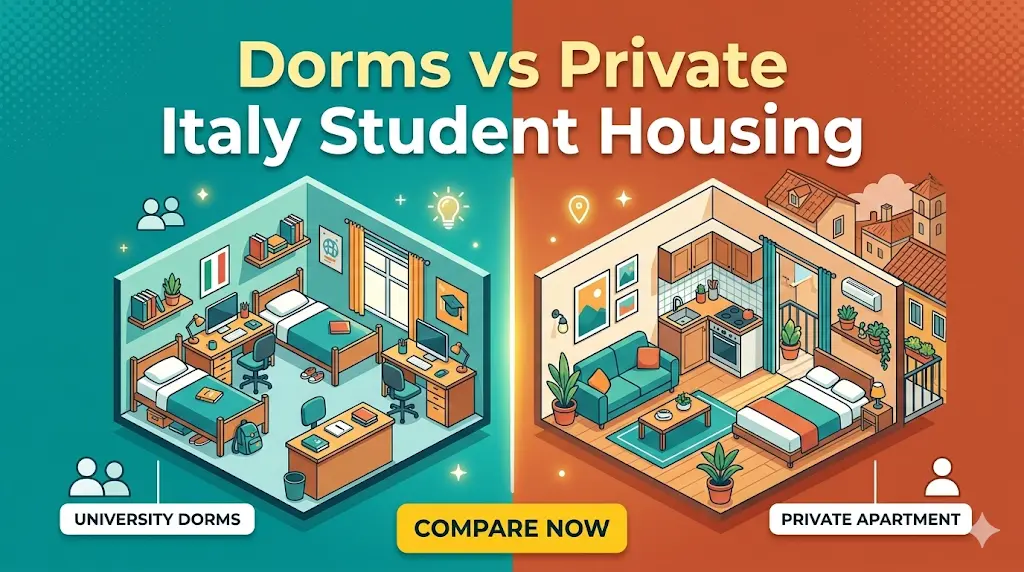
University Dormitories: The Traditional Campus Experience
University dorms, often referred to as studentati or residenze universitarie, are managed either directly by the university or by regional agencies for the “Right to Study” (DSU). These residences are designed specifically to support student life, providing a convenient and relatively affordable gateway into the Italian academic world.
On-Campus vs. Off-Campus Dorms
Unlike the sprawling campuses common in the United States or the UK, Italian universities are often spread across a city. Consequently, “on-campus” housing usually means a building located within walking distance of specific faculty buildings. Many dormitories are managed by regional bodies like ERSU or EDISU, which provide subsidized housing based on financial need and academic merit.
Amenities and Social Life
Dorms offer a pre-packaged social life. They typically feature communal kitchens, study rooms, laundry facilities, and sometimes even gyms or cafeterias. For a newcomer, this is an invaluable resource for making friends quickly. However, dorm life also comes with rules—curfews in some traditional religious residences, guest restrictions, and shared living spaces that might not suit everyone.
Costs and Application Deadlines
Dormitory prices are generally lower than private rentals, often ranging from 250 EUR to 600 EUR per month, depending on the city and whether you opt for a shared or single room. The catch is the application process. Deadlines are often very early (sometimes in the spring for a fall start), and priority is given to students receiving Scholarships for International Students in Italy or those with lower income brackets (ISEE).
Private Rentals: Independence in the Heart of the City
If you value autonomy and want to live like a local, the private rental market is your best bet. This is the most common path for Italian and international students alike, especially after their first year.
Shared Apartments (Posto Letto and Camera Singola)
The most popular private option is renting a room in a shared apartment.
- Posto Letto: This is a “bed space” in a shared room. It is the cheapest way to live in a private flat but offers the least privacy.
- Camera Singola: A private bedroom in a shared apartment. This is the “gold standard” for most students, balancing social interaction with a private sanctuary.
Studios and One-Bedroom Apartments (Monolocali)
For those with a higher budget or a need for total independence, a monolocale (studio) is an option. While these provide maximum privacy, they are significantly more expensive and come with the added responsibility of managing all utility contracts yourself.
Finding Private Housing
The private market moves fast. Websites like Idealista, Immobiliare.it, and Roomless are essential tools. However, competition is fierce. Many students find that Settling In Italy: Daily Life Tips for Expats includes learning how to navigate the “hidden” market of Facebook groups and word-of-mouth referrals.
Comparing Dorms vs. Private Housing: At a Glance
The following table summarizes the key differences to help you weigh your options based on your priorities.
| Feature | University Dormitories | Private Rentals (Shared Flat) |
| Typical Monthly Cost | 250 EUR – 600 EUR | 400 EUR – 900 EUR (higher in Milan/Rome) |
| Utilities (Gas/Electric) | Usually included | Often paid separately (spese escluse) |
| Social Environment | Very high; easy to meet people | Moderate; depends on roommates |
| Privacy | Low (shared rooms/kitchens) | Moderate to High (single rooms) |
| Bureaucracy | High (Strict deadlines/eligibility) | Moderate (Contracts and deposits) |
| Location | Close to university faculties | Anywhere in the city |
| Flexibility | Fixed academic year contracts | Variable (Transitorio vs. 4+4) |
Legal Requirements and Rental Contracts
Renting in Italy involves a fair amount of paperwork. Whether you are in a dorm or a private flat, you must ensure your stay is legally documented.
The Importance of a Registered Contract
In the private market, always insist on a registered contract (contratto registrato). This protects your rights as a tenant and is often a requirement for Renewing Your Italian Residence Permit: Process and Tips. Unregistered “black market” rentals are illegal and leave you with no legal recourse in case of a dispute with your landlord.
Common Contract Types for Students
- Contratto Transitorio per Studenti: A short-term contract (6 to 36 months) designed specifically for students. It offers lower tax rates for landlords, which can sometimes result in lower rent for you.
- Shared Lease: Where all roommates sign one contract and are “jointly and severally” liable for the rent.
Security Deposits (Caparra)
Expect to pay 1 to 3 months of rent as a security deposit. This is held by the landlord and returned at the end of the lease, provided there is no damage to the property. Understanding Italian Rental Contracts 101: 4+4, 3+2, and Transitorio is vital before you sign any documents or hand over money.
Budgeting for Your Stay: Beyond the Rent
When comparing dorms and private housing, don’t just look at the base rent. Hidden costs can quickly add up in the private market.
- Condominio: Building maintenance fees. In private rentals, check if these are included (spese incluse) or extra.
- TARI: The garbage tax. This is usually paid annually and can be a surprise for new residents.
- Heating: Italy has specific laws about when central heating can be turned on. In older buildings, heating costs can be substantial in the winter.
- Agency Fees: If you find an apartment through a real estate agent (agenzia immobiliare), expect to pay a fee usually equivalent to 10% of the annual rent or one month’s rent plus VAT.
Conclusion
The choice between a university dorm and private housing in Italy is a tradeoff between convenience and independence. Dorms offer an affordable, social, and simplified entry into Italian life, making them ideal for first-year international students. On the other hand, private rentals provide the freedom to choose your neighborhood, your roommates, and your lifestyle, allowing for a deeper integration into the local community.
Whichever path you choose, start your search early—at least 3 to 4 months before your arrival—and ensure every agreement is backed by a legal contract. By carefully weighing the pros and cons outlined in this guide, you can secure a home that supports both your academic success and your personal enjoyment of the incredible Italian experience.
References
Primary sources (official)
- Ministero dell’Università e della Ricerca (MUR): Official information on university housing and DSU services. https://www.mur.gov.it/it
- Universitaly: The official government portal for international students in Italy. https://www.universitaly.it/
Other helpful sources
- Erasmus Play: A specialized student housing search engine for European destinations. https://erasmusplay.com/en/italy.html
Disclaimer
The information provided in this article is for general informational purposes only and does not constitute legal or financial advice. Housing markets, rental laws, and university policies in Italy are subject to change. It is highly recommended to verify all contract details and current prices with the relevant institutions or a qualified professional before making any financial commitments.