EU Citizens vs Non-EU: Work Eligibility in Italy
Navigating Italian labor laws depends heavily on your nationality. This comprehensive guide breaks down the stark differences in work eligibility between EU and non-EU citizens, covering visas, residence permits, and the essential steps to legally launch your career in Italy.
Disclosure: This post may contain affiliate links. We may earn a commission at no extra cost to you if you make a purchase through these links. Read full disclosure.
Understanding the Two-Tier Immigration System
Italy, like most European Union member states, operates under a two-tier immigration system that distinguishes significantly between citizens of the European Union (EU) and those from outside the bloc (non-EU). For those looking to make the Mediterranean their professional home, understanding which category you fall into is the first and most critical step in your journey. While the dream of the Italian “dolce vita” is universal, the administrative path to achieving it varies from a simple registration for some to a complex, multi-stage visa process for others.
The Italian job market remains a vibrant hub for sectors such as high-end manufacturing, fashion, and an emerging tech scene. However, the legal right to participate in this market is strictly regulated. EU citizens benefit from the principle of “free movement,” allowing them to treat the entire Italian peninsula as an extension of their home labor market. Conversely, non-EU nationals—often referred to as “Third Country Nationals”—must navigate the intricacies of the Decreto Flussi, employer sponsorship, and specific residence permits.
Whether you are a software developer from Sweden or a marketing executive from the United States, your first task is to assess your EU Citizens vs Non-EU: Work Eligibility in Italy status against the current legislative framework. This guide provides a deep dive into the requirements for both groups, ensuring you are prepared for the bureaucratic hurdles that lie ahead.
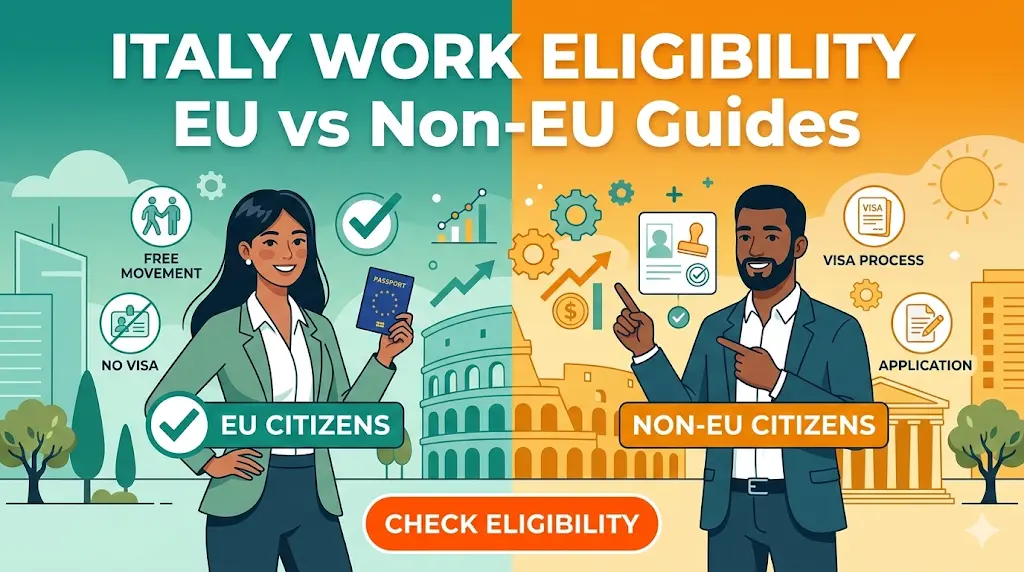
Work Eligibility for EU Citizens
Citizens of the EU, as well as those from the European Economic Area (EEA—Iceland, Liechtenstein, Norway) and Switzerland, enjoy a high degree of professional freedom in Italy. Their right to work is protected by European treaties that aim to create a single, borderless labor market.
The Right to Free Movement
If you are an EU citizen, you do not need a work visa or a work permit to take up employment in Italy. You have the legal right to move to Italy, search for a job, and begin working under the same conditions as an Italian national. Employers are not required to provide sponsorship or prove that they could not find a local candidate before hiring you. This lack of a “labor market test” makes EU citizens highly attractive to Italian companies that need to fill roles quickly.
Registration Requirements for Stays Over 90 Days
While no visa is required, EU citizens are still subject to local administrative registration if they plan to stay for more than three months.
- Fiscal Code: Even before moving, or immediately upon arrival, you must obtain a Codice Fiscale. This tax code is essential for signing an employment contract, opening a bank account, and accessing health services. Many newcomers find that Why Codice Fiscale Is Essential for Foreigners in Italy is their very first administrative priority.
- Residency Registration (Iscrizione Anagrafica): After 90 days of residence, you must register with the local Comune (town hall). To do this as a worker, you simply need to show your identity document and your employment contract or recent payslips.
Professional Equality
EU citizens are entitled to equal treatment regarding pay, working conditions, and social security benefits. They can access the Italian healthcare system (SSN) and are protected by the same Labor Laws in Italy: Worker Rights and Unions that protect local Italian workers.
Work Eligibility for Non-EU Citizens
For citizens of non-EU countries, the process of working in Italy is significantly more rigorous. Generally, a non-EU national cannot simply arrive in Italy and begin a job search; the legal right to work must usually be secured before entering the country.
The Quota System: Decreto Flussi
Most non-EU work permits are subject to the Decreto Flussi, an annual government decree that sets a quota for how many foreign workers can enter Italy for subordinate (employee) and self-employed work.
- The “Click Day” Process: Applications are submitted online during specific “click days.” Because the demand often far exceeds the available spots, the process is highly competitive.
- Employer Sponsorship: For subordinate work, a specific Italian employer must apply for a Nulla Osta (work clearance) on your behalf. This clearance is only granted if there is a spot available within the annual quota.
High-Skilled Pathways: The EU Blue Card
If you are a “highly qualified” worker, you may be able to bypass the standard quota system. The EU Blue Card is a specialized work permit for non-EU professionals who possess a higher education degree and have a job offer that meets a specific salary threshold.
- Advantages: The Blue Card offers a faster processing time and easier family reunification compared to standard work permits.
- Eligibility: You must have a job offer for at least one year and a salary that is significantly higher than the Italian average. For those with advanced technical backgrounds, researching EU Blue Card in Italy: Requirements and Benefits can reveal a much more accessible path to residency.
Self-Employment and Entrepreneurship
Non-EU nationals who wish to work as freelancers or start a business must apply for a self-employment visa (Lavoro Autonomo). This also falls under the quota system and requires proof of significant financial resources, professional certifications, and a viable business plan.
Comparing Eligibility and Requirements
To help visualize the administrative divide, the following table summarizes the key differences between EU and non-EU work eligibility in Italy.
| Feature | EU / EEA / Swiss Citizens | Non-EU Citizens |
| Entry Visa Required | No | Yes (National Visa) |
| Work Permit Required | No | Yes (Nulla Osta) |
| Quota Restrictions | None (Free Movement) | Yes (Decreto Flussi) |
| Employer Sponsorship | Not Required | Mandatory for most roles |
| Residence Permit | Registration at Comune | Permesso di Soggiorno |
| Job Search Rights | Unrestricted | Limited (usually requires visa first) |
| Fiscal Code Needed | Yes | Yes |
The “Permesso di Soggiorno” Requirement
A fundamental difference between these two groups is the Permesso di Soggiorno (Residence Permit).
While EU citizens simply register their presence at the town hall, non-EU citizens must apply for a physical residence permit within eight days of arriving in Italy with their work visa. This card is your primary legal ID and specifies that you have the right to work.
- The Application Kit: Non-EU workers must mail a “kit” via the post office to initiate the process.
- Fingerprinting: You will eventually be summoned to the Questura (police headquarters) for fingerprinting.
- Validity: The permit is typically tied to the duration of your work contract. Non-EU graduates often find that Transitioning from a Student Visa to a Work Visa is a specific, well-regulated process that allows them to stay in the country if they find employment before their student permit expires.
Professional Recognition and Qualifications
Regardless of nationality, if you are entering a “regulated profession” (such as medicine, engineering, or law), you must have your qualifications recognized by the relevant Italian ministry.
EU Qualification Recognition
EU citizens benefit from a streamlined recognition process thanks to EU directives. Usually, a degree obtained in one EU country must be recognized in another, although you may still need to register with a local professional board (Ordine).
Non-EU Qualification Recognition
Non-EU nationals often face a more arduous process involving a Dichiarazione di Valore (Declaration of Value) issued by an Italian consulate. This document proves that your foreign degree is equivalent to an Italian one.
Conclusion
The divide between EU and non-EU work eligibility in Italy is a reflection of broader European immigration policy. For EU citizens, Italy offers a seamless professional transition with minimal red tape, centered mostly on local residency registration. For non-EU citizens, the path is defined by quotas, employer sponsorship, and the meticulous management of visas and residence permits.
While the hurdles for non-EU workers are higher, specialized pathways like the EU Blue Card and student-to-work transitions provide viable opportunities for those with the right skills and preparation. Success for any international worker in Italy depends on early planning, a clear understanding of your legal category, and a patient approach to the Italian administrative system.
References
Primary sources (official)
- Visto per l’Italia – Ministry of Foreign Affairs: The official government portal for determining visa requirements based on nationality and purpose of stay. https://vistoperitalia.esteri.it/home/en
- Ministero dell’Interno – Immigrazione: The official site of the Italian Ministry of the Interior for residence permit (Permesso di Soggiorno) regulations. https://www.interno.gov.it/it/temi/immigrazione-e-asilo
Other helpful sources
- EURES – Living and Working in Italy: The European Job Mobility Portal’s guide to the Italian labor market for both EU and non-EU nationals. https://ec.europa.eu/social/main.jsp?catId=449&langId=en
Disclaimer
This article is for informational purposes only and does not constitute legal or professional immigration advice. Italian immigration laws, visa quotas (Decreto Flussi), and EU regulations are subject to frequent changes. Always consult the official websites of the Italian Ministry of Foreign Affairs and the Ministry of the Interior or a qualified immigration lawyer before making significant relocation decisions.