EU Blue Card in Italy: Requirements and Benefits
This comprehensive guide details the eligibility criteria, application process, and advantages of the EU Blue Card for highly skilled non-EU workers in Italy. Learn about the new salary thresholds, experience-based qualifications for IT professionals, and the streamlined path to residency and family reunification.
Disclosure: This post may contain affiliate links. We may earn a commission at no extra cost to you if you make a purchase through these links. Read full disclosure.
Introduction to EU Blue Card in Italy
For highly skilled professionals looking to advance their careers in Europe, Italy offers one of the most attractive pathways: the EU Blue Card. Designed to attract top talent from outside the European Union, this special residence permit allows qualified individuals to bypass the often restrictive quota systems that govern standard work visas. With recent legislative updates making the card more accessible than ever, understanding the nuances of this program is essential for anyone aiming to work in Italy’s dynamic economy.
The EU Blue Card is not merely a work permit; it is a status that grants significant rights, including mobility within the EU, accelerated family reunification, and equal treatment with national workers. However, the application process involves rigorous documentation and strict adherence to eligibility criteria. Whether you are a software engineer, a corporate executive, or a specialized researcher, navigating the Italian bureaucratic landscape requires preparation and precision.
This guide provides an in-depth analysis of the EU Blue Card in Italy. We will explore the specific requirements, the step-by-step application procedure, the rights it confers, and how it compares to other immigration routes. By the end of this article, you will have a clear roadmap for securing your future as a high-skilled professional in the Bel Paese.
What is the EU Blue Card
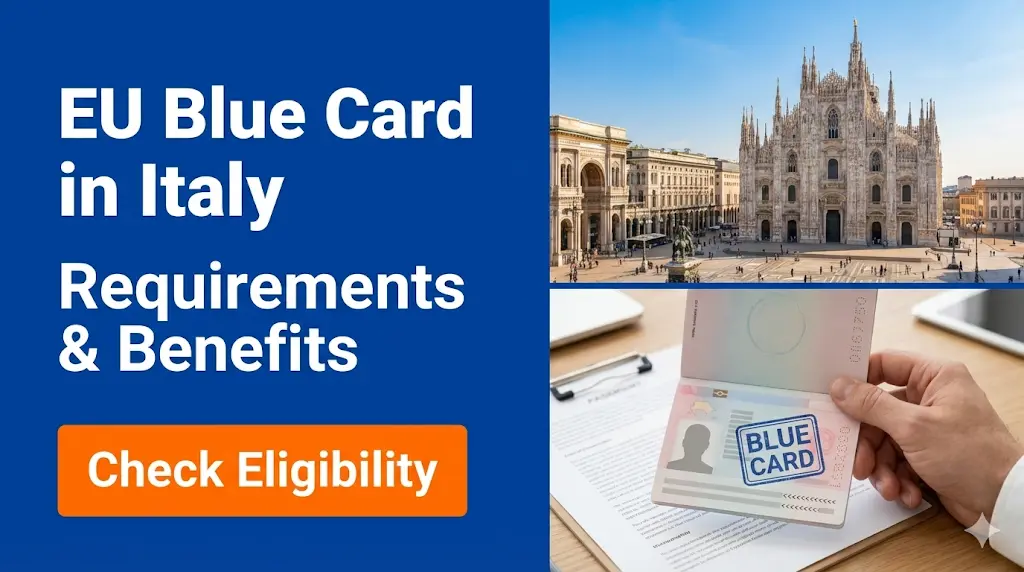
The EU Blue Card is a work and residence permit for non-EU/EEA nationals that allows them to live and work in an EU member state for the purpose of highly qualified employment. It was introduced to address labor shortages in key sectors and to make Europe a more competitive destination for global talent.
In Italy, the EU Blue Card (Carta Blu UE) is governed by Article 27-quater of the Immigration Code. Unlike standard work visas, which are subject to the annual Decreto Flussi (Flow Decree) quotas, the Blue Card is quota-exempt. This means applications can be submitted at any time of the year, provided the applicant meets the qualifications.
Recent changes to Italian law, implementing the new EU Directive 2021/1883, have significantly broadened access to the card. These updates include reduced minimum contract durations, lower salary thresholds, and the recognition of professional experience in lieu of formal education for certain sectors, particularly Information Technology.
Eligibility Criteria for Applicants
To qualify for an EU Blue Card in Italy, both the applicant and the employment offer must meet specific standards. The criteria are strictly enforced to ensure that the permit is reserved for truly “highly qualified” work.
Valid Employment Contract or Job Offer
You must have a valid work contract or a binding job offer from an employer based in Italy.
- Duration: Under the new rules, the contract must have a duration of at least six months. Previously, a one-year contract was required.
- Nature of Work: The position must be for “highly qualified employment,” which generally corresponds to Level 1, 2, or 3 of the ISTAT classification of professions (legislators, entrepreneurs, executive professions, intellectual, scientific, and highly specialized professions).
Minimum Salary Threshold
The salary offered must meet a minimum threshold to prevent wage dumping and ensure the applicant is financially self-sufficient.
- The Threshold: As of the latest regulations, the gross annual salary must not be lower than the average gross annual salary in Italy as defined by ISTAT. Alternatively, recent decrees have pegged this to the minimum income required for exemption from healthcare participation costs (approximately €27,000 per year).
- Comparison: This threshold is generally lower than in other major EU economies like Germany or France, making Italy an accessible option for skilled workers.
Educational Qualifications or Professional Experience
Historically, a three-year university degree was mandatory. However, Italy now recognizes professional experience as a valid alternative in specific cases.
- University Degree: A higher education qualification of at least three years (Bachelor’s degree or higher). The degree must be validated by the Italian Consulate in the country where it was issued (Declaration of Value).
- IT Professionals: For managers and specialists in Information and Communication Technology (ICT), a degree is no longer strictly required. Applicants can substitute the degree with at least three years of relevant professional experience acquired within the seven years preceding the application.
- Other Sectors: For other highly skilled sectors, applicants can demonstrate at least five years of comparable professional experience in the specific field.
Professional Qualifications
If the profession is regulated in Italy (e.g., doctors, architects, engineers), the applicant must furnish proof that they meet the legal requirements to practice that profession in Italy. This often involves recognition of foreign qualifications by the relevant Italian ministry.
The Application Process: Step-by-Step
Obtaining an EU Blue Card involves a coordinated effort between the employer in Italy and the applicant in their home country. The process is initiated by the employer.
Step 1: The Nulla Osta Request
The Italian employer must apply for a Nulla Osta (Work Authorization) from the One-Stop Shop for Immigration (Sportello Unico per l’Immigrazione – SUI) at the local Prefecture.
- Submission: The application is submitted electronically via the Ministry of the Interior’s portal.
- Documents Required: The employer must submit the company’s details, the proposed contract, proof of the applicant’s qualifications, and a commitment to pay for the applicant’s return journey in case of expulsion.
- Timeline: By law, the SUI must issue the Nulla Osta within 90 days, although recent simplifications aim to reduce this to 30-60 days for trusted employers. If no decision is made within the deadline, the authorization may be deemed granted under the “silence-is-consent” rule in specific circumstances.
Step 2: Visa Application at the Consulate
Once the Nulla Osta is issued, it is sent electronically to the Italian Consulate or Embassy in the applicant’s country of residence.
- Booking: The applicant must book an appointment at the consulate.
- Documents: You will need the Nulla Osta, a completed long-stay visa application form (National Visa Type D), a valid passport, passport photos, and proof of accommodation in Italy.
- Interview: Consular officers may interview the applicant to verify their intent and qualifications.
For a detailed look at the general procedures for entering Italy, reviewing the Ultimate Guide to Visas and Immigration in Italy can provide broader context on document preparation.
Step 3: Arrival and Residence Permit
Upon arriving in Italy, the Blue Card holder must complete several mandatory steps within eight working days:
- Contract of Stay: Visit the SUI to sign the Contratto di Soggiorno (Contract of Stay) with the employer.
- Permit Application: Go to a post office (Poste Italiane) to submit the “Kit Giallo” application for the residence permit (Permesso di Soggiorno).
- Fingerprinting: Attend an appointment at the Questura (Police Headquarters) for fingerprinting.
- Collection: Pick up the electronic residence permit card once it is ready.
Navigating the post-arrival bureaucracy is critical. Ensure you are familiar with the steps outlined in Italian Residence Permit (Permesso di Soggiorno) Explained to avoid delays in legalizing your stay.
Benefits of the Italian EU Blue Card
The Blue Card offers substantial advantages over a standard work visa, designed to encourage long-term settlement.
1. Exemption from Quotas
The most significant benefit is the exemption from the Decreto Flussi. Standard work visas are limited by annual caps, and spots often run out within minutes of the application window opening. Blue Card applicants face no such competition; if you meet the criteria, you can be hired regardless of the quota status.
2. Family Reunification
Blue Card holders have the right to bring their family members (spouse and minor children) to Italy.
- No Waiting Period: Unlike other visa categories that may require a waiting period to prove housing and income, Blue Card holders can often apply for family reunification simultaneously with their own application, or immediately after ensuring housing availability.
- Spousal Employment: The spouse of a Blue Card holder is granted a residence permit for family reasons, which allows them to work in Italy immediately without needing a separate work permit.
For more details on bringing dependents, refer to Family Reunification and Spouse Visas in Italy.
3. Mobility Within the EU
After 12 months of legal residence in Italy, a Blue Card holder can move to another EU member state (except Denmark and Ireland) for highly qualified employment without obtaining a new visa from scratch.
- Simplified Process: You simply apply for a new Blue Card in the destination country.
- Accumulation of Time: Periods of residence in different EU member states can count towards the five-year requirement for EU Long-Term Resident status (Permanent Residency), provided the last two years were spent in the country of application.
4. Path to Permanent Residency
Blue Card holders can apply for permanent residency (Permesso di soggiorno UE per soggiornanti di lungo periodo) after five years of continuous legal residence in the EU, provided at least the last two years have been in Italy. This status grants rights virtually identical to Italian citizens, excluding the right to vote.
5. Equal Treatment
Blue Card holders enjoy the same treatment as Italian nationals regarding:
- Working conditions (pay, dismissal, health and safety).
- Freedom of association (unions).
- Education and vocational training.
- Recognition of diplomas and qualifications.
- Access to public goods and services.
Comparison Table: EU Blue Card vs. Standard Work Visa
Understanding the differences between the Blue Card and the standard subordinate work visa is crucial for choosing the right path.
| Feature | EU Blue Card | Standard Work Visa (Subordinate) |
| Quota System | Exempt (Apply anytime) | Subject to Quotas (Decreto Flussi) |
| Eligibility | Degree or 3-5 years exp. | Any qualification level |
| Salary Threshold | Minimum ~€27,000 | National collective agreement minimums |
| Contract Duration | Minimum 6 months | Fixed-term or Indefinite |
| Family Rights | Immediate reunification | Subject to specific conditions |
| EU Mobility | Yes (after 12 months) | No (tied to Italy) |
| Processing Priority | High | Low (First-come, first-served) |
If you do not meet the high-skill criteria for the Blue Card, you will likely need to navigate the quota system.
Document Checklist for the Blue Card
To ensure a smooth application, gather the following documents. All foreign documents must be translated into Italian and legalized (or Apostilled).
- Employer Documents:
- Company registration (Visura Camerale).
- Recent financial statements.
- Signed employment proposal (Modello Q).
- Declaration of housing availability for the worker.
- Applicant Documents:
- Valid Passport (copy of all pages).
- Educational Credentials: University diploma + Declaration of Value (Dichiarazione di Valore) issued by the Italian Consulate, or CIMEA Statement of Comparability.
- Proof of Experience (if applicable): Employment contracts, pay slips, and reference letters proving 3 years (IT) or 5 years (other) of relevant high-level experience.
- Curriculum Vitae (CV) in Italian.
- Health Insurance (for the initial period before SSN registration).
Costs and Processing Times
Costs
- Visa Fee: Approximately €116 (subject to change).
- Residence Permit Fee: Approximately €70-€100 depending on duration + €30 for the electronic card + €16 revenue stamp.
- Administrative Costs: Translations, legalizations, and potential legal fees if using an immigration lawyer.
Processing Times
- Nulla Osta: Legally 90 days, but often processed in 45-60 days.
- Visa: 2 weeks to 3 months, depending on the consulate’s workload.
- Residence Permit: 3 to 6 months after arrival for the physical card to be issued.
Common Challenges and Solutions
1. Recognition of Foreign Degrees
The most common bottleneck is obtaining the Dichiarazione di Valore (DoV) from the Italian Consulate. This document confirms the value of your foreign degree.
- Solution: Alternatively, you can request a Statement of Comparability from CIMEA (Information Centre on Academic Mobility and Equivalence). CIMEA certificates are digital, faster to obtain (often within a few weeks), and legally recognized by Italian authorities for visa purposes.
2. Defining “Highly Qualified”
Sometimes the SUI may dispute whether a specific job role counts as “highly qualified.”
- Solution: Ensure the job description in the contract closely matches the ISTAT codes for Level 1, 2, or 3 professions. A detailed letter from the employer explaining the complexity of the role helps.
3. Salary Discrepancies
The salary must clearly meet the threshold before bonuses.
- Solution: Ensure the base gross salary listed in the contract meets the ~€27,000 requirement without relying on variable performance bonuses.
Conclusion
The EU Blue Card represents the gold standard for immigration to Italy for professionals. It removes the uncertainty of the quota system and provides a stable, privileged status for you and your family. By recognizing professional experience in IT and reducing contract duration requirements, Italy has made a clear statement: it is open for global talent.
While the paperwork is significant, the benefits of living and working in Italy—combined with the freedom to eventually move within the EU—make the Blue Card a powerful tool for career growth. Whether you are an engineer, a developer, or a corporate leader, this permit is your key to unlocking a future in Europe.
References
Primary sources (official)
- Ministry of the Interior (Sportello Unico per l’Immigrazione): https://portaleservizi.dlci.interno.it/
- Ministry of Foreign Affairs and International Cooperation (Visto per Italia): https://vistoperitalia.esteri.it/home/en
Other helpful sources
- CIMEA (Academic Equivalence): https://www.cimea.it/
Disclaimer
The information provided in this article is for educational and informational purposes only and does not constitute official legal or immigration advice. Salary thresholds, application fees, and legislative requirements for the EU Blue Card are subject to change by the Italian government. Always verify the latest requirements with the Italian Consulate in your jurisdiction or a qualified immigration lawyer before submitting any applications.