Comparing Italian Visas: Tourist vs Long-Stay
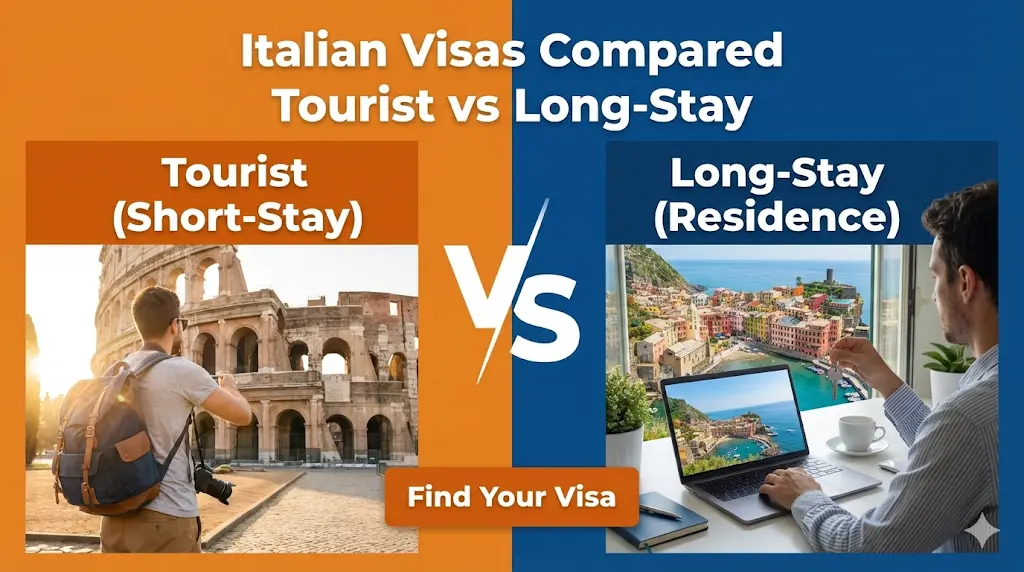
Navigating Italian immigration law can be daunting. This comprehensive guide breaks down the critical differences between the short-term Schengen Tourist Visa (Type C) and the National Long-Stay Visa (Type D), covering duration limits, permitted activities, residency rights, and the strict rules on switching statuses.
Disclosure: This post may contain affiliate links. We may earn a commission at no extra cost to you if you make a purchase through these links. Read full disclosure.
Introduction to Tourist vs Long-Stay Italian Visas
For millions of people around the globe, Italy represents the ultimate dream destination. Whether it is the allure of art history in Florence, the culinary delights of Emilia-Romagna, or the rugged beauty of the Dolomites, the country exerts a powerful magnetic pull. However, turning that dream into a reality—whether for a summer vacation or a permanent relocation—requires a clear understanding of the legal frameworks that govern entry and residence.
The Italian immigration system is notoriously complex, often causing confusion among travelers and aspiring expatriates. The most fundamental distinction lies between two primary categories: the Uniform Schengen Visa (Type C), commonly known as the Tourist Visa, and the National Visa (Type D), also referred to as the Long-Stay Visa. Confusing these two can lead to serious legal consequences, including deportation, entry bans, and the derailment of long-term relocation plans.
In this extensive guide, we will dissect the nuances of both visa types. We will explore who needs them, what activities they permit, the financial requirements for each, and the critical limitations that every applicant must understand before booking a flight. Whether you are planning a three-month sabbatical or a permanent move to Il Bel Paese, this article will serve as your roadmap to navigating Italian bureaucracy.
The Legal Framework of Italian Immigration
To understand the difference between a tourist visa and a long-stay visa, one must first understand the two legal jurisdictions that Italy operates under: the Schengen Area and Italian National Law.
The Schengen Area Agreement
Italy is a member of the Schengen Area, a zone of 29 European countries that have abolished internal border controls. The “Tourist Visa” is actually a Schengen Visa. It is governed by EU regulations and allows travel not just to Italy, but to any country within the zone. Its primary purpose is short-term movement for tourism, business, or family visits.
Italian National Law
The “Long-Stay Visa” is a National Visa. It is governed specifically by Italian law (Legislative Decree 286/98). While it allows transit through other Schengen countries, its primary purpose is to grant the holder the right to reside in Italy long-term. This visa is the necessary precursor to obtaining an Italian Residence Permit (Permesso di Soggiorno).
The Tourist Visa (Schengen Type C) Explained
The Schengen Visa Type C is the most common visa issued by Italy. It is designed for short-term stays and is strictly regulated by the “90/180 rule.”
Who Needs a Tourist Visa
Not everyone needs to apply for a physical visa to enter Italy as a tourist.
- Visa-Waiver Citizens: Citizens of countries such as the United States, Canada, Australia, Japan, and the United Kingdom can enter Italy without a visa for up to 90 days. Their passport is simply stamped upon arrival.
- Visa-Required Citizens: Citizens of many other countries (e.g., India, China, Russia, South Africa) must apply for a visa at an Italian consulate before traveling.
Regardless of whether you need a physical visa or are visa-exempt, the rules of stay remain exactly the same.
The 90/180 Rule
This is the most critical restriction of the Tourist Visa. You are permitted to stay in the Schengen Area for a maximum of 90 days within any 180-day period.
- Rolling Window: The 180-day period is not a calendar year. It is a “rolling” window that looks backward from each day of your stay.
- Calculation: To check if you are legal today, look back 180 days. Have you been in the Schengen Area for less than 90 days in that window? If yes, you are legal. If no, you are overstaying.
Permitted Activities on a Tourist Visa
- Tourism: Sightseeing, visiting museums, and leisure travel.
- Visiting Family/Friends: Short social visits.
- Business: Attending meetings, conferences, or trade fairs. Crucially, you cannot be employed by an Italian company or receive a salary in Italy.
- Short Study: Taking a language course or cooking class that lasts fewer than 90 days.
- Medical Treatment: Receiving short-term care (provided you have proof of payment and appointment).
Prohibited Activities
- Employment: You cannot work for an Italian employer.
- Residency: You cannot apply for residency or sign a long-term lease (usually).
- Public Funds: You cannot access the Italian national healthcare system (SSN) or claim benefits.
For a deeper dive into the application process and specific document requirements for this category, refer to our Italy Schengen Visa Guide: Tourist and Business Travel.
The Long-Stay Visa (National Type D) Explained
The National Visa Type D is a completely different legal instrument. It is intended for anyone wishing to stay in Italy for more than 90 days. It effectively signals your intent to move to Italy, whether temporarily or permanently.
The Gateway to Residency
The Type D visa is merely an entry ticket. Its validity usually ranges from 365 days to a specific date corresponding with a contract. However, the visa itself does not grant you the final right to live in Italy. It grants you the right to enter Italy to apply for a Residence Permit.
Without a Type D visa, you generally cannot apply for a residence permit. This is why you cannot simply enter as a tourist and decide to stay; you lack the requisite entry visa to initiate the residency process.
Common Categories of Long-Stay Visas
Unlike the generic “Tourist” visa, Type D visas are highly specific. You must apply for a sub-category that matches your purpose:
- Work (Subordinate): For those with a job offer from an Italian company.
- Work (Self-Employment): For freelancers and entrepreneurs.
- Study: For university degrees or long-term language courses.
- Elective Residence: For retirees with passive income.
- Family Reunification: For moving to join a family member who is already a resident.
- Investor: For high-net-worth individuals investing in Italian companies or bonds.
Permitted Activities
- Living: You can reside in Italy year-round.
- Working: Permitted only if your specific visa category allows it (e.g., Work or Family visas allow work; Elective Residence and Study visas have restrictions).
- Healthcare: You are eligible (and often required) to register with the National Health Service (Servizio Sanitario Nazionale).
- ID Card: You can obtain an Italian Identity Card (Carta d’Identità).
Once you arrive with this visa, the clock starts ticking for you to formalize your status. To understand the immediate next steps, check our guide on Italian Residence Permit (Permesso di Soggiorno) Explained.
Side-by-Side Comparison of Tourist vs Long-Stay Visas
The following table highlights the operational differences between the two visa types.
| Feature | Tourist Visa (Schengen Type C) | Long-Stay Visa (National Type D) |
| Duration of Stay | Max 90 days per 180 days | 365 days + (Renewable via Permit) |
| Primary Purpose | Tourism, Short Business, Visits | Residency, Work, Study, Retirement |
| Geographic Scope | All Schengen Countries | Italy (plus 90/180 transit in Schengen) |
| Work Rights | Strictly Prohibited | Allowed (Category Dependent) |
| Residency Permit | Cannot Apply | Must Apply within 8 days of arrival |
| Healthcare Access | Travel Insurance Required | National Healthcare (SSN) Access |
| Tax Residency | Generally No (unless overstaying) | Yes (Worldwide income usually taxed) |
| Renewable in Italy | No (Must leave) | Yes (Renewable indefinitely) |
Financial Requirements and Solvency
Both visa types require proof of financial means, but the scale and nature of the proof differ significantly.
Tourist Visa Financials
For a tourist visa, the focus is on subsistence. You must prove you have enough cash to survive your trip and buy a ticket home.
- Daily Amount: The Ministry of Interior sets a daily table. For example, a solo traveler staying 1-5 days needs a fixed sum of roughly €270. For longer trips, it’s a daily rate (e.g., €28 per day).
- Proof: Credit card limits, bank statements, or cash.
Long-Stay Visa Financials
For a long-stay visa, the focus is on sustainability. You must prove you can support a life in Italy without becoming a burden on the state.
- Students: Must prove approx. €6,000 per year (tied to the social allowance).
- Elective Residence: Must prove substantial passive income (pensions, rents) of roughly €31,000+ per year.
- Self-Employed: Must show proof of income from the previous year exceeding the exemption limit for healthcare participation (approx. €8,500), though in practice, consulates ask for much more.
Understanding the financial commitment for long-term residency is crucial. For retirees, the bar is particularly high. You can learn more about specific passive income thresholds in our article on Elective Residence Visa in Italy: The Retirement Visa Guide.
The “Declaration of Presence” vs. “Permit of Stay”
One of the most confusing aspects for new arrivals is how to declare their presence to the police.
For Tourists: Dichiarazione di Presenza
If you enter Italy directly from a non-Schengen country (e.g., New York to Rome), the stamp in your passport acts as your “Declaration of Presence.”
However, if you enter Italy from another Schengen country (e.g., New York to Paris to Rome), you will not get a stamp in Rome. In this case, strictly speaking, tourists are required to go to the Questura (police headquarters) within 8 days to fill out a “Declaration of Presence” form. Hotels usually do this automatically for guests, but those staying in Airbnbs or with friends should be aware of this rule.
For Residents: Permesso di Soggiorno
Holders of a Long-Stay Visa do not just declare their presence; they must apply for a residency card. Within 8 working days of arrival, they must go to a Post Office (Poste Italiane) to pick up a “Kit Giallo” (Yellow Kit) and mail their application to the immigration authorities. This initiates the process of getting a biometric card that proves their legal status.
Switching from Tourist to Long-Stay Status
This is the most frequently asked question: “Can I enter Italy as a tourist and then apply for a work or study visa?”
The General Rule: No
Under Italian law, you cannot convert a Schengen C (Tourist) visa into a National D (Long-Stay) visa while inside Italy.
- If you find a job while visiting Rome as a tourist, you must return to your home country.
- Your employer must apply for authorization (Nulla Osta) in Italy.
- Once authorized, you must visit the Italian consulate in your home country to get the Type D visa.
- Only then can you return to Italy to work.
The Exceptions
There are very few exceptions to this rule:
- Family Members of EU Citizens: If you are a non-EU citizen who enters as a tourist and marries an Italian or EU citizen, you may be able to apply for a residence permit (Carta di soggiorno) directly in Italy without returning home.
- Force Majeure: Severe humanitarian reasons or health issues that prevent travel (extremely rare and difficult to prove).
Attempting to overstay a tourist visa to “wait out” a work permit application is a dangerous strategy that can lead to being banned from the entire Schengen Area. For those looking to work, following the correct consular channels is non-negotiable.
Healthcare Rights Comparison
Access to medical care is another major differentiator.
- Tourist Visa: You are required to have private travel medical insurance covering up to €30,000. You cannot register with the Italian National Health Service (SSN). If you have a medical emergency, you will be treated, but you must pay out of pocket or use your insurance.
- Long-Stay Visa: Once you apply for your residence permit, you are generally eligible to register with the SSN.
- Workers: Registration is mandatory and free (paid via taxes).
- Students/Retirees: Registration is voluntary and requires an annual fee (e.g., approx. €149 for students, much higher for retirees).
- Once registered, you receive a Tessera Sanitaria (Health Card) and have the same rights as an Italian citizen.
Making the Right Choice for Your Goals
Choosing the correct visa depends entirely on your intent.
Choose the Tourist Visa If:
- You want to travel, sightsee, or take a “test run” of living in Italy.
- You are attending a short conference or business meeting.
- You are taking a cooking course or language class lasting less than 3 months.
- You do not intend to work or live in Italy permanently.
Choose the Long-Stay Visa If:
- You plan to move your life to Italy.
- You have a job offer or want to enroll in a university degree program.
- You want to retire in Italy.
- You want to bring your family to live with you.
- You want to start the clock toward permanent residency and eventual citizenship.
If your goal is higher education, the specific requirements for the Type D Study Visa are unique.
Conclusion
The distinction between the Tourist Visa and the Long-Stay Visa is the foundation of Italian immigration law. The Tourist Visa is a temporary pass for visitors, offering freedom of movement but no rights to settlement. The Long-Stay Visa is a commitment, a legal status that opens the door to integration, employment, and a new life in Europe.
Mistaking one for the other is a recipe for bureaucratic disaster. By clearly identifying your goals—whether a Roman holiday or a Roman life—you can select the appropriate legal pathway and ensure your time in Italy is memorable for the right reasons, not for legal troubles. Always consult the official consular requirements for your specific nationality, and plan your application well in advance of your travel dates.
References
Primary sources (official)
- Ministry of Foreign Affairs and International Cooperation (Visto per Italia): https://vistoperitalia.esteri.it/home/en
- Polizia di Stato (Entry and Residence): https://www.poliziadistato.it/articolo/10617
Other helpful sources
- Portale Immigrazione (Poste Italiane): https://www.portaleimmigrazione.it/
Disclaimer
The information provided in this article is for educational and informational purposes only and does not constitute official legal or immigration advice. Visa rules, fees, and the 90/180 calculation method are subject to change by Italian and EU authorities. Always verify the latest requirements with the Italian Consulate in your jurisdiction or a qualified legal professional before traveling or applying for a visa.