Do Italian visas require proof of forward or return travel?
Standing at the airline check-in counter while an agent threatens to deny your boarding because you only have a one-way ticket to Rome is a terrifying expat nightmare. I once nearly missed my flight because I misunderstood the strict airline liability rules. This guide explains exactly when Italian visas require proof of onward travel and how to legally avoid boarding denials.
Disclosure: This post may contain affiliate links. We may earn a commission at no extra cost to you if you make a purchase through these links. Read full disclosure.
Short Stay Versus Long Stay Visa Flight Requirements
The Rigid Rules for Type C Schengen Visas
If you are traveling to Italy for tourism, a short business trip, or a brief language course lasting less than ninety days, you are applying for a Type C Schengen Visa. For this specific category, the Italian Ministry of Foreign Affairs is absolutely uncompromising: you must provide a confirmed round-trip flight itinerary. The consulate will explicitly reject your application if you cannot prove exactly when and how you plan to leave the Schengen Area before your ninety days expire.
Expats frequently assume they can just buy a one-way ticket and figure out their return date later, but doing so guarantees a visa denial. In an attempt to circumvent this, some applicants purchase “dummy tickets”—unpaid flight reservations generated by third-party travel agencies meant solely to satisfy the paperwork requirement. I strongly advise against this. Italian consular officers are highly trained to verify Passenger Name Record (PNR) codes directly in airline databases. If they discover your flight itinerary is a fake or expired hold, your visa will be instantly rejected for deception, placing a permanent black mark on your European immigration record. You must provide a legitimate, verifiable booking that perfectly aligns with your requested travel dates. Understanding this massive difference in documentation is a core component when reviewing Schengen Visa Requirements Italy.
The Flexibility of Type D National Visas
However, if you are relocating to Italy for a year or more—perhaps for university, a corporate transfer, or retirement—you are applying for a Type D National Visa. It is completely illogical to buy a return flight for a date a year in the future, as airlines typically do not even publish flight schedules that far out.
Fortunately, Italian consulates understand this. When evaluating long-stay visa applications, they generally accept a one-way flight itinerary. Instead of demanding a return ticket, the consular officer will heavily scrutinize your financial portfolio to ensure you possess sufficient funds to eventually purchase a ticket back to your home country if your long-term plans fail. If you are pursuing specialized residency paths, carrying the approval paperwork detailed in Italian Elective Residence Visa VRE Complete Guide helps prove your legitimate intent.
Surviving the Airline Check In Counter
Understanding Carrier Liability Laws
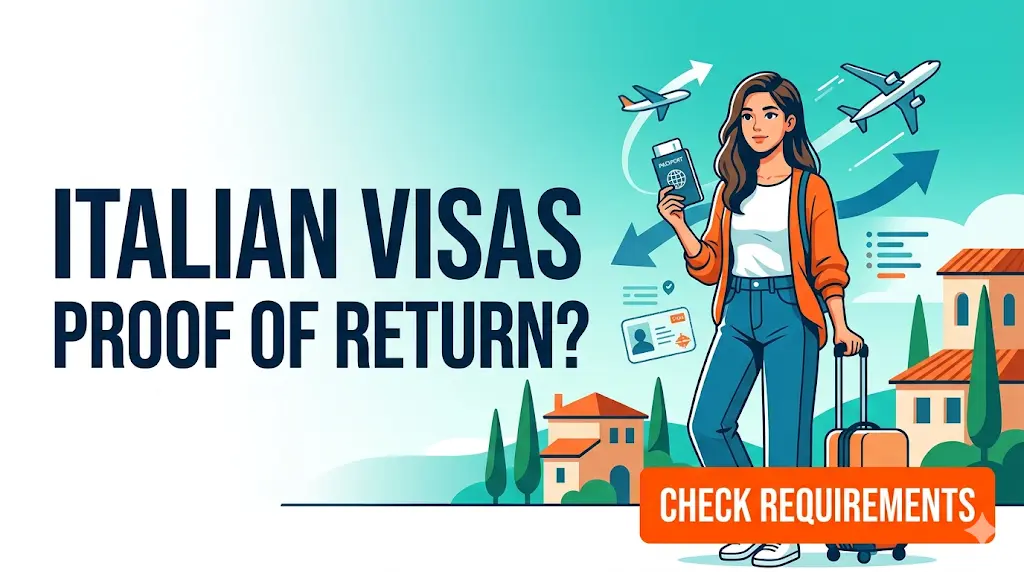
Even if the Italian consulate issues your Type D visa based on a one-way ticket, you are not safe until you actually clear the airline gate. This is where most foreign residents face absolute panic. Airline gate agents are trained to universally ask for return tickets when checking passengers in for international flights.
They do this because of strict international carrier liability laws. If an airline flies you to Italy and border control denies your entry because you look like an illegal immigrant intending to overstay, the airline is heavily fined and forced to fly you back at their own expense. To mitigate this massive financial risk, their default internal policy is to demand proof of onward travel from everyone.
Defending Your Long Term Status at the Gate
When the gate agent asks to see your return ticket, you must advocate for yourself immediately. You must clearly present your passport and point directly to the Type D visa sticker. You have to explicitly explain that you are a long-term resident, not a tourist. Having secondary paperwork readily available, such as a signed Italian employment contract or a university enrollment letter, helps prove your legitimate long-term intent.
When you finally land at Rome-Fiumicino or Milan-Malpensa, you will face a second layer of scrutiny at passport control. The Italian border police (Polizia di Frontiera) have the ultimate authority to deny your entry. If you hand them a passport with a one-way ticket, they will ask about your intentions. Remaining calm and having your housing and financial documents readily accessible proves you are prepared. Surviving this final interrogation is a crucial step before you can formally begin Navigating Italian Bureaucracy Comune and Prefettura. If you applied via the new digital portals, having your electronic files organized is just as important, a reality discussed in Electronic submission of Italian visa application available.
The Refundable Ticket Strategy
If you are deeply anxious about arguing with a stubborn gate agent who refuses to understand Italian immigration law, there is a widely used expat workaround. Many foreigners simply purchase a fully refundable return ticket to their home country the night before their departure.
They show this return itinerary to the airline agent to secure their boarding pass, board the flight to Rome or Milan, and then immediately cancel the return ticket via their smartphone for a full refund while waiting on the tarmac. While this requires temporarily floating a large amount of cash on your credit card, it completely neutralizes the threat of being denied boarding.
Preparing Your Digital and Physical Document Portfolio
Certified Translations and Proving Long Term Intent
When you apply for a Type D visa with a one-way ticket, the consulate replaces the requirement for a return flight with an intense demand for financial and administrative proof. You must prove exactly why you are staying long-term. This requires submitting massive amounts of foreign documentation, such as bank statements, police background checks, and university diplomas. These documents are legally useless to the Italian government unless they are flawlessly translated.
Getting your documents properly legalized and translated is a massive bottleneck. I always advise expats to use RushTranslate for this step. Getting your vital records and financial statements processed by RushTranslate ensures that the Italian consulate receives certified, legally accurate documents formatted to their exact standards. Do not attempt to translate these sensitive legal documents yourself or use an amateur service. A consular officer already scrutinizing your lack of a return ticket will instantly reject your file over a poorly translated bank statement.
Relying on RushTranslate guarantees compliance with the strict standards of the Italian Ministry of Foreign Affairs and prevents your application from being bounced back. Having your pristine RushTranslate files properly organized ensures a smooth submission, a crucial preparatory step before tackling Checking Your Italian Tax Code Codice Fiscale Status. Furthermore, properly translated employment histories are vital when navigating Types of Italian Employment Contracts Contratti di Lavoro.
Health Insurance as Your Ultimate Safety Net
Alongside your translated documents, the most heavily scrutinized piece of paper in your entire visa portfolio is your proof of health insurance. Whether you are flying on a round-trip tourist ticket or a one-way relocation flight, you must prove you will not become a financial burden on the Italian state if you suffer a medical emergency. Even if you plan on Registering with the Italian Public Healthcare System SSN later, you legally cannot access the public grid until you physically arrive and obtain a residence permit.
To satisfy the consulate and immediately bypass airline scrutiny, you must secure comprehensive private insurance before you fly. I highly recommend securing a policy through Cigna Global for your arrival. Using Cigna Global is a bulletproof way to satisfy the strict Schengen and National visa health insurance requirements. Because Cigna Global is a globally recognized expat insurance provider, their certificates of coverage are explicitly tailored to meet Italian consular limits. When a gate agent or border guard questions your one-way ticket, presenting a robust Cigna Global policy demonstrates your absolute financial independence and legitimate status.
Having Cigna Global ensures that if you face a sudden medical emergency during your chaotic first month in Italy, you won’t be bankrupted by private clinic bills. Securing this premium safety net protects your physical health and your savings while you navigate the exhausting reality of relocating to the Mediterranean, an essential survival tactic we cover heavily in Healthcare in Italy An Expats Guide. This coverage remains your primary lifeline until you successfully conquer the bureaucracy of Renewing Your Italian Permesso di Soggiorno.
| Visa Category | Duration of Stay | Forward/Return Ticket Required? | Best Practice for Airline Check-In |
| Schengen Visa (Type C) | Under 90 Days | Yes, strictly mandatory. | Present confirmed round-trip itinerary. |
| National Visa (Type D) | Over 90 Days | No, one-way is generally accepted. | Present Type D visa and proof of long-term housing/employment. |
| Visa-Exempt Tourist | Under 90 Days | Yes, highly scrutinized by airlines. | Present confirmed onward or return travel out of the Schengen zone. |
References
Primary sources (official)
- Ministero degli Affari Esteri – Il Visto per l’Italia (Official Visa Guidelines) – https://vistoperitalia.esteri.it/home/en
- Consolato Generale d’Italia a New York – Tourism and transit – https://consnewyork.esteri.it/en/servizi-consolari-e-visti/servizi-per-il-cittadino-straniero/visti/visas-to-enter-italy/tourism-and-transit/
Other helpful sources
- AXA Schengen – Flight Itinerary for Schengen Visa – https://www.axa-schengen.com/en/visa/requirements/documents/flight-itinerary
- Book For Visa – Is Flight Itinerary Required for Italy Tourist Visa – https://bookforvisa.com/blog/is-flight-itinerary-required-for-italy-tourist-visa
Disclaimer
The information provided in this article is for educational and informational purposes only and does not constitute official legal or immigration advice. Airline check-in policies regarding proof of onward travel are dictated by international carrier liability laws and the discretion of individual gate agents. While Italian National Visas (Type D) generally permit entry on a one-way ticket, Schengen Short-Stay Visas (Type C) strictly require a confirmed round-trip or onward flight itinerary. Always verify the most current documentation requirements directly with your airline and your local Italian Consulate prior to booking international travel.