Mandatory EU Student Fees vs Private University Costs
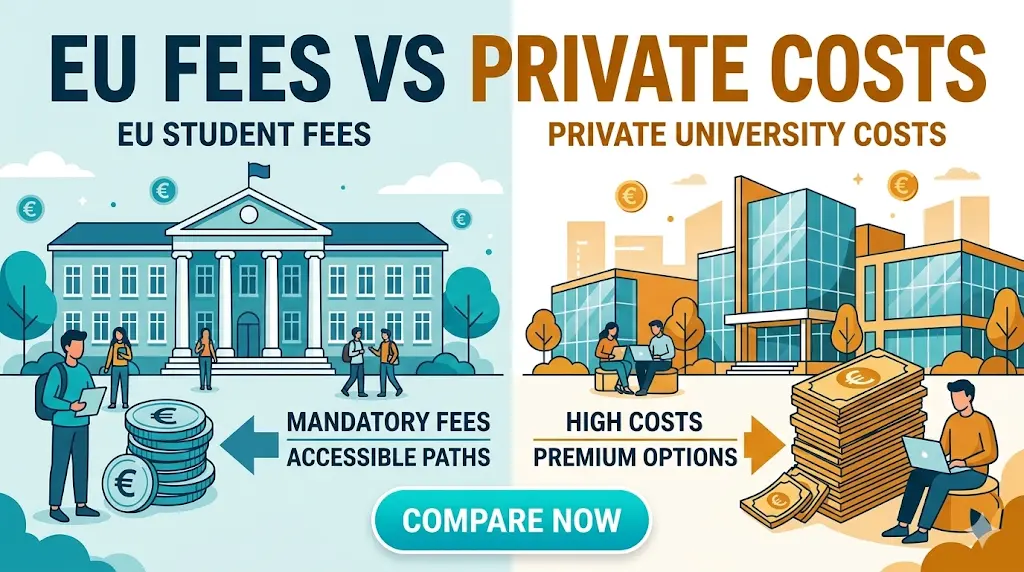
Navigating the financial landscape of Italian higher education requires understanding the sharp contrast between public university fees, which are often based on family income, and the fixed, higher premiums of private institutions. This guide breaks down those costs for 2026.
Disclosure: This post may contain affiliate links. We may earn a commission at no extra cost to you if you make a purchase through these links. Read full disclosure.
Understanding the Italian University Financial Landscape
Italy has long been a premier destination for international scholars, offering a unique blend of ancient academic tradition and modern innovation. However, for many students, the first major hurdle isn’t the entrance exam, but deciphering the complex web of tuition fees and administrative costs. The Italian higher education system is primarily split between public universities—supported by the state—and private universities, which operate independently.
Public universities in Italy charge regulated tuition fees that vary based on household income, typically calculated through the ISEE indicator. EU students generally pay the same rates as Italian students, making public education comparatively affordable. Annual fees often range from a few hundred to around three thousand euros, depending on income bracket and institution. Private universities set independent tuition rates that are significantly higher and not income based. Costs can range from approximately six thousand to over twenty thousand euros per year. While private institutions may offer scholarships, overall expenses are usually substantially greater than public alternatives.
For European Union (EU) citizens and residents, public universities offer a highly subsidized route to a degree, where “mandatory fees” are often scaled according to the student’s financial background. In contrast, private institutions, while offering specialized networks and modern facilities, carry a much higher price tag that remains relatively fixed regardless of income. Choosing between these paths requires a deep dive into your personal budget, career goals, and eligibility for financial aid. Before committing to a university, it is also essential to consider your long-term plan, such as Stay-Back Options: Working After Graduation in Italy, to ensure your investment pays off.
Mandatory Fees in Public Universities
Public universities in Italy (Università Statali) are the backbone of the country’s education system. They are generally much more affordable than their private counterparts because the Italian government heavily subsidizes the “cost per student.” However, “affordable” does not mean free, and there are several mandatory components to these fees.
The ISEE and Income-Based Tuition
The most distinctive feature of public university fees in Italy is the ISEE (Indicatore della Situazione Economica Equivalente). This is a calculation of a student’s family income and assets. Public universities use the ISEE Parificato for international students to determine which “tax bracket” or fee tier they fall into.
- Minimum Fees: Students with a low ISEE may pay as little as 156 EUR per year (representing basic regional taxes).
- Maximum Fees: Students at the top of the income scale or those who do not submit an ISEE usually pay between 2,500 EUR and 4,000 EUR per year.
Regional Tax for the Right to Study
Regardless of your tuition tier, every student in a public university must pay a mandatory regional tax (Tassa Regionale per il Diritto allo Studio). This fee typically ranges from 120 EUR to 160 EUR and goes toward funding regional scholarships, canteen subsidies, and student housing. This is a crucial part of Scholarships for International Students in Italy, as these regional bodies are the primary providers of need-based aid.
Fixed Administrative Fees
In addition to tuition and regional taxes, students are often charged small fixed fees for “bollo virtuale” (stamp duty) and insurance. These are usually negligible (around 16 EUR to 30 EUR) but are mandatory for enrollment to be considered legally valid.
Costs of Attending Private Universities
Private universities in Italy (Università Non Statali) operate under different financial rules. While they are still accredited by the Ministry of University and Research (MUR), they do not receive the same level of state subsidies as public institutions.
Fixed Tuition Rates
In private universities, tuition is rarely based on the ISEE. Instead, there is a set annual fee that applies to all students, though some institutions offer “early bird” discounts or merit-based reductions.
- Average Costs: Tuition at top private schools like Bocconi, LUISS, or Cattolica can range from 10,000 EUR to over 20,000 EUR per year.
- Specialized Master’s: If you are pursuing a professional degree, such as one of the MBA Programs in Italy: Best Business Schools, costs can climb significantly higher, sometimes reaching 35,000 EUR or more for a single year of study.
Additional Services and Facilities
The higher cost of private universities often covers services that are “extra” at public universities. This includes more intensive career counseling, better access to alumni networks, and modern on-campus facilities. However, students must still pay the mandatory regional tax (DSU tax) even at private institutions, as this is a legal requirement for all students in the Italian territory.
Comparing Public and Private University Costs
To help you decide which path fits your financial profile for the 2026 academic year, it is helpful to see the costs side-by-side.
| Expense Category | Public University (EU/ISEE) | Private University |
| Annual Tuition | 156 EUR – 4,000 EUR | 10,000 EUR – 25,000 EUR |
| Regional Tax | ~140 EUR (Mandatory) | ~140 EUR (Mandatory) |
| Application Fee | 30 EUR – 100 EUR | 100 EUR – 250 EUR |
| Health Insurance | Mandatory for non-EU | Mandatory for non-EU |
| Revenue Stamp | 16 EUR (Mandatory) | 16 EUR (Mandatory) |
| Career Services | Basic / Standard | Advanced / Premium |
Hidden Costs: Living Expenses and Materials
When comparing mandatory fees and tuition, many students forget to budget for the day-to-day costs of being a student in Italy. These “hidden” costs can sometimes outweigh the tuition itself, especially in expensive hubs like Milan or Rome.
Housing and Utilities
Accommodation is the largest variable. You will need to choose between university-owned dorms (which are subsidized for public university students with a low ISEE) and the private rental market. If you are struggling to decide, our guide on Student Housing: Dorms vs Private in Italy provides a detailed breakdown of what to expect in 2026. On average, a room in a shared apartment in Milan can cost 600 EUR to 800 EUR per month, plus utilities.
Books and Laboratory Fees
In some STEM and architecture programs at public universities, students are responsible for buying their own specialized materials and textbooks, which can add several hundred euros to the annual budget. Private universities sometimes include digital library access and course readers in their tuition, but this is not always a guarantee.
Financial Aid and Fee Waivers
Both public and private universities offer pathways to reduce the financial burden, though the criteria for each differ significantly.
Public University Waivers
The most common way to avoid mandatory public fees is through a DSU scholarship (Diritto allo Studio Universitario). If granted, this usually results in a full tuition waiver, a free meal per day at the university canteen, and a cash stipend. Enrollment in these programs often requires Recognizing a Foreign Diploma in Italy to ensure your previous studies are legally equivalent to the Italian standard required for the scholarship.
Private University Merit Scholarships
Private schools are more likely to offer “merit-based” rather than “need-based” aid. If you have an exceptional GPA or high scores on entrance exams (like the GMAT or GRE), you may be eligible for a 50% or 100% tuition discount. These are highly competitive and often require an early application.
Conclusion
The choice between the mandatory fee structure of a public university and the higher investment of a private university in Italy depends on your financial flexibility and your specific career trajectory. Public universities offer an incredibly inclusive, income-based model that makes a world-class degree accessible to almost anyone, provided they can navigate the bureaucracy of the ISEE.
Private universities, while significantly more expensive, offer a “fast-track” experience with premium networking and modern facilities. Regardless of the path you choose, understanding the full scope of tuition, regional taxes, and living expenses for 2026 is the key to a successful and stress-free academic journey in Italy.
References
Primary sources (official)
- Ministero dell’Università e della Ricerca (MUR): Official guidelines on university funding and student fee regulations. https://www.mur.gov.it/it
- Universitaly: The official government portal for international students to search for courses and fee structures. https://www.universitaly.it/
Other helpful sources
- Study in Italy (Ministero degli Affari Esteri): Detailed resources for international students regarding tuition and living costs. https://studyinitaly.esteri.it/en/Tuition-fees
Disclaimer
The information provided in this article is for general informational purposes only and does not constitute official legal or financial advice. University fees, regional taxes, and scholarship criteria in Italy are subject to change by the government and individual institutions. Always verify current costs and deadlines on the official website of your chosen university and the Ministry of University and Research before making financial commitments.