Long-Term Visa vs Schengen Visa: What Foreigners Should Know
Planning a trip or a permanent move to Europe can be confusing. This comprehensive guide breaks down the critical differences between a short-stay Schengen visa and a long-term National visa, helping you choose the right legal pathway for Italy.
Disclosure: This post may contain affiliate links. We may earn a commission at no extra cost to you if you make a purchase through these links. Read full disclosure.
Introduction to Long-Term Visa vs Schengen Visa
Italy is a founding member of the European Union and a participating state in the Schengen Agreement. This means its borders and visa regulations are intertwined with those of its European neighbors. However, while short-term tourism is heavily standardized across the entire Schengen Zone, long-term immigration remains strictly under the sovereign control of the Italian government.
Understanding whether you need a Schengen Visa or a National Long-Term Visa dictates everything from the paperwork you must submit to the rights you will hold once you step off the airplane. Are you allowed to work? Can you rent an apartment legally? Will you have access to the public healthcare system? The answers to all these questions depend entirely on the specific visa category stamped into your passport.
In this exhaustive guide, we will dissect the characteristics of both the Type C Schengen Visa and the Type D National Visa. We will explore their distinct purposes, limitations, application requirements, and the specific scenarios in which each is appropriate. Whether you are planning a summer backpacking trip across Europe or preparing to relocate your entire family to Rome, this article will serve as your definitive roadmap to Italian visa compliance.
Understanding the Schengen Visa Type C
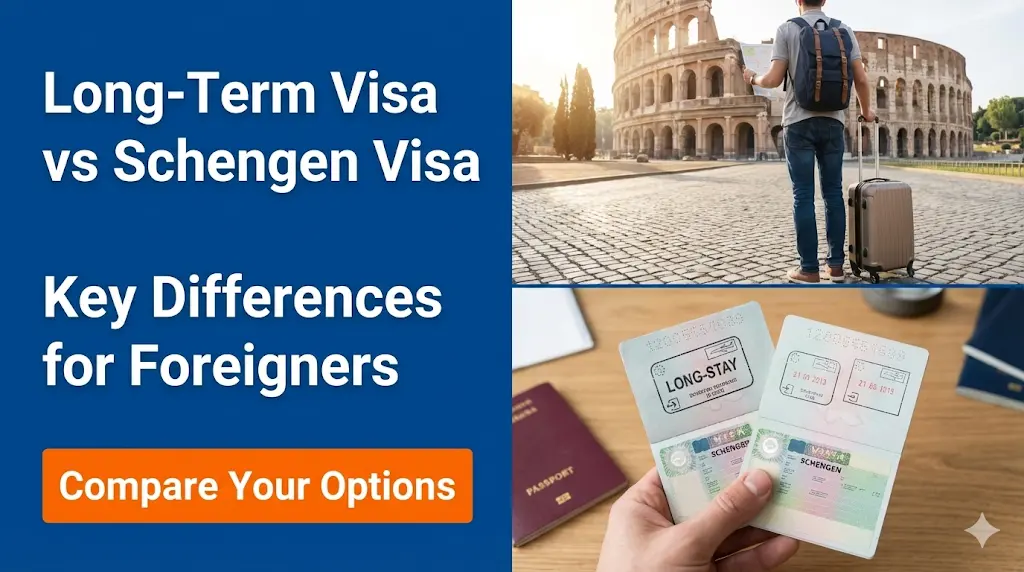
The Schengen Visa, officially known as the Uniform Short-Stay Visa or Type C Visa, is the most common entry document issued for travel to Europe. It is designed exclusively for temporary visits and is recognized by all member states of the Schengen Area.
The Schengen Area Explained
To understand the Type C visa, you must first understand the Schengen Area. This is a zone comprising 29 European countries that have officially abolished all passport and other types of border control at their mutual borders. The area functions as a single jurisdiction for international travel purposes, with a common visa policy. When you hold a valid Schengen Visa issued by Italy, you are generally free to travel to France, Germany, Spain, and other member states without needing separate visas or going through border checks.
The Ninety One Hundred and Eighty Day Rule
The defining characteristic of the Schengen Visa is its strict time limitation, universally known as the 90/180-day rule. This rule dictates that a non-European Union national cannot stay in the Schengen Area for more than 90 days within any rolling 180-day period.
This is a “rolling” window, which means that on any given day you are physically present in the Schengen Area, you must look backward exactly 180 days. If you have already spent 90 days in the zone during that specific timeframe, you must leave immediately. This rule applies regardless of whether you hold a physical Schengen Visa sticker in your passport or if you are from a visa-exempt country like the United States, Canada, Australia, or the United Kingdom. For a deeper dive into how tourists and business professionals utilize this travel authorization, you can review our Italy Schengen Visa Guide: Tourist and Business Travel.
Common Uses for a Schengen Visa
The Type C visa is strictly for non-immigrant purposes. The most common reasons foreign nationals apply for this visa include:
- Tourism and leisure travel.
- Visiting family members or friends residing in Italy.
- Attending business meetings, conferences, or corporate events.
- Participating in short-term cultural or sports events.
- Undergoing brief medical treatments or consultations.
- Enrolling in short language courses lasting less than three months.
Limitations of the Type C Visa
It is crucial to understand what the Schengen Visa does not allow you to do. Holding a Type C visa grants you zero residency rights in Italy. You are strictly prohibited from engaging in any form of gainful employment, whether it is working for an Italian company, taking a temporary job in a restaurant, or setting up a local business. You cannot register as a resident at the local town hall, you cannot enroll in the Italian National Health Service, and you generally cannot sign a long-term residential lease. It is purely a visitor’s pass.
Exploring the Long-Term National Visa Type D
If your intentions in Italy extend beyond a three-month vacation, you must step out of the Schengen framework and navigate Italian national immigration law. This is where the National Visa, or Type D Visa, comes into play.
The Purpose of a National Visa
The Type D visa is a long-stay visa that authorizes you to enter Italy with the explicit intention of establishing legal residency. Unlike the short-stay visa, which is standardized across Europe, the exact requirements, financial thresholds, and application procedures for a Type D visa are determined solely by the Italian government. It is issued for stays exceeding 90 days and up to one year (though it is indefinitely renewable from within Italy).
While a National Visa is issued by Italy, it still retains some Schengen benefits. A valid Type D visa allows you to transit through other Schengen countries to reach Italy, and once you have your Italian residence permit, you can travel to other Schengen countries for tourism purposes for up to 90 days within a 180-day period.
Common Categories of Long-Term Visas
Because the Type D visa covers anyone moving to Italy, it is divided into dozens of highly specific sub-categories based on your reason for relocating. Some of the most frequently issued long-term visas include:
- Study Visa: For students enrolled in full-time degree programs at Italian universities or long-term study abroad programs.
- Work Visa: For foreign nationals who have secured a job offer from an Italian employer. This pathway is heavily regulated by annual quotas known as the Decreto Flussi, or quota-exempt pathways like the EU Blue Card.
- Family Reunification Visa: For the spouses, minor children, and sometimes dependent parents of foreign nationals already legally residing in Italy or Italian citizens.
- Elective Residence Visa: Often referred to as the retirement visa, this is for individuals with high levels of passive income who wish to live in Italy without working.
- Digital Nomad Visa: A newly implemented pathway for highly skilled remote workers employed by foreign companies.
The Crucial Next Step The Residence Permit
Perhaps the most significant difference between the two visas is what happens after you arrive. A Type C Schengen Visa is the final document you need; you arrive, you visit, you leave. A Type D National Visa, however, is merely an entry ticket.
Under Italian law, anyone entering the country on a Type D visa must apply for a Permesso di Soggiorno (Residence Permit) within eight days of arriving in Italy. The visa gets you across the border, but the Permesso di Soggiorno is what gives you the legal right to stay, rent an apartment, open a bank account, and access healthcare. To fully grasp how this secondary administrative process works, we recommend reading our breakdown of What an Italian ‘Permesso di Soggiorno Allows You to Do.
Key Differences Between Type C and Type D Visas
To help you visualize the contrast between these two immigration pathways, we have compiled the essential data points into the following comparison table.
| Feature | Schengen Visa Type C | National Visa Type D |
| Primary Purpose | Short-term visits (Tourism, Business) | Long-term relocation (Work, Study, Family) |
| Maximum Duration | 90 days within any 180-day period | Valid for entry; allows stays over 90 days |
| Geographic Scope | Valid for the entire Schengen Area | Issued by Italy, for residency in Italy |
| Right to Work | Strictly prohibited | Allowed (depending on specific visa type) |
| Residence Permit Requirement | Not required | Mandatory (must apply within 8 days of entry) |
| Access to Public Healthcare | Emergency only (requires travel insurance) | Full access upon SSN registration |
| Processing Time | Usually 15 to 30 days | Varies widely; often several months |
Evaluating the Differences in Depth
Duration of Stay: The timeline constraint is the most rigid barrier. If your plans require you to stay in Italy for 91 days, the Schengen Visa is legally insufficient, and border agents will not grant exceptions for missed flights or extended sightseeing.
Right to Work or Study: The Type D visa is the only legal gateway to entering the Italian labor market or enrolling in a multi-year academic program. Even if you hold a Type D Elective Residence visa, your rights are restricted (the Elective Residence visa forbids work), highlighting that long-term visas are highly specialized.
Application Complexity and Processing Times: Obtaining a Type C visa is generally a matter of proving you have enough money for your trip, a return flight, and travel insurance. The application is reviewed relatively quickly. The Type D visa, however, is a major bureaucratic undertaking. It often requires background checks, translated and apostilled birth certificates, university transcripts, or labor authorizations (Nulla Osta) that can take several months to acquire before you can even book a consulate appointment.
Can You Convert a Schengen Visa into a Long-Term Visa?
One of the most frequently asked questions by foreign nationals is whether they can enter Italy as a tourist on a Schengen Visa (or visa-waiver) and simply convert that status into a long-term residency permit once they find a job, enroll in a school, or decide they want to stay.
The answer is overwhelmingly no.
Italian immigration law is incredibly strict regarding the conversion of short-term visitor status into long-term residency. The system is designed to prevent individuals from bypassing the rigorous background checks and quota systems associated with the Type D visa process in their home countries. If you enter Italy as a tourist, you are expected to leave as a tourist.
If you find an employer willing to hire you while you are vacationing in Rome, you cannot simply go to the local police station and ask for a work permit. You must return to your country of legal residence, have your prospective employer apply for your labor authorization in Italy, and then apply for a Type D work visa at the Italian consulate in your home country.
There are only a few exceedingly rare exceptions to this rule, primarily involving immediate family members of Italian or European Union citizens. If you are curious about these rare edge cases and the legal mechanisms involved, you can explore our specific guide on Converting a Schengen Visa to a Long-Stay Visa in Italy.
Choosing the Right Visa for Your Needs
Selecting the correct visa is a matter of aligning your travel goals with Italian legal frameworks. Here are a few common scenarios to help illustrate which visa is appropriate.
Scenario One The Tourist or Business Traveler
You are planning to spend the summer exploring the Amalfi Coast, attending a week-long corporate conference in Milan, and then visiting friends in France before returning home. Your total time in Europe will be 45 days.
- The Solution: You need a Type C Schengen Visa. Because your stay is well under the 90-day limit and you will not be engaged in local employment, the short-stay visa perfectly covers your itinerary. If you hold a passport from a visa-exempt country like the USA or UK, you do not even need to apply for a physical visa in advance; your passport grants you entry under Schengen rules.
Scenario Two The Prospective Student
You have been accepted into a Master’s degree program at the University of Bologna. The program lasts for two academic years. You plan to live in student housing and travel around Europe during your holiday breaks.
- The Solution: You must apply for a Type D National Student Visa. A Schengen visa is useless here, as your program exceeds 90 days. You will apply at the consulate in your home country, and upon arriving in Bologna, you will convert that Type D visa into a Student Residence Permit, which will allow you to live in Italy legally for the duration of your studies.
Scenario Three The Remote Worker or Expat
You are a freelance graphic designer who wants to spend six months living in a Tuscan villa to soak up the culture while continuing to work for your clients back home in Canada.
- The Solution: This is a tricky scenario that catches many people off guard. You cannot do this on a Schengen Visa, because six months is 180 days, far exceeding the 90-day limit. Furthermore, working remotely while on tourist status technically violates the terms of a Type C visa. You must apply for a Type D National Visa—specifically, the new Digital Nomad Visa or an Independent Work Visa—to legally reside and work remotely in Italy for that duration.
How to Apply Preparation and Best Practices
Whether you are applying for a short-term or long-term visa, the preparation process shares similar foundational steps. However, the level of scrutiny applied by the consulate will vary drastically.
Securing an Appointment
For both visa types, your journey begins with the Italian Consulate or Embassy that has jurisdiction over your permanent place of residence. Italy utilizes an online booking system called Prenot@mi. Appointments for Type D visas, in particular, are notoriously difficult to secure due to high demand. It is highly recommended to start checking for appointments at least three to four months before your intended departure date.
Gathering Required Documentation
For a Type C Schengen Visa, the documentation is fairly standard across all European consulates:
- A valid passport (valid for at least three months beyond your planned departure from the Schengen area).
- Round-trip flight itineraries.
- Proof of accommodation (hotel bookings or a letter of invitation from a host).
- Proof of sufficient financial means (recent bank statements).
For a Type D National Visa, the dossier is significantly heavier. Depending on the category, you will need to provide:
- Labor clearance documents (Nulla Osta) from the Italian immigration desk.
- University enrollment letters and proof of tuition payment.
- FBI or national police background checks, legally apostilled.
- Certified translations of vital records like marriage or birth certificates.
- Extensive proof of passive income (for retirement visas).
Ensuring your paperwork is flawless is the only way to succeed. A single missing translation can result in your application being rejected on the spot.
Securing Health Insurance Coverage
Health insurance is mandatory for both visas, but the requirements differ. For a Type C Schengen Visa, you simply need a travel insurance policy covering medical emergencies and repatriation with a minimum coverage of €30,000.
For a Type D National Visa, you must provide comprehensive health insurance that covers all risks for the first year of your stay, or until you are legally able to enroll in the Italian public healthcare system. The policy cannot have excessive deductibles or limits on standard care.
What Happens If You Overstay Your Visa?
The consequences of violating European immigration laws are severe and long-lasting. Whether you hold a Type C visa or a Type D visa that you failed to convert into a residence permit, remaining in Italy beyond your authorized period categorizes you as an undocumented migrant.
The Schengen Area utilizes sophisticated centralized databases, including the Schengen Information System (SIS), to track the entry and exit of foreign nationals. In the near future, the implementation of the biometric Entry/Exit System (EES) will automatically flag any passport that has overstayed the 90-day limit the moment it is scanned at a border checkpoint.
If you are caught overstaying, you face several immediate and future penalties:
- Heavy Fines: You can be fined thousands of euros upon exiting the country.
- Deportation: You may be detained and formally deported back to your home country.
- Entry Bans: The most damaging consequence is being issued an entry ban. This will prevent you from entering Italy—and by extension, the entire Schengen Area—for a period ranging from one to five years, or even longer in severe cases.
- Future Denials: A history of overstaying will remain on your immigration record, making it incredibly difficult to secure any future visas for Europe, the United States, the UK, or Canada.
Conclusion
The distinction between a Long-Term Type D Visa and a Short-Stay Type C Schengen Visa is the absolute foundation of European immigration law. While the Schengen Visa offers incredible freedom and flexibility for tourists and brief business visitors, it is an impenetrable dead end for anyone seeking to build a life in Italy. The National Visa, with all its bureaucratic hurdles and exhaustive documentation requirements, is the only legitimate pathway to true residency, allowing you to legally work, study, and integrate into Italian society.
By carefully evaluating your goals, calculating your intended duration of stay, and understanding the strict limitations against converting a tourist status into long-term residency, you can avoid the devastating consequences of visa violations. Successful immigration to Italy is never accidental; it is the result of meticulous planning, deep research, and choosing the right legal pathway long before you pack your bags.
References
Primary sources official
- European Commission EU Immigration Portal – Schengen Visa Information: https://home-affairs.ec.europa.eu/policies/schengen-borders-and-visa/visa-policy_en
- Ministero degli Affari Esteri e della Cooperazione Internazionale (Ministry of Foreign Affairs) – Visto per l’Italia Portal: https://vistoperitalia.esteri.it
Other helpful sources
- Schengen Visa Info – Types of Schengen Visas: https://www.schengenvisainfo.com/schengen-visa-types/
- Mazzeschi Corporate Immigration – Italian Visas and Permits: https://www.mazzeschi.it
Disclaimer
The information provided in this article is for educational and informational purposes only and does not constitute official legal or immigration advice. Visa regulations, application requirements, and border control policies in Italy and the wider Schengen Area are subject to frequent changes. Always consult the official websites of the Italian Ministry of Foreign Affairs, your local Italian consulate, or a certified immigration attorney for the most current and personalized guidance regarding your specific travel or relocation plans.