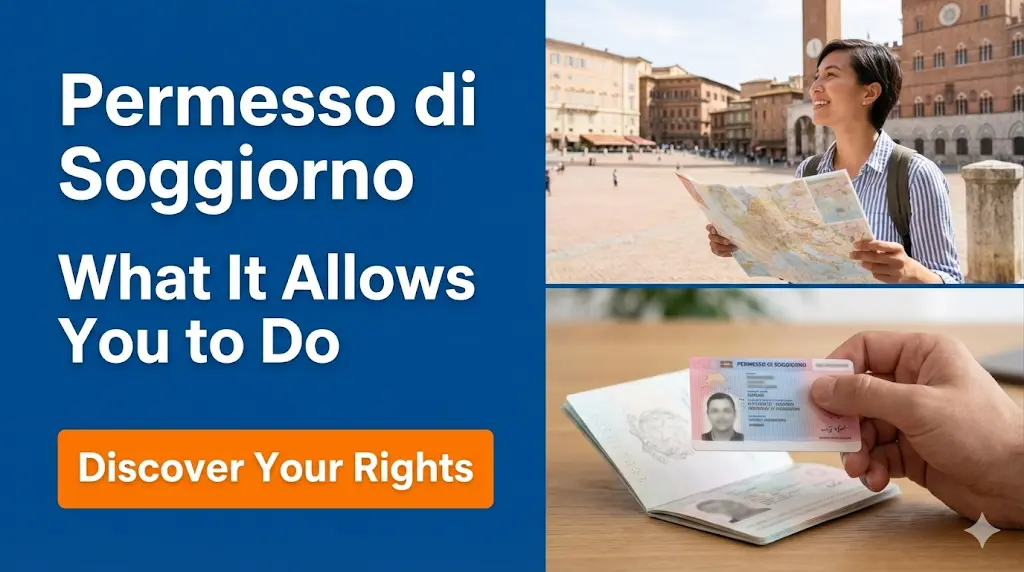
What an Italian ‘Permesso di Soggiorno’ Allows You to Do
Discover exactly what an Italian Permesso di Soggiorno allows you to do. From unlocking Schengen travel and public healthcare to securing employment and setting up a bank account, learn how this vital document transforms your legal status and daily life in Italy.
Disclosure: This post may contain affiliate links. We may earn a commission at no extra cost to you if you make a purchase through these links. Read full disclosure.
Introduction to Italian ‘Permesso di Soggiorno’
Moving to Italy is an exciting adventure, but getting past the initial visa stage is just the beginning of your bureaucratic journey. If you are a non-EU citizen planning to stay in Italy for more than 90 days, you are legally required to obtain a Permesso di Soggiorno—the official Italian residence permit. While your initial visa acts as the key that unlocks the door to Italy, the residence permit is what actually allows you to step inside, unpack your bags, and build a daily life.
But what exactly does this plastic card (or paper document, in some specific cases) actually entitle you to do? A common misconception among new expats is that all residence permits are created equal, or that simply holding one grants you absolute freedom in Italy. In reality, the rights, privileges, and obligations tied to your Permesso di Soggiorno are heavily dependent on the specific category of your permit.
In this comprehensive guide, we will explore the extensive rights granted to residence permit holders. We will cover everything from your ability to travel freely across Europe and access Italy’s excellent public healthcare system, to your rights regarding employment, education, and long-term financial planning. Understanding these allowances is critical for successfully integrating into Italian society and avoiding accidental violations of your immigration status.
The Core Right: Legal Residency and Long-Term Stay
The most fundamental right granted by the Permesso di Soggiorno is the authorization to legally reside on Italian soil beyond the standard 90-day tourist limit. Without this document, your presence in Italy becomes illegal once your entry visa or visa-free Schengen allowance expires.
- The 8-Day Rule: By law, you must apply for your residence permit within eight working days of arriving in Italy. Once you submit your application (usually via a “Kit Giallo” at the post office), you receive a postal receipt (ricevuta). This receipt is legally binding and protects your right to stay in Italy while your physical card is being processed.
- Duration of Stay: The permit allows you to live in Italy for the duration specified on the card, which typically ranges from six months to two years, depending on your visa type. For example, student permits are usually issued for one year, while work or investor permits might be issued for two years.
- The Integration Agreement: If you are applying for a residence permit of one year or more for the first time, you will generally be asked to sign an Integration Agreement (Accordo di Integrazione). This grants you the right to access free civic and language courses, but it also obligates you to achieve specific integration goals (like reaching a basic level of Italian) to maintain your residency rights.
For a broader understanding of how this document fits into the overall immigration framework, you can read our foundational article: Italian Residence Permit (Permesso di Soggiorno) Explained.
Travel Freedom: Exploring the Schengen Area and Beyond
One of the most celebrated perks of holding an Italian residence permit is the travel mobility it provides. Italy is a member of the Schengen Area, and holding a valid Italian Permesso di Soggiorno acts as a powerful travel document.
- Visa-Free Schengen Travel: With a valid residence permit card and your passport, you are legally allowed to travel to any other country within the Schengen Area without applying for a separate tourist visa. You can travel for leisure or business for up to 90 days within any 180-day period.
- Exiting and Entering Italy: You can freely leave and re-enter Italy multiple times during the validity of your permit. You are not confined to the Italian borders.
- Traveling with the Receipt (Ricevuta): This is where the rules become incredibly strict. If your permit is expiring and you have applied for a renewal, you will be traveling on your postal receipt. With a renewal receipt, you can leave Italy and travel to your home country, but you must take a direct flight. You are strictly prohibited from transiting through other Schengen countries (e.g., you cannot have a layover in Germany or France) while traveling on a receipt. If it is your first residence permit application (meaning you only have the first issuance receipt), you generally cannot travel outside of Italy at all until the physical card is issued, unless your original entry visa (Type D, multiple entry) is still valid.
Employment and Education Rights
Does your Permesso di Soggiorno allow you to work? The answer is: it depends entirely on the reason the permit was issued.
- Work Permits (Lavoro Subordinato/Autonomo): If you hold a permit for subordinate work or self-employment, you have full access to the Italian labor market. You can be hired by an Italian company, start a business, or work as a freelancer (provided you open a Partita IVA). You are also protected by Italian labor laws, meaning you have the right to fair wages, paid leave, and severance pay.
- Family Permits (Motivi Familiari): If you obtained your permit through family reunification (e.g., you are the spouse of an Italian citizen or a legal foreign resident), you are granted unrestricted rights to work and study in Italy. You do not need to convert your permit to a work permit if you find a job.
- Student Permits (Motivi di Studio): The Italian student residence permit is highly generous. It allows you to study full-time at your university, but it also grants you the right to work part-time. Students are legally allowed to work up to 20 hours per week, with a maximum limit of 1,040 hours per year. Furthermore, upon graduation, you have the right to convert your student permit into a work permit or a “job search” permit valid for one year.
- Elective Residence Permits (Residenza Elettiva): This permit, often used by retirees, explicitly forbids any form of gainful employment in Italy. You are allowed to live in Italy based on your passive income from abroad, but you cannot take a local job or run an active business.
Accessing the Italian National Health Service (SSN)
Healthcare is a primary concern for any expat, and your residence permit is your gateway to the Servizio Sanitario Nazionale (SSN), Italy’s public healthcare system.
- Mandatory Enrollment: If you hold a permit for work or family reasons, you have the right—and the obligation—to register for the SSN. Registration is usually free, and it grants you a Tessera Sanitaria (Health Card). This card provides you with a primary care physician (Medico di Base), heavily subsidized specialist visits, free hospital care, and discounted prescription medications.
- Voluntary Enrollment: If you hold a student permit or an Elective Residence permit, you are not automatically enrolled in the free public system. However, your Permesso di Soggiorno grants you the right to voluntarily “buy into” the SSN by paying an annual flat fee. This is often far more comprehensive and cost-effective than maintaining private health insurance.
- The EHIC Card: Once you are registered with the SSN and hold a Tessera Sanitaria, the back of your card functions as the European Health Insurance Card (EHIC). This grants you the right to access emergency public healthcare in any other European Union country during temporary visits.
To learn the exact step-by-step process for getting your health card, review our detailed guide on How to Register for Italian Healthcare (SSN) as a Foreigner.
Financial and Administrative Rights
Having a legal residence permit is the key that unlocks almost all administrative functions in everyday Italian life. Without it, you are effectively a tourist with no local footprint.
- Registering Your Residency (Iscrizione Anagrafica): Holding a Permesso di Soggiorno gives you the right to go to your local Town Hall (Comune) and officially register your residence. This enters you into the local population registry (Anagrafe).
- Obtaining a Carta d’Identità: Once registered at the Comune, you have the right to apply for an Italian Identity Card (Carta d’Identità Elettronica or CIE). This serves as your primary domestic ID, meaning you no longer need to carry your passport for domestic flights or official transactions.
- Opening a Resident Bank Account: While tourists can only open restrictive “non-resident” accounts, holding a Permesso di Soggiorno allows you to open a fully functional Italian resident bank account. This is essential for receiving a salary, setting up direct debits for utilities, and managing your finances efficiently.
- Signing Leases and Buying Property: Landlords are legally required to verify that non-EU tenants have a valid Permesso di Soggiorno before signing a long-term rental contract (such as a 4+4 or 3+2 lease). Similarly, while foreigners can buy property under certain treaties, having a residence permit simplifies the notary process, allows you to claim “first home” (prima casa) tax benefits, and enables you to secure an Italian mortgage.
- Obtaining a Codice Fiscale: While you can get a temporary tax code from the embassy, your residence permit solidifies your status, allowing you to link your Codice Fiscale to your permanent Italian address, which is required for employment and taxation.
If you are struggling with the local registry office, our post on Navigating Italian Bureaucracy: Comune and Prefettura breaks down the exact documents you need to bring.
Social Welfare and Civic Participation
Depending on your specific permit and how long you have lived in Italy, you may also gain access to the country’s social safety net.
- Access to Bonuses and Subsidies: Long-term residents with valid work or family permits have the right to apply for various social benefits provided by the INPS (the national social security institute). This can include maternity benefits, family allowances (Assegno Unico), and even unemployment benefits (NASpI) if you lose your job after paying sufficient contributions.
- Public Education: Your residence permit grants your children the absolute right to enroll in the Italian public school system, from kindergarten through high school, completely free of charge. This right applies regardless of the type of permit you hold.
- Civic Participation: While you cannot vote in national political elections (which requires citizenship), some municipalities allow long-term residence permit holders to participate in local public life, such as voting in specific local referendums or running for advisory councils representing foreign residents.
The Pathway to Permanent Residency and Citizenship
Your temporary Permesso di Soggiorno is the stepping stone to permanent rights in Italy and the European Union.
- The 5-Year Milestone: If you legally and continuously reside in Italy for five years on eligible permits (such as work or family, but not standard study permits), you earn the right to apply for the EU Long-Term Residence Permit (Permesso di Soggiorno UE per Soggiornanti di Lungo Periodo). This permanent card does not expire (it merely needs a photo update every 10 years). To obtain it, you must prove you have a stable income exceeding the annual social allowance (about €7,101 for a single person in 2026), adequate housing, and an A2 level of Italian proficiency. This card grants you almost equal rights to Italian citizens in the labor market and allows you to work in other EU countries under certain conditions.
- The 10-Year Milestone: After ten years of continuous legal residency with your Permesso di Soggiorno, non-EU citizens have the right to apply for Italian citizenship through naturalization. (This timeline is reduced to four years for EU citizens and three years for those with Italian grandparents).
Obligations and Restrictions to Keep in Mind
Rights always come with responsibilities. Failing to adhere to the rules governing your permit can result in it being revoked.
- Continuous Absence Rules: You do not have the right to leave Italy for extended periods while holding a temporary permit. By law, if your permit is valid for less than two years, you cannot be absent from Italy for more than six consecutive months. If your permit is valid for two years or more, you cannot be absent for a continuous period exceeding half the length of the permit (e.g., 12 months for a 2-year permit). Violating this rule will result in the authorities refusing to renew your card.
- For Permanent Residents: If you are working towards the 5-year EU Long-Term permit, your absences are even strictly scrutinized. Over the 5-year qualifying period, you cannot be outside of Italy for more than 6 consecutive months, or more than 10 months in total across the entire five years.
- The Renewal Obligation: You have the strict obligation to apply for the renewal of your permit. The law requires you to submit your renewal application via the post office at least 60 days before the expiration date printed on the card.
- Address Updates: You are legally required to inform the Questura (Police Headquarters) and the Comune within 15 days if you move to a new residential address.
Summary of Permit Types and Primary Rights
To help you quickly identify what you can and cannot do, here is a breakdown of the most common permits and their associated rights.
| Permit Type | Right to Work in Italy? | Right to Free Public Healthcare (SSN)? | Pathway to Permanent Residency? |
| Lavoro Subordinato (Employed Work) | Yes, unlimited | Yes, mandatory & free | Yes |
| Motivi Familiari (Family Reasons) | Yes, unlimited | Yes, mandatory & free | Yes |
| Motivi di Studio (Study) | Yes, part-time (20 hours/week) | No, but voluntary buy-in allowed | No, must convert to work permit first |
| Residenza Elettiva (Retirement) | No, strictly prohibited | No, but voluntary buy-in allowed | Yes |
| Lavoro Autonomo (Self-Employed) | Yes, unlimited | Yes, mandatory & free | Yes |
| Digital Nomad Visa (Remote Work) | Yes, strictly remote/freelance | Varies, private insurance often required | Yes |
Conclusion
The Italian Permesso di Soggiorno is far more than a simple immigration stamp; it is the foundational document of your life as an expat. It is the key that transforms you from a passing visitor into a legally recognized resident with access to Europe’s borders, Italy’s robust healthcare system, and the vibrant local economy.
Understanding exactly what your specific permit allows you to do—and just as importantly, what it prohibits—is the secret to a stress-free life in Italy. By respecting the absence limitations, renewing on time, and leveraging your rights to healthcare and banking, you can fully embrace the local lifestyle with absolute peace of mind, knowing your legal footing is secure.
References
Primary sources (official)
- European Commission EU Immigration Portal – Entry Conditions for Italy: https://home-affairs.ec.europa.eu/policies/migration-and-asylum/eu-immigration-portal/student-italy_en
- University of Turin – Residence permit and stay requirements: https://en.unito.it/living-turin/when-you-arrive/residence-permit-and-stay-requirements
Other helpful sources
- Idealista – Italy residence permit guide: https://www.idealista.it/en/news/legal-advice-in-italy/2026/02/17/321022-italy-residence-permit-guide-understanding-the-permesso-di-soggiorno
- Refugee.info Italy – Your right to travel: https://italy.refugee.info/hc/articles/5388934101399-Your-right-to-travel
Disclaimer
The information provided in this article is for educational and informational purposes only and does not constitute official legal or immigration advice. Immigration laws and administrative procedures in Italy are subject to frequent changes. Always consult the official websites of the Italian Ministry of the Interior, your local Questura, or a certified immigration attorney for the most current and personalized guidance regarding your specific residency situation.