International Academic Conferences in Italy: List
Finding and registering for academic conferences in Italy often feels like chasing ghosts through outdated university portals. I once missed a major submission deadline in Rome simply because the English version of the university website hadn’t been updated in six months. This guide outlines the top international academic conferences across Italy and how to successfully navigate the local registration bureaucracy.
Disclosure: This post may contain affiliate links. We may earn a commission at no extra cost to you if you make a purchase through these links. Read full disclosure.
The Reality of Navigating the Italian Academic Conference Circuit
Deciphering University Portals and Calls for Papers
The Italian academic ecosystem is deeply decentralized. Unlike North America or the UK, where major academic symposiums are usually aggressively marketed months in advance through streamlined, centralized portals, Italy relies heavily on fragmented, university-specific networks. If you are an expat researcher or a visiting scholar trying to find an upcoming Call for Papers (CFP), you will quickly realize that the most prestigious symposiums are often buried on the fourth page of a regional university department’s website.
Furthermore, you cannot rely entirely on English translations. Italian universities are notorious for updating the Italian versions of their web pages while leaving the English translations languishing for months. This creates a massive informational disadvantage for international scholars. I highly recommend using ItalianPod101 to build a solid foundation in academic Italian reading comprehension. Being able to read a CFP in its original Italian ensures you are seeing the absolute most up-to-date deadlines, submission formatting rules, and peer-review requirements without having to wait for the administration to eventually post the English translation.
When you do find a conference that aligns with your research, submitting your abstract often requires navigating localized submission portals that demand excessive documentation. Italian academia is famously bureaucratic. You may be asked to provide your entire academic history just to submit a 300-word abstract. If you are already dealing with the overarching stress of relocating for your research, maintaining a pristine, organized dossier of your academic background is vital. Reviewing the Student transcript requirements for Italy student visa will give you a perfect baseline of the types of legalized, officially translated documents you should keep on hand for these rigorous academic registrations.
The Hidden Bureaucracy of Conference Registration
Once your paper is accepted, the battle shifts from academic rigor to financial bureaucracy. Registering and paying the conference fee in Italy is rarely as simple as clicking a checkout button with a credit card. Many public Italian universities use the PagoPA system, a centralized electronic payment system utilized by the Italian public administration. If you do not have an Italian bank account or a fiscal code (Codice Fiscale), navigating PagoPA as an international attendee can be an absolute nightmare of error messages and rejected foreign cards.
If you are an expat already living and researching in Italy, you must ensure your administrative profile is flawless before conference season begins. You will likely need to request funding or reimbursement from your host institution, which requires generating specific electronic invoices (fatturazione elettronica). Dealing with university administrative clerks (the Segreteria) to process these reimbursements requires immense patience and a very specific, highly formal tone. Using ItalianPod101 to master formal email etiquette allows you to politely but firmly follow up with the accounting department, ensuring your conference travel grants are processed before the fiscal year ends.
Additionally, if you are presenting on behalf of a local Italian university, your legal residency status must be perfectly maintained to receive your stipends. Before the busy spring conference season begins, make sure you have reviewed Timelines for picking up your permesso di soggiorno in Italy to ensure your physical residency card is valid and in your pocket before you travel across the country for your symposium.
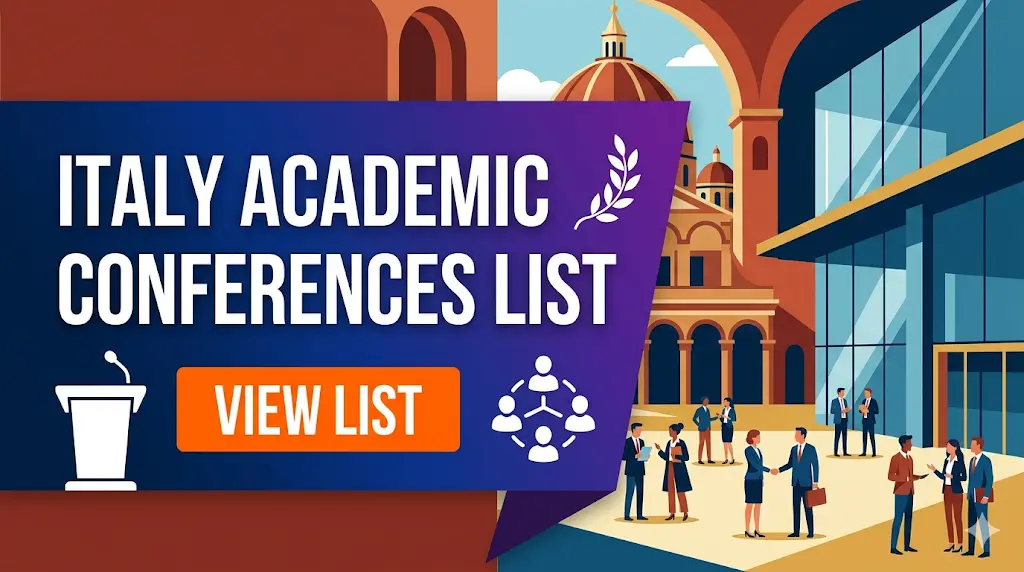
Top International Academic Conferences in Italy by Discipline
Technology, Engineering, and Hard Sciences
Italy’s northern regions, particularly Milan, Turin, and Bologna, serve as the undisputed heavyweight champions of technology and hard science conferences. Milan frequently hosts massive international symposiums sponsored by global organizations like the IEEE (Institute of Electrical and Electronics Engineers) and the ACM (Association for Computing Machinery). In 2026, for example, Milan will host major events like the International Conference on Mechanical Engineering and Robotics Research (ICMERR) and the International Conference on Power Electronics and Control Engineering (PECE).
Turin is historically the industrial heart of Italy and naturally attracts conferences focused on aerospace, automotive engineering, and advanced manufacturing. Bologna, home to the massive Leonardo supercomputer, has rebranded itself as Italy’s “Data Valley,” hosting highly specialized academic gatherings centered on Artificial Intelligence, machine learning, and big data architecture.
Because these hard-science conferences are outward-facing and highly international, the primary language of presentation is almost exclusively English. However, the networking events, the coffee breaks, and the post-conference dinners are where the actual collaborative partnerships are forged, and those interactions heavily favor Italian. Brushing up on industry-specific vocabulary with ItalianPod101 will allow you to confidently transition from delivering your English presentation into a casual, native-language networking conversation with senior Italian engineers, making you far more memorable to potential research partners.
Humanities, Arts, and Social Sciences
If your research falls into the humanities, arts, history, or social sciences, you will likely find yourself traveling to the historic centers of Rome, Florence, and Venice. These cities are living museums, making them the perfect, inspiring backdrops for disciplines focused on human culture. Rome hosts massive events like the World Conference on Social Sciences Studies and the International Conference on Art Studies, often utilizing the historic campuses of Sapienza University or private international hubs like John Cabot University.
Florence is the global epicenter for Renaissance studies, frequently hosting specialized symposiums backed by prestigious international research institutes like Villa I Tatti (The Harvard University Center for Italian Renaissance Studies). Venice, leveraging its connection to the Biennale, is a hotspot for contemporary art theory, architecture, and environmental humanities conferences focused on coastal preservation.
The humanities circuit in Italy is deeply intellectual and inherently traditional. The academic hierarchy is strictly enforced, and addressing a senior researcher casually can be seen as a severe breach of professional etiquette. I utilized the cultural modules on ItalianPod101 to learn the exact nuances of formal Italian titles (Chiarissimo Professore, Dottore). Knowing how to properly address a session chair during the Q&A segment of a humanities panel projects respect and instantly legitimizes your presence in the deeply traditional Italian academic sphere.
Medical, Healthcare, and Biotechnology
Italy boasts a world-class public healthcare system and a massive pharmaceutical and biotechnology manufacturing sector, making it a prime destination for global medical congresses. Milan and Rome are the primary hosts for these massive events, with Milan frequently hosting the Global Health & Medical Expo alongside highly specialized summits like the International Conference on Biomedical Engineering and Biotechnology (ICBEB).
These medical conferences are incredibly high-stakes, often drawing thousands of delegates, pharmaceutical representatives, and top-tier clinical researchers from around the globe. Because the medical field in Italy is so heavily regulated by the state, discussions often veer into the complexities of European health policy and Italian regional health administration. If you are an expat researcher working within the Italian medical system, understanding the local context is vital. I recommend reviewing our guide on Finding Doctors and Hospitals in Italy to grasp how the clinical infrastructure actually operates on the ground, which will provide immense context when you attend policy-heavy public health seminars.
Practical Strategies for Expat Researchers and Attendees
Managing Visas and Administrative Hurdles
If you are an expat currently residing in Italy with a valid Permesso di Soggiorno, traveling domestically to attend a conference in Naples or Florence is wonderfully simple. However, if you are a researcher based outside the Schengen Area trying to enter Italy specifically to present your paper, you face a significant bureaucratic hurdle.
You must secure a short-stay Schengen Visa (Type C) for scientific research or tourism. To get this visa, you absolutely must request a formal, stamped Letter of Invitation from the Italian university hosting the conference. Without this specific letter, your visa application will likely be rejected. If you are coordinating travel for international colleagues, point them toward How Italy handles visa applications for Indian citizens to understand the strict consular requirements and timeline delays they might face. Furthermore, as border policies evolve, it is vital to track new electronic entry requirements; reviewing Italy’s ETIAS implementation date and what travelers need ensures you aren’t turned away at the airport for missing a simple digital pre-authorization.
If you are an expat researcher already living in Italy, you must also be mindful of your own administrative duties. If you move to a new city to accept a post-doctoral fellowship after meeting a colleague at a conference, you cannot just pack your bags and go. You must legally update your residency status. Read our guide on How to change your address with the Questura in Italy to ensure your immigration file follows you safely to your new academic home. Furthermore, if you are in Italy accompanying a spouse who is the primary researcher, understanding the Conditions for working while on Italy Family Reunification Visa is essential if you plan to accept a paid speaking gig or a short-term conference coordination contract.
Mastering Conference Networking and Cultural Etiquette
Attending an academic conference in Italy is not just about reading your paper; it is a complex performance of La Bella Figura—the Italian concept of making a good, polished impression. Academic events in Italy are distinctly formal. While American tech conferences might welcome jeans and hoodies, Italian academic symposiums require sharp, tailored business attire. Showing up underdressed instantly signals that you do not take the event, or the hosting institution, seriously.
The most critical networking at an Italian conference does not happen during the panel sessions; it happens during the pausa caffè (coffee break) and the aperitivo (pre-dinner drinks). You must be aggressive but polite during these breaks. Italian academics naturally cluster together and speak rapidly in their native tongue. If you stand awkwardly in the corner waiting for someone to switch to English, you will be ignored.
This is where your language preparation truly pays off. I used the conversational icebreaker lessons from ItalianPod101 to confidently approach groups of Italian researchers at the coffee bar. Knowing how to politely interrupt, introduce your research focus in Italian, and make small talk about the host city’s architecture bridges the cultural divide effortlessly. Even if the conversation eventually switches back to English for complex technical discussions, initiating the interaction in Italian proves your cultural dedication and makes you an incredibly memorable networking contact.
If you are planning an extended stay in Italy to conduct field research after the conference concludes, ensuring your personal logistics are flawless is just as important as your academic prep. I highly recommend running through a comprehensive Checklist: All You Need Before Moving to Italy to guarantee you haven’t overlooked hidden tax implications, housing contracts, or local banking requirements that could derail your research trip. Additionally, if you plan to leverage your conference connections into opening a private academic consultancy, you must understand the steep financial barriers involved; reviewing Acceptable financial proof for Italy self-employment visa will give you a sobering look at the fiscal realities of striking out on your own in the Italian market.
Recurring Major Academic Conferences in Italy
| Conference Name / Focus | Typical Host City | General Timing | Academic Discipline |
| ICBEB (Biomedical Eng. & Biotech) | Rome / Milan | Spring (April/May) | Healthcare, Medical Tech |
| XR SALENTO (eXtended Reality) | Otranto | Summer (June/July) | Computer Science, VR/AR |
| World Conference on Social Sciences | Rome | Spring (May) | Sociology, Humanities |
| IEEE Real Time Conference | Various (e.g., La Biodola) | Spring/Summer | Electrical Engineering, Physics |
| Europe Universities Summit (THE) | Milan | Spring (May) | Higher Education Policy |
References
Primary sources (official)
- Ministero dell’Università e della Ricerca (MUR) – https://www.mur.gov.it/it
- European University Institute (EUI) – Academic Events and Seminars – https://www.eui.eu/
- John Cabot University – Academic Events Calendar – https://calendar.johncabot.edu/
Other helpful sources
- Conferences Daily – Italy Academic Conference Directory – https://conferencesdaily.com/conferences/italy
- European Law Blog – Academic Calendar and Calls for Papers – https://www.europeanlawblog.eu/academic-calendar
Disclaimer
The information provided in this article is for educational and informational purposes only and does not constitute official academic, legal, or immigration advice. Academic conference schedules, Call for Papers (CFP) deadlines, and specific Schengen visa requirements for international researchers are highly dynamic and subject to frequent changes by the hosting universities and the Italian Ministry of Foreign Affairs. Always verify conference dates, submission guidelines, and entry requirements directly through the official symposium portals and your local Italian consulate before making any travel arrangements or paying registration fees.