Conditions for working while on Italy Family Reunification Visa
Arriving in Italy as a dependent spouse often feels like a sudden loss of professional identity, leaving you terrified about your legal right to earn an income. I spent my first months in Rome rejecting local freelance gigs because I falsely assumed working would violate my family visa. This guide clarifies the exact conditions, rights, and limitations for working while holding an Italian Family Reunification Visa.
Disclosure: This post may contain affiliate links. We may earn a commission at no extra cost to you if you make a purchase through these links. Read full disclosure.
The Legal Right to Work: Fact vs Fiction
Unrestricted Access to the Italian Labor Market
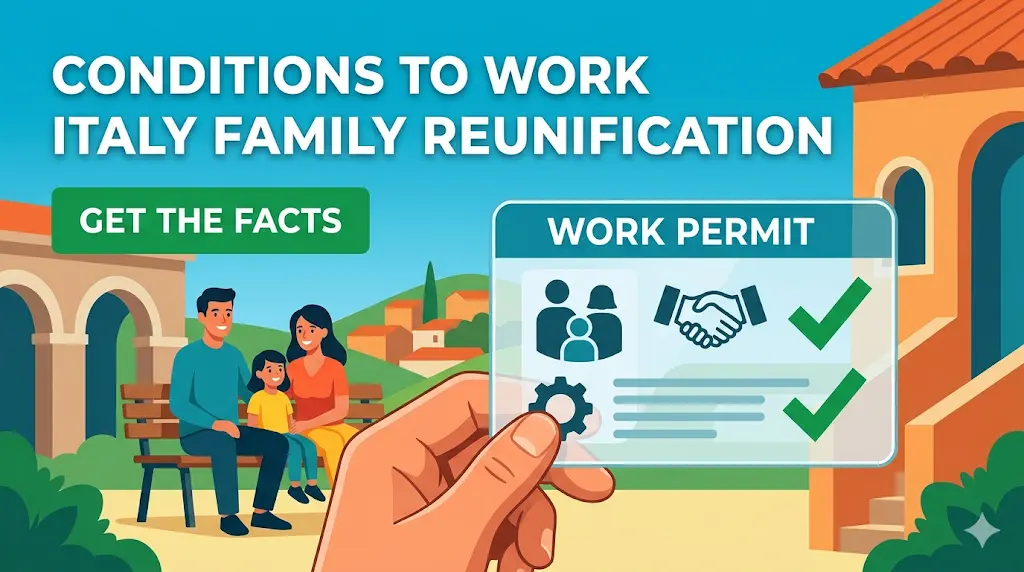
The single greatest misconception among expats is that a family visa strictly binds you to the home as a financial dependent. This is entirely false. Under Italian immigration law, specifically the Consolidated Immigration Act (Testo Unico sull’Immigrazione), holding a Permesso di Soggiorno per Motivi Familiari (Residence Permit for Family Reasons) grants you the immediate, legal right to work in Italy.
The reality is that a family visa is often much more powerful than a standard work visa. Most non-EU foreigners attempting to enter the Italian labor market must battle the incredibly restrictive annual quota system. This quota dictates exactly how many foreigners can be hired from abroad each year, a chaotic bottleneck heavily detailed in Understanding the Decreto Flussi in Italy. Because you are already legally residing in Italy under the sponsorship of your family member, you completely bypass this quota system. You do not need the government’s permission to be hired, and an employer does not need to apply for a special security clearance (Nulla Osta) to offer you a job. You can be hired exactly like an Italian citizen.
Subordinate Employment vs Freelancing
Your family permit allows for incredible professional flexibility. You are legally permitted to accept subordinate employment (lavoro subordinato). This means you can sign a standard, full-time or part-time contract with an Italian company. When you attend job interviews, Italian Human Resources departments might initially be confused by your permit, as many assume they must sponsor you. You must confidently explain that your motivi familiari permit grants you unrestricted hiring rights. Navigating these local HR expectations and understanding your employment rights is crucial, a reality we explore deeply in Types of Italian Employment Contracts Contratti di Lavoro.
Alternatively, your family permit also grants you the right to work autonomously (lavoro autonomo). If you want to start your own consulting business, open a retail shop, or work as a digital freelancer, you are legally permitted to open an Italian tax number (Partita IVA).
While foreigners applying directly from abroad face massive hurdles to secure a self-employment visa, you can launch a business tomorrow simply because you hold a family permit. If you plan to pursue freelancing, understanding the associated tax brackets and invoicing rules is paramount. You can review these complex local structures in Italian Self-Employment Visa Partita IVA Requirements.
The Limitations: Visa Dependency and Mobility
Tied to Your Sponsor’s Timeline
While the family permit grants you incredible professional freedom, it comes with a terrifying catch: your legal status is entirely dependent on your primary sponsor. The duration of your Permesso di Soggiorno per Motivi Familiari is inextricably linked to the duration of your spouse’s (or parent’s) permit.
If your spouse holds a two-year corporate transfer permit, your family permit will also expire in exactly two years. If your spouse loses their job and their work permit is revoked, your family permit becomes instantly invalid, regardless of whether you are currently employed in a high-paying job. Similarly, if your marriage ends in divorce or legal separation, your right to remain in Italy under the family reunification pathway dissolves. You must be hyper-vigilant about tracking the expiration dates of the primary sponsor’s paperwork, as falling out of status while Renewing Your Italian Permesso di Soggiorno can result in immediate termination by your Italian employer and potential deportation.
Geographic Restrictions Across the EU
Another massive limitation is geographic. Expats frequently assume that an Italian residence permit allows them to live and work anywhere within the European Union. This is a dangerous myth.
Your Italian family permit grants you the right to work strictly within the borders of the Italian Republic. You cannot use this permit to accept a job based in Germany, France, or Spain. While you are free to travel across the borderless Schengen Zone for tourism (up to 90 days out of any 180-day period), the moment you engage in remunerated labor on foreign European soil without a local work visa, you are violating international immigration law.
Converting to an Independent Work Permit
Because the dependency on your sponsor creates a fragile legal foundation, Italian law offers a critical safety net. If you secure a stable, long-term employment contract, or if you establish a successful freelance business, you have the legal right to convert your family permit into an independent work permit (conversione del permesso di soggiorno).
Converting your permit severs your immigration tie to your spouse. If your marriage subsequently ends, or if your spouse decides to leave Italy, you will retain your own independent legal right to remain in the country based on your own employment. Execuring this conversion requires immaculate paperwork and timing, a process that mirrors the strict requirements found when Converting a Student Visa to a Work Visa in Italy.
Bureaucratic Steps to Start Working
Securing Your Codice Fiscale and Anagrafe
Before you can legally sign an employment contract or open a Partita IVA, you must have your foundational Italian bureaucracy in order. The absolute first requirement is your Codice Fiscale (tax identification code). You cannot be added to an Italian payroll system without this unique alphanumeric identifier. If you did not receive this code from the consulate before arriving, or if you are unsure if it is fully activated, you must urgently resolve this by reviewing Checking Your Italian Tax Code Codice Fiscale Status.
Furthermore, Italian employers will require proof of your official registered address. You must ensure you are properly registered at the local town hall’s civil registry (Anagrafe). Without this residenza, you cannot open a standard Italian bank account to receive your salary. Surviving this grueling analog transition is a massive culture shock, detailed extensively in Navigating Italian Bureaucracy Comune and Prefettura.
Translating Professional and Civil Documents
When you apply for highly skilled jobs in Italy, local employers will demand to see your university degrees and letters of recommendation from past foreign employers. However, presenting these documents in English often results in administrative friction, especially if the HR department needs to verify your qualifications against local Italian labor standards.
To completely eliminate this hurdle, you must use RushTranslate. By submitting your foreign diplomas and CV to RushTranslate, you guarantee the hiring manager receives certified, legally accurate Italian documents. Relying on RushTranslate proves to an employer that you are a serious, highly organized professional.
Furthermore, if you ever decide to convert your family permit to an independent work permit, the immigration office will demand translated copies of your civil status and police clearances. Sending these vital records to RushTranslate prevents the police from rejecting your conversion application over a language technicality. Utilizing RushTranslate ensures your professional and civil documents are always flawlessly formatted for Italian authorities.
Managing Healthcare During the Employment Transition
When you first arrive in Italy on a family visa, you are legally entitled to join the public health grid alongside your sponsor. However, the process of registering at the local health authority (ASL) and receiving your public health card (Tessera Sanitaria) can take months.
During this administrative waiting period, or if you are transitioning between a dependent status and an independent freelance career, you are incredibly vulnerable. If you suffer a medical emergency before the public system formally activates your profile, you could face massive out-of-pocket clinic bills. The systemic gaps within the local health authorities are a severe reality dissected in Registering with the Italian Public Healthcare System SSN.
To survive this dangerous waiting period, you must maintain robust private health insurance. I highly recommend securing a policy through Cigna Global. Using Cigna Global guarantees that you and your dependents have immediate access to top-tier private hospitals and English-speaking doctors while you wait for the local bureaucracy to catch up.
If you decide to work as a freelancer rather than taking a corporate job, maintaining an active Cigna Global policy acts as your ultimate medical safety net, completely insulating you from the slow wait times of the public system. Securing Cigna Global protects your physical health and your savings, allowing you to focus entirely on building your new career in Italy, an essential survival tactic covered deeply in Healthcare in Italy An Expats Guide.
| Permit Feature | Family Reunification Permit | Standard Corporate Work Permit |
| Right to Work in Italy | Yes, fully unrestricted. | Yes, but strictly tied to the sponsoring employer. |
| Subject to Quotas (Decreto Flussi) | No | Yes, highly restricted. |
| Validity Duration | Tied to the primary sponsor’s permit. | Typically 1 to 2 years, renewed independently. |
| Right to Open a Business | Yes | Generally No (Requires a separate self-employment visa). |
References
Primary sources (official)
- Ministero del Lavoro e delle Politiche Sociali – Permesso di soggiorno per motivi familiari – https://www.lavoro.gov.it/notizie/pagine/permesso-di-soggiorno-per-motivi-familiari
- Consolato Generale d’Italia Londra – Family Reunification – https://conslondra.esteri.it/en/servizi-consolari-e-visti/servizi-per-il-cittadino-straniero/visti/family-reunification/
Other helpful sources
- Refugee.info Italy – Permesso di Soggiorno per Motivi Familiari Rights – https://italy.refugee.info/articles/6587659565597
- Studio Legale Metta – Italian Family Visa and Work Rights – https://www.studiolegalemetta.com/
Disclaimer
The information provided in this article is for educational and informational purposes only and does not constitute official legal, tax, or immigration advice. The Permesso di Soggiorno per Motivi Familiari grants foreign nationals the legal right to engage in subordinate and autonomous work within Italy without requiring a separate Nulla Osta under the Decreto Flussi quota system. However, the validity of this permit remains strictly contingent upon the legal status of the primary sponsoring family member. Always consult a registered Italian immigration attorney (avvocato immigrazionista) and an international tax advisor (commercialista) to verify your independent labor rights and tax liabilities prior to signing an employment contract or opening a Partita IVA.