Leasing vs Buying a Car in Italy: Financial Impact
Trying to decide whether to lease or buy a car in Italy usually ends in a spreadsheet full of confusing taxes and administrative dead-ends. I nearly lost my mind calculating the true cost of ownership while my residency paperwork stalled. This guide breaks down the harsh financial realities of leasing versus buying so you can confidently hit the road without emptying your expat wallet.
Disclosure: This post may contain affiliate links. We may earn a commission at no extra cost to you if you make a purchase through these links. Read full disclosure.
The Administrative Burden of Buying a Car
The Hidden Upfront Costs
Buying a used car in Italy is not as simple as handing over cash and grabbing the keys. When you purchase a vehicle, you are immediately hit with the passaggio di proprietà (transfer of ownership fee). Unlike in the United States or the United Kingdom, where transferring a title costs a nominal administrative fee, the Italian state charges hundreds of euros for this privilege. The exact cost is calculated based on the engine’s power output in kilowatts and your specific province of residence. This hidden fee easily adds €400 to €600 to your purchase price before you even drive the car off the dealership lot.
Then comes the infamous ownership tax. Every single year, you must pay the Bollo Auto. This is an aggressive regional tax based on your engine’s power and its European emission class. Older, more polluting cars are penalized heavily. I highly recommend calculating this hidden liability using our guide on the Annual Car Registration Fee Bollo Auto in Italy before you fall in love with a cheap, older car that will silently bleed your budget dry year after year.
Furthermore, you are financially responsible for routine maintenance and extraordinary breakdowns. Italian mechanics are incredibly skilled, but parts for foreign or imported vehicles can take weeks to arrive and cost a premium. Dealing with a broken transmission in a foreign country is deeply stressful, and absorbing a €2,000 repair bill entirely out of pocket can completely destroy your Cost of Living in Italy 2026 Budgeting for Expats.
The Insurance and Residency Traps
If you decide to buy a car outright, securing RC Auto (mandatory liability insurance) as a foreigner is financially brutal. Italian insurance companies generally do not care about your spotless, twenty-year driving record back in your home country. By default, newly arrived expats are placed in the highest possible risk category, known as Classe 14. This means your annual insurance premium can easily exceed €1,000 for just the most basic liability coverage, let alone comprehensive theft and collision.
Beyond insurance, you face a massive bureaucratic hurdle: you cannot legally buy a car in Italy without an officially registered residency. A tourist visa or a foreign passport is simply not enough. You need an active Italian identity card and a registered address in the state database. If your local municipality is slow to process your housing paperwork, you are completely blocked from participating in the auto market.
Understanding these administrative delays is crucial for your sanity. You must review Navigating Italian Bureaucracy Comune and Prefettura and heavily track the Timelines for picking up your permesso di soggiorno in Italy to ensure you are legally eligible to purchase a vehicle before you waste your time negotiating with local dealerships.
Noleggio Lungo Termine (Long-Term Rental) Explained
Why Traditional Leasing is Different Here
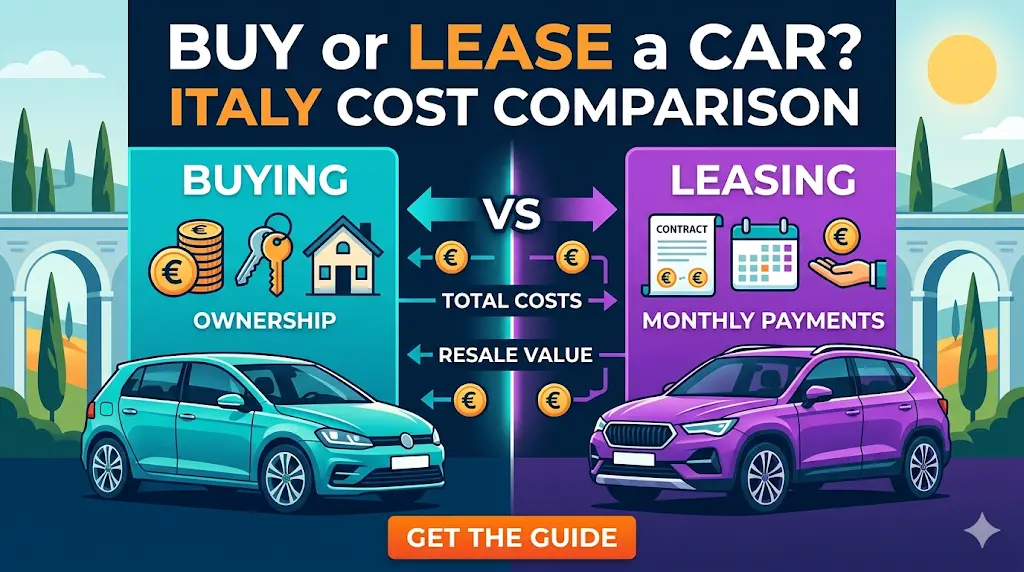
When Americans or Brits talk about leasing a car, they usually mean financing a car’s depreciation over three years with the distinct option to buy it for a residual value at the end of the term. In Italy, standard financial leasing (leasing finanziario) is historically restricted to businesses and VAT-registered professionals. For private individuals and expat families, the dominant and much more accessible alternative is Noleggio Lungo Termine (NLT), or long-term rental.
NLT is a completely different financial product. Under this arrangement, the rental company retains full ownership of the vehicle permanently. You sign a contract—typically for 36 or 48 months—and agree to a strict annual mileage limit. At the end of the term, you simply hand the keys back to the agency. You never own the physical asset, but crucially, you also never own the depreciation.
For expats, the beauty of NLT lies in its simplicity. You are completely shielded from the volatile secondary car market in Italy. You never have to worry about finding a private buyer, haggling over prices, or visiting a notary to complete a messy transfer of ownership when you eventually decide to upgrade your vehicle or leave the country.
The All-Inclusive Financial Predictability
The biggest psychological and financial draw of NLT for expats is the bundled predictability. Your fixed monthly payment covers virtually everything except fuel and highway tolls. Routine maintenance (like oil changes and tire rotations), extraordinary repairs, roadside assistance, and the mandatory annual Bollo Auto are all paid and managed by the rental company.
More importantly, the NLT company pays the insurance. Because these agencies insure massive national fleets, they secure premium bulk rates. By choosing an NLT contract, you completely bypass the brutal Classe 14 insurance penalty that punishes new expats. The agency provides comprehensive coverage, including theft and fire, baked right into your monthly fee.
The only catch is the approval process. You must prove you can comfortably afford the monthly payments. NLT companies typically want to see a robust, permanent Italian employment contract—a reality you can explore further in Types of Italian Employment Contracts Contratti di Lavoro—or a significant upfront financial deposit to offset your lack of an Italian credit history. This lack of history is the exact same barrier expats face when attempting to secure traditional funding, a struggle fully detailed in Getting an Auto Loan in Italy as a Foreigner.
The Financial Breakdown and Capital Management
Upfront Capital and Currency Conversion
If you decide to buy a car outright to avoid long-term monthly contracts, you will need a massive chunk of liquid capital ready on day one. Whether you choose to buy locally or suffer the massive import taxes outlined in Taxation of Gifted Cars Imported to Italy, moving €15,000 or €20,000 from your home country to an Italian dealership via a traditional bank wire is a terrible financial move. Your home bank will inevitably gouge you with hidden foreign transaction markups and exorbitant wire fees.
To protect my own capital during my relocation, I managed all of my major cross-border transactions using Wise. By transferring my home currency into Wise, I converted the funds to euros at the real, mid-market exchange rate. I then used my Wise account to execute a standard, low-cost SEPA transfer directly to the Italian dealership.
Using Wise for these heavy capital transfers ensures you keep hundreds of dollars in your pocket instead of donating them to your bank’s corporate profit margins. It provides the exact liquidity you need to make a massive purchase in Italy without feeling penalized for holding your primary wealth in a foreign currency.
Opportunity Cost and Wealth Management
The buy-versus-lease debate ultimately hinges on a core financial concept: opportunity cost. A car is a rapidly depreciating liability. If you drop €25,000 in cash to buy a car in Italy, that capital is completely dead. It is actively losing value every single day while sitting parked on a cobblestone street.
Alternatively, you can choose a low-deposit NLT contract and keep your €25,000 actively invested. Savvy expats deeply prefer to park their heavy capital in Interactive Brokers. By keeping your long-term savings globally invested in diversified equities through Interactive Brokers, your wealth continues to compound and outpace inflation, completely shielded from localized Italian retail banking fees and aggressive local wealth taxes.
You can then effortlessly fund your monthly NLT car payment out of your regular Italian salary. If you do not have a local salary, you can simply liquidate small, controlled amounts from Interactive Brokers, route them through Wise to secure the best currency conversion rate, and pay your monthly rental invoice seamlessly. Maintaining your core wealth in Interactive Brokers while renting a depreciating physical asset locally is the ultimate financial optimization strategy for an expat.
Making Your Final Decision as a Foreigner
Tax Deductions for Freelancers
If you are moving to Italy as an entrepreneur, consultant, or freelancer with an active Partita IVA (VAT number), the tax implications heavily swing the pendulum toward leasing. The Italian Revenue Agency allows self-employed individuals to deduct a specific percentage of their vehicle costs from their taxable income, depending on how strictly the car is utilized for business purposes.
NLT contracts make this accounting process incredibly simple and transparent. Instead of manually tracking vehicle depreciation schedules, saving hundreds of individual maintenance receipts, and categorizing insurance invoices, you simply hand your commercialista a single, itemized monthly invoice from the rental company.
The ease of this localized accounting saves you hours of administrative headache and reduces your accounting fees. To understand how these business write-offs fit into your broader immigration strategy, it is vital to read up on the Acceptable financial proof for Italy self-employment visa.
Timeline and Exit Strategy
Finally, you must ruthlessly evaluate your exit strategy. If your work visa is only valid for two or three years, buying a car is a massive, unnecessary risk. Selling a car in Italy requires notarized documents, finding a local buyer willing to pay the aggressive transfer taxes, and dealing with slow municipal bureaucracy right when you are frantically trying to pack your bags and cancel your apartment lease.
NLT allows you to perfectly align your vehicle contract with your visa duration. When it is time to leave the country, you simply drop the car off at the agency, sign a release form, and head straight to the airport. The peace of mind that comes with knowing you are not financially tethered to an unsold vehicle in a foreign country is worth its weight in gold.
| Financial Factor | Buying Outright | NLT (Long-Term Rental) |
| Upfront Cost | High (Full sticker price + Ownership Transfer Fee) | Low/Moderate (Initial Deposit/Anticipo) |
| Asset Depreciation | You absorb 100% of the financial loss | Handled entirely by the rental company |
| Insurance Cost | Punishingly high for new expats (Classe 14) | Fully included in the fixed monthly fee |
| Maintenance & Taxes | Unpredictable, out of pocket, heavily bureaucratic | Fully included in the fixed monthly fee |
| Exit Strategy | Difficult (Requires finding a buyer and notary fees) | Simple (Return the keys at the end of the term) |
References
Primary sources (official)
- ACI (Automobile Club d’Italia) – Costi del passaggio di proprietà – https://www.aci.it/servizi/costi-del-passaggio-di-proprieta/
- Ministero dei Trasporti – Immatricolazione e acquisto auto – https://www.mit.gov.it/
Other helpful sources
- Laleggepertutti – Acquisto auto all’estero e comunicazioni – https://www.laleggepertutti.it/200664_acquisto-auto-allestero-obbligatorio-comunicare-i-dati-alla-motorizzazione
- GinevraRent – Deducibilità fiscale del noleggio a lungo termine – https://www.ginevrarent.it/deducibilita-noleggio-lungo-termine/
Disclaimer
The information provided in this article is for educational and informational purposes only and does not constitute official legal, tax, or financial advice. Italian vehicle registration laws, insurance risk classifications (RC Auto), and the tax deductibility rules for Noleggio Lungo Termine (NLT) contracts are highly complex and subject to frequent administrative updates. Always consult directly with a certified Italian commercialista or a qualified auto dealership regarding your specific visa status, employment contract, and local residency registration before signing any financial leasing or purchase agreements.