Cost Comparison: Prepaid vs Postpaid SIM in Italy
Landing in Italy and realizing you cannot order a taxi or map your way home without a local phone number is an immediate source of panic. I spent my first week running between mobile shops, utterly confused by the paperwork required just to get a basic data plan. This guide decodes Italian mobile contracts so you can get connected immediately.
Disclosure: This post may contain affiliate links. We may earn a commission at no extra cost to you if you make a purchase through these links. Read full disclosure.
The Expat Reality of Mobile Plans in Italy
Why Prepaid Rules the Italian Market
In the United States, the United Kingdom, and many other parts of the world, a postpaid mobile contract is the absolute standard for adult professionals. You sign a two-year agreement, the company runs a credit check, and you pay a bill at the end of every month. If you walk into an Italian mobile shop expecting this same setup, you are in for a massive cultural shock.
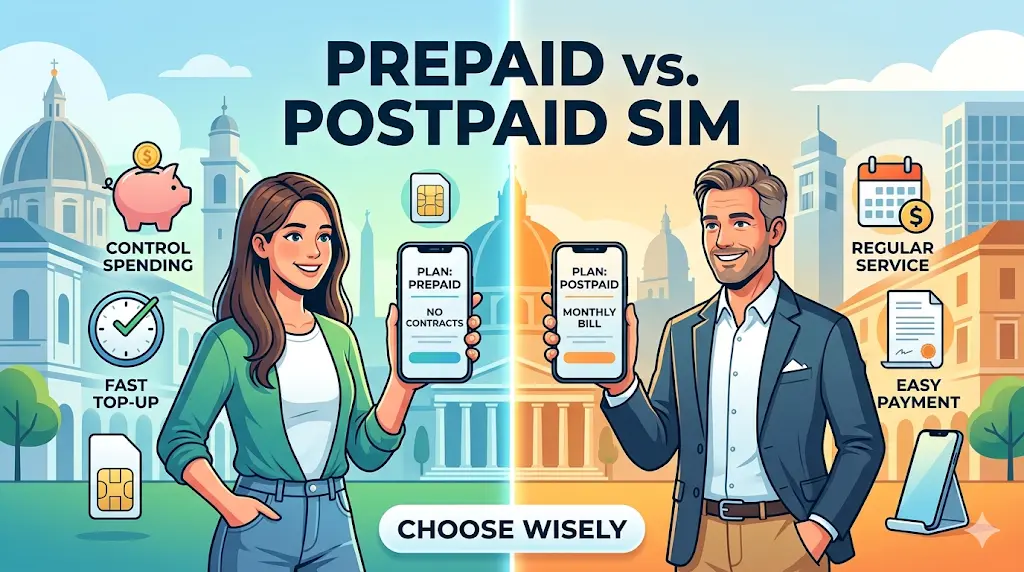
In Italy, the vast majority of consumer mobile plans are ricaricabile (prepaid). Unlike in the US, where prepaid phones are often associated with burner phones or bad credit, prepaid in Italy is the modern, smart standard. The Italian telecommunications market is incredibly competitive, resulting in some of the lowest mobile data prices in Europe. A standard prepaid plan from a major carrier like TIM, Vodafone, or WINDTRE, or a budget provider like Iliad, will typically give you 100GB to 200GB of 5G data, plus unlimited calls and texts, for less than ten euros a month.
Because mobile plans are so inexpensive, they significantly lower your monthly overhead, which is a welcome relief when calculating your Cost of Living in Italy 2026 Budgeting for Expats. With prepaid, there are no credit checks, no massive cancellation fees, and no long-term commitments. If you decide to switch providers to get a better deal next month, you simply port your number over in a matter of days. For expats who might be Finding Temp Agencies and Short Term Work in Italy, the flexibility of a prepaid plan that you can pause or cancel at any time is invaluable.
The Bureaucracy of Postpaid Contracts
If you explicitly request an abbonamento (postpaid contract) at an Italian telecom store, the clerk will likely ask for a mountain of paperwork. To secure a postpaid mobile plan, you must prove your financial stability and your legal right to remain in the country long-term.
This usually requires presenting your passport, your Codice Fiscale (tax code), and crucially, a valid residence permit. If you have just arrived and only hold a postal receipt proving you applied for your residency, many major telecom providers will reject your postpaid application outright. Waiting for your physical residency card can take months, and tracking the Timelines for picking up your permesso di soggiorno in Italy is stressful enough without being digitally disconnected in the meantime.
Furthermore, postpaid contracts require a registered Italian IBAN for a direct debit (domiciliazione bancaria). Setting up a traditional Italian bank account requires a registered address and a valid residence permit, creating a frustrating Catch-22. To avoid this bureaucratic nightmare entirely, almost all expats opt for prepaid SIMs upon arrival, completely sidestepping the institutional gatekeeping detailed in Navigating Italian Bureaucracy Comune and Prefettura.
Breaking Down the True Costs
Hidden Fees and Activation Charges
While Italian mobile data is incredibly cheap, getting the SIM card operational comes with initial setup costs. When comparing prepaid and postpaid, you must look beyond the advertised monthly rate.
With a prepaid SIM, you generally pay a one-time activation fee (costo di attivazione) that ranges from zero to ten euros, plus the cost of the physical SIM card itself (usually another ten euros). You are also required to pay the first month’s plan cost upfront. Overall, you should expect to walk out of the store having spent about 25 to 30 euros on day one. After that, your monthly cost remains locked at the advertised low rate.
Postpaid plans, conversely, are often bundled with device financing. If you want the newest iPhone, Italian carriers will gladly give it to you on an abbonamento. However, these contracts usually lock you in for 24 to 30 months. If you need to leave the country unexpectedly or change your visa status, breaking this contract incurs massive penalty fees and demands the immediate payout of the remaining phone balance. If you are a professional moving to one of the Top Italian Cities for IT Jobs and Tech Startups, your employer might provide a corporate postpaid phone. In this scenario, ensure you understand the terms of your Types of Italian Employment Contracts Contratti di Lavoro to see if personal use of the corporate data plan is allowed and untaxed.
| Feature | Ricaricabile (Prepaid) | Abbonamento (Postpaid) |
| Monthly Cost | €7.00 – €15.00 | €15.00 – €30.00+ |
| Data Allowance | 100GB to 300GB+ | Often Unlimited |
| Contract Length | Monthly, no commitment | 12 to 30 months |
| Bank Account Required? | No (can pay by card or cash) | Yes (Requires SEPA direct debit) |
| Credit Check? | No | Yes |
| Expat Accessibility | Immediate (Requires Passport & Tax Code) | Difficult (Requires Residency & Italian IBAN) |
Paying Your Monthly Bill as a Foreigner
Maintaining your prepaid SIM is where many foreigners stumble. Every month, you must ensure you have enough credit on your SIM card to cover the renewal cost. You can buy a ricarica (top-up) in cash at any local tabaccheria (tobacco shop), but the most convenient method is through your provider’s mobile app.
This is where your foreign credit cards will likely fail you. Many Italian telecom apps actively block US, UK, and Australian credit cards, or your home bank will flag the transaction as fraud and hit you with a foreign transaction fee. I bypassed this entirely by setting up my mobile top-ups through Wise.
Because Wise provides you with a legitimate European IBAN and a multi-currency debit card, Italian telecom apps accept it flawlessly. You can use Wise to convert your home currency to euros at the mid-market rate, load your mobile app, and never worry about your data cutting out while navigating the metro. Furthermore, if you miraculously manage to secure a postpaid contract but still lack a traditional Italian bank account, you can actually use the European IBAN provided by Wise to establish the mandatory SEPA direct debit, satisfying the telecom company’s strict payment requirements.
Connectivity for Remote Workers and Investors
Data Caps and Home Internet Alternatives
If you are relocating under Italy’s new digital residency pilot for expats, reliable internet is your lifeline. The process of getting home fiber internet installed in an Italian apartment can take anywhere from two weeks to two months, depending on the ancient wiring in your building.
Because prepaid mobile plans offer such massive data caps—often 200GB to 300GB per month—many digital nomads simply use their mobile phone as a hotspot to power their laptops and run their businesses during their first few months in the country. This bypasses the need to sign a 24-month postpaid fiber contract for an apartment you might only rent for a year. If you are operating as a freelancer, tracking these telecom expenses is critical; you can find more information on managing your freelance cash flow in our guide on Acceptable financial proof for Italy self-employment visa.
Maintaining Access to Home Accounts
One of the most overlooked aspects of choosing a mobile plan in Italy is how it impacts your financial security back home. When you move to Italy, you must maintain your home country phone number to receive Two-Factor Authentication (2FA) SMS codes. If you cancel your US or UK number, you will be locked out of your bank accounts, credit cards, and investment portfolios.
Many serious expat investors use Interactive Brokers to manage their global portfolios safely outside of the high-tax Italian mutual fund system. If you lose your home phone number, accessing your Interactive Brokers dashboard becomes an absolute nightmare of security verifications. I solved this by utilizing an eSIM for my cheap Italian prepaid data plan, while keeping my physical US SIM card active in my phone solely on Wi-Fi calling mode to receive authentication texts for Interactive Brokers.
You never want to be locked out of Interactive Brokers while trying to execute a critical trade or withdraw funds just because you mismanaged your Italian SIM card setup. Furthermore, the math speaks for itself. By choosing an 8-euro Italian prepaid SIM over a 35-euro postpaid contract, you save hundreds of euros a year. You can systematically route those monthly telecom savings directly into your Interactive Brokers account, allowing your expat budget to actively build your wealth.
Being strategic about your mobile plan is just as important as managing your cross-border taxes. Just as you rely on Wise for seamlessly moving your euros and dollars without banking fees, optimizing your local expenses allows you to thrive financially abroad. Ensure you keep your digital life secure and properly documented, as losing access to your primary financial accounts is a bureaucratic disaster on par with the Consequences of losing your permesso di soggiorno card. Once your connectivity is stabilized, you can comfortably focus on bigger financial goals, like understanding the US-Italy Tax Compliance: Form 8891 vs Modello 730 rules for your investments.
References
Primary sources (official)
- AGCOM (Autorità per le Garanzie nelle Comunicazioni) – Official Italian Telecom Regulator – https://www.agcom.it/
- Ministero delle Imprese e del Made in Italy – Communications Sector – https://www.mimit.gov.it/it/comunicazioni
Other helpful sources
- Iliad Italia – Prepaid Offers and Transparency – https://www.iliad.it/
- TIM (Telecom Italia) – Mobile Consumer Plans – https://www.tim.it/fisso-e-mobile/mobile/passa-a-tim
Disclaimer
The information provided in this article is for educational and informational purposes only and does not constitute official financial, legal, or telecommunications advice. Italian mobile carrier terms of service, the availability of specific prepaid (ricaricabile) data allowances, and the strict banking or residency requirements for postpaid (abbonamento) contracts are subject to frequent changes by the providers. Always review the exact contractual terms, international roaming fees, and SEPA direct debit requirements directly with the telecommunications company before signing an agreement or porting your phone number.