Cost of Translating and Apostilling Documents for Italy
Getting your paperwork rejected at the Italian consulate because your birth certificate lacks a specific stamp is a soul-crushing expat rite of passage. I spent hundreds of euros fixing translation errors and chasing missing Apostilles during my visa process. This guide breaks down the true costs of translating and authenticating your documents so you can survive Italian bureaucracy without overspending.
Disclosure: This post may contain affiliate links. We may earn a commission at no extra cost to you if you make a purchase through these links. Read full disclosure.
Understanding the Apostille Requirement and Its Hidden Costs
The Hague Convention Explained
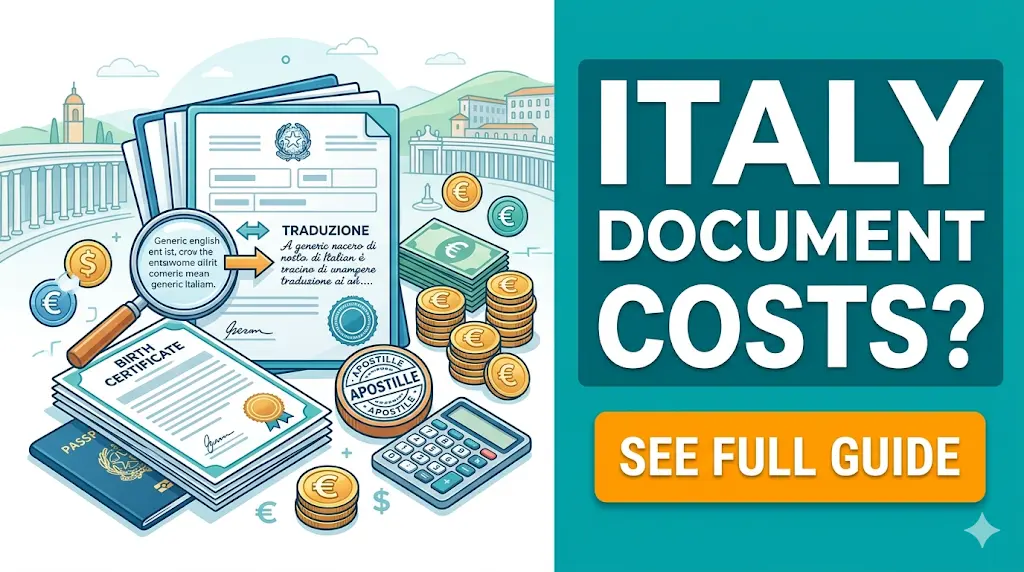
When you move to Italy, the local government does not automatically trust a birth certificate, marriage license, or background check issued by a foreign entity. To prove your documents are legitimate, they must bear an Apostille. This is a specialized, internationally recognized authentication certificate issued under the Hague Convention of 1961.
An Apostille is literally a separate piece of paper attached to your original document with a specialized rivet or seal. It verifies the signature of the official who signed your document. If you show up at an Italian consulate or a local town hall without this piece of paper physically attached to your vital records, your application will be immediately dismissed. Fighting with municipal clerks over unauthenticated paperwork is one of the most exhausting aspects of Navigating Italian Bureaucracy Comune and Prefettura, so getting this right before you leave your home country is critical.
State Versus Federal Apostille Fees
The actual cost of obtaining an Apostille varies wildly depending on exactly what document you need authenticated and how quickly you need it. In the United States, documents issued by a state entity—such as a birth certificate from New York or a marriage license from California—must be apostilled by that specific state’s Secretary of State. The government fee for this is usually nominal, ranging from $5 to $20 per document.
However, federal documents—most notably the FBI background check required for almost all long-stay visas—must be apostilled by the US Department of State in Washington, D.C. While the federal fee is also low (currently $20), the processing time is notoriously abysmal, often taking two to three months.
If you are racing against the clock to secure your visa, waiting three months for a federal Apostille is impossible. This forces most expats to hire private expediting agencies in Washington, D.C., who physically walk your documents into the authentication office. These expeditors charge anywhere from $150 to $300 per document. If you are hiring an expeditor from overseas and need to pay their invoice in dollars from your European account, traditional bank transfers will hit you with massive hidden markups. Using Wise to pay these American expeditors ensures you convert your euros at the true mid-market rate, saving you a substantial amount on foreign transaction fees.
The Translation Trap Certified Versus Sworn
The Rules of Italian Document Translation
An Apostille only authenticates the signature on the document; it does not translate the contents. Because Italian is the only official language of the state, every single piece of foreign paperwork—including the Apostille page itself—must be translated into Italian.
You cannot simply translate the document yourself, nor can you use an unverified online service. The Italian government strictly requires the translation to be officially certified. There are generally two ways to accomplish this, and choosing the wrong one can blow up your entire relocation budget.
Consulate Legalization Outside Italy
If you are applying for your visa in your home country, the Italian consulate will require you to submit translations done by a translator who is officially registered with that specific consulate.
The translator will typically charge you a per-word or per-page fee, which usually averages between $30 and $60 per page. Once the translator completes the job, you must present the original document, the Apostille, and the translation to the consulate. The consulate then charges a “legalization fee” (typically around €10 to €20 per document, payable in your local currency) to place their official consular stamp on the translation, certifying it for use in Italy.
If you are juggling multiple application requirements, such as proving your long-term passive income or gathering the Acceptable financial proof for Italy self-employment visa, your document stack can easily exceed twenty pages. Paying for standard translation and consular legalization for a massive packet of financial documents can quickly cost you over a thousand dollars.
Traduzione Giurata Inside Italy
If you are already in Italy—perhaps converting a student visa to a work visa, applying for citizenship, or registering your foreign marriage—you cannot use a standard foreign translator. You must obtain a traduzione giurata, which is a sworn translation.
To get a sworn translation, you must hire a professional translator who is registered with the local Italian court (Tribunale). The translator completes the work and physically goes to the courthouse to swear an oath before a public official that the translation is entirely accurate.
This process is highly bureaucratic and heavily taxed. You must pay the translator’s professional fee (usually €40 to €80 per page), plus the cost of marche da bollo (revenue stamps). The Italian state requires one €16 marca da bollo for every four pages of translation (or every 100 lines of text), plus an additional €16 stamp for the oath document itself. A simple three-page birth certificate with an Apostille will cost you nearly €150 just to get translated and sworn. When managing your overall Cost of Living in Italy 2026 Budgeting for Expats, you must build a dedicated buffer strictly for these localized administrative extortion fees.
Strategies for Managing Visa and Translation Costs
Minimizing Your Financial Document Translations
One of the most expensive mistakes expats make is translating entire bank statements. When applying for an elective residence visa or a digital nomad visa, the consulate wants to see deep proof of financial stability. If you download a standard 50-page monthly statement from a retail bank, it will be filled with useless line items, daily coffee purchases, and repetitive legal disclosures. Paying a certified translator $40 a page to translate your daily grocery habits is an absolute waste of capital.
You must be strategic about where you hold your primary wealth and how you report it. Many veteran expats consolidate their global portfolios in Interactive Brokers. Because Interactive Brokers is a highly sophisticated, globally integrated platform, it allows you to generate concise, customized, one-page summary reports of your net asset value and passive dividend yields.
By submitting a dense, one-page verified statement from Interactive Brokers rather than a massive retail bank ledger, you save hundreds of dollars in unnecessary translation fees. Furthermore, having your core wealth securely parked in Interactive Brokers keeps your capital safe from high-fee Italian mutual funds once you actually move, and it makes dealing with dual-taxation reporting significantly cleaner—a massive relief when you inevitably have to untangle your US-Italy Tax Compliance Form 8891 vs Modello 730.
| Document / Service | Average Cost (USD/EUR) | Hidden Fees to Watch Out For |
| State Apostille (US) | $5 – $20 | Courier shipping to the state capital |
| Federal Apostille (US) | $20 | Expeditor fees ($150 – $300) due to severe backlogs |
| Consulate Translation | $30 – $60 per page | Consular legalization stamp fees |
| Sworn Translation (Italy) | €40 – €80 per page | €16 marca da bollo required every 4 pages |
| International Courier | $40 – $100 per shipment | Return shipping labels often required by state offices |
Paying Foreign Translators and Agencies
Managing the logistics of an international move requires you to constantly push money across borders before you even arrive. You might be sitting in London but need to hire a sworn translator in Milan to prepare your paperwork for when you land.
Italian sworn translators are traditional professionals; they do not accept foreign credit cards through online portals. They will send you an invoice with an Italian IBAN and expect a direct bank transfer. If you instruct your home bank to send a SWIFT wire to the translator in Italy, your bank will charge you a hefty outgoing wire fee and apply a terrible exchange rate markup.
To solve this operational nightmare, you should run all of your relocation logistics through Wise. By funding your Wise account in your home currency, you can convert your money to euros at the real, mid-market rate. More importantly, Wise gives you local European bank details, allowing you to pay the Italian translator via a standard, free SEPA transfer. You can use this exact same strategy to pay your immigration lawyer, your apartment deposit, and your initial municipal fees. Relying on Wise ensures that every euro you spend actually goes toward clearing your bureaucratic hurdles, rather than lining the pockets of international banking intermediaries. We break down the exact math behind these savings in our guide on Exchange Rates Sending Money to Italy Smartly.
Budgeting for Shipping and Document Transit
Finally, do not underestimate the cost of simply moving paper around the world. Original vital records cannot be emailed. You must physically mail your original birth certificate to the Secretary of State, who mails it back to you. You then mail it to your translator, who mails the certified packet back to you for your consulate appointment.
If any of these steps happen across international borders, you must use tracked, expedited couriers like FedEx or DHL. Losing an original, apostilled background check in standard international mail will completely derail your relocation and reset the Timelines for picking up your permesso di soggiorno in Italy.
Budget at least $200 to $300 strictly for courier shipping labels. If you need sudden liquidity to cover a massive unexpected shipping cost or a last-minute expeditor fee, you can easily liquidate a small portion of your assets in Interactive Brokers, withdraw the funds to your Wise account, and pay the invoice immediately without disrupting your broader long-term investment strategy. By keeping your capital fluid between Interactive Brokers and Wise, you maintain the agility necessary to outmaneuver the relentless financial demands of the Italian immigration system.
References
Primary sources (official)
- US Department of State – Office of Authentications – https://travel.state.gov/content/travel/en/records-and-authentications/authenticate-your-document/office-of-authentications.html
- Hague Conference on Private International Law (HCCH) – Apostille Section – https://www.hcch.net/en/instruments/conventions/specialised-sections/apostille
Other helpful sources
- Studio Bocca – Translating and Legalizing Documents for Italy – https://www.studiobocca.it/en/translating-legalizing-documents-italy/
- Mazzeschi Legal Counsels – Sworn Translations (Traduzione Giurata) in Italy – https://www.mazzeschi.it/sworn-translations-in-italy/
Disclaimer
The information provided in this article is for educational and informational purposes only and does not constitute official legal, immigration, or financial advice. The administrative fees for Apostilles, consular legalization, and the specific application of the marca da bollo for a traduzione giurata are highly complex and subject to frequent updates by the respective national governments and local Italian tribunals. Always consult directly with the official Italian consulate in your jurisdiction or a certified Italian immigration attorney to verify the exact document authentication and translation requirements for your specific visa or citizenship application.