VAT (IVA) in Italy: How It Affects Prices and Freelancers
Navigating the Italian tax system often feels like trying to read a map of Venice while blindfolded in a rainstorm. I remember my first month in Florence, staring at a grocery receipt and wondering why there were three different tax percentages listed at the bottom for what I thought was a simple bag of pasta and some wine. This guide will demystify the complex world of Imposta sul Valore Aggiunto (IVA) to help you budget accurately and manage your business without the usual administrative headaches.
Disclosure: This post may contain affiliate links. We may earn a commission at no extra cost to you if you make a purchase through these links. Read full disclosure.
The Foundations of IVA in Italy
Value Added Tax, known locally as IVA, is a consumption tax that touches every single transaction you make in Italy. Unlike in many parts of North America, where tax is added at the cash register, Italy’s prices are almost always displayed "IVA inclusa." This makes shopping easier for the average consumer, but it can create a massive disconnect for expats who eventually decide to open a business or work as a freelancer. Understanding the underlying structure is the first step toward financial literacy in your new home.
The Four Tiered IVA Rate System
Italy does not have a single VAT rate. Instead, it uses a tiered system designed to tax luxury items more heavily while keeping basic necessities slightly more affordable. The standard rate is currently 22%, which applies to most goods and services, from designer clothing to electronics and professional consulting fees. However, when you go to the supermarket, you will see the lower rates in action.
The 4% rate is reserved for "primary necessities." This includes basic foodstuffs like bread, milk, and fresh vegetables, as well as certain medical supplies and books. There is also a 5% rate, which is relatively new and applies to specific items like some herbs and certain social services. Then there is the 10% reduced rate, which you will encounter most often when eating out at restaurants, staying in hotels, or paying for basic home renovations. Knowing these rates is essential when calculating your Cost of Living in Italy 2026: Budgeting for Expats because it allows you to see where your money is actually going.
Why Every Receipt Matters
In Italy, the "scontrino" (the small paper receipt) is more than just proof of purchase; it is a legal requirement. You may have noticed shopkeepers practically chasing you out the door to hand you a tiny slip of paper. This is because the Guardia di Finanza (the financial police) can technically stop you outside a shop and ask to see your receipt. If you don't have it, both you and the shopkeeper could be fined.
This culture of receipts is Italy’s way of fighting tax evasion. For you, the expat, these receipts are vital for understanding how much IVA you are paying. If you are just a resident with a standard job, you cannot "reclaim" this tax. However, if you are planning on Starting a Business in Italy: Entrepreneur Visa and Procedures, these receipts become the lifeblood of your accounting system.
IVA Inclusa vs IVA Esclusa
One of the biggest traps for new expats is the "IVA Esclusa" trap. While consumer prices must include tax, B2B (business-to-business) quotes almost never do. If you hire a plumber, a lawyer, or a web designer and they tell you the price is 1,000 Euro, you need to ask immediately: "IVA inclusa?" If it is not, your actual bill will be 1,220 Euro. This 22% surprise has ruined many a monthly budget for those who haven't yet acclimated to the local business culture.
How IVA Impacts the Daily Life of an Expat
When you move to Italy, your relationship with IVA changes depending on your residency status and how you earn your money. For the tourist or the new arrival, it’s a hidden cost. For the long-term resident, it becomes a factor in every major purchasing decision, especially when Buying Property in Italy: Notary Fees and Taxes or renovating a home.
Professional Services and Contractor Invoices
If you are renovating an apartment or seeking legal advice, the IVA becomes a significant portion of your expenditure. For home renovations, there are often "IVA agevolata" (reduced VAT) schemes where you might only pay 10% instead of 22% on labor and certain materials. Navigating these rules requires a good relationship with your contractor and a deep understanding of the current "Bonus" schemes provided by the government.
When paying professional fees, you will also notice something called the "Contributo Integrativo." This is often a 4% charge added on top of the base fee, which is then itself taxed with IVA. It feels like paying tax on a tax, and in a way, it is. These professional social security contributions are standard for lawyers, architects, and accountants, so don't be alarmed when you see multiple percentage additions on your final invoice.
Utility Bills and Hidden Surcharges
Your electricity, gas, and water bills are another area where IVA fluctuates. Generally, domestic energy is taxed at 10%, but there are tiers. If your consumption exceeds a certain limit, or if you are taxing a "second home" (which many expats unknowingly do if they haven't yet finalized their residency), the rates and fixed costs can climb significantly.
Setting up these services is often the first hurdle. Many expats find it helpful to use services like Wise to manage these recurring payments, as their multi-currency accounts allow you to hold Euro and pay local SEPA direct debits without the predatory exchange rates often found in traditional banks. This is particularly useful if you are still receiving income in your home currency while paying Italian IVA-taxed bills.
The Cost of Digital Services
If you are a digital nomad or work remotely, you might be surprised to find that digital products—like software subscriptions, E-books, or streaming services—are also subject to Italian IVA if you are a resident here. Even if the company is based in the US or Ireland, the "place of supply" rules mean you pay the 22% Italian rate. This is why your Netflix or Spotify bill might slightly change in price once you update your billing address to an Italian one.
| Category | Typical IVA Rate | Examples |
|---|---|---|
| Basic Food | 4% | Bread, milk, cheese, fresh fruit |
| Prepared Food/Dining | 10% | Restaurants, cafes, hotels |
| Standard Goods | 22% | Clothing, cars, electronics, wine |
| Professional Services | 22% | Lawyers, consultants, web designers |
| Domestic Utilities | 10% | Electricity and gas for primary residence |
| Medical Devices | 4% | Eyeglasses, prosthetics, certain equipment |
The Freelancer’s Burden: Navigating IVA with a Partita IVA
The moment you move from being an employee to a freelancer, your relationship with the Italian state changes forever. You are no longer just a taxpayer; you are an unpaid tax collector for the government. Managing a Partita IVA (the Italian VAT number) is notoriously complex, and the stakes are high.
The Role of the Freelancer as a Tax Collector
When you issue an invoice as a standard freelancer, you add 22% IVA to your fee. That money does not belong to you. It is held in trust, and you must pay it to the Agenzia delle Entrate (the Italian tax office) on a quarterly or monthly basis. I’ve seen many expats get into deep financial trouble because they saw their bank account balance grow and forgot that 22% of that money was "virtual."
Using a separate business account via Wise can be a lifesaver here. You can instantly move the IVA portion of every paid invoice into a separate "Jar" or sub-account. This ensures that when your tax bill arrives, the money is sitting there, untouched and ready to be paid via an F24 form. For more on the initial setup, check out our guide on How to Open a Partita IVA in Italy: Step-by-Step.
The Regime Forfettario Exception
If you are just starting out, you will likely want to apply for the "Regime Forfettario." This is a simplified tax regime for small businesses earning under 85,000 Euro per year. The biggest draw for expats is that under this regime, you are "IVA esente." This means you do not add 22% to your invoices, making your services much more competitive for private clients who cannot reclaim VAT.
However, there is a massive catch: if you don't charge IVA, you also cannot deduct the IVA you pay on your business expenses. If you buy a 2,000 Euro laptop for work, you pay the full 22% tax and you get zero credit back. For many, this trade-off is worth it for the lower overall income tax rate (5% or 15%), but it’s a calculation you must make with an expert. You can dive deeper into this in our article on The Regime Forfettario in Italy: Flat-Rate Tax for Freelancers.
Deducing Expenses and Offsetting IVA
If you are not in the Forfettario regime, you operate under the "Regime Ordinario." Here, the IVA game is all about "detrazione." You track all the IVA you pay on business-related expenses (office rent, supplies, professional fees) and subtract that from the IVA you collected from your clients. You only pay the difference to the state.
This requires meticulous record-keeping. You must ensure that every purchase is backed by a "fattura" (invoice) addressed to your Partita IVA and Codice Fiscale, not just a simple "scontrino." If you are a US citizen living in Italy, managing these local requirements while staying compliant with the IRS can be a nightmare. This is where a specialized service like Taxes for Expats becomes invaluable, as they understand the interplay between Italian VAT accounting and US self-employment tax obligations.
Invoicing and the Electronic Revolution
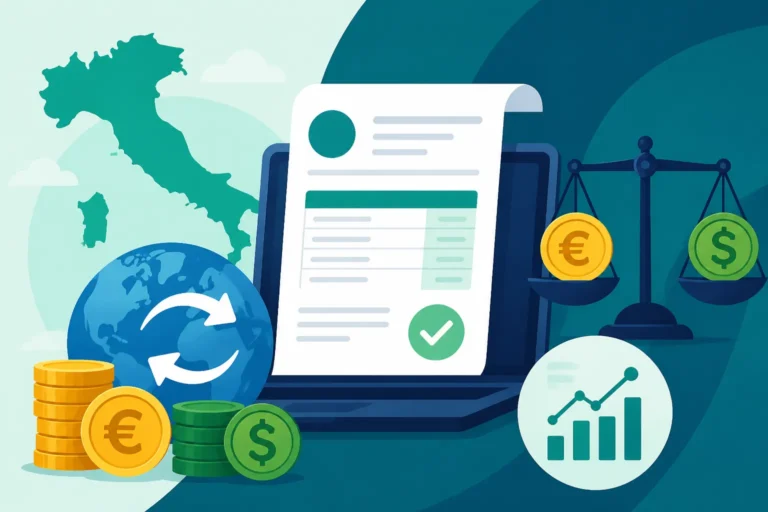
Italy was a pioneer in "Fatturazione Elettronica" (Electronic Invoicing). Gone are the days of sending a simple PDF or a paper invoice. Today, almost all transactions between Italian entities must pass through a government-controlled exchange system called the "Sistema di Interscambio" (SdI).
Understanding the Fattura Elettronica System
When you "send" an invoice, you are actually uploading an XML file to the government's portal. The government checks it for errors and then "delivers" it to your client. If the invoice doesn't go through the SdI, it technically doesn't exist in the eyes of the law. This system has significantly reduced the "nero" (under the table) economy, but it added a layer of digital bureaucracy for expats.
To access these portals, you will absolutely need to get your digital identity sorted. See our guide on SPID and Digital Identity for Italian Tax and Services to understand how to log in to these government platforms. Most freelancers use third-party software that connects to the SdI to make this process more user-friendly.
The "Bollo" Virtuale
Even if you are exempt from IVA under the Forfettario regime, you aren't completely free of small taxes on your invoices. Any invoice over 77.47 Euro that does not have IVA applied must have a "Marca da Bollo" (revenue stamp) of 2 Euro. In the world of electronic invoicing, this is paid virtually. Your accountant will typically tally these up at the end of the year, and you pay them in one go. It’s a small amount, but forgetting it can lead to annoying "avvisi di accertamento" (fines) from the tax office.
Working with International Clients
If your clients are outside of Italy, the IVA rules change again. When invoicing a client in the USA or UK, you generally do not charge IVA, as the service is "exported." However, you must include specific legal wording on your invoice explaining why IVA isn't applied (e.g., "Operazione non soggetta…").
If your client is in another EU country, you usually apply the "Reverse Charge" mechanism. This means you don't charge the tax, but you must be registered with VIES (VAT Information Exchange System). Failing to tick the VIES box on your initial Partita IVA application is one of the most common mistakes I see. Without it, your intra-EU invoices are technically invalid. This is why Choosing a Commercialista (Accountant) in Italy who has experience with international clients is so important.
Common Pitfalls and Administrative Hurdles
The Italian bureaucracy is famous for a reason. One small mistake in an IVA filing can lead to a cascade of letters from the Agenzia delle Entrate. Being proactive is your only defense.
Penalties for Late Filings
The deadlines for IVA are non-negotiable. Whether you file monthly or quarterly, missing the payment date results in immediate interest and penalties. However, Italy offers a system called "Ravvedimento Operoso," which allows you to "repent" for your lateness. If you realize you missed a payment and pay it voluntarily before the tax office catches you, the fines are significantly reduced.
The "Codice Fiscale" Necessity
You cannot do anything involving IVA without a tax code. Whether you are buying a SIM card or signing a commercial lease, this alphanumeric string is your identity in Italy. If you haven't secured yours yet, please follow the steps in How to Get a Codice Fiscale in Italy (and Why You Need One). It is the key that unlocks every door in the Italian financial system.
Dealing with the Agenzia delle Entrate
If you do receive a notice of a discrepancy, don't panic, but don't ignore it either. Often, these are simple automated errors. Having a Taxes for Expats professional or a local commercialista to represent you can save you thousands of Euro in wrongly assessed fines. The language barrier in these notices is often the hardest part; the "legalese" used by the tax office is difficult even for native Italians to parse.
Practical Strategies for Financial Management
To survive and thrive in Italy, you need to automate your finances as much as possible. The less you have to think about IVA daily, the more you can enjoy the "Dolce Vita."
Expert Tax Filing and Compliance
For many of us, the goal is to live in Italy, not to become Italian tax experts. Outsourcing this stress is the best investment you can make. While a local commercialista handles your Italian filings, remember that your home country may still want a piece of the pie. Taxes for Expats provides the necessary bridge for Americans to ensure that their Italian IVA-taxed income is reported correctly to the IRS, avoiding the dreaded double taxation.
Using International Accounts for Business Cash Flow
Traditional Italian banks can be slow and expensive. When you are managing the ebb and flow of IVA payments, you need flexibility. Wise is often the preferred choice for expats because it provides you with a local Italian IBAN. You can receive payments from clients, hold your tax reserves in a separate folder, and pay your F24 tax forms directly. The ability to convert currency at the mid-market rate also means that when you need to send money home, you aren't losing 3-5% to hidden bank fees.
Managing Cash and Small Transactions
While Italy is moving toward a cashless society, cash is still king in many small "Alimentari" or village bars. Always carry a bit of cash for these transactions, but remember the scontrino rule. Even for a 1.20 Euro espresso, that receipt is your shield against the financial police and your only window into the 22% (or 10%) tax you just paid. For a broader view of how these small costs add up, take a look at our Money Matters in Italy: Banking and Finance for Expats guide.
Disclaimer
This article is for informational purposes only and does not constitute legal, financial, or tax advice. The Italian tax code is subject to frequent changes, and the specific 2026 regulations may vary based on your individual residency status and income levels. Always consult with a qualified "Commercialista" in Italy and a certified tax professional in your home country before making financial decisions.