Money Matters in Italy: Banking and Finance for Expats
Moving to Italy is a dream, but managing your finances in a new country can be challenging. This comprehensive guide covers everything expats need to know about Italian banking, managing currency transfers, understanding local taxes, and building a solid financial foundation.
Disclosure: This post may contain affiliate links. We may earn a commission at no extra cost to you if you make a purchase through these links. Read full disclosure.
Introduction
Entering the world of Italian banking and finance requires patience, preparation, and a willingness to adapt to local customs. The financial landscape in Italy is a fascinating blend of deeply entrenched traditional banking institutions and rapidly emerging financial technologies. While modern digital payments are becoming increasingly common, certain bureaucratic procedures still rely on paper forms, in-person appointments, and official stamps.
For expatriates, the challenge is not just translating the language, but translating the financial culture. You will encounter new terminology, unfamiliar fee structures, and strict anti-money laundering regulations that dictate how cash can be handled. Furthermore, establishing your financial footprint in Italy is intimately tied to your legal immigration status and your residency. You cannot simply walk into a bank and open an account with just a passport; a synchronized dance of securing your tax code, finalizing your address, and presenting the correct visas is required.
This extensive guide is designed to demystify the entire financial ecosystem for expatriates living in Italy. We will explore the step-by-step process of opening a bank account, compare traditional high-street banks with modern digital alternatives, decode the hidden fees of international money transfers, and provide a foundational overview of the Italian tax system. By understanding these financial mechanisms, you can protect your assets, avoid costly administrative errors, and focus your energy on enjoying your new Italian life.
Establishing Your Financial Identity
Before you can engage with any banking institution or financial service in Italy, you must establish your official financial identity within the country. This identity revolves around one critical document: the Codice Fiscale.
The Codice Fiscale is the Italian equivalent of a Social Security Number in the United States or a National Insurance Number in the United Kingdom. It is an alphanumeric code generated based on your name, date of birth, and place of birth. Absolutely no financial transaction of significance can occur without this code. You need a Codice Fiscale to open a bank account, sign a residential lease, set up utility bills, register for the national healthcare system, and sign an employment contract.
Fortunately, obtaining a Codice Fiscale is relatively straightforward and should be done before or immediately after your arrival. You can apply for one at the Italian consulate in your home country prior to your move, or visit the local Agenzia delle Entrate (Italian Revenue Agency) once you arrive in Italy. Presenting your passport and visa is usually sufficient to have the official paper certificate issued on the spot. Armed with your Codice Fiscale, you are ready to tackle the banking system.
Opening a Bank Account in Italy
Securing an Italian bank account is vital for paying rent, receiving a salary, and setting up direct debits for your monthly utility bills. The process requires navigating specific classifications based on your residency status.
Non-Resident vs Resident Accounts
Italian banks offer two distinct categories of accounts for foreigners: the Conto Corrente per Non Residenti (Non-Resident Account) and the Conto Corrente per Residenti (Resident Account).
If you have just arrived in Italy and have not yet officially registered your residency at the local town hall (the Comune), you are legally considered a non-resident. Non-resident accounts are heavily restricted due to international anti-money laundering laws. They generally only allow you to deposit imported foreign currency or euros and do not offer access to credit cards, overdraft facilities, or investment portfolios. Furthermore, the maintenance fees for non-resident accounts are significantly higher than those for residents.
Once you have completed your registration with the Comune and obtained your official certificate of residency, you can either upgrade your non-resident account or open a standard resident account. Resident accounts offer the full spectrum of banking services, lower fees, and seamless integration with local payment networks. For a deep dive into the specific documentation and strategies required for this process, you should review our dedicated guide on How to Open a Bank Account in Italy.
The Documentation Process
When you are ready to visit the branch, preparation is key. Unlike digital-first countries where accounts can be opened in minutes on a smartphone, traditional Italian banks often require an in-person appointment with a bank manager. You must bring a comprehensive dossier of documents, including:
- Your valid passport.
- Your Italian visa and Permesso di Soggiorno (Residence Permit) or the official receipt proving you have applied for it.
- Your official Codice Fiscale certificate.
- Proof of your Italian residential address (such as a registered rental contract or a recent utility bill).
- Proof of employment or a demonstration of financial self-sufficiency.
It is highly recommended to bring an Italian-speaking friend or translator to this appointment if your language skills are not yet conversational, as banking contracts are complex and legally binding documents.
Traditional Banks vs Digital Banks
The Italian banking sector offers a choice between long-established traditional banks with extensive branch networks and modern digital banks that operate entirely online.
Traditional High Street Banks
Institutions such as Intesa Sanpaolo, UniCredit, and Banca Nazionale del Lavoro (BNL) dominate the Italian high street. The primary advantage of a traditional bank is physical access. If you encounter a complex issue, need to negotiate a mortgage, or require certified cashier’s checks (assegni circolari) for large purchases like real estate or a vehicle, having a dedicated local branch and a personal relationship with a bank manager is invaluable.
However, traditional banks are notorious for their bureaucracy. Opening an account can be slow, their online banking interfaces are sometimes outdated or lack English translation, and their fee structures can be opaque, often including monthly maintenance fees, charges for ATM withdrawals outside their specific network, and fees for executing transfers.
Digital and Challenger Banks
In recent years, the market has been disrupted by digital-only banks, often referred to as challenger banks. European platforms like N26 and Revolut, as well as Italian-specific digital banks like Fineco and Illimity, have become incredibly popular among the expatriate and digital nomad communities.
Digital banks offer rapid account opening processes directly from your smartphone, excellent multi-language user interfaces, real-time transaction notifications, and minimal to zero monthly maintenance fees. They are ideal for day-to-day spending, peer-to-peer transfers, and managing multiple currencies. However, they may lack the capacity for complex local services, such as paying certain regional taxes via specific physical forms.
Comparison of Banking Options
To help you decide which banking route best suits your lifestyle, consider the following comparison table.
| Feature | Traditional Italian Bank | Digital / Challenger Bank |
| Account Opening | In-person appointment, extensive paperwork. | Online via app, identity verification via video/photo. |
| Monthly Fees | Typically €5 to €15, depending on the tier. | Often free for basic accounts, premium tiers available. |
| Language Support | Primarily Italian; English depends on the branch staff. | Fully multilingual apps and customer support. |
| Physical Branches | Extensive network across all Italian cities and towns. | None. All support is handled via chat, email, or phone. |
| Complex Services | Mortgages, safety deposit boxes, official bank drafts. | Limited. Excellent for daily spending and fast transfers. |
Understanding Bank Fees and Taxes
One of the most surprising aspects of Italian finance for expats from countries with “free banking” models is the sheer variety of fees associated with maintaining an account.
When reviewing the terms and conditions of an Italian bank account, pay close attention to the Canone Mensile (monthly maintenance fee). Even if an account is advertised as having no monthly fee, you must be aware of the Imposta di Bollo (Stamp Duty). Italian law mandates a wealth tax on bank accounts. If your average daily balance exceeds €5,000 during the billing period, the bank is legally required to deduct a flat state stamp duty of €34.20 per year (usually charged quarterly at €8.55). This is a government tax, not a bank fee, and it applies to all traditional accounts in Italy.
Additionally, scrutinize the fee schedule for ATM withdrawals. Withdrawing cash from an ATM (known in Italy as a Bancomat) that belongs to your bank’s network is usually free. However, withdrawing from a different bank’s machine often incurs a fee of €1.50 to €3.00 per transaction.
The Role of Poste Italiane in Financial Life
You cannot discuss finance in Italy without mentioning Poste Italiane (the Italian Postal Service). The post office in Italy functions as a parallel banking system and is deeply integrated into the daily financial life of the country.
Poste Italiane offers a banking service called BancoPosta. They provide checking accounts, prepaid debit cards (the incredibly popular Postepay), savings accounts, and investment products. For many expatriates living in rural areas or small villages where major commercial banks have closed their physical branches, the local post office is the only accessible financial institution.
Furthermore, you will inevitably visit the post office to pay official bills. Many government fees, utility bills, and traffic fines are issued as physical paper slips called Bollettini Postali. While many of these can now be paid online or at a local tobacconist (Tabaccheria), the post office remains the traditional hub for processing these payments.
Everyday Payment Methods and Cash Culture
Italy’s relationship with money is undergoing a rapid transition. Historically, Italy was a heavily cash-based society. Small businesses, cafes, and local markets vastly preferred cash, and attempting to pay for a one-euro espresso with a card was often met with visible frustration.
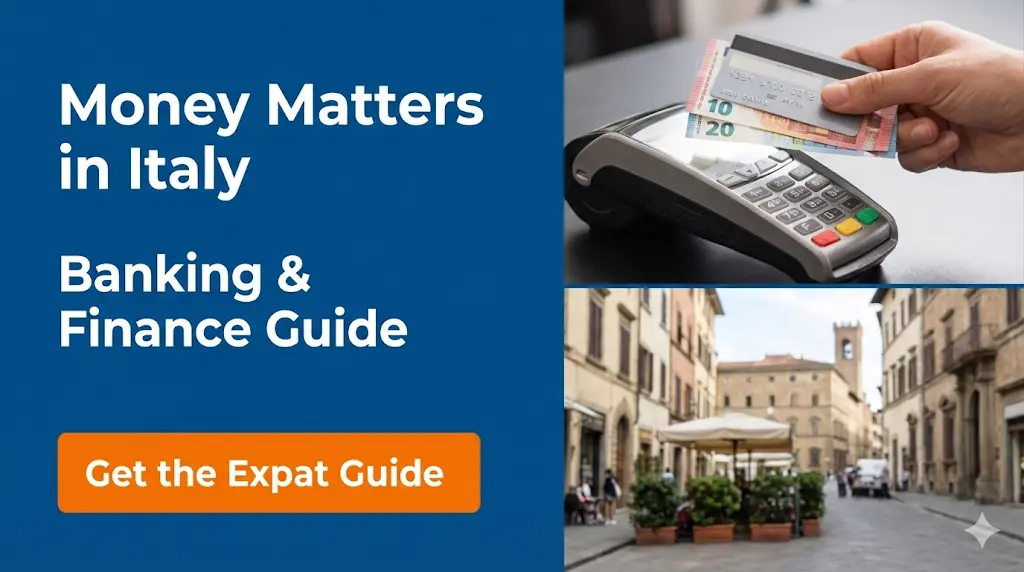
Today, the landscape has modernized significantly. The Italian government has implemented strict laws mandating that all merchants, regardless of size, must accept electronic payments via Point of Sale (POS) machines. While cash is still widely used and necessary for small tips, outdoor markets, and rural areas, you can now comfortably navigate daily life in major cities using a card or smartphone wallet.
Bancomat vs Credit Cards
When discussing card payments, Italians frequently use the term Bancomat. While Bancomat is technically a specific domestic debit card network, the term has become a catch-all phrase for any debit card or ATM machine.
Credit cards (Carte di Credito) are widely accepted, especially Visa and Mastercard. However, true credit cards—where you carry a revolving balance and pay interest—are less common among the general Italian population compared to North America. Most Italian bank cards are debit cards or prepaid cards that deduct funds directly and immediately from your checking account.
Satispay and Alternative Networks
Italy also boasts a unique, highly successful mobile payment network called Satispay. This app links directly to your bank account via IBAN and allows you to make fee-free payments at thousands of local merchants simply by scanning a QR code. It is incredibly popular for splitting bills among friends and paying at small, independent shops that prefer to avoid the higher transaction fees of traditional credit card networks.
Managing Currency Exchange and International Transfers
As an expatriate, you will likely need to move money across borders, whether you are transferring savings to buy property in Italy, sending money back home to pay a student loan, or receiving a pension from abroad.
Using a traditional high street bank to execute an international wire transfer outside of the Eurozone is generally the most expensive and inefficient method available. Traditional banks utilize the SWIFT network, which often involves intermediary banks that extract hidden fees. More importantly, traditional banks rarely offer the true mid-market exchange rate; they apply a substantial markup on the currency conversion, which can cost you hundreds or thousands of euros on large transfers.
To protect your wealth, you should utilize specialized foreign exchange (FX) brokers and digital transfer services. Platforms like Wise (formerly TransferWise), Revolut, and OFX offer transparent, low-cost international transfers using the real mid-market exchange rate. They charge a small, upfront percentage fee rather than hiding their profit in a terrible exchange rate. To understand the mechanics of these networks and determine the most cost-effective routing for your specific needs, explore our detailed comparison in SEPA vs SWIFT Transfers: Choosing a Money Transfer.
Within Europe, transferring money is blissfully simple. Italy is part of the Single Euro Payments Area (SEPA). Any transfer between Italian bank accounts, or from an Italian account to an account in France, Germany, or any other SEPA country, is executed quickly (often on the same day) and usually free of charge, operating exactly like a domestic transfer.
Understanding the Italian Tax System for Expats
The subject of taxation in Italy is vast, complex, and a frequent source of anxiety for expatriates. The Italian tax system is renowned for its high rates and intricate bureaucracy. It is highly advisable to consult a registered Italian accountant (a Commercialista) to ensure you remain fully compliant and avoid severe penalties.
Tax Residency Rules
The most crucial concept to grasp is tax residency. You are considered a tax resident of Italy if you spend more than 183 days a year (184 days in a leap year) physically present in the country, or if your primary center of vital, economic, and family interests is located in Italy.
If you meet the criteria for tax residency, you are legally obligated to declare and pay taxes to the Italian government on your worldwide income. This includes salaries earned remotely from foreign companies, rental income from properties in your home country, and global capital gains. If you are not a tax resident, you only pay taxes on income specifically generated within the Italian territory.
Personal Income Tax (IRPEF)
The cornerstone of the Italian tax system is the Imposta sul Reddito delle Persone Fisiche (IRPEF), the progressive personal income tax. The tax brackets escalate rapidly. While the government occasionally adjusts the specific brackets, the structure generally starts at around 23% for low-income earners and scales up to 43% for higher income brackets, plus additional regional and municipal surcharges. To gain a thorough understanding of these brackets, deductions, and filing deadlines, refer to our comprehensive guide: Understanding Italy’s Tax System: A Guide for Foreigners.
Double Taxation Treaties
If you are earning income abroad and paying taxes in Italy, you might fear being taxed twice on the same money. Fortunately, Italy has signed Double Taxation Avoidance Agreements with over 100 countries, including the United States, the United Kingdom, Canada, and Australia. These treaties ensure that the tax you pay in one country can generally be credited against your tax liability in the other, preventing double taxation.
Special Tax Regimes and Incentives for New Residents
To combat brain drain and attract foreign capital, the Italian government has introduced several highly lucrative, specialized tax regimes aimed specifically at expatriates, wealthy individuals, and returning Italian citizens.
The Lavoratori Impatriati Regime
This is one of the most generous tax incentives in Europe for working professionals. Often referred to as the “Brain Return” law, this regime historically allowed eligible incoming workers, freelancers, and entrepreneurs to exempt up to 70% (and in some southern regions, up to 90%) of their Italian income from personal income tax for a period of five years, extendable under certain conditions. While recent legislative updates have modified the exact percentages and eligibility criteria, it remains a massive financial draw for highly skilled expatriates moving their careers to Italy.
The 100k Flat Tax for High Net Worth Individuals
For extraordinarily wealthy expatriates, Italy offers a flat tax regime. Under this program, new tax residents can opt to pay a single, flat fee of €100,000 per year (or higher, depending on recent legal revisions) to completely cover all taxes on their foreign-sourced income, regardless of how many millions they earn globally. This allows wealthy individuals to live in Italy while shielding their vast international portfolios from the progressive Italian tax rates.
The 7% Pensioner Flat Tax
To encourage retirees to revitalize the economy of smaller municipalities, Italy introduced a special 7% flat tax rate. Foreign retirees who receive a pension from abroad and choose to relocate to a qualifying small town (typically under 20,000 inhabitants) in specific southern regions of Italy can apply a flat 7% tax rate to all of their foreign-sourced income, including their pensions and foreign investments, for up to ten years.
Declaring Foreign Assets: IVIE and IVAFE
If you are a tax resident in Italy, your reporting obligations extend beyond just your income; you must also declare your global wealth. Italy imposes wealth taxes on assets held outside of the country.
When you file your annual Italian tax return, you must complete the “RW Form” (Quadro RW) for monitoring purposes. Furthermore, you must calculate and pay two specific taxes:
- IVIE (Imposta sul Valore degli Immobili situati all’Estero): A tax on the value of real estate properties you own outside of Italy. The rate varies but is typically around 1.06% of the property’s value or purchase price, with offsets available for property taxes paid in the foreign country.
- IVAFE (Imposta sul Valore delle Attività Finanziarie detenute all’Estero): A tax on the value of foreign financial assets, such as foreign bank accounts, stock portfolios, and investment funds. The rate is generally 0.2% of the total value of the assets.
Failing to declare these assets can result in devastating financial penalties, making the services of a qualified Commercialista absolutely essential for expats with international ties.
Cost of Living and Budgeting Strategies
Your financial success in Italy will largely depend on how accurately you anticipate your daily expenses. The cost of living in Italy varies dramatically depending on geography.
The northern regions, particularly cities like Milan, Bologna, and Turin, boast higher average salaries but correspond with Northern European living costs. Rent, dining out, and entertainment in Milan can easily rival prices in London or Paris. Conversely, the southern regions and islands—such as Puglia, Calabria, and Sicily—offer a significantly lower cost of living, where housing and daily groceries are remarkably affordable, though local salaries are proportionally lower.
When establishing your monthly budget, expatriates must account for unique Italian expenses. If you are renting an apartment, you must budget for the Spese Condominiali (condominium fees), which cover building maintenance, elevator usage, and sometimes communal central heating. These fees can range from €50 to over €300 per month and are often not included in the advertised rental price.
Additionally, you are responsible for the TARI (Tassa sui Rifiuti), the annual municipal garbage tax, which is calculated based on the square footage of your property and the number of occupants.
Paying Public Fees with PagoPA
When budgeting for municipal taxes, school fees, or even traffic fines, you will encounter the PagoPA system. PagoPA is not an app, but rather a unified national digital payment node created by the Italian government. Whenever you owe money to the public administration, you receive a notice containing a PagoPA QR code. You can scan and pay this code directly through your Italian mobile banking app, at an ATM, at the post office, or even at the cash register of a local supermarket or tobacconist.
Credit Scores Mortgages and Financing
If you plan to settle in Italy long-term and purchase property, understanding the local credit environment is crucial. Expatriates are often shocked to discover that their stellar credit scores from the United States, the UK, or Australia mean absolutely nothing to an Italian bank.
Italy does not rely on the three-digit credit score system prevalent in North America. Instead, creditworthiness is assessed through a national central risk database known as the Centrale dei Rischi, managed by the Bank of Italy, and private bureaus like CRIF. These databases track your borrowing history exclusively within Italy. If you have never held an Italian credit card or taken a loan in Italy, you essentially have no credit history.
When applying for an Italian mortgage (Mutuo), the bank relies far less on arbitrary scores and heavily on demonstrable, stable income. They want to see long-term Italian employment contracts (contratto a tempo indeterminato), multiple years of Italian tax returns, and substantial liquid assets. The general rule of thumb for Italian banks is that your total monthly debt obligations, including the new mortgage payment, must not exceed roughly 30% to 35% of your net monthly income.
Obtaining a mortgage as a newly arrived foreigner with a foreign income stream is exceptionally difficult and often requires a much higher down payment (sometimes 40% to 50%) compared to an Italian citizen. Partnering with an independent mortgage broker (mediatore creditizio) who specializes in international clients is the most effective way to navigate this complex financing landscape.
Conclusion
Managing your finances as an expatriate in Italy is an ongoing process of education and adaptation. The Italian financial system, with its unique blend of ancient bureaucracy and cutting-edge digital payments, requires patience and a proactive approach.
By prioritizing the acquisition of your Codice Fiscale, carefully selecting a banking institution that aligns with your lifestyle, and utilizing modern foreign exchange platforms to protect your international wealth, you establish a secure foundation for your new life. Furthermore, understanding the profound implications of Italian tax residency and the generous incentives available to new arrivals ensures that you remain compliant while maximizing your wealth. Do not let the initial complexity of acronyms like IRPEF, ISEE, or IVIE intimidate you. Surround yourself with knowledgeable professionals, specifically a trusted Commercialista, and approach your financial integration as you would approach learning the Italian language: one step, one form, and one espresso at a time.
References
Primary sources (official)
- Agenzia delle Entrate (Italian Revenue Agency): The definitive governmental source for all tax regulations, forms, tax residency criteria, and information on special tax regimes like the Lavoratori Impatriati. https://www.agenziaentrate.gov.it/
- Banca d’Italia (Bank of Italy): The central bank provides comprehensive guidelines on the Italian banking system, consumer protection rights, and the Centrale dei Rischi credit reporting system. https://www.bancaditalia.it/
Other helpful sources
- Poste Italiane: The official site for the Italian postal service, detailing the BancoPosta financial products, Postepay cards, and procedures for paying public utility bills. https://www.poste.it/
Disclaimer
The information provided in this article is intended for general educational and informational purposes only and does not constitute official financial, tax, or legal advice. Italian tax laws, banking regulations, and special residency incentive programs are highly complex and subject to frequent legislative changes and regional variations. Individual financial situations vary significantly. It is strongly recommended that you consult directly with a certified Italian accountant (Commercialista), a qualified tax attorney, or a licensed financial advisor to receive professional guidance tailored to your specific personal and international financial circumstances before making any major financial decisions or filing tax declarations in Italy.