Emergency Medical Care at Night or Weekends in Italy
Falling ill after hours in a foreign country is deeply stressful, but Italy provides a robust out-of-hours healthcare infrastructure. This comprehensive guide explains how expats and travelers can access the Guardia Medica, emergency rooms, and duty pharmacies during nights and weekends.
Disclosure: This post may contain affiliate links. We may earn a commission at no extra cost to you if you make a purchase through these links. Read full disclosure.
Introduction
The Italian National Health Service, known as the Servizio Sanitario Nazionale (SSN), provides an extensive safety net that catches you when your regular family doctor is off duty. The system is meticulously divided into tiers of urgency to ensure that everyone receives appropriate care while keeping life-saving resources free for those who truly need them.
For expats who have already navigated the process of registering for public healthcare, you know that your primary point of contact is your general practitioner. However, these doctors operate on standard business hours. When their clinics close, the state activates a specialized out-of-hours medical service and keeps hospital emergency departments running around the clock.
Understanding the difference between an urgent but non-life-threatening illness and a true medical emergency is the key to navigating this system efficiently. If you choose the wrong pathway, you may end up waiting ten hours in a crowded hospital waiting room or facing unexpected administrative fees. This guide is designed to empower you with the exact knowledge you need to handle nighttime and weekend medical situations. We will explore how to summon an on-call doctor, how to decode the triage color system at the hospital, where to buy medication at three in the morning, and how your insurance status dictates the financial outcome of your care. For a broader overview of how standard daytime healthcare operates, you can review our Healthcare in Italy: An Expats’ Guide.
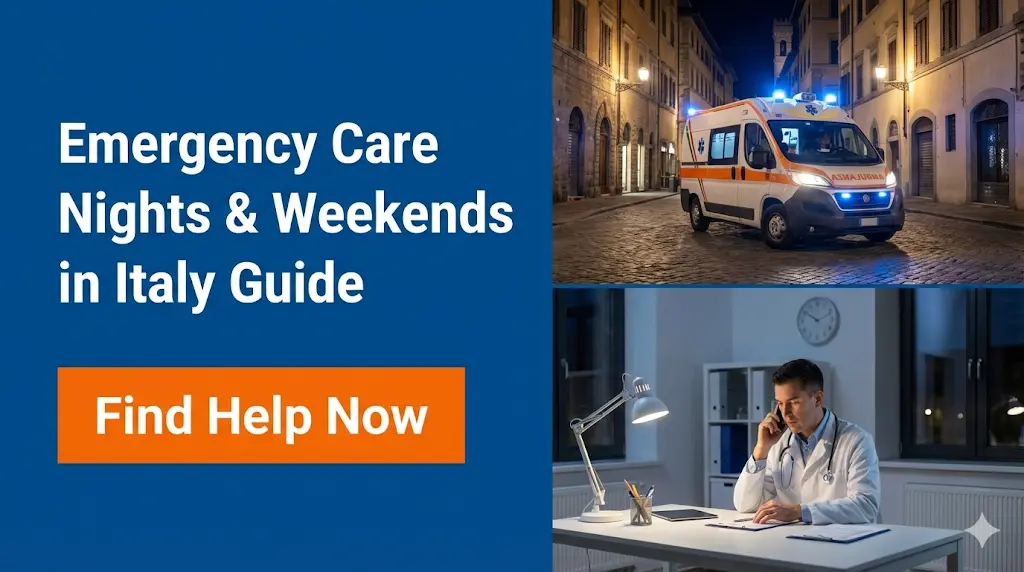
Understanding the Guardia Medica and Continuity of Care
When your regular doctor closes their clinic for the evening or the weekend, the baton of your healthcare is passed to a public service historically known as the Guardia Medica. In recent years, the Italian Ministry of Health has officially rebranded this service as the Servizio di Continuità Assistenziale, which translates to the Continuity of Care Service. Regardless of the official name change, almost all Italians still refer to it as the Guardia Medica.
This service is the absolute backbone of Italy’s out-of-hours healthcare. It is staffed by qualified, fully licensed medical doctors who are specifically contracted by the regional health authorities to provide primary care when standard clinics are closed.
The operating hours of the Guardia Medica are standardized across the country to fill the gaps left by general practitioners. During the standard workweek, the service is active overnight, typically starting at 8:00 PM and concluding at 8:00 AM the following morning. During the weekend, the service begins much earlier to cover the entire break. It generally activates at 10:00 AM on Saturday (or the day before a public holiday) and runs continuously until 8:00 AM on Monday (or the first working day after the holiday).
It is crucial to understand what the Guardia Medica can and cannot do. These doctors are equipped to handle urgent but non-life-threatening medical issues that simply cannot wait until your regular doctor reopens. If you have a severe earache, a sudden urinary tract infection, a high fever that won’t break, or a debilitating bout of gastroenteritis, this is the service you need.
The doctors on duty can perform physical examinations, provide immediate medical advice, administer basic treatments, and write official prescriptions for medications that you need to start taking immediately. Furthermore, if you fall ill on a Sunday and cannot go to work on Monday, the Guardia Medica doctor is legally authorized to issue an official medical certificate for your employer, documenting your illness for up to a maximum of three days.
However, the Guardia Medica clinics are not mini-hospitals. They do not have X-ray machines, advanced blood testing laboratories, or life support equipment. If the out-of-hours doctor examines you and determines that your condition is severe or requires complex diagnostics, they will immediately instruct you to go to the hospital or dispatch an ambulance on your behalf.
How to Access the Out of Hours Doctor
Accessing the Guardia Medica has historically been a slightly confusing process for expats, as every local health authority used to have its own specific toll-free phone number. However, Italy is currently undergoing a massive structural update to align with European Union directives.
The country is actively rolling out the harmonized European number for non-urgent medical assistance: 116117. This single, easy-to-remember number is free to call from any landline or mobile phone and operates 24 hours a day, seven days a week. When you dial 116117, you are connected to a centralized dispatch center. A trained operator, who often speaks English or has access to a translation service, will ask you a series of triage questions to determine the nature of your problem.
If your issue is deemed a non-emergency, the operator will connect you directly to the Guardia Medica doctor on duty for your specific postal code. As of late 2025, the 116117 number is fully active in major regions like Lombardy, Piedmont, Tuscany, Lazio (specifically Rome), and Veneto, with other regions rapidly coming online. If you reside in a region where the switch has not yet occurred, you will need to search online for “Guardia Medica” plus the name of your town to find the local ten-digit phone number.
When you speak to the doctor, they will decide the best course of action based on your symptoms. They have three primary options. First, they may simply offer telephone advice and electronically send a prescription to your phone. Second, they may ask you to travel to their physical clinic (l’ambulatorio) for a hands-on examination. Third, if you are too ill or physically incapacitated to travel, the doctor will conduct a home visit (visita domiciliare) and arrive at your apartment or hotel to treat you.
The most significant barrier for expatriates during this process is language. While the central dispatch operators for 116117 may speak English, the local doctors dispatched to your home or staffing the neighborhood clinic often only speak Italian. It is highly advisable to have a bilingual friend, neighbor, or landlord present with you to help translate your symptoms accurately. If you need to figure out where to get ongoing medicine after this visit, you can read our guide on Finding and Using Pharmacies in Italy.
Navigating the Pronto Soccorso
If your medical situation escalates beyond a simple infection or a mild fever, you must bypass the Guardia Medica entirely and head straight to the Pronto Soccorso, the Italian emergency room.
Italian emergency rooms are located within all major public hospitals and operate non-stop. They are staffed by specialized emergency medicine physicians, trauma surgeons, and specialized nurses. The Pronto Soccorso is designed to handle life-threatening situations, severe traumas, heart attacks, strokes, major breathing difficulties, and complex fractures.
The most critical thing to understand about the Italian emergency room is that patients are absolutely not seen on a first-come, first-served basis. Upon arrival, you will immediately undergo a triage process with a specialized nurse. The nurse will evaluate your vital signs, listen to your symptoms, and assign you a priority color code. This color code dictates how quickly you will be seen by a doctor.
Recently, Italy updated its national triage guidelines to a five-color system to improve patient flow and reduce overcrowding:
- Red (Emergenza): This indicates an immediate, life-threatening emergency. The patient has absent or severely compromised vital functions (e.g., cardiac arrest, massive hemorrhage). Red code patients bypass the waiting room entirely and are treated instantly.
- Orange (Urgenza Indifferibile): High urgency. The patient is at high risk of rapid deterioration or severe impairment of vital functions. The target waiting time is typically extremely short, often under 10 to 15 minutes.
- Light Blue or Blue (Urgenza Differibile): Medium or deferrable urgency. The patient is stable but suffering from a condition that requires complex diagnostics or interventions, usually accompanied by intense pain. The target waiting time is generally under 60 minutes.
- Green (Urgenza Minore): Minor urgency. The patient has a minor injury or illness that needs medical attention but does not pose any risk to vital functions and can be deferred. The target waiting time can be up to 120 minutes, though in major cities during weekends, green codes often wait much longer.
- White (Non Urgenza): Non-urgent. This code is assigned to situations that are not emergencies at all and should ideally be handled by a general practitioner or the Guardia Medica. White code patients will wait until all other colored codes are cleared, which can mean waiting all night.
If you are a foreigner or an expat, understanding these triage codes also helps you prepare for the financial aspect of the visit. True emergencies (Red, Orange, and usually Blue) are treated completely free of charge for everyone, regardless of nationality or insurance status, as a matter of fundamental human rights. However, if you are triaged as a Green or White code, you will likely be charged a regional co-pay, known as a ticket, upon discharge. This fee acts as a deterrent against clogging the emergency room with minor ailments. To understand the costs related to ambulance transport to these facilities, refer to Emergency Medical Services in Italy: 112 and Hospitals.
Important Emergency Phone Numbers
When panic sets in, remembering a complex phone number is the last thing you want to do. Fortunately, Italy has fully integrated into the European Union’s universal emergency response system.
The only number you truly need to memorize for an acute crisis is 112.
Dialing 112 connects you to the centralized European emergency dispatch center, known as the Numero Unico Europeo per le Emergenze. The operators at this center are trained to handle extreme stress and almost always speak multiple languages, including English. They will instantly geolocate your smartphone and ask whether you need the police, the fire brigade, or medical assistance. If you request medical help, they will instantly route your call to the emergency medical dispatchers.
In some Italian regions, the legacy direct medical emergency number, 118, is still active and runs parallel to 112. Dialing 118 connects you directly to the ambulance dispatch center (Soccorso Sanitario). If you need an ambulance for a suspected heart attack or a severe car accident, dialing 118 is the fastest route, though 112 will achieve the exact same result with only a few seconds of internal transfer time.
Finding a Pharmacy Open at Night or on Sundays
Securing a prescription from an out-of-hours doctor is only half the battle. Once you have the prescription in hand at 2:00 AM, you need a place to fill it. Because standard businesses in Italy strictly close at night and on Sundays, the country operates a heavily regulated, rotational system to guarantee citizens 24/7 access to medications.
This system is called the Farmacia di Turno (Duty Pharmacy). By law, a specific number of pharmacies in every municipality must take turns remaining open overnight, on Sundays, and during major national holidays like Christmas or Ferragosto.
If you walk up to your neighborhood pharmacy and the metal shutters are down, do not despair. Look at the wall next to the entrance or on the glass door. By law, every closed pharmacy must display a printed list or a digital screen showing exactly which pharmacies in the immediate area are currently on duty. You can also spot an open duty pharmacy from down the street by looking for a brightly illuminated, flashing green cross.
If you are too ill to wander the streets reading notice boards, you can easily find the duty roster online. Every region has websites and mobile apps dedicated to tracking the Farmacia di Turno based on your GPS location.
There is one critical financial detail to understand about duty pharmacies. Because the pharmacist is working an unsociable night shift to provide this essential service, they are legally permitted to charge a specific surcharge known as the diritto di chiamata (call fee). This fee is generally around 7.50 euros and is added to the total cost of your medication.
However, this fee is completely waived if you present a prescription from the Guardia Medica or the Pronto Soccorso that was written that exact same night and is explicitly marked with the word “Urgente” (Urgent) by the prescribing doctor. If you are just buying over-the-counter painkillers without a prescription at 3:00 AM, you will have to pay the call fee.
Pediatric Emergencies Out of Hours
When a child falls ill in the middle of the night, the stress levels for parents skyrocket. The Italian healthcare system has specific pathways designed to protect its youngest and most vulnerable residents.
If your child has a minor illness, such as a low-grade fever or an earache, you can call the standard 116117 out-of-hours number. However, it is important to note that the doctors staffing the standard Guardia Medica are generalists, not specialized pediatricians. While they are fully qualified to evaluate a child, they often exercise extreme caution. If an infant or a very young toddler presents with a high fever or ambiguous symptoms, the Guardia Medica doctor will almost always advise the parents to take the child to the hospital for a specialized evaluation.
For this reason, most Italian parents bypass the out-of-hours clinic entirely when dealing with a sick baby and head straight to a Pronto Soccorso Pediatrico (Pediatric Emergency Room). Every major city in Italy has dedicated pediatric hospitals or large general hospitals with specific emergency wings exclusively for children. These wards are staffed entirely by pediatric specialists and feature child-friendly environments designed to reduce trauma and fear. The triage system works exactly the same as the adult ER, prioritizing cases based on the severity of the child’s symptoms.
Costs Insurance and Bureaucracy
Navigating the financial implications of out-of-hours care depends entirely on your residency status and the type of health insurance you hold.
If you are an expatriate who has officially acquired residency and holds a valid Italian health card (Tessera Sanitaria), utilizing the Guardia Medica is completely free of charge. You simply present your card to the doctor, and the state covers the cost of the consultation or the home visit.
If you are an EU citizen visiting Italy as a tourist, you must present your European Health Insurance Card (EHIC). This card entitles you to the same free access to the Guardia Medica as an Italian resident, as the treatment is considered medically necessary and cannot be postponed until you return home.
If you are a non-EU tourist, a digital nomad on a short stay, or an expat whose residency paperwork is still processing, you do not have free access to the Guardia Medica. However, you can absolutely still use the service. You will be treated as a private patient and charged a regulated fee for the visit. This fee is incredibly reasonable by international standards, typically ranging from 15 to 30 euros for an ambulatory visit, and slightly more for a home visit. The doctor will issue you a formal receipt, which you can later submit to your travel insurance or private health insurance provider for reimbursement.
In the emergency room, as mentioned earlier, the costs are dictated by your triage color code. Even for non-residents without insurance, a life-threatening “Red Code” intervention is free. If you are assigned a “White Code” for a non-urgent issue, you will be required to pay the regional ticket upon discharge, which usually ranges from 25 to 50 euros, plus the costs of any non-urgent blood tests or X-rays performed.
Comparison of Out of Hours Medical Services
To simplify your decision-making process during a stressful moment, here is a quick reference table summarizing the available services.
| Medical Service | Best Used For | Access Method | Cost Expectation | Wait Time |
| Guardia Medica | High fevers, minor infections, urgent prescriptions, sick notes. | Call 116117 or local regional number. | Free with SSN/EHIC. €15-€30 without. | Fast (Depends on call volume / home visits). |
| Pronto Soccorso (ER) | Severe trauma, heart attacks, strokes, breathing issues. | Walk-in or call 112 for an ambulance. | Free for real emergencies. Co-pay for non-urgent. | Triage-based. Life threats seen instantly. |
| Pediatric ER | Acute illness in infants and toddlers. | Walk-in or call 112. | Free for real emergencies. Co-pay for non-urgent. | Triage-based. |
| Duty Pharmacy | Buying prescribed meds or OTC drugs at night. | Walk-in (Look for flashing green cross). | Cost of drugs + €7.50 night fee (unless urgent script). | Immediate. |
Private Alternatives and Telemedicine
For many expatriates, the language barrier and the potential wait times of the public system are simply too daunting to deal with in the middle of the night. If you have the financial means or comprehensive private health insurance, Italy offers excellent private alternatives for out-of-hours care.
Several private medical networks cater specifically to the expatriate and tourist communities in major cities like Rome, Milan, and Florence. Services like “Doctors in Italy” operate 24/7 digital platforms and apps. Through these services, you can request an English-speaking, board-certified private doctor to come directly to your hotel room or apartment within an hour, even at 2:00 AM on a Sunday.
Additionally, the rise of telemedicine means you can often secure an instant video consultation with a private, English-speaking doctor. These doctors can evaluate your symptoms over a video call and instantly issue an electronic prescription that you can take to the nearest duty pharmacy.
The downside to these private services is the cost. A private hotel or home visit in the middle of the night can be very expensive. However, for those who prioritize immediate, native-language communication and extreme convenience, these services provide an invaluable safety net. You will pay out of pocket upfront and submit the detailed medical invoice to your private international insurance for a claim.
Conclusion
Falling ill when the rest of the country is asleep or enjoying a weekend holiday does not mean you are left without medical support. The Italian out-of-hours healthcare system is vast, highly structured, and deeply committed to ensuring that care is always available. By understanding the distinction between the life-saving urgency of the Pronto Soccorso and the primary care continuity provided by the Guardia Medica, you can navigate medical hurdles with confidence and efficiency.
Preparation is the ultimate antidote to panic. Take five minutes today to save the 112 and 116117 numbers in your phone. Locate the nearest hospital with an emergency room, and familiarize yourself with the closest duty pharmacy notice board in your neighborhood. Armed with this knowledge and a clear understanding of your insurance rights, you can rest easy knowing that whether it is a Tuesday afternoon or a Sunday at midnight, world-class medical care is just a phone call away in Italy.
References
Primary sources (official)
- Ministero della Salute (Ministry of Health): The official Italian government portal providing guidelines on the Servizio Sanitario Nazionale, emergency triage codes, and out-of-hours care directives. https://www.salute.gov.it/
- 116117 European Non-Emergency Call Number: Official information from the Italian Ministry of Interior regarding the rollout and function of the harmonized medical assistance number. https://sdg.interno.gov.it/en/f5-116117-the-european-non-emergency-call-number
Other helpful sources
- Doctors in Italy: An online platform offering telehealth and private, English-speaking medical assistance for tourists and expats, detailing how to access urgent care. https://www.doctorsinitaly.com/
Disclaimer
The information provided in this article is intended for general educational and informational purposes only and does not constitute official medical advice, diagnosis, or legal instruction. Healthcare protocols, triage systems, and regional phone numbers in Italy are subject to updates. Always consult directly with licensed medical professionals or emergency dispatchers regarding your specific health condition. In the event of a severe, life-threatening emergency, dial 112 immediately.