Healthcare Differences for EU vs Non-EU Residents
Discover the key healthcare differences for EU versus non-EU residents relocating to Italy. This comprehensive guide explains public system access, voluntary and mandatory registration requirements, insurance mandates, and essential tips for navigating Italian medical services seamlessly.
Disclosure: This post may contain affiliate links. We may earn a commission at no extra cost to you if you make a purchase through these links. Read full disclosure.
Introduction to Healthcare Differences for EU vs Non-EU Residents
The Italian medical landscape is built upon a dual foundation: a robust, universally accessible public healthcare system and a modern, efficient private healthcare sector. For Italian citizens, the rules of engagement are straightforward. For expatriates, however, the pathway to securing a primary care physician, getting prescriptions filled, and accessing specialist care is heavily dictated by whether you hold a passport from a European Union member state or a non-EU country.
The differences between these two groups are profound. They are rooted in the fundamental legal frameworks that govern European freedom of movement versus international immigration laws. A citizen of France or Germany moving to Rome will experience a virtually seamless transition of their healthcare rights, moving from one European public system to another with minimal friction. Conversely, an American, Canadian, or British citizen moving to Florence will encounter strict visa prerequisites, mandatory private insurance requirements upon entry, and a highly categorized public registration system that often involves significant out-of-pocket fees.
Understanding these distinctions before you pack your bags is essential for safeguarding your health and your finances. A misstep in your healthcare planning can lead to unexpected medical bills, delayed access to essential medications, or complications with your immigration status. This exhaustive guide will break down the Italian healthcare system from both the EU and non-EU perspectives. We will explore the nuances of mandatory versus voluntary registration, detail the specific documentation required for each group, examine the rising costs of public healthcare access for third-country nationals, and provide actionable advice on utilizing the private sector. Whether you are arriving for a short-term study program or a permanent retirement, this guide will equip you with the knowledge needed to manage your health in Italy with absolute confidence.

The Italian National Health Service Overview
To fully comprehend how your nationality affects your medical access, you must first understand the structure of the Italian public healthcare system. Founded in 1978, the Servizio Sanitario Nazionale is the backbone of Italian medical care. It was established on the guiding principles of universality, equality, and equity, aiming to provide comprehensive health services to the entire population regardless of their individual socioeconomic status.
Regional Administration and Local Health Authorities
While the central Ministry of Health in Rome outlines the national health plan and guarantees a baseline of essential medical services, the Servizio Sanitario Nazionale is highly decentralized. It is administered at the regional level. This means that the healthcare system in Lombardy operates somewhat independently from the system in Sicily or Campania.
At the local level, healthcare is managed by the Azienda Sanitaria Locale, often referred to simply as the ASL. Your local ASL office is your primary point of contact for all bureaucratic health matters. It is the physical office where you will go to register for the public system, choose your general practitioner, and apply for medical exemptions. Because the system is regionally managed, the efficiency, wait times, and even the required paperwork can vary from one municipality to the next, which often adds a layer of complexity for newly arrived expatriates.
What the Public System Covers
Once registered with the Servizio Sanitario Nazionale, residents gain access to a remarkably comprehensive suite of services. This includes free consultations with an assigned family doctor, free or heavily subsidized pediatric care for children, completely free hospitalizations and emergency room visits, and access to heavily discounted prescription medications for chronic and acute illnesses.
However, it is a common misconception that public healthcare in Italy is entirely free at the point of use. For non-urgent specialist consultations (such as seeing a dermatologist or a cardiologist) and diagnostic imaging (like an MRI or an X-ray), patients are required to pay a subsidized co-payment known as the “ticket.” This fee is legally capped to ensure affordability, but it is an ongoing cost that all residents, regardless of nationality, must budget for.
Healthcare Access for European Union Citizens
For citizens of the European Union, the European Economic Area, and Switzerland, accessing healthcare in Italy is an incredibly streamlined process. The European Union’s freedom of movement directives ensure that citizens can travel, work, and reside in any member state while maintaining their fundamental social security and healthcare rights.
Short Term Stays and the European Health Insurance Card
If an EU citizen is visiting Italy for a short-term stay—typically defined as less than three months—they do not need to register with the Italian healthcare system. Instead, they are protected by the European Health Insurance Card.
The European Health Insurance Card allows EU visitors to access medically necessary, state-provided healthcare during a temporary stay in Italy under the exact same conditions and at the exact same cost as people insured in Italy. If a German tourist breaks their leg while skiing in the Italian Alps, they simply present their card at the public hospital. They will receive the necessary surgery and care, and the hospital will bill the German health system directly, or the patient will pay the standard Italian co-payment. It is crucial to note that this card is not a substitute for comprehensive travel insurance, as it does not cover private healthcare facilities or medical repatriation, but it is an ironclad safety net for acute medical emergencies.
Transferring Rights with the S1 Form
When an EU citizen decides to relocate to Italy permanently or for an extended period, the process of transferring their healthcare rights involves a specific document known as the S1 Form.
The S1 form is a certificate of entitlement to healthcare. It is primarily used by cross-border workers, posted workers, and, most commonly, European retirees drawing a state pension from their home country. Before leaving their home country, the EU citizen requests the S1 form from their national health insurance authority. Upon arriving in Italy and registering their residency at the local town hall, they present the S1 form to the local ASL. The Italian health authority will then register the individual into the Servizio Sanitario Nazionale entirely free of charge. The individual’s home country continues to reimburse Italy for the cost of their healthcare. This reciprocal agreement ensures that European retirees can enjoy their golden years in Italy without worrying about purchasing expensive private health insurance.
Mandatory Registration for Employed EU Citizens
For EU citizens who move to Italy to take up local employment or start a self-employed business, the integration into the healthcare system is even more direct. By securing a legal employment contract and paying taxes in Italy, an EU citizen automatically qualifies for “mandatory registration” in the public health system.
Their contributions to the healthcare system are deducted automatically from their Italian paycheck via standard payroll taxes. They simply need to present their employment contract, their Italian tax code, and their certificate of residency to the ASL to activate their coverage. They will not be charged any separate, lump-sum annual fee to access the system.
Healthcare Access for Non European Union Residents
For individuals arriving from outside the European Union, the path to securing healthcare is significantly more complex, heavily scrutinized, and often quite expensive. Third-country nationals are subject to strict immigration laws, and the Italian government requires concrete proof that these individuals will not become a financial burden on the state’s welfare system.
The Visa Stage and Private Insurance Requirements
The healthcare journey for a non-EU citizen begins long before they board a flight to Italy. To obtain almost any type of long-stay visa—whether it is a student visa, an elective residence visa for retirees, or a digital nomad visa—the Italian consulate in the applicant’s home country will demand proof of comprehensive health insurance.
Because the applicant is not yet a resident of Italy, they cannot rely on the public system to satisfy this visa requirement. They must purchase a private health insurance policy that covers medical emergencies and hospitalizations for the duration of their intended stay, or at least for the first year. This policy must typically offer a minimum coverage amount (often thirty thousand euros or more) and guarantee emergency medical evacuation. Without this private policy, the consulate will categorically deny the visa application.
The Residence Permit Requirement
Once the non-EU citizen arrives in Italy with their valid visa, they have exactly eight days to apply for their residence permit. The legal status of a non-EU expat hinges entirely on this document.
You cannot fully register for the public healthcare system until you hold a valid residence permit, or at the very least, the official postal receipt proving that your permit application is actively being processed by the immigration police. This creates a vulnerable window of time during the first few weeks of relocation, reinforcing the absolute necessity of the private health insurance policy purchased during the visa stage.
Mandatory Registration for Non EU Workers
Just like their European counterparts, non-EU citizens who are legally employed in Italy by an Italian company, or who hold a valid self-employment visa and pay Italian taxes, qualify for mandatory registration.
Because they are contributing to the national tax base, their enrollment in the Servizio Sanitario Nazionale is free at the point of registration. Furthermore, this mandatory, free registration extends to their dependent family members who have joined them in Italy through an official family reunification visa. Refugees and individuals holding asylum status are also granted free, mandatory registration to ensure their fundamental human rights are protected.
Voluntary Registration for Students and Retirees
The starkest difference in the Italian healthcare system applies to non-EU citizens who reside in Italy legally but do not generate income that is taxed by the Italian state. This category primarily includes international students, au pairs, religious workers, and retirees living in Italy on the Elective Residence Visa.
Because these individuals are not contributing to the healthcare system through payroll taxes, they are not entitled to free public healthcare. Instead, they must opt for “voluntary registration.” This pathway grants them the exact same rights, services, and access to doctors as an Italian citizen, but it requires the payment of a significant, lump-sum annual fee directly to the regional health authority.
The Cost Divide for Voluntary Registration Fees
For many years, the cost of voluntary registration for non-EU expats was incredibly low, making Italy an highly attractive destination for retirees and digital nomads. However, in recent years, the Italian government passed legislation that dramatically altered the financial landscape for third-country nationals seeking public healthcare.
Understanding the New Financial Thresholds
The fees for voluntary registration are now strictly categorized by the applicant’s visa type and, in the case of retirees, their global income. It is vital for prospective expats to calculate these costs accurately before committing to a move.
For international students holding a valid study visa and without any dependent family members, the state offers a subsidized flat rate. Currently, this rate is set at seven hundred euros per year. Au pairs on cultural exchange visas face a slightly higher flat rate of one thousand two hundred euros annually.
The most significant financial impact falls upon retirees and financially independent expats holding the Elective Residence Visa. For these individuals, the cost of voluntary registration is calculated as a percentage of their total global income from the previous tax year. The government has established a strict minimum contribution floor of two thousand euros per year. This means that regardless of how low your income is, you will pay no less than two thousand euros. If your global income exceeds a specific threshold (typically around thirty-two thousand euros), the fee increases incrementally, capping out at a maximum possible contribution of nearly two thousand eight hundred euros annually.
The Calendar Year Rule
A major bureaucratic quirk that frequently frustrates non-EU expats is the validity period of the voluntary registration fee. The fee you pay does not cover you for a rolling twelve-month period from the date of payment. Instead, it covers strictly the calendar year, from January first to December thirty-first.
Furthermore, the Italian health authorities do not pro-rate this fee. If an American retiree moves to Italy in September and wishes to register for the public healthcare system, they must pay the full two thousand euro minimum fee for coverage that will expire just three months later at the end of December. They will then be required to pay another two thousand euros in January to maintain their coverage for the new year. Consequently, many non-EU expats arriving late in the year choose to rely entirely on their private health insurance until January rolls around to maximize their financial investment.
Comparing the Required Documentation
When it is time to physically visit the local ASL office to register for healthcare, the dossier of documents you must present highlights the divide between EU and non-EU residents. The bureaucratic burden placed on third-country nationals is noticeably heavier.
Documents Required for European Union Citizens
An EU citizen seeking to register with the Italian system generally needs to provide a relatively simple set of documents:
- A valid passport or European National Identity Card.
- The official Italian tax identification number, known as the Codice Fiscale.
- A certificate of residence issued by the local Italian municipality.
- Proof of employment (an Italian work contract) OR the S1 form issued by their home country proving their transferred healthcare rights.
Documents Required for Non European Union Citizens
A non-EU citizen must present a much more extensive portfolio to prove their legal right to access the system:
- A valid passport from their home country.
- The official Italian Codice Fiscale certificate.
- A certificate of residence or a sworn declaration of their current address.
- The physical Residence Permit card, or the official postal receipt proving the permit application is actively processing.
- For employed expats: A valid Italian employment contract or recent pay slips.
- For voluntary registration: The stamped postal receipt (known as the F24 form) proving that the exact annual lump-sum fee has been paid in full to the regional health authority prior to the appointment.
Once the ASL clerk verifies these documents, the individual is officially enrolled. They will choose their primary care physician and receive a temporary paper certificate. Shortly thereafter, they will complete the process of Obtaining the Italian Health Card Tessera Sanitaria, which will be mailed to their home address.
Navigating the Private Healthcare Sector
Given the bureaucratic hurdles, the language barriers, and the rising costs of voluntary registration for non-EU citizens, the private healthcare sector plays a massive role in the expatriate experience.
Private healthcare in Italy is modern, highly efficient, and incredibly accessible. Private hospitals and independent clinics operate entirely outside the public Servizio Sanitario Nazionale framework. For expats, the private sector offers three distinct advantages: speed, comfort, and linguistic ease.
While the public system often features long waiting lists for non-urgent specialist appointments, a private clinic can usually accommodate a patient within a few days. Furthermore, private clinics in major metropolitan hubs like Rome, Milan, and Florence actively cater to the international community. They are staffed by bilingual administrators and top-tier medical specialists who are fluent in English.
Bridging the Gap for Non EU Expats
For non-EU expats, relying on the private sector is often a logistical necessity during their first year in Italy. Because the process of obtaining a residence permit can take several months, non-EU citizens are frequently locked out of the public healthcare system during their initial transition period. The private health insurance policy they were required to purchase for their visa becomes their primary lifeline.
Many expats choose a hybrid approach to their health management. They endure the paperwork to register for the public system to secure their safety net for catastrophic emergencies, complex surgeries, and chronic medication management. Simultaneously, they maintain a private international health insurance policy to cover routine specialist visits, dental care, and fast-track diagnostics. For a deeper dive into managing these dual expenses and understanding typical out-of-pocket consultation fees, refer to our guide on the Cost of Healthcare in Italy What Expats Need to Know.
Choosing a Family Doctor and Booking Appointments
Regardless of whether you are an EU or non-EU citizen, once you are registered with the public system, the operational mechanics of receiving care are identical. You will be assigned, or asked to choose, a primary care physician, known locally as the Medico di Base.
This doctor acts as the ultimate gatekeeper to your public healthcare journey. If you fall ill, you book a free appointment with your Medico di Base. If they determine that your condition requires specialized attention, such as a consultation with an endocrinologist or an orthopedic surgeon, they will issue an official medical referral.
With this referral in hand, you must navigate the centralized regional booking system, known as the CUP. You cannot call a public specialist directly; you must call the CUP hotline or use their digital web portal to find the next available appointment in your region. The wait time for this appointment will be dictated by a priority code assigned by your primary doctor based on the clinical urgency of your condition.
Emergency Medical Services for All Nationalities
While the bureaucratic pathways to routine healthcare are deeply divided by nationality, there is one area of the Italian healthcare system where total equality reigns supreme: emergency medical care.
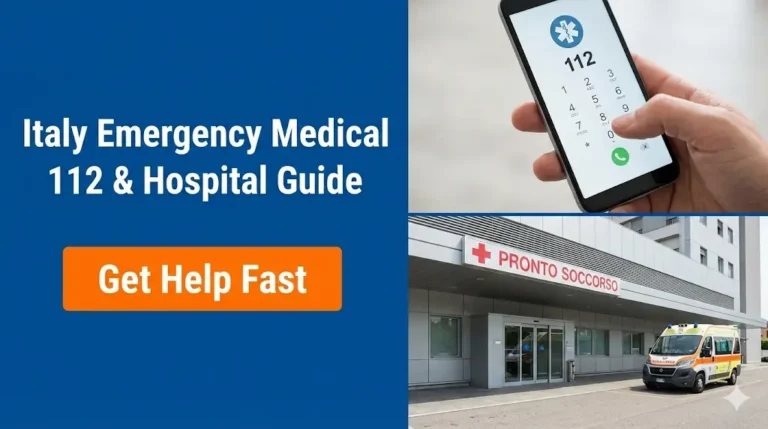
The Italian constitution guarantees the right to life-saving medical intervention to every human being on Italian soil. If an acute situation arises, the Emergency Medical Services in Italy 112 and Hospitals are available to everyone. It does not matter if you are an Italian citizen, an EU tourist holding an EHIC card, a non-EU expat waiting for a residence permit, or even an undocumented immigrant.
If you are involved in a severe car accident, suffer a heart attack, or experience massive trauma, you will be taken to the emergency room, known as the Pronto Soccorso. You will be evaluated by a triage nurse and assigned a color code based on the severity of your condition. If your condition is deemed an immediate threat to your life or long-term health, you will receive immediate, world-class medical, surgical, and inpatient care entirely free of charge. The public hospitals will never ask for a credit card or deny life-saving treatment based on your immigration status.
Conclusion
The differences in accessing healthcare for EU versus non-EU residents in Italy highlight the complex intersection of public health policy and international immigration law. For European citizens, the transition is largely seamless, protected by reciprocal agreements that honor the spirit of a unified continent. They can easily transfer their rights, utilize the EHIC for short stays, and seamlessly integrate into the Italian workforce without facing punitive health access fees.
For non-EU citizens, the path is undeniably steeper. Relocating from outside the European Union requires meticulous financial planning, a willingness to navigate dense bureaucracy, and an understanding of the significant costs associated with voluntary registration and mandatory private insurance. The necessity of the residence permit acts as a firm gatekeeper to public services.
However, despite these initial hurdles, the end result is access to one of the most capable, humane, and advanced medical systems in the world. Whether you navigate the public system through mandatory enrollment, pay the annual voluntary fee, or rely on the swift efficiency of the private international clinics, Italy provides a comprehensive safety net. By researching your specific visa requirements, gathering your documentation meticulously, and understanding the financial realities of your residency status, you can ensure that your health is thoroughly protected, allowing you to fully embrace the magnificent adventure of living in Italy.
References
Primary sources official
- Ministero della Salute (Italian Ministry of Health): The central governmental portal outlining the national health plan, voluntary and mandatory registration criteria for foreigners, and emergency care rights. https://www.salute.gov.it/
- European Union Official Website: Comprehensive guidelines on the application, usage, and limitations of the European Health Insurance Card (EHIC) and the S1 form for transferring social security rights. https://europa.eu/youreurope/citizens/health/
Other helpful sources
- Expatica Italy: An expansive resource for expatriates offering detailed, step-by-step guides on navigating the Italian healthcare system, private insurance options, and residence permit requirements. https://www.expatica.com/it/healthcare/
- The Local Italy: An English-language news network providing ongoing coverage and practical advice regarding changes to Italian immigration law, voluntary healthcare fees, and expat community experiences. https://www.thelocal.it/
Disclaimer
The information provided in this article is intended for general educational and informational purposes only and does not constitute official medical, legal, or immigration advice. Italian healthcare regulations, voluntary registration fees, and visa requirements for both EU and non-EU citizens are subject to frequent legislative updates by national and regional authorities. Always consult directly with the official Italian Embassy or Consulate in your home country, a qualified immigration lawyer, or your local Azienda Sanitaria Locale (ASL) to verify your specific eligibility, requirements, and healthcare costs before relocating.