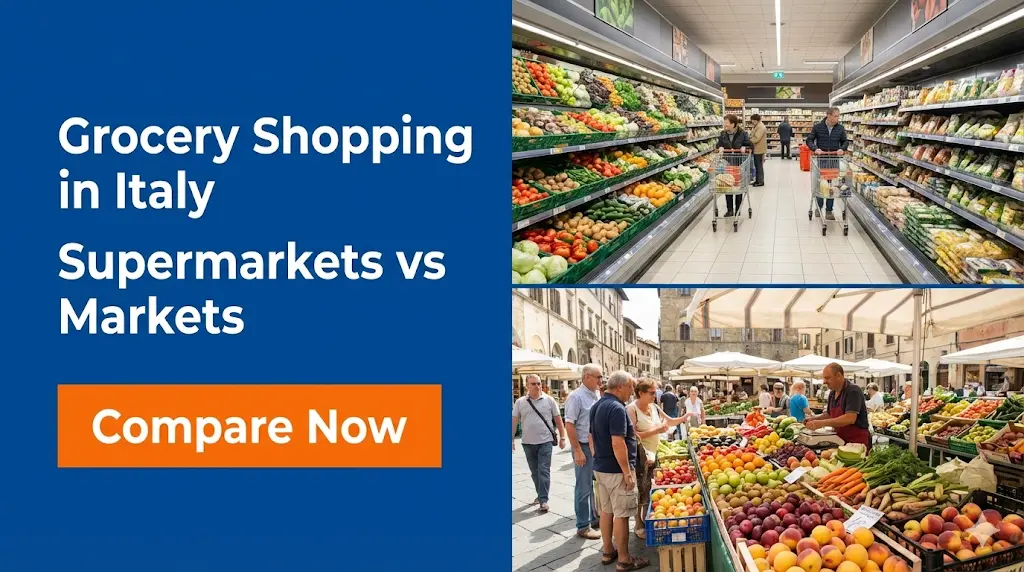
Grocery Shopping in Italy: Supermarkets vs Markets
Master the art of grocery shopping in Italy with this comprehensive guide. Discover the differences between major supermarket chains and vibrant open-air markets, learn essential local etiquette, navigate specialty food shops, and optimize your budget for authentic Italian cooking.
Disclosure: This post may contain affiliate links. We may earn a commission at no extra cost to you if you make a purchase through these links. Read full disclosure.
Introduction to Grocery Shopping in Italy
The simple errand of buying groceries can initially feel like an intimidating cultural hurdle. From figuring out how to unlock a shopping cart with a stray coin to understanding the strict “do not touch” rules at the neighborhood produce stand, Italian food shopping is governed by a distinct set of unwritten social protocols and logistical quirks. Furthermore, the retail ecosystem is highly fragmented. While massive hypermarkets exist on the outskirts of major cities, the heart of Italian food culture remains fiercely localized in neighborhood specialty shops and vibrant weekly open-air markets.
If you are a newly arrived expatriate, walking into a bustling Italian market or a crowded supermarket during the evening rush hour can be sensory overload. Understanding where to buy specific items, how to interact with local vendors, and how to navigate the automated weighing systems will save you from frustration and help you blend in seamlessly with the locals. For those Settling In Italy: Daily Life Tips for Expats, mastering the grocery run is an essential, highly rewarding rite of passage.
This comprehensive guide is designed to decode the Italian grocery shopping experience. We will explore the major supermarket chains dominating the market, break down the rigid rules of supermarket and market etiquette, and highlight the charm and necessity of traditional specialty shops. By the end of this guide, you will be fully equipped to shop confidently, eat seasonally, and savor the true essence of Italian domestic life.
The Supermarket Landscape in Italy
Italy’s supermarket scene is unique compared to many other European countries, characterized by a mix of powerful regional cooperatives, premium domestic chains, and rapidly expanding discount powerhouses. Depending on where you live, you will encounter several store formats, ranging from tiny urban minimarkets (minimarket) squeezed into historic alleyways to massive out-of-town hypermarkets (ipermercati) that sell everything from fresh fish to flat-screen televisions.
Major Italian Supermarket Chains
The Italian grocery market is dominated by a few key players, many of which operate under a cooperative model rather than a standard corporate structure.
Conad
Conad is currently the undisputed market leader in Italy, holding roughly 15% of the national grocery market share. It is a massive cooperative consortium composed of smaller regional groups. This means that the Conad in Sicily might carry vastly different local products than a Conad in Lombardy, catering specifically to regional tastes. Conad is highly regarded for its expansive selection of fresh food, excellent private-label products, and strong community ties. You will find them in various sizes, from the large Spazio Conad hypermarkets to the smaller, neighborhood-focused Conad City stores.
Coop Italia
Coop is another massive, historic consumer cooperative, deeply ingrained in the country’s social fabric. With a market share of around 12%, Coop is renowned for its ethical sourcing, extensive organic lines, and community-driven initiatives. Many Coop stores act as social hubs, and their private-label goods are highly trusted by Italian families for being GMO-free and environmentally sustainable.
Gruppo Selex
Holding approximately 14.5% of the market, Selex is a quiet giant. You might not see many stores explicitly named “Selex,” as they operate under well-known regional banners like Famila, A&O, and Mercato. They are known for their commitment to animal welfare and sustainability.
Esselunga
For those seeking a premium, high-efficiency shopping experience, Esselunga is the standard-bearer, particularly dominant in northern and central Italy. Esselunga operates its own production plants, ensuring immaculate quality control from the supplier to the shelf. Their stores are upscale, beautifully designed, and their private-label products are frequently preferred by consumers over national name brands. Esselunga was also a pioneer in Italian online grocery delivery.
The Rise of Discount Supermarkets
If budget is your primary concern, the discount sector in Italy is booming, driven by consumers seeking relief from inflation and high energy costs.
Eurospin
Eurospin is Italy’s homegrown discount powerhouse and the largest discounter in the country. They focus almost exclusively on their own private-label goods, offering incredibly affordable groceries without compromising on baseline quality.
Lidl and MD
The German giant Lidl has a massive and growing footprint across Italy, offering excellent weekly specials and surprisingly high-quality European imports alongside local Italian produce. MD is another prominent homegrown Italian discount chain that provides a no-frills, highly economical shopping experience.
Supermarket Etiquette and Unwritten Rules
Shopping in an Italian supermarket requires strict adherence to several unwritten rules. Failing to follow these procedures will not only cause delays but will quickly draw the ire of cashiers and your fellow shoppers.
Unlocking the Shopping Cart
When you arrive at a medium to large supermarket, the shopping carts (carrelli) are usually chained together in the parking lot or the entryway. To unlock a cart, you must insert a coin—typically a €1 or 50-cent piece—into the slot on the handle. This releases the chain. When you are finished shopping, you must return the cart to the designated corral and plug the chain back in to retrieve your coin. If you do not carry cash, you can often purchase a small, reusable plastic token from the customer service desk to keep on your keychain for this exact purpose.
The Produce Weighing System and Plastic Gloves
This is the single most important rule for foreigners to learn: You must weigh your own produce before reaching the checkout register. When you enter the fresh fruit and vegetable section (ortofrutta), you will notice dispensers for thin plastic disposable gloves. By law, for hygiene reasons, you must put a plastic glove on the hand you are using to touch and select the fresh produce. Do not touch apples or tomatoes with your bare hands.
Once you have placed your selected items into a plastic bag, you must look at the price sign above the produce bin. The sign will display a specific number (e.g., “Bilancia 42”). You then take your bag to the digital scales (bilancia) located throughout the produce section, place the bag on the scale, and type in that specific number. The machine will print a barcode sticker, which you must affix to the outside of your bag. If you bring unweighed, un-barcoded produce to the checkout lane, the cashier cannot weigh it for you; you will be forced to leave the line, go back, weigh it, and start over.
The Speed of the Checkout Lane
Italian cashiers are incredibly fast, and they expect you to keep up. In Italy, the cashier does not bag your groceries. As they scan your items, the goods are pushed down a small, slanted ramp. It is entirely your responsibility to bag your items as quickly as they are scanned.
You must bring your own reusable shopping bags, or the cashier will ask if you want to purchase plastic or biodegradable bags (buste or sacchetti), which cost a few cents each. A pro tip is to place your heaviest items (cans, bottles) on the conveyor belt first, so they are the first items you pack into the bottom of your bags, followed by fragile items like eggs and bread last. Have your payment method ready the moment the final item is scanned.
Navigating the Italian Open Air Market
While supermarkets offer convenience, the soul of Italian gastronomy lives in the open-air market (mercato all’aperto). Markets are where you find the freshest, most vibrant seasonal ingredients, engage directly with the farmers who grew them, and experience the loud, chaotic, and beautiful theater of Italian daily life.
Weekly Markets vs Daily Covered Markets
Almost every town and neighborhood in Italy hosts a weekly market. These sprawling events take over entire piazzas or streets, usually from early morning until around 1:00 PM. Weekly markets sell everything from fresh fruits, vegetables, cheeses, and cured meats to cheap clothing, leather goods, and household hardware.
In contrast, major cities have daily covered food markets, known as a Mercato Rionale (neighborhood market) or Mercato Centrale (central market). Famous examples include the Mercato di Testaccio in Rome or the Mercato Centrale in Florence. These indoor markets are permanent fixtures, housing dozens of independent stalls operated by specialized butchers, fishmongers, and greengrocers, operating six days a week from morning until early afternoon.
The Importance of Seasonality
When you shop at an Italian market, you are shopping strictly according to the seasons. You will not find fresh strawberries in December or artichokes in August. The vendors sell what is currently thriving in the local soil. This hyper-seasonality ensures that the food is not only cheaper but infinitely more flavorful. If you notice every stall is suddenly overflowing with bright red tomatoes or wild bitter greens, that is a clear signal of what you should be cooking that week.
Market Etiquette How to Shop Like a Local
Shopping at a traditional Italian market is a highly interactive social experience. It requires communication, patience, and a strict adherence to local customs.
The Golden Rule Do Not Touch the Produce
While supermarkets require you to wear a plastic glove to select your own produce, open-air markets operate on an entirely different system. You must never touch the produce with your bare hands. There is no faster way to infuriate an Italian market vendor than squeezing their peaches or picking up their tomatoes.
The proper etiquette is to greet the vendor with a polite “Buongiorno” (Good morning), and then verbally request what you want. You can point to the items and say “Vorrei…” (I would like…). The vendor acts as your personal shopper. They will ask you when you plan to eat the item. If you tell them you need avocados for today (per oggi), they will expertly select the perfectly ripe pieces. If you need them for a dinner party three days from now (per venerdì), they will select firmer pieces that will ripen perfectly on time.
Waiting Your Turn and the Queuing System
Italians are not famous for forming orderly, single-file lines. A crowd gathered around a popular cheese stall might look like a disorganized mob, but there is actually a strict invisible order.
When you approach a busy stall, you must ask the crowd, “Chi è l’ultimo?” (Who is the last one?). Someone will nod or raise their hand. You now know that it is your turn immediately after that person is served. You must pay attention, because when the vendor finishes with them, it is your responsibility to step forward and place your order. Recently, some highly modernized stalls have introduced a ticket dispenser with numbers, but the verbal system remains the standard across the country.
Cash is King Payment Methods
While the pandemic accelerated the adoption of contactless card payments across Italy, the open-air market remains fiercely loyal to cash. Many small farmers and independent vendors do not accept credit cards, and even if they do, they vastly prefer cash to avoid paying transaction fees on tiny purchases.
Always carry a variety of small bills and coins. Handing a vendor a €50 note for a €2 bunch of basil is considered highly inconsiderate, as it drains their limited supply of small change. Keep your denominations to €5, €10, and €20 notes, along with a heavy purse of €1 and €2 coins.
Haggling Is It Acceptable?
There is a common misconception that you should haggle at European markets. In Italy, you absolutely do not haggle over the price of food. The price per kilo listed on the small chalkboard signs is fixed and final. Attempting to bargain down the price of a wedge of Parmigiano-Reggiano or a kilo of apples is considered insulting.
The only exception to the haggling rule is at the weekly non-food markets. If you are buying leather belts, unbranded clothing, or vintage household goods from a flea market stall, polite negotiation is expected and welcomed. You might ask for a slight discount if you are purchasing multiple items from the same clothing vendor, but food vendors are strictly off-limits for bargaining.
Specialty Food Shops The Traditional Italian Way
Beyond supermarkets and weekly markets, the traditional Italian retail landscape is defined by the bottega—small, highly specialized, family-run food shops. While buying all your groceries in one massive supermarket trip is convenient, shopping at specialized botteghe guarantees vastly superior quality and expert advice.
- La Macelleria (The Butcher): Italian butchers are highly skilled artisans. They will not only cut your meat to order but will happily advise you on exactly which cut of beef is best for a slow-cooked ragù versus a quick pan-sear.
- La Pescheria (The Fishmonger): Essential for buying fresh, local seafood. The vendor will clean, scale, and debone the fish for you upon request.
- Il Forno / La Panetteria (The Bakery): Bread is bought fresh daily in Italy. Bakeries open incredibly early, offering an array of regional breads, focaccia, and pizza al taglio (pizza by the slice).
- La Salumeria / La Formaggeria (The Deli/Cheese Shop): This is where you buy your affettati (sliced cured meats like prosciutto and salami) and regional cheeses. Meats are sliced paper-thin right in front of you, exactly to your requested weight (usually measured in etti, where 1 etto equals 100 grams).
- Il Fruttivendolo (The Greengrocer): An independent shop selling strictly fresh fruits and vegetables, operating with the same “do not touch” rules as the open-air market.
Building a relationship with your local specialty shop owners is one of the great joys of living in Italy. If you become a regular, they will save the best cuts of meat for you, offer you samples of new cheeses, and share their family recipes.
Dietary Preferences and Specialty Aisles
A common fear among expats with specific dietary restrictions is that moving to the land of pasta and bread will be a nutritional nightmare. Fortunately, this could not be further from the truth.
Italy has incredibly high awareness of celiac disease. In fact, by law, children diagnosed with celiac disease receive state stipends to purchase gluten-free food. As a result, almost every standard supermarket features an extensive Senza Glutine (gluten-free) aisle, packed with high-quality gluten-free pastas, breads, cookies, and flours. Furthermore, pharmacies also act as specialty food stores, carrying premium, medically approved gluten-free products.
The organic food movement is also massive in Italy. Organic products are labeled as Biologico or simply Bio. You will find dedicated Bio sections in all major supermarkets like Conad and Esselunga, as well as specialized organic supermarket chains like NaturaSì. If maintaining a clean, organic diet is a priority for your family, be sure to check out our dedicated guide on Eating Healthy: Organic and Whole Foods in Italy.
Budgeting and Shopping Strategies
To optimize your grocery budget in Italy, you must learn to shop like an Italian. Buying imported brands from the US or the UK (like specific peanut butters, hot sauces, or breakfast cereals) will drastically inflate your grocery bill. Embrace the local alternatives. The private-label products offered by Conad, Coop, and Esselunga are exceptionally high quality and significantly cheaper than branded equivalents.
When navigating prices on the shelves, you might want to understand how consumption taxes apply to your groceries, which are built into the final sticker price. You can demystify this system by reading Understanding Italian VAT (IVA): A Guide for Shoppers.
Table: Supermarket vs Market Comparison
Use this quick-reference table to decide where to shop based on your daily needs.
| Feature | Supermarkets (Supermercati) | Open-Air Markets (Mercati) | Specialty Shops (Botteghe) |
| Best Used For | Bulk buying, cleaning supplies, pantry staples, convenience. | Fresh seasonal produce, local cheeses, immersive cultural experience. | High-quality fresh meat, premium seafood, daily fresh bread. |
| Price Range | Low to Moderate (especially at discounters like Eurospin). | Low to Moderate (excellent value for in-season vegetables). | Moderate to High (paying a premium for artisan quality). |
| Payment Method | Cards widely accepted, contactless, cash. | Cash preferred; cards rarely accepted for small purchases. | Cards generally accepted, but cash preferred for small amounts. |
| Key Etiquette Rule | Weigh your own produce and wear a plastic glove. | Do not touch the produce; ask “Chi è l’ultimo?” to queue. | Greet the shopkeeper upon entry and exit. |
Conclusion
Grocery shopping in Italy is far more than a mundane weekly chore; it is a vibrant, deeply ingrained cultural activity that connects you directly to the rhythm of the Mediterranean seasons and the heart of the local community. While the initial learning curve—navigating the automated scales, avoiding the faux pas of squeezing the tomatoes, and remembering to bring your own bags—might seem steep, these routines quickly become second nature.
By balancing the incredible convenience and broad selection of modern supermarkets like Conad or Esselunga with the sensory joy and unmatched freshness of the local mercato and neighborhood botteghe, you unlock the true secret to Italian cooking. Embrace the chaos of the queue, practice your Italian vocabulary with the local butcher, and allow the seasonal harvest to dictate your dinner menu. In doing so, you will not only save money and eat better, but you will fully integrate into the delicious, vibrant reality of Italian daily life.
References
Primary sources (official)
- Ministero dell’agricoltura, della sovranità alimentare e delle foreste (MASAF) – The official Italian Ministry of Agriculture, Food Sovereignty and Forestry, providing guidelines on food safety, agricultural standards, and seasonal farming regulations: https://www.politicheagricole.it/
Other helpful sources
- Grocery Trade News – Top 10 Supermarkets in Italy by Revenue (Details on market share for Conad, Selex, Coop, Esselunga, and Eurospin): https://www.grocerytradenews.com/top-10-supermarkets-in-italy-by-revenue/
- Expatica – Italian supermarkets and grocery shopping (Insights on locked carts, plastic gloves, and produce weighing rules): https://www.expatica.com/it/living/household/italian-supermarkets-79836/
Disclaimer
The information provided in this article is for educational and informational purposes only. Supermarket market shares, pricing, and specific store protocols are subject to change based on corporate policies and shifting economic conditions in Italy. Local open-air market rules, operating hours, and vendor preferences can vary significantly from region to region. Always observe the behavior of locals in your specific municipality and adapt to the established regional etiquette when grocery shopping.