Currency Exchange at Airports vs Banks in Italy
Landing exhausted in Rome and needing euros for a taxi, only to lose a massive percentage of your money at an airport kiosk, is a brutal expat welcome. I once handed over three hundred dollars at Fiumicino and received a criminally low stack of euros in return. This guide explains how to navigate currency exchange in Italy without getting scammed.
Disclosure: This post may contain affiliate links. We may earn a commission at no extra cost to you if you make a purchase through these links. Read full disclosure.
The Trap of Airport Currency Exchange Kiosks
Exchange Rate Markups Explained
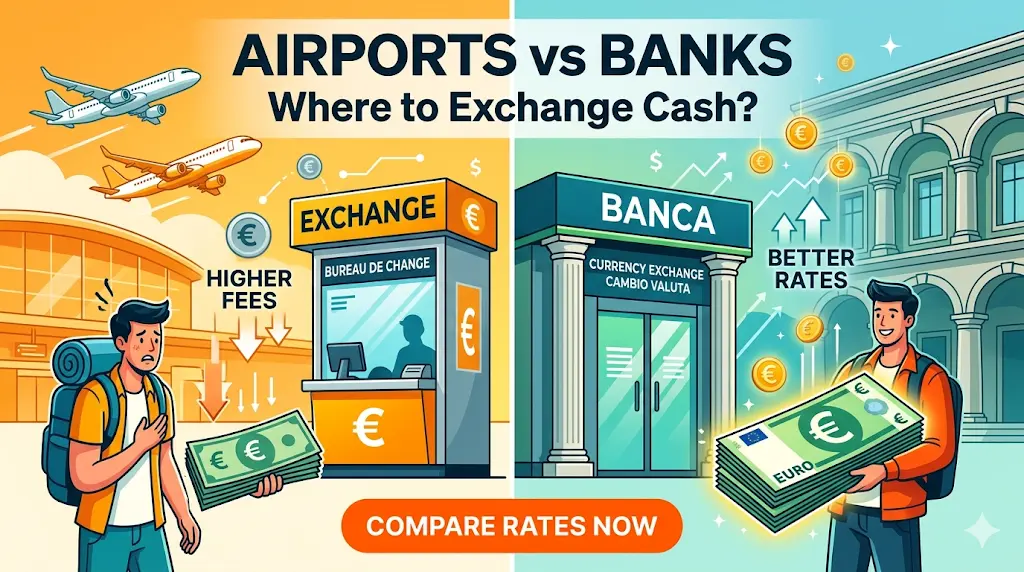
When you stagger off an international flight, the brightly lit currency exchange booths near the baggage claim look incredibly convenient. Brands like Travelex or local airport affiliates rely entirely on this jet-lagged convenience to generate massive profits.
These kiosks operate using a predatory financial mechanism known as an exchange rate markup or “spread.” They buy your foreign currency at a price drastically lower than the true mid-market rate (the official interbank rate published daily by the European Central Bank and the Banca d’Italia), and they sell you euros at a significantly inflated price. On average, airport kiosks apply a markup ranging from 10% to 15% on the true exchange rate. If you are trying to carefully map out your initial Cost of Living in Italy 2026 Budgeting for Expats, surrendering fifteen percent of your starting capital just to get cash for a train ticket is a devastating financial leak.
The Illusion of Zero Commission
The most common psychological trap these airport kiosks use is the massive, neon “0% Commission” sign. As a stressed expat, you see this and assume you are getting a fair, transparent deal.
The reality is that the commission is entirely baked into the terrible exchange rate. They do not need to charge you a flat five-euro fee because they are already skimming twenty euros off the top of the currency conversion itself. You must ignore the marketing and look purely at the “We Buy” and “We Sell” numbers displayed on their digital boards. The wider the gap between those two numbers, the worse the deal is for you.
Using Traditional Italian Banks for Currency Exchange
Bureaucracy and Non Resident Limitations
If airports are a scam, the logical next step for most foreigners is to simply walk into a local Italian bank—such as Intesa Sanpaolo, UniCredit, or BNL—and ask to exchange foreign cash for euros.
If you attempt this without holding an active account at that specific branch, the teller will almost certainly turn you away. Due to strict European Union Anti-Money Laundering (AML) directives, Italian banks refuse to process cash exchanges for walk-in tourists or undocumented expats. To open a bank account so you can execute these exchanges, you must provide your verified residency documents and your official tax identity. If you have not yet completed the steps in Checking Your Italian Tax Code Codice Fiscale Status or finished Navigating Italian Bureaucracy Comune and Prefettura, you are entirely locked out of the traditional Italian retail banking system.
Bank Hidden Fees and Processing Times
Even if you successfully open an Italian bank account, relying on them for your currency exchange needs is highly inefficient. If you instruct your home country bank to send a SWIFT wire directly to your new Italian account, you will be attacked by fees from all sides.
First, your home bank will charge an outgoing international wire fee. Then, intermediary banks will take a cut as the money travels across the globe. Finally, your Italian retail bank will apply its own corporate exchange rate markup to convert your foreign currency into euros, plus an incoming wire fee. The entire process can take up to five business days, leaving you stranded without liquid capital when you need to put a deposit down on an apartment or begin Getting an Auto Loan in Italy as a Foreigner.
Withdrawing Euros Safely from Italian ATMs
Declining Dynamic Currency Conversion
The absolute best way to get physical cash when you arrive in Italy is to bypass the exchange kiosks entirely and use your foreign debit card at a local ATM. However, this method is rigged with a highly sophisticated software trap known as Dynamic Currency Conversion (DCC).
When you insert a non-European debit card into an Italian ATM, the machine will recognize your home currency. The screen will display a prompt asking if you want to be charged in your home currency with a “guaranteed” exchange rate, rather than being charged in euros. The prompt is deliberately designed to make accepting the conversion look like the safe, logical choice.
You must always decline this conversion. If you press “Accept,” you are authorizing the local ATM operator to dictate the exchange rate, which usually includes an 8% to 12% hidden markup. By pressing “Decline Conversion” or “Proceed in Local Currency,” you force the transaction to be processed in pure euros. Your home bank or card network (like Visa or Mastercard) will then perform the currency conversion on the backend, which is almost universally cheaper than the ATM’s rate. Remembering this one rule is the core lesson of Avoiding ATM Withdrawal Fees in Italy.
Avoiding Independent Tourist ATMs
Not all ATMs are created equal. As you walk through major transport hubs like Termini Station in Rome or popular tourist squares in Florence, you will see bright blue and yellow ATMs branded as Euronet.
You must avoid these independent kiosks at all costs. These machines charge massive flat fees (often €4 to €5 per withdrawal) simply for using their hardware, in addition to aggressively pushing the worst DCC rates in the country. To withdraw cash safely, only use authentic Italian bank ATMs attached to physical bank branches (look for the official “Bancomat” logo). For smaller daily transactions, you should skip cash altogether and integrate into the local digital economy by understanding the strategies in Using Mobile Payment Apps Satispay etc in Italy.
The Smartest Ways to Manage Cross Border Money
Digital Solutions for Daily Spending
To completely eliminate the friction of currency exchange, veteran expats rely entirely on modern financial technology. For daily operational cash flow, rent payments, and ATM withdrawals, Wise is the undisputed champion.
By setting up a Wise account before you even board your flight to Italy, you can fund your digital wallet with your home currency. You can then convert that money to euros instantly inside the Wise app at the true, mid-market exchange rate—the exact rate you see on Google, with no hidden spreads. When you arrive at the airport, you simply take your physical Wise debit card, walk past the predatory exchange kiosks, and withdraw euros directly from an official Bancomat.
Furthermore, Wise provides you with a localized European IBAN. This allows you to pay your Italian landlord, settle utility bills, and execute free SEPA transfers exactly like a local resident, completely bypassing the massive SWIFT fees charged by traditional banks. Integrating Wise into your daily life is the most effective strategy discussed in Exchange Rates Sending Money to Italy Smartly.
Managing Large Capital Transfers
While digital wallets are perfect for daily expenses, they are not designed to house your life savings or complex investment portfolios. When you need to move massive amounts of capital across borders—perhaps to buy a home outright or to secure your retirement—relying on retail banking rails or basic payment apps is a mistake.
For heavy capital management, the most secure and cost-effective route is using Interactive Brokers. Because Interactive Brokers operates as a globally regulated, institutional-grade platform, it allows expats to execute massive foreign exchange (Forex) conversions at raw interbank rates with microscopically low commissions.
You can move your life savings into Interactive Brokers in your home currency, execute the conversion to euros at fractions of a cent on the dollar, and keep your wealth safely invested in global equities rather than letting it stagnate in a low-yield Italian retail bank. When you need local liquidity, you simply withdraw the specific amount of euros required to fund your life in Italy. Holding your significant wealth in Interactive Brokers also generates the clean, standardized financial reports your accountant desperately needs when calculating your compliance for Declaring a Foreign Property in Italy’s Quadro RW and navigating dual-taxation treaties like the US-Italy Tax Compliance Form 8891 vs Modello 730. By separating your daily spending tools from your global wealth management platforms, you effectively shield yourself from every currency exchange trap Italy has to offer.
| Exchange Method | Exchange Rate Used | Hidden Fees | Best For |
| Airport Kiosks | Predatory Retail Rate | 10% – 15% Spread | Absolute emergencies only |
| Italian Retail Banks | Corporate Rate | Incoming SWIFT Fees + Spread | Very limited use; difficult to access |
| Bank ATM (Declining DCC) | Visa/Mastercard Rate | Your Home Bank’s Foreign Fee | Quick cash on arrival |
| Wise Card at Bank ATM | True Mid-Market Rate | Zero Spread | Daily spending and local cash withdrawals |
| Interactive Brokers Forex | Interbank Rate | Nominal Commission | Converting life savings, moving massive capital |
References
Primary sources (official)
- Banca d’Italia – Euro foreign exchange reference rates – https://www.bancaditalia.it/compiti/operazioni-cambi/index.html?com.dotmarketing.htmlpage.language=1
- European Central Bank – Euro reference exchange rates – https://www.ecb.europa.eu/stats/policy_and_exchange_rates/euro_reference_exchange_rates/html/index.en.html
Other helpful sources
- European Consumer Centre – Currency Conversion and Consumer Rights – https://commission.europa.eu/live-work-travel-eu/consumer-rights-and-complaints_en
- Investopedia – Dynamic Currency Conversion (DCC) Explained – https://www.investopedia.com/terms/d/dynamic-currency-conversion.asp
Disclaimer
The information provided in this article is for educational and informational purposes only and does not constitute official financial, legal, or banking advice. Foreign exchange rates, Dynamic Currency Conversion (DCC) markups, and ATM operator fees are highly volatile and subject to continuous change by local financial institutions. The regulatory environment regarding Anti-Money Laundering (AML) directives strictly governs the ability of non-residents to exchange physical currency at Italian retail banks. Always verify the specific fee schedule, currency conversion spread, and European IBAN requirements with your chosen financial provider or brokerage before executing international wire transfers.