The Regime Forfettario in Italy: Flat-Rate Tax for Freelancers
Dealing with the Italian tax man feels like walking into a labyrinth blindfolded while someone throws boiling espresso at you. I remember staring at my first tax estimation in a dusty office in Milan, wondering why half my hard-earned income was destined to vanish into the "bureaucracy void." This guide breaks down the Regime Forfettario to show you how to keep more of your euros and stay sane.
Disclosure: This post may contain affiliate links. We may earn a commission at no extra cost to you if you make a purchase through these links. Read full disclosure.
The Foundation of the Regime Forfettario
The Regime Forfettario is essentially Italy’s way of saying, "We know our tax system is a nightmare, so here is a shortcut for the little guys." It is a simplified tax regime designed for small businesses and freelancers. Unlike the standard tax system where you are taxed on your profit (revenue minus expenses) at progressive rates, the Forfettario applies a flat percentage to a pre-determined portion of your total revenue.
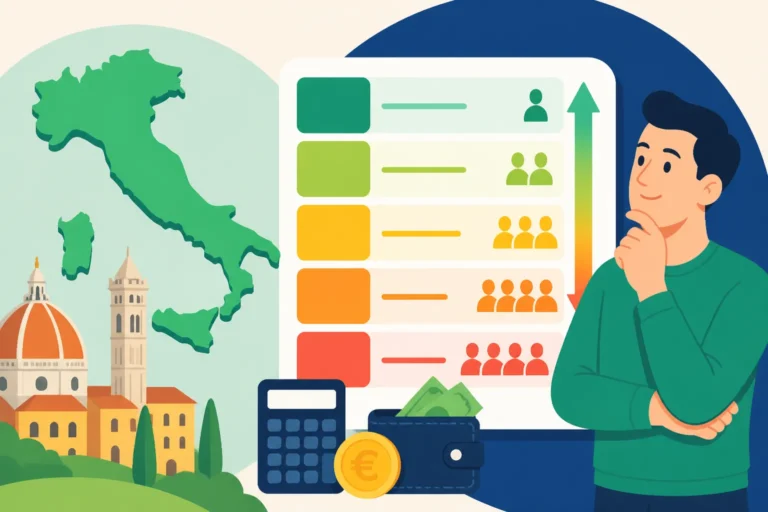
When I first moved here, I spent weeks trying to understand the Italian Income Tax (IRPEF) Brackets Explained before realizing that, as a freelancer, I didn't necessarily have to deal with those sliding scales. For most of us starting out, the Forfettario is the golden ticket. It eliminates the need for Value Added Tax (IVA) on your invoices, which makes your services instantly cheaper and more competitive than larger firms.
The Magic of the Five Percent and Fifteen Percent Tax Rates
The headline feature that draws most expats to this regime is the incredibly low substitute tax rate. For the first five years of your business, if you meet certain "start-up" requirements, you only pay a 5% tax on your taxable income. After those five years, or if you don't qualify for the start-up rate, the tax jumps to 15%. Even at 15%, it is significantly lower than the entry-level 23% IRPEF rate you would find in the ordinary regime.
Qualifying for that 5% rate is usually the goal. To get it, your business must be truly new—meaning you haven't done the same professional activity in the three years prior, even as an employee. If you were already doing the exact same job in Italy for a different boss, the Agenzia delle Entrate might view your new Partita IVA as a simple continuation of your old job and deny you the lower rate.
How the Flat Rate System Differs from Ordinary Taxation
In the ordinary tax world, you spend your life collecting receipts for every paperclip and train ticket, hoping your accountant can deduct them to lower your tax bill. In the Regime Forfettario, you cannot deduct individual expenses. There is no point in saving that receipt from your lunch meeting. Instead, the government assigns you a "Coefficient of Profitability" based on your industry code (Codice ATECO).
If your coefficient is 78%, the government assumes that for every 1,000 euros you earn, 220 euros were expenses and 780 euros are pure profit. You are only taxed on those 780 euros. For a consultant, this is usually a dream. For someone with high overhead, like a shopkeeper, it can be a disadvantage. This is why understanding your own business costs is so vital before you commit to this tax path, as you need to know if your real expenses are lower or higher than the government's estimate.
Eligibility Requirements for the Flat Rate Scheme
The Forfettario is a privilege, not a right, and the Italian government is very strict about who gets to stay in the "cool kids' club." The most famous rule is the revenue cap, but there are several other hurdles involving your residency and even your previous year's salary if you were an employee.
I have seen many friends get excited about the 5% tax rate, only to realize they earned too much in their previous corporate job to qualify. The bureaucracy doesn't just look at what you are doing now; it looks at where you came from.
The Eighty Five Thousand Euro Revenue Cap Explained
As of 2026, the revenue limit for the Regime Forfettario is 85,000 euros per year. This is a "hard" cap. If you earn 85,001 euros, you are technically out. However, there is a nuance: if you exceed 85,000 but stay under 100,000 euros, you finish the current year in the Forfettario and switch to the ordinary regime the following year. If you cross the 100,000-euro mark, you are kicked out of the regime immediately, and you have to apply VAT to all income earned from that moment forward.
Monitoring this cap is a full-time job toward the end of the year. If you are a high-earning freelancer, you might find yourself in the bizarre position of turning down work in December just to avoid crossing the threshold and losing your tax benefits. When receiving payments from abroad, especially in different currencies, using a platform like Wise is essential to ensure you are tracking the exact Euro amount that hits your account, rather than losing track through hidden bank fees.
Residency and Employee Income Restrictions
To use the Forfettario, you must be a tax resident in Italy. Generally, this means you spend more than 183 days a year here. Additionally, if you were also an employee in the previous year, your gross employment income cannot have exceeded 30,000 euros. If you made 31,000 euros at a desk job in London or New York last year and now want to move to Tuscany to freelance, you are barred from the Forfettario for your first year.
Furthermore, you cannot be a part of a partnership (SNC or SAS) or have a controlling interest in an SRL (private limited company) that performs activities similar to your freelance work. The government wants to prevent people from splitting one big business into multiple small "Forfettario" pieces to avoid higher taxes.
Calculating Your Taxable Income Under Forfettario
This is where the math gets specific, and where many expats get tripped up. Because you don't deduct actual costs, your tax bill is remarkably predictable, provided you know your ATECO code. Your ATECO code is a classification number for your specific type of work (e.g., "Graphic Design" or "Translator").
Calculating your taxes involves three steps: finding your gross revenue, applying your coefficient, and then subtracting your mandatory social security contributions. Only after those steps do you apply the 5% or 15% tax rate.
Understanding the Coefficient of Profitability
Every profession has a assigned percentage. For most professional services, the coefficient is 78%. For retail, it might be 40%. For construction, 86%. Let's look at a typical scenario for an English-speaking consultant living in Rome.
| Component | Example Calculation |
|---|---|
| Total Annual Revenue | 50,000 EUR |
| Industry Coefficient (78%) | 39,000 EUR (Taxable Base) |
| Assumed Expenses (22%) | 11,000 EUR (Non-taxable) |
| Social Security (INPS) Paid | 10,000 EUR (Deductible from base) |
| Final Taxable Income | 29,000 EUR |
| Substitute Tax (5%) | 1,450 EUR |
In this table, you can see that the "real" tax rate on the 50,000 euros earned is incredibly low. This is why the regime is so popular. However, for Americans, it is worth noting that the IRS does not always view this "substitute tax" the same way they view traditional income tax. Checking in with experts like Taxes for Expats is a smart move to ensure you are maximizing your Foreign Tax Credits back home.
Deducting Social Security Contributions (INPS)
The only thing you are allowed to subtract from your taxable base before the tax is calculated is the social security (INPS) you paid during that same year. This creates a bit of a "lag" in your first year of business. In Year 1, you haven't paid any INPS yet, so you can't deduct anything. In Year 2, you pay the INPS for Year 1, which then lowers your taxable base for Year 2.
This interaction between INPS and the substitute tax is the core of your financial planning. You need to be aware of INPS Social Security Contributions in Italy: An Overview to understand how much of your revenue will actually be "eaten" by the state. While the 5% tax sounds great, the INPS contributions for freelancers are usually around 26%, which is often the bigger bill.
Managing Your Finances and Administration
The administrative burden of the Forfettario is lighter than the ordinary regime, but "lighter" in Italy still means you have a stack of digital paperwork. You don't have to keep a VAT register, but you still have to issue invoices correctly and keep track of your revenue to ensure you don't hit that 85k ceiling.
One of the biggest hurdles for new expats is the digital identity requirement. You cannot interact with the tax office without a SPID and Digital Identity for Italian Tax and Services. This digital "key" allows you to log into your tax portal (Fisconline) and see your contributions and tax debts.
The Importance of the Partita IVA and Codice Fiscale
You cannot breathe in the Italian financial system without a Codice Fiscale, and you cannot bill a client without a Partita IVA. When you apply for the Forfettario, you are essentially requesting a Partita IVA specifically flagged for this regime. This tells your clients and the government that you are not charging VAT.
I have seen people try to use their foreign company structures to work in Italy while living here, which is a fast track to a "permanent establishment" audit. It is much safer to How to Open a Partita IVA in Italy: Step-by-Step and do things the local way. Once you have your numbers, you can also apply for The Italian Health Card (Tessera Sanitaria): Uses and How to Get One, which is often linked to your residency and professional status.
Handling Invoicing and the Electronic Invoice (Fattura Elettronica)
Since 2024, almost everyone in the Regime Forfettario is required to use the Fattura Elettronica (Electronic Invoicing). Gone are the days of sending a simple PDF via email. Now, your invoice must be sent through the government’s Exchange System (SDI). If it isn't in the system, it legally doesn't exist.
Issuing an electronic invoice requires specific software. Many Italian banks offer this, but most expats prefer third-party platforms that are more user-friendly. Your invoice must also include a specific "bollo" (revenue stamp) of 2 euros if the total amount exceeds 77.47 euros. You don't buy a physical stamp anymore; you pay it virtually through your tax portal every quarter.
Navigating INPS and Social Security Obligations
While the tax part of the Forfettario is a flat 5% or 15%, the social security part is where things get "Italian." Depending on what you do, you will either fall into the Gestione Separata (for consultants and creative professionals) or the Gestione Artigiani e Commercianti (for traders and artisans).
The rates and payment schedules are different, and failing to plan for these payments is the number one reason freelancers go broke in their second year. The "tax hit" in Italy often comes all at once in June and November, and it includes not just what you owe for last year, but a massive "down payment" for next year.
Gestione Separata vs. Professional Funds
If you are a translator, web designer, or general consultant, you will likely join the Gestione Separata. There is no fixed minimum payment; you pay a percentage (roughly 26%) of your taxable income. If you earn nothing, you pay nothing. This is great for those with fluctuating income.
However, if you belong to a protected profession with its own "Albo" (like architects, lawyers, or engineers), you don't pay INPS. You pay into your own professional fund (Cassa). These funds often have mandatory minimum yearly payments regardless of your income. It is vital to Choosing a Commercialista (Accountant) in Italy who understands your specific profession, as the rules for these funds can be wildly different from the standard INPS rules.
The Thirty Five Percent Reduction for Artisans and Traders
If you are registered as an artisan or a trader (Commerciante), you have a different deal. You have to pay a mandatory minimum contribution of about 4,000 euros a year, even if your revenue is zero. The upside is that if you are in the Regime Forfettario, you can apply for a 35% reduction in these contributions.
This reduction is a massive help for those starting a small shop or a craft business. But be warned: paying less into the system means you are accruing fewer pension "points." If you plan to stay in Italy long-term, you need to weigh the immediate cash flow benefit against your future retirement needs.
Practical Steps to Setting Up and Common Pitfalls
Setting up is actually the easy part; staying compliant is where the "veteran" status comes in. You can't just wing it with a spreadsheet. Italian tax law changes every year with the "Legge di Bilancio" (Budget Law), and what was true in December might be different in January.
One of the most common pitfalls is the "Saldo e Acconto" system. In June, you pay the balance (Saldo) for the previous year and the first installment of the advance (Acconto) for the current year. In November, you pay the second installment of the advance. This means in your second year of business, you might end up paying nearly 50-60% of your current cash in one go.
Working with a Commercialista
In some countries, people do their own taxes. In Italy, doing your own taxes is a form of professional masochism. You need a commercialista. They are not just accountants; they are your shield against the Agenzia delle Entrate. They will handle your Filing Taxes in Italy: Modello 730 vs Redditi PF and ensure your electronic invoices are reaching the SDI correctly.
When looking for a commercialista, find one who speaks English if your Italian isn't up to technical par. More importantly, find one who is tech-savvy. Many old-school accountants still want you to bring physical folders to their office, which is a nightmare if you are living a digital nomad lifestyle.
Avoiding the Fake Freelance Trap
The Italian government is very sensitive to "falsa Partita IVA." This is when a company fires an employee and hires them back as a "freelancer" to avoid paying social security and providing benefits. If you only have one client, you work in their office, and you use their equipment, the government might decide you are actually an employee.
If they make this determination, the company gets fined, and you might lose your Forfettario status because you are no longer considered an independent professional. To avoid this, try to diversify your client base. Even having a few small side projects or international clients (paid via Wise to keep costs down) helps prove that you are a genuine business entity.
Understanding the Italian Health Ticket System
While the Forfettario covers your income tax, it doesn't exempt you from the other costs of living in Italy. Many expats assume that the 5% tax covers everything, but you still have to deal with the Understanding the Italian Health Ticket (Co-Payment) System. Even as a freelancer, when you go for a specialist visit or a blood test, you will often pay a "ticket" (a small fee), unless your income is below a very low threshold.
Your Forfettario income counts toward your "ISEE" (a measure of your household's economic status). If your business becomes very successful, your ISEE will rise, and you might lose access to certain social bonuses or discounted rates for nursery schools and utilities. It is all connected, and a good veteran expat knows that every euro earned on an invoice eventually ripples through their entire Italian life.
Disclaimer
This guide is provided for informational purposes only and does not constitute professional tax, legal, or financial advice. Italian tax laws are notoriously complex and subject to frequent changes. Always consult with a qualified commercialista or tax professional before making decisions regarding your Partita IVA or tax regime. The author is an expat sharing personal experiences and research, not a licensed financial advisor.