Family Reunification and Spouse Visas in Italy
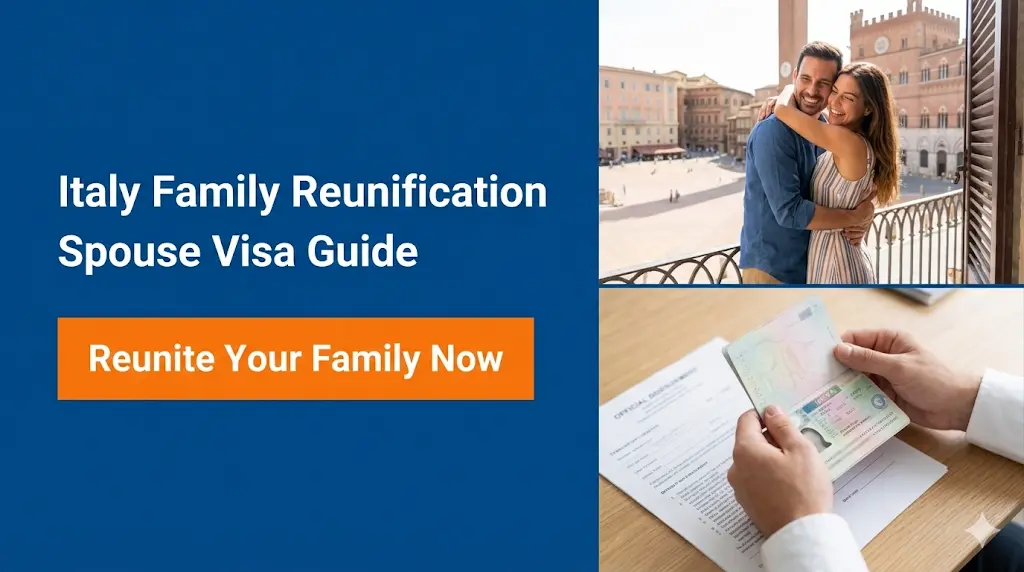
Navigating Italian immigration to bring loved ones abroad requires patience and precision. This guide details the specific requirements for Family Reunification (Ricongiungimento Familiare) and Spouse Visas, covering income thresholds, housing certificates, and the step-by-step application process for both EU and non-EU sponsors.
Disclosure: This post may contain affiliate links. We may earn a commission at no extra cost to you if you make a purchase through these links. Read full disclosure.
Introduction to Family Reunification and Spouse Visas in Italy
Moving to Italy is an adventure filled with the promise of la dolce vita, but for many expatriates, the experience is incomplete without their loved ones by their side. Whether you are a foreign worker already settled in Milan, a retiree enjoying the Tuscan countryside, or the spouse of an Italian citizen, navigating the legal pathways to bring your family to Italy is a top priority. However, the Italian bureaucratic system is notoriously complex, distinguishing sharply between citizens of the European Union and non-EU nationals.
The process is governed by strict laws intended to ensure that incoming family members will be adequately supported without becoming a burden on the state’s social welfare system. From obtaining the elusive Nulla Osta (authorization) to proving your accommodation meets local hygiene standards, the journey is rigorous. Yet, thousands of families successfully reunite in Italy every year.
This comprehensive guide will demystify the procedures for Family Reunification (Ricongiungimento Familiare) and the Spouse Visa. We will explore who is eligible, the financial hurdles you must clear, and the critical distinction between applying from abroad versus regularizing a family member who is already in Italy.
Understanding the Two Main Pathways
Before diving into paperwork, it is crucial to identify which legal category applies to your situation. Italy operates two distinct systems for family immigration, and confusing them is a common source of visa denials.
1. Family Reunification (Ricongiungimento Familiare)
This pathway is strictly for non-EU citizens residing in Italy with a valid residence permit (Permesso di Soggiorno) who wish to bring their non-EU family members from abroad. This is the most complex route, requiring the sponsor in Italy to prove income and housing eligibility before the family member can even apply for a visa in their home country.
2. Family Member of an EU/Italian Citizen
If the sponsor is an Italian citizen or a citizen of another EU country living in Italy, the process is significantly streamlined. Under EU Directive 2004/38/EC, the right to family unity is considered a fundamental right. Consequently, there are fewer income requirements, and the housing regulations are less stringent compared to the non-EU route.
Who Is Eligible for Family Reunification?
Italy does not allow you to bring just anyone. The law (Legislative Decree 286/98) defines “family” quite narrowly for immigration purposes.
If you are a non-EU resident in Italy, you may request reunification for:
- Spouses: You must be legally married and over the age of 18. Italy recognizes civil unions (for same-sex couples) as equivalent to marriage. However, fiancé(e)s do not qualify for this visa.
- Minor Children: Unmarried children under the age of 18. This includes adopted children and children of the spouse from a previous relationship, provided the other parent has given consent.
- Adult Children: Only if they are dependent due to serious health reasons resulting in total disability (100% invalidity). You cannot bring an adult child simply because they are studying or unemployed.
- Dependent Parents: Parents over 65 may be reunited only if they have no other children in their home country capable of supporting them, or if their other children cannot support them due to serious health issues. You must prove you provide their financial support.
Important Note for Students: If you hold a Student Visa, you can apply for family reunification, but you must meet the same financial and housing requirements as a worker. This is often difficult for students working restricted part-time hours.
For a broader understanding of how these visa types fit into the general immigration landscape, reviewing the Ultimate Guide to Visas and Immigration in Italy is highly recommended.
Requirements for the Sponsor (Non-EU)
The burden of proof lies heavily on the sponsor living in Italy. Before your family member approaches the Italian consulate in their home country, you must obtain a Nulla Osta (Clearance/Authorization) from the Sportello Unico per l’Immigrazione (SUI) in Italy. To get this, you must satisfy two major pillars: Economic Resources and Housing Suitability.
1. Economic Resources (Income)
You must demonstrate that you earn enough money to support yourself and the family members you intend to bring. The benchmark used is the annual Social Allowance (Assegno Sociale), which is adjusted annually.
As of 2026, the calculation generally follows this formula:
- Base Income: Annual amount of the Social Allowance (approx. €6,947, subject to inflation adjustments).
- Multiplier: You need the base amount plus half the amount for each family member you wish to bring.
For example, if the annual social allowance is roughly €7,000:
- To bring 1 family member (e.g., spouse): Income of ~€10,500 required.
- To bring 2 family members (e.g., spouse + child): Income of ~€14,000 required.
- To bring 3 family members: Income of ~€17,500 required.
- To bring 4 or more: Income of ~€21,000 required.
Note: If you are reuniting with two or more children who are under 14 years old, the income requirement is capped at double the annual social allowance.
2. Housing Suitability (Idoneità Alloggiativa)
This is often the biggest stumbling block for expats. You must prove that your apartment is large enough and meets local hygiene standards.
- Certificate: You need a certificate issued by the technical office of your local Comune (municipality).
- Occupancy Standards: While it varies by region, generally, you need about 14 square meters per inhabitant. A studio apartment might be too small for a family of three.
- Documentation: You will need your lease agreement, floor plan (planimetria), and boiler maintenance records.
Securing the right property is the first step. If you are currently house-hunting with reunification in mind, consult Finding Rental Apartments in Italy: Websites and Tips to ensure your lease will support your application.
The Application Process: Step-by-Step
Navigating the bureaucracy requires a strategic approach. Do not book travel tickets until the visa is actually in hand.
Step 1: Online Application for Nulla Osta
The sponsor in Italy logs into the Ministry of the Interior’s portal (Portale Servizi ALI) using their SPID (digital identity).
- Complete the “Modello S” (or “Modello T” depending on the exact family relationship).
- Upload copies of your permit, passport, and tax documents (CUD or Unico).
- Wait. The legal processing time is 90 days, though in major cities like Rome or Milan, it can take significantly longer.
Step 2: The Appointment at the Prefettura
Once the immigration office reviews your online submission, you will be summoned to the Prefettura (Prefecture) to submit the original hard copies of your documents:
- Original employment contract and recent payslips.
- Original Housing Suitability Certificate.
- Revenue stamp (Marca da Bollo).
If everything is in order, the Nulla Osta will be issued electronically and sent directly to the Italian Consulate in your family member’s home country. You will also receive a copy.
Step 3: Consular Visa Application
Within 6 months of the Nulla Osta issuance, your family member must apply for the visa at the Italian Embassy or Consulate in their country of residence. They will need:
- The Visa Application Form (Type D – Family).
- Valid Passport.
- Copy of the Nulla Osta.
- Proof of Relationship: Marriage or birth certificates. Crucial: These documents must be translated into Italian and legalized (or Apostilled) by the authorities of the issuing country. If the consulate cannot verify the relationship, the visa will be denied.
Step 4: Arrival in Italy
Once the visa is approved, your family member can travel to Italy.
- Within 8 Days: Upon arrival, you must inform the Sportello Unico and apply for their residence permit. This initiates the process for them to receive their own Italian Residence Permit (Permesso di Soggiorno) Explained.
Family Cohesion: An Alternative Route?
What happens if your spouse is already in Italy on a tourist visa? Can they stay?
This process is known as Family Cohesion (Coesione Familiare). It allows a family member currently in Italy (legally) to convert their status to a family residence permit without returning home to get a visa.
- Eligibility: The family member must have entered Italy legally (e.g., a tourist stamp) and the visa/entry stamp must not have expired.
- Risk: It is riskier than reunification. If the processing takes too long or if documents are missing, the family member might overstay their tourist visa, complicating their legal standing.
- Procedure: You apply directly through the Post Office (Poste Italiane) using the “Kit Giallo,” skipping the Nulla Osta phase, but you must still include all proof of income and housing suitability in the kit.
The “EU Spouse” Pathway
If you are an Italian citizen or an EU national living in Italy, the process is governed by Legislative Decree 30/2007. This is significantly easier and faster.
Key Differences
- No Nulla Osta: You do not need to apply for authorization from the immigration office.
- Visa Facilitation: If your non-EU spouse requires a visa to enter Italy, they apply directly at the consulate for a “Tourism/Visit to Family Member of EU Citizen” visa. This is often free of charge and processed primarily on the basis of the marriage certificate.
- Direct Permit Application: Once in Italy, the spouse goes directly to the Questura (Police Headquarters) or Post Office to apply for a Carta di Soggiorno (Residence Card for Family Members of EU Citizens). This card is valid for 5 years.
Income Thresholds for Reunification (2026 Estimates)
The table below outlines the estimated annual income required based on the number of dependents. These figures are based on the standard social allowance calculation and are subject to annual adjustment.
| Family Members to Reunite | Calculation Method | Estimated Annual Income Required (Net) |
| 1 Family Member | Social Allowance + 50% | ~€10,420 |
| 2 Family Members | Social Allowance + 100% | ~€13,894 |
| 3 Family Members | Social Allowance + 150% | ~€17,367 |
| 4 Family Members | Social Allowance + 200% | ~€20,841 |
| 2+ Children (<14 years) | Capped at Double Allowance | ~€13,894 (Fixed) |
Note: Always verify the current year’s “Assegno Sociale” amount with the INPS website or a patronage institute (Patronato).
Vital Documents and Legalization
One of the most frequent causes of delay is document legalization. Italian authorities will not accept a foreign marriage or birth certificate at face value.
- Translation: Documents must be translated into Italian by a certified translator.
- Legalization/Apostille: If your country is a signatory to the Hague Convention, you need an Apostille stamp. If not, you need legalization from the Italian Embassy in the issuing country.
- Validity: Some documents (like criminal records or marital status certificates) expire after 6 months. Ensure they are fresh when you apply.
Once your family arrives, you will need to register their presence with the local authorities. This is a critical step for accessing services like school and doctors.
Rights of the Family Member
Once your family member obtains their Residence Permit for Family Reasons (Permesso di Soggiorno per Motivi Familiari), they enjoy substantial rights:
- Work: They have full access to the labor market. They can be employed or self-employed without needing a separate work visa.
- Education: Children have the right (and obligation) to attend Italian schools.
- Healthcare: They are entitled to register with the National Health Service (SSN).
- Mobility: They can travel within the Schengen Zone for up to 90 days in any 180-day period without a visa.
Common Pitfalls and Troubleshooting
1. The “Residency” Trap
The sponsor must have a registered residency (Residenza) at the address where the family will live. If you only have a “domicile” or are staying in temporary housing without a registered lease, your housing certificate will be denied.
2. Income Fluctuations
The immigration office looks at your previous year’s tax return (CUD or Modello Unico). If you started a new job recently and your last year’s income was low, you may need to wait until you have sufficient payslips to prove your current stability.
3. Housing Certificate Delays
In some municipalities, getting the Idoneità Alloggiativa can take months. Apply for this document as soon as you sign your lease, even before you start the Nulla Osta process.
Conclusion
Family Reunification is a testament to Italy’s commitment to the social value of the family unit, but it is protected by a fortress of paperwork. Whether you are a non-EU worker proving your financial stability or an EU citizen exercising your treaty rights, success depends on meticulous preparation.
Do not underestimate the time required for document legalization abroad or the wait times at the Italian Prefecture. Start gathering your financial proofs and housing documents well in advance. While the process is arduous, the reward—building a life in Italy surrounded by the people you love—is well worth the effort.
References
Primary sources (official)
- Ministry of the Interior (Sportello Unico per l’Immigrazione): https://www.interno.gov.it/it/temi/immigrazione-e-asilo/modalita-dingresso/sportello-unico-limmigrazione
- Polizia di Stato (Family Reunification): https://www.poliziadistato.it/articolo/10619
Other helpful sources
- Integrazione Migranti (Legal Guides): http://www.integrazionemigranti.gov.it/
Disclaimer
The information provided in this article is for educational and informational purposes only and does not constitute official legal or immigration advice. Income thresholds, document requirements, and processing times for Family Reunification are subject to change by the Italian government. Always verify the latest requirements with the Sportello Unico at your local Prefecture or a qualified immigration lawyer before submitting your application.