Italy visa rules for Canadian and Australian citizens
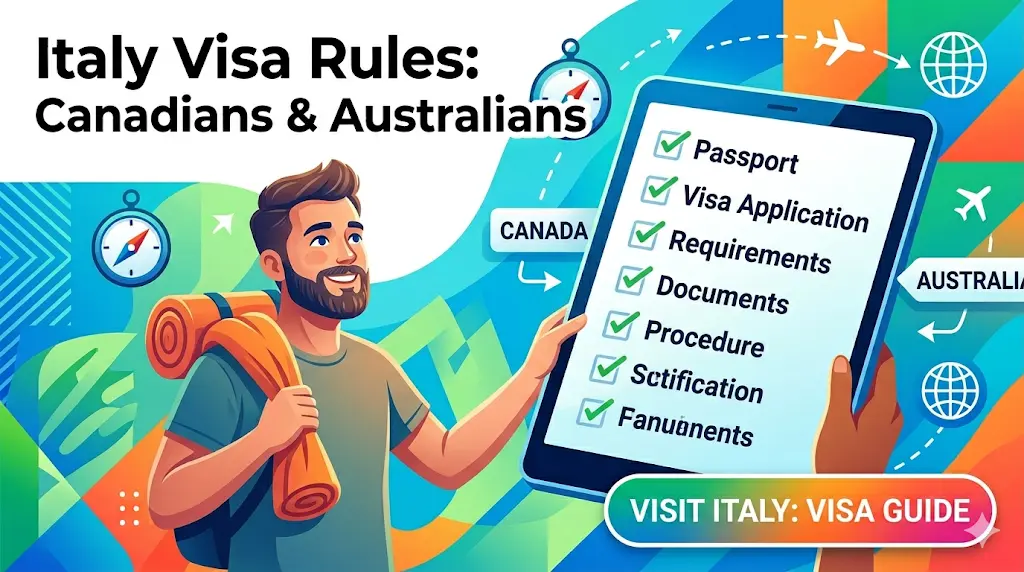
Arriving in Italy with a powerful passport gives you a false sense of security until you realize the border police do not care how polite you are. I remember staring at my exit stamp, devastated to learn my nationality didn’t exempt me from the strict 90-day tourist limit. This guide breaks down the specific visa pathways and realities for Australians and Canadians trying to legally stay in Italy.
Disclosure: This post may contain affiliate links. We may earn a commission at no extra cost to you if you make a purchase through these links. Read full disclosure.
The Schengen Limit and the New Digital Borders
Having a Canadian or Australian passport is a massive privilege, but it creates a dangerous illusion of limitless mobility. Many expats from these countries arrive in Italy under the assumption that they can simply figure out the paperwork once they find an apartment or a job. This is a catastrophic administrative error that can result in your deportation.
How the Tourist Exemption Actually Works
Citizens of Canada and Australia currently enjoy visa-free access to the Schengen Area for short stays. This means you can arrive at Rome Fiumicino or Milan Malpensa without applying for a visa in advance. However, this exemption is strictly limited to 90 days within any rolling 180-day period.
The most common mistake expats make is thinking this 90-day limit resets if they simply cross the border into Switzerland or the UK for a weekend and come back. It does not. The 180-day window is a rolling calculation looking backward from your current date. If you spend 90 days in Italy, you must leave the entire Schengen Area for a full 90 days before you can legally re-enter. Attempting to organize your long-term move while simultaneously dodging this ticking clock is incredibly stressful. This is why mapping out a concrete legal strategy is the most crucial step on your Checklist: All You Need Before Moving to Italy.
The ETIAS Launch and Automated Tracking
In the past, some backpackers and digital nomads relied on the fact that border guards were human and occasionally forgot to stamp passports, creating a gray area regarding exactly how long they had been in the country. Those days are permanently over.
The European Union is launching the Entry/Exit System (EES) and the European Travel Information and Authorisation System (ETIAS). Understanding the Italy’s ETIAS implementation date and what travelers need is vital, as this system entirely digitizes the border. Every entry and exit will be biometrically recorded. If you overstay your 90 days by even a single afternoon, the automated system will flag your passport. You cannot bypass this by taking a train across a land border. Once flagged, you face massive fines, deportation, and a potential multi-year ban from entering Europe entirely.
The Working Holiday Visa Lifeline
If you are a younger expat, you have access to one of the most powerful and underutilized legal loopholes available: the bilateral Youth Mobility agreements. Italy has specific, reciprocal Working Holiday Visa (WHV) programs established with both Australia and Canada.
Age Limits and Application Quirks
The Working Holiday Visa allows you to live and work in Italy for up to one year. However, the demographic restrictions are rigid. For Australian citizens, you must be between the ages of 18 and 30 (inclusive) at the time of application. For Canadian citizens, the agreement is slightly more generous, allowing applicants between the ages of 18 and 35.
You cannot apply for this visa from within Italy; you must submit your application to the Italian consulate that holds jurisdiction over your permanent residence in your home country. The application requires demonstrating a minimum bank balance to prove you can support yourself before you find a local job, as well as providing a clean criminal background check.
Presenting your local Australian or Canadian police checks to the Italian consulate is a frequent point of failure because the consulate demands these legal documents be in Italian. You cannot translate these yourself. Relying on RushTranslate is the most effective way to solve this. By sending your background checks to RushTranslate, you will quickly receive the certified Italian translations that consular officers demand, preventing your application from being rejected on a technicality.
Turning a Working Holiday into a Long Term Stay
The Canadian and Australian agreements differ slightly when it comes to renewals. Historically, the Australian Working Holiday Visa in Italy is strictly a once-in-a-lifetime opportunity; it lasts for 12 months and cannot be renewed or extended. The Canadian agreement recently underwent updates, occasionally allowing Canadian citizens to participate twice (up to 24 months total) depending on specific professional categories.
When you arrive in Italy with your WHV, your administrative marathon is only just beginning. Within your first eight days, you must go to the post office to apply for your physical residency card. Knowing How long after entry to apply for a residence permit in Italy is non-negotiable. If you secure a permanent employment contract during your Working Holiday, converting that permit into a standard work visa is technically possible, but it requires navigating the complex quota system of the Italian Decreto Flussi (Flow Decree).
| Feature | Australian Citizens | Canadian Citizens |
| Visa-Free Tourist Stay | 90 days out of 180 days | 90 days out of 180 days |
| Working Holiday Age Limit | 18 to 30 years old | 18 to 35 years old |
| Working Holiday Duration | 12 Months (Non-renewable) | Up to 12 Months (Possible 2nd term) |
| Health Insurance Required | Yes (Comprehensive Private) | Yes (Comprehensive Private) |
| Document Translations | Required (Certified Italian) | Required (Certified Italian) |
Long Term Visas for Professionals and Retirees
If you have aged out of the Working Holiday program, or you intend to move to Italy to run a business or retire, you must navigate the grueling standard national visa pathways. These are aggressively scrutinized by the consulates in Toronto, Vancouver, Sydney, and Melbourne.
Elective Residency and Digital Nomad Pathways
For retirees or individuals with significant wealth, the Elective Residency Visa (ERV) is the most common route. The ERV requires you to prove substantial, reliable passive income—such as pensions, rental properties, or dividends. You are strictly forbidden from engaging in local Italian employment on this visa.
If you need to work, you must look into alternative routes. Preparing the Acceptable financial proof for Italy self-employment visa is notoriously difficult because Italy places strict annual quotas on freelance visas. However, the introduction of the new digital nomad pathway provides a glimmer of hope for remote workers. If you are exploring Italy’s new digital residency pilot for expats, you must prove that you are a highly skilled worker earning a salary from a non-Italian employer.
Regardless of the visa category, your foreign financial documents must be localized. Handing an Italian consular officer a stack of Australian superannuation statements or Canadian corporate tax returns in English will result in an immediate rejection. You must use RushTranslate to process your financial portfolio. Getting your bank statements and tax returns processed by RushTranslate guarantees that the Italian officials can seamlessly read and verify your wealth without bureaucratic friction.
Navigating the Consular and Questura Labyrinth
Once your visa is approved and you arrive in Italy, you must immediately transition your visa into a Permesso di Soggiorno (residence permit). This involves mailing a thick yellow envelope at the post office and eventually attending a fingerprinting appointment at the local police station (Questura).
You will be tracking the Timelines for picking up your permesso di soggiorno in Italy, which can agonizingly stretch for six to ten months. During this waiting period, your physical location is critical. If you move apartments while waiting for your card, you must execute the steps for How to change your address with the Questura in Italy flawlessly to ensure you do not miss your appointment notice. Furthermore, if you happen to have a parent or grandparent born in Italy, investigating the Italian visa policy for dual nationals might allow you to bypass these visas entirely and claim citizenship by descent (jure sanguinis), though this process requires translating decades of vital family records.
Healthcare Requirements for Foreign Passports
The most common reason Canadian and Australian citizens are denied long-term Italian visas is a misunderstanding of how healthcare requirements work during the application process.
Why Provincial Healthcare and Medicare Fail
Many Australians mistakenly believe that the Reciprocal Health Care Agreement (RHCA) between Australia and Italy will satisfy the consulate. It will not. The RHCA is designed strictly for short-term tourists facing sudden medical emergencies; it is valid only for up to six months and does not cover long-term routine care. Canadians face a similar reality, as provincial healthcare plans (like OHIP or MSP) do not provide the global coverage required by Italian law.
To secure an Elective Residency Visa, a Digital Nomad Visa, or a Working Holiday Visa, the Italian consulate strictly demands proof of comprehensive private health insurance. The policy must cover 100 percent of emergency medical expenses, hospitalization, and medical repatriation, usually with zero deductibles. Handing the consulate a cheap travel insurance printout from a budget airline will guarantee a visa denial.
Securing Private Health Coverage
To bypass this hurdle effortlessly, veteran expats secure their coverage through Cigna Global. Because Cigna Global offers top-tier, internationally compliant health plans, their policy certificates are universally recognized by Italian consulates in both Canada and Australia.
When you attach your Cigna Global policy documents to your visa application, you instantly prove to the Italian government that you will not become a financial burden on their public healthcare system. Even after you arrive in Italy, keeping your Cigna Global active is an incredibly strategic move. As detailed in the Cost of Healthcare in Italy: What Expats Need to Know, registering for the local public health system (Tessera Sanitaria) can take months of paperwork, and public waiting times for specialists can be severe.
By holding a Cigna Global policy, you bridge this dangerous administrative gap and gain immediate access to Italy’s network of high-quality private hospitals and English-speaking specialists. You must protect your physical and legal health simultaneously; dealing with the Consequences of losing your permesso di soggiorno card while trying to figure out how to pay out-of-pocket for a medical emergency is an absolute nightmare. If you are bringing your family, ensuring your spouse and children are covered under your Cigna Global plan is vital, especially if you are managing the complex Conditions for working while on Italy Family Reunification Visa. By securing robust insurance and perfectly translating your documents, you transform the intimidating Italian immigration process into a manageable checklist.
References
Primary sources (official)
- Il Visto per l’Italia (Official Ministry of Foreign Affairs Visa Portal): https://vistoperitalia.esteri.it/home/en
- European Union ETIAS Official Information: https://travel-europe.europa.eu/etias_en
Other helpful sources
- Portale Immigrazione (Official Italian Immigration Portal): https://www.portaleimmigrazione.it/
- Polizia di Stato (Italian State Police – Foreigners Section): https://www.poliziadistato.it/articolo/10617
Disclaimer
The information provided in this article is for general informational purposes only and does not constitute official legal, immigration, or financial advice. Italian visa regulations, bilateral Youth Mobility agreements, and consular document requirements are highly complex and subject to frequent legislative updates. Always verify current visa categories, insurance minimums, and translation protocols directly with the specific Italian Consulate holding jurisdiction over your permanent residence in Canada or Australia before submitting an application or booking international travel.