Italian visa policy for dual nationals
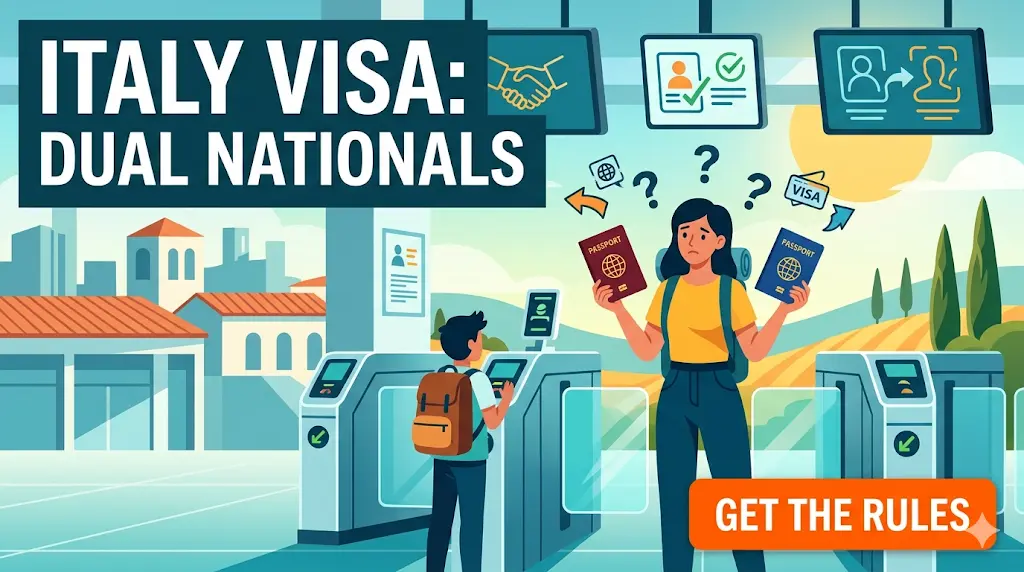
Standing at the Rome-Fiumicino passport control line, holding two different passports, and realizing you handed the border agent the wrong one is a heart-stopping moment. I once almost violated Schengen rules because I swapped my travel documents mid-trip. This guide clarifies the exact rules for dual nationals entering Italy, explaining which passport to use and how to avoid border penalties.
Disclosure: This post may contain affiliate links. We may earn a commission at no extra cost to you if you make a purchase through these links. Read full disclosure.
Choosing the Right Passport at the Border
The EU versus Non-EU Passport Advantage
If you are lucky enough to hold dual citizenship where one of your passports is from a European Union member state (such as Ireland, Germany, or France) and the other is from a non-EU country (like the United States, the United Kingdom, or Canada), your choice at the airport is incredibly simple. Always present your EU passport when landing in Italy.
Utilizing an EU passport grants you absolute freedom of movement under European law. You are completely exempt from the 90/180-day Schengen limit, you do not need to show return flight itineraries, and you bypass the rigorous questioning frequently aimed at tourists.
However, many expats hold two non-EU passports. For example, you might be a dual citizen of the United States and India. In this scenario, you must strategically choose which passport offers the best visa-free privileges. A US passport allows you to enter Italy without a visa for up to 90 days, whereas an Indian passport requires you to endure the complex, months-long process of applying for a Type C Schengen visa. Always travel on the stronger passport to avoid bureaucratic friction, keeping in mind the foundational rules detailed in Schengen Visa Requirements Italy.
The Golden Rule of Entering and Exiting
The single most damaging mistake dual nationals make is attempting to mix and match their passports during a single trip. If you hand the Italian border police your Canadian passport when you land in Milan, you must hand them that exact same Canadian passport when you fly out.
The European border control database records your entry and exit digitally. If you enter on a Canadian passport, the system starts a countdown. If you try to leave two weeks later using your Australian passport, the border agent scanning it will see absolutely no record of your legal entry into the Schengen Area. Simultaneously, the system will flag your Canadian passport as having overstayed because there is no recorded exit. This discrepancy can result in severe interrogations, missed flights, and a permanent red flag on your immigration profile. Understanding this technical tracking is a massive learning curve covered in Italy Border police vs immigration office who checks documents.
Visas ETIAS and the 90 Day Schengen Limit
The Myth of Resetting the 90 Day Clock
A pervasive and dangerous myth among dual nationals is the belief that they can “reset” their 90-day Schengen allowance simply by switching passports. Let’s say you hold both a US and an Australian passport, both of which grant visa-free entry. The myth suggests you can stay in Italy for 90 days on your US passport, cross the border to Switzerland for a day, and re-enter Italy on your Australian passport for another 90 days.
This is unequivocally false and highly illegal. The Schengen 90/180-day limitation applies to you as an individual human being, not to the specific travel document you carry in your pocket. The incoming Entry/Exit System (EES) utilizes advanced biometric data, matching your fingerprints and facial scans across all the passports you hold. If you attempt to manipulate the timeline by swapping nationalities, you will be caught, fined heavily, and likely banned from re-entering Europe for years.
The Incoming ETIAS Requirement
If you travel using a visa-exempt non-EU passport, your spontaneous trips to Italy are about to change. By 2026, the European Union is enforcing the European Travel Information and Authorisation System (ETIAS). This electronic waiver acts as a pre-clearance security check before you board your flight.
If you are a dual national with two non-EU passports (e.g., US and UK), you must ensure that your approved ETIAS is digitally linked to the exact passport you intend to hand to the Italian border guard. If you apply for ETIAS using your UK passport but try to travel on your US passport, the airline will deny your boarding pass because your US passport chip lacks the clearance. You must meticulously align your digital authorizations, a shift heavily detailed in ETIAS visa waiver What it means for traveling to Italy.
Bureaucracy Document Translation and Healthcare
Aligning Your Vital Records Across Borders
When dual nationals decide to formally move to Italy by applying for a long-stay visa—such as the pathway outlined in the Italian Elective Residence Visa VRE Complete Guide—the paperwork burden doubles. The Italian consulate frequently requires comprehensive background checks, birth certificates, and marriage licenses. If you hold multiple nationalities, they may demand clean police records from every country where you hold citizenship.
Because the Italian government strictly operates in Italian, submitting an FBI background check from the US and an ACRO police certificate from the UK in their original English formats will result in an instant visa rejection. You must provide certified Italian translations of every foreign document. This is exactly where veteran dual nationals rely heavily on RushTranslate. By submitting your various international documents to RushTranslate, you guarantee that the consular officer receives a fully standardized, legally certified Italian dossier.
I strongly advise against attempting to translate these sensitive legal documents yourself. A single mistranslated legal term regarding your dual citizenship status can trigger an administrative hold. Relying on RushTranslate eliminates this risk and ensures compliance with the strict standards of the Ministry of Foreign Affairs. Having your pristine RushTranslate files properly organized is the best way to survive the relentless scrutiny of Italian municipal clerks when you eventually begin Navigating Italian Bureaucracy Comune and Prefettura and tackling Checking Your Italian Tax Code Codice Fiscale Status.
Health Insurance Requirements for Dual Citizens
If you are entering Italy using a non-EU passport for a long-term relocation, your second citizenship does not exempt you from the strict Schengen medical insurance mandates. Before the consulate issues your visa, you must prove you possess a comprehensive private health insurance policy covering emergency hospitalization and repatriation.
Because you cannot access the public health system until your residency is fully finalized—a massive bureaucratic gap explored in Registering with the Italian Public Healthcare System SSN—you must bridge this vulnerability with private coverage. I highly recommend securing a policy through Cigna Global. Using Cigna Global provides a robust, internationally recognized policy that explicitly satisfies Italian national visa requirements.
Because Cigna Global covers expats globally, it is the perfect solution for dual nationals who frequently bounce between their two home countries and Italy. Presenting a Cigna Global certificate proves to the Italian state that you are not a financial liability. Securing Cigna Global ensures you are safely protected from unexpected medical emergencies the moment you land, giving you peace of mind while you handle your relocation paperwork, a survival tactic we cover heavily in Healthcare in Italy An Expats Guide.
Italian Dual Citizens Returning Home
Traveling with an Italian Passport
If one of your passports is Italian (perhaps acquired through ancestry or marriage), you belong to a completely different legal category. Under Italian law, if you possess Italian citizenship, you must enter and exit Italy as an Italian citizen. You cannot choose to enter Rome as an American tourist just because it feels easier or because you left your Italian passport at home.
Entering as an Italian citizen grants you the ultimate right of abode. You never have to worry about visas, ETIAS, or 90-day limits. However, to utilize this right without causing friction at the border, you must travel with a valid Italian passport or a valid Italian Electronic Identity Card (CIE).
Registering with AIRE and the Anagrafe
While having an Italian passport removes the immigration hurdle, it introduces a separate layer of civic responsibility. If you are an Italian dual citizen who has lived abroad and is now returning to Italy permanently, you must update your status.
If you lived abroad, you were legally required to be registered with the Register of Italians Residing Abroad (AIRE). Upon moving back to Italy, you must officially deregister from AIRE and register your physical presence at the local town hall’s Civil Registry (Anagrafe).
When you register at the local town hall to claim your permanent residency, the clerks will likely demand updated, certified copies of your foreign vital records, especially if you were married abroad or had children abroad since your citizenship was recognized. Once again, you must utilize RushTranslate to provide sworn Italian translations of these foreign life events. Without certified translations, the town hall will refuse to transcribe your marriage or children into the Italian civil registry, effectively blocking your family from accessing local benefits and schools.
| Passport Combination | Best Passport for Entry | Visa / ETIAS Required | 90-Day Limit Applies? |
| Italian + Non-EU | Italian | No | No |
| Other EU + Non-EU | EU Passport | No | No |
| Two Visa-Exempt Non-EU | Either (pick one and stick to it) | Yes (ETIAS required soon) | Yes |
| Visa-Exempt + Visa-Required | Visa-Exempt (e.g., US over Indian) | Yes (ETIAS required soon) | Yes |
References
Primary sources (official)
- Ministero degli Affari Esteri – Il Visto per l’Italia – https://vistoperitalia.esteri.it/home/en
- European Union – ETIAS Travel Authorisation – https://travel-europe.europa.eu/etias_en
Other helpful sources
- EEAS – Frequently Asked Questions on Schengen Visas – https://www.eeas.europa.eu/
Disclaimer
The information provided in this article is for educational and informational purposes only and does not constitute official legal or immigration advice. Dual nationals traveling to the Schengen Area are strictly bound by the rules of the passport they present at the border; the 90/180-day limitation applies to the individual traveler, regardless of holding multiple visa-exempt passports. Italian citizens are required by law to enter and exit Italian territory using their Italian travel documents. Always verify current entry requirements and border policies with the official Italian consulate in your jurisdiction prior to traveling.