Italian tax residency rules vs immigration visa
Opening your Italian mailbox to find a massive, unexpected tax bill from the revenue agency because you misunderstood your visa status is a terrifying expat milestone. I spent weeks in pure panic realizing my tourist status didn’t shield me from local tax liabilities. This guide clarifies the dangerous, confusing boundary between your immigration visa and your actual Italian tax residency.
Disclosure: This post may contain affiliate links. We may earn a commission at no extra cost to you if you make a purchase through these links. Read full disclosure.
The Great Expat Misunderstanding Visas vs Taxes
Immigration Residency Your Right to Stay
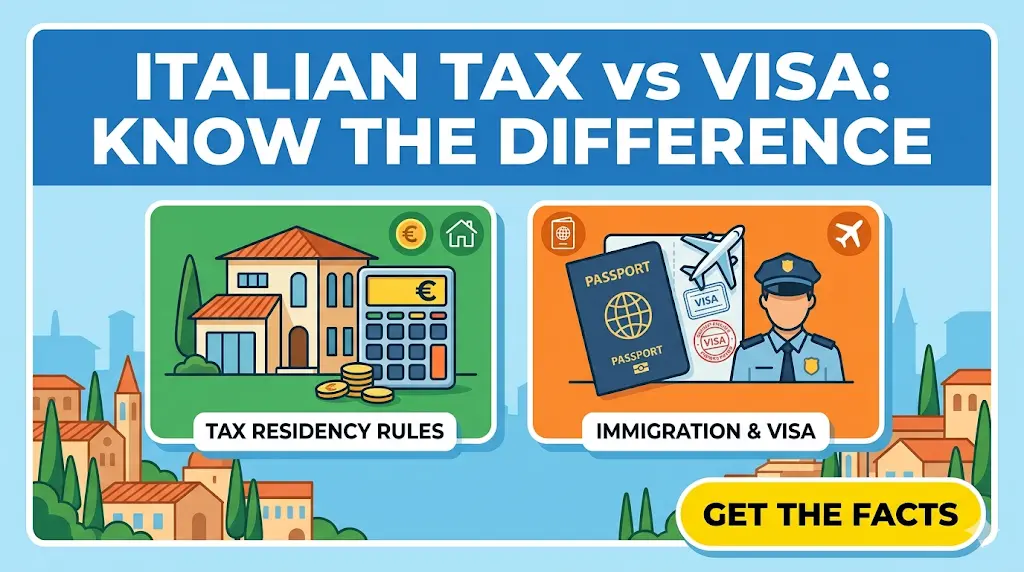
The most devastating mistake foreigners make when relocating is conflating the legal right to be in Italy with the obligation to pay taxes there. These are two completely separate legal frameworks governed by entirely different branches of the Italian government. Your immigration residency is managed by the Ministry of the Interior, specifically the border police and the local Questura (police headquarters).
A visa simply grants you permission to cross the border and legally sleep in a bed in Italy. Whether you are navigating the short-term limitations of Schengen Visa Requirements Italy, or establishing a permanent footing through the Italian Elective Residence Visa VRE Complete Guide, your visa sticker and your subsequent residence permit are just immigration tools.
Having a visa does not automatically mean you owe Italian taxes. Paradoxically, not having a visa does not mean you are exempt from Italian taxes either. The Italian revenue agency (Agenzia delle Entrate) operates completely independently of the immigration police. They do not care what type of visa you hold; they only care about where your economic center of life is physically located. When you are busy Renewing Your Italian Permesso di Soggiorno, the police are looking at your criminal record and housing suitability, not your global stock portfolio.
Fiscal Residency The 183 Day Physical Presence Rule
The golden rule of Italian taxation is the 183-day physical presence test. According to Article 2 of the Italian tax code (TUIR), if you are physically present in Italy for 183 days or more in a single calendar year (184 in a leap year), you are legally considered an Italian tax resident.
This law applies uniformly to everyone. It applies if you are an undocumented immigrant, a digital nomad hopping between short-term rentals, or a tourist who accidentally overstayed their Schengen allowance. If you hit that 183-day mark, you owe taxes to the Italian state on your worldwide income.
The 183 days do not have to be consecutive. You cannot simply leave for the weekend and reset the clock. The Italian tax authorities are highly sophisticated and will track your physical presence through credit card swipes, passport border stamps, utility bills, and cellular data usage. You cannot hide your presence behind a foreign passport. If you live your life in Italy for more than half the year, you are an Italian taxpayer.
Civil Registration and the Tax Trap
Registering at the Anagrafe
The 183-day physical presence rule is just one pathway to becoming a tax resident. The second, much more common trap for expats, involves civil registration. When you secure a long-term visa and sign a residential lease, you are legally required to register your permanent address at the local town hall. This administrative hurdle is deeply covered in Navigating Italian Bureaucracy Comune and Prefettura.
The moment you successfully register your address at the Anagrafe (Civil Registry), you become an official Italian resident on paper. By law, the Agenzia delle Entrate automatically classifies anyone registered at the Anagrafe for more than half the calendar year as a fiscal resident.
This creates a massive liability for unwary expats. Even if you physically leave Italy in June and spend the next nine months traveling through Asia, as long as your name remains active in the Italian Anagrafe, you are legally liable for Italian taxes. You must formally deregister with the town hall before you move abroad. Securing your initial identification number, which links you to this complex municipal system, is an essential process explained in Checking Your Italian Tax Code Codice Fiscale Status.
Worldwide Income and Double Taxation
Once you trigger Italian tax residency—either via the 183-day physical presence rule, formal civil registration at the Anagrafe, or by moving your primary family and economic interests to Italy—you are subject to worldwide taxation.
Italy does not just tax the money you make inside its borders. Italy will tax your local salary, your foreign government pensions, your stock dividends sitting in a brokerage account back home, and the rental income you earn from a house you own in another country. You must aggressively calculate these global liabilities when formulating your Cost of Living in Italy 2026 Budgeting for Expats.
To prevent you from paying full taxes twice on the exact same income, Italy has signed Double Taxation Agreements (DTAs) with dozens of countries. However, claiming relief under a DTA is absolutely not automatic. You must formally prove to the Italian tax authorities that you have already paid taxes abroad on that specific capital, requiring meticulous documentation.
| Concept | Immigration Residency | Fiscal (Tax) Residency |
| Regulating Authority | Ministry of the Interior / Questura | Agenzia delle Entrate |
| Qualifying Factor | Valid Visa or Permesso di Soggiorno | 183+ days present, or Anagrafe registration |
| Global Impact | Allows free movement within the Schengen Zone | Triggers taxation on worldwide income |
| Cancellation Method | Visa expiration or long absences | Formal deregistration from the Anagrafe |
Bureaucratic Survival and Paperwork
Translating Financial and Vital Records
When you sit down with your Italian accountant (commercialista) to file your first Italian tax return, you will have to present all your foreign financial documents. The Italian revenue agency requires absolute proof of your foreign income, capital gains, and taxes already paid to foreign governments in order to apply those crucial double taxation treaty benefits.
The Italian government strictly operates in Italian. You cannot simply hand your accountant an English W-2, a foreign pension statement, or a massive foreign tax return and expect the Agenzia delle Entrate to accept it during an audit. You must provide sworn Italian translations of these dense financial documents. This is exactly where veteran expats rely on RushTranslate. By utilizing RushTranslate, you ensure that your foreign financial records are translated with exact legal and fiscal accuracy.
I strongly advise against using amateur translation software for your tax documents. A single mistranslated financial term can cause the revenue agency to misclassify your income, leading to massive fines. Sending your foreign tax returns and dividend statements to RushTranslate guarantees that your commercialista has certified, compliant documents to defend your tax profile. Furthermore, when you first register at the town hall, you will need translated birth and marriage certificates. Relying on RushTranslate for these vital civil documents ensures your family is registered correctly, completely avoiding the municipal nightmares that cause foreigners to abandon their relocation plans.
Bridging the Healthcare Gap
The complex intersection of your visa and your tax residency creates a massive, expensive problem regarding your healthcare. To maintain your legal visa status, you must possess valid health insurance at all times. Many expats assume they can simply solve this by joining the public health grid immediately, a process detailed in Registering with the Italian Public Healthcare System SSN.
However, if you are not working locally for an Italian employer, joining the SSN voluntarily requires you to pay an annual fee based on a percentage of your worldwide income. If you have substantial foreign investments, a high-paying remote job, or heavy pension distributions, buying into the Italian public healthcare system can cost you thousands of euros a year because it is based directly on your newly established, global tax residency profile.
To avoid this massive financial hit during your initial transition, or to satisfy the strict visa requirements before your tax residency is even formalized, you must secure robust private insurance. I highly recommend securing a policy through Cigna Global. Using Cigna Global provides a comprehensive, internationally recognized policy that satisfies the immigration police for your visa, without forcing you to immediately declare your worldwide income to the local health authority.
Presenting a Cigna Global certificate proves to the Italian state that you are not a financial burden on their medical infrastructure. Securing Cigna Global ensures you are safely covered for medical emergencies from the exact moment you land, giving you the critical breathing room to figure out your complex tax strategy with your accountant. Maintaining an active Cigna Global policy acts as an essential financial shield while you navigate the exhausting reality of Mediterranean bureaucracy, a survival tactic heavily covered in Healthcare in Italy An Expats Guide.
References
Primary sources official
- Agenzia delle Entrate – Residence for tax purposes – https://www.agenziaentrate.gov.it/portale/web/english/residence-for-tax-purposes
- Ministero dell’Economia e delle Finanze – Double Taxation Agreements – https://www.finanze.gov.it/
Other helpful sources
- PwC Worldwide Tax Summaries – Italy Individual Residence – https://taxsummaries.pwc.com/italy/individual/residence
- Studio Legale Metta – Tax Residency in Italy – https://www.studiolegalemetta.com/
Disclaimer
The information provided in this article is for educational and informational purposes only and does not constitute official legal, tax, or immigration advice. Fiscal residency and immigration residency are governed by separate legal codes in Italy. You may trigger Italian tax residency (and subsequent taxation on your worldwide income) simply by being physically present in the country for 183 days or by registering at the Anagrafe, regardless of your specific visa status. Always consult a registered Italian immigration attorney (avvocato immigrazionista) and a certified international tax advisor (commercialista) to verify your exact legal obligations and tax liabilities upon relocating.