Acceptable financial proof for Italy self-employment visa
Walking into the consulate with what I thought was an impressive bank balance, only to have my self-employment visa rejected because I lacked a highly specific municipal certificate, was a devastating lesson in Italian bureaucracy. I spent months deciphering the unwritten rules of independent work. This guide details the exact financial proof required to successfully secure your Italian self-employment visa.
Disclosure: This post may contain affiliate links. We may earn a commission at no extra cost to you if you make a purchase through these links. Read full disclosure.
The Financial Baseline vs Bureaucratic Reality
The Legal Minimum Exemption Threshold
When researching the Italy self-employment visa (visto per lavoro autonomo), the most dangerous piece of information you will find online is the “legal minimum.” Italian immigration law states that independent workers must prove an annual income higher than the minimum level required for exemption from healthcare contributions. Currently, this baseline figure sits at roughly €8,500 per year.
Expats frequently read this number, print out a bank statement showing €10,000, and assume they are fully qualified to move to Rome or Milan. This is a catastrophic misunderstanding of the process. The €8,500 figure is merely a statutory baseline, not the practical threshold for visa approval. Consular officers are acutely aware that living in modern Italy on less than nine thousand euros a year is practically impossible.
If you submit an application hovering around this legal minimum, the consulate will reject you on the grounds that your business venture is unsustainable. They will assume you are using the freelance visa as a backdoor to enter the country and subsequently rely on public funds or seek unauthorized subordinate employment. To be taken seriously, your financial proof must vastly exceed this baseline, a reality you must account for when building your Cost of Living in Italy 2026 Budgeting for Expats.
The Chamber of Commerce Parametri Finanziari
The true financial threshold for your self-employment visa is not decided by the consulate in your home country, but rather by the local authorities in the specific Italian city where you plan to live. Before you can even apply for the visa, you must obtain an official document called the Attestazione dei parametri di riferimento (Attestation of Reference Parameters) from the local Chamber of Commerce (Camera di Commercio).
This is a uniquely frustrating Italian hurdle. You must declare exactly what kind of freelance work or business you intend to operate. The local Chamber of Commerce will then evaluate your business category and determine exactly how much capital you need to legally and successfully launch that specific activity in their jurisdiction. For a freelance graphic designer, they might demand proof of €15,000. For an independent architect or a specialized consultant, they might demand €25,000 or more.
You must prove to the local police headquarters (Questura) that you possess this exact amount of liquid capital before they will issue the preliminary security clearance (Nulla Osta) required for your visa. Understanding the intense local scrutiny involved in securing a Partita IVA (VAT number) is a foundational step outlined in our guide to Italian Self-Employment Visa Partita IVA Requirements.
Navigating the Decreto Flussi Quotas
Proving you have the money is only half the battle; the other half is proving it at the exact right time. Unlike standard corporate transfers or student visas, generic self-employment visas are strictly capped by the Italian government’s annual immigration quota system, known as the Decreto Flussi.
Historically, the Italian government allocates an incredibly small number of spots for self-employed foreigners—often limiting it to just 500 visas per year globally for standard freelancers. Because the competition is incredibly fierce, the financial scrutiny is absolutely brutal. The authorities use your financial documentation as the primary filter to weed out weak applicants.
If you are hoping to bypass these chaotic quotas, you must qualify for highly specific, extra-quota exemptions, such as the digital nomad visa or the formal investor visa (which requires a minimum €250,000 to €2,000,000 corporate investment). For standard freelancers battling the quota, ensuring your financial paperwork is flawless is your only defense against rejection, a high-stakes dynamic deeply explored in Understanding the Decreto Flussi in Italy.
Compiling Your Acceptable Financial Proof
Liquid Capital and Personal Bank Statements
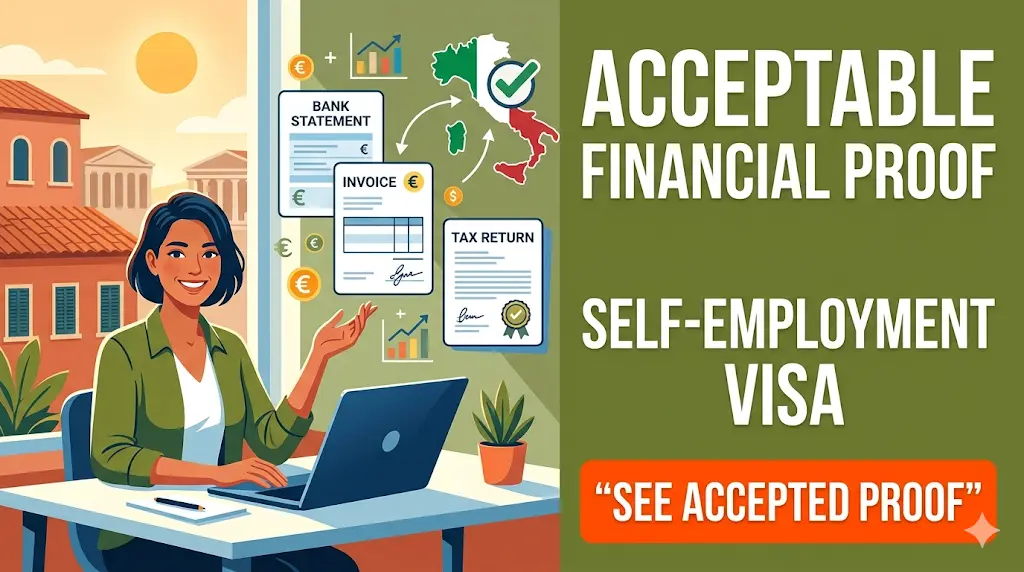
The most heavily scrutinized component of your application is your personal banking history. The Italian consulate and the Questura want to see substantial, accessible, and liquid capital. They will require at least six to twelve months of stamped, official bank statements.
Consular officers are specifically trained to look for “fund dumping”—the practice of suddenly transferring a massive amount of borrowed cash into your account the week before your appointment. If they see a sudden, unexplained deposit of $30,000 with no prior history of savings, they will instantly reject your application. Your bank statements must show a natural, steady accumulation of wealth or a clearly documented, legitimate source for the funds (such as the sale of a property).
The funds must be entirely yours, unencumbered, and immediately available to be transferred to an Italian bank account upon your arrival. If your capital is locked in restrictive retirement accounts, illiquid real estate, or inaccessible foreign trusts, the consulate will not count it toward your required parametri finanziari.
Past Tax Returns and Ongoing Client Contracts
To prove that your intended freelance activity is actually viable, you must prove that you have been successfully doing it in your home country. The consulate does not want to grant a self-employment visa to someone treating their move to Italy as a career experiment.
You must provide your foreign tax returns from the last two to three years proving a consistent, reliable income from your independent professional activities. Furthermore, you should provide ongoing, active contracts with international clients. These contracts must clearly outline your retainer fees or projected income, proving that you will continue to generate revenue the moment you step off the plane in Rome or Milan.
However, an Italian municipal clerk or consular officer cannot read a US IRS 1040, a UK HMRC tax return, or a complex English consulting contract. This is exactly why veteran expats rely heavily on RushTranslate. By utilizing RushTranslate, you ensure that your foreign tax returns and client contracts are translated into perfectly formatted, legally accurate Italian. I strongly advise against using amateur software for this. Relying on RushTranslate eliminates the risk of an officer misunderstanding your income streams. Having your pristine RushTranslate files properly organized is the most effective way to prove your professional viability without triggering administrative delays.
Business Plans for Foreign Entrepreneurs
If you are applying to enter Italy not as a simple freelancer (libero professionista) but as a business owner or entrepreneur (imprenditore), the financial proof requirements shift dramatically. You are no longer just proving you can support yourself; you must prove your business will actively benefit the Italian economy.
Entrepreneurs are usually required to submit a highly detailed, localized business plan. This document must outline your market research, projected operational costs, local hiring plans, and expected revenue over the next three years. Additionally, you may be required to prove a massive minimum investment capability (often €500,000 for specific enterprise visas) and demonstrate the intent to hire at least three Italian residents.
If your business plan incorporates partnerships or vendor agreements from your home country, those documents must be translated. Sending your corporate foundational documents to RushTranslate guarantees that the Italian Chamber of Commerce can instantly comprehend your global business structure. The certified paperwork provided by RushTranslate serves as your ultimate administrative shield when defending your business model to skeptical local authorities.
| Type of Financial Proof | Purpose of Document | Legal / Translation Requirement |
| Personal Bank Statements | Proves immediate liquid capital and financial stability. | Official bank stamps; certified translation often required. |
| Foreign Tax Returns | Proves historical success as an independent worker. | Certified Italian translation strictly mandatory. |
| Active Client Contracts | Demonstrates guaranteed future revenue streams. | Certified Italian translation strictly mandatory. |
| Chamber of Commerce Certificate | Sets the exact monetary threshold for your visa. | Issued in Italian natively. |
Mandatory Expenses That Drain Your Capital
Securing a Registered Lease
When calculating your required financial proof, you must account for the massive upfront capital required just to satisfy the consulate’s basic living requirements. You cannot apply for a self-employment visa with the intention of staying in a hotel or booking a temporary vacation rental while you look around.
The Italian consulate mandates that you must secure permanent, legal housing before you even submit your visa application. You must present a formalized, long-term rental contract that has been officially registered with the Agenzia delle Entrate (the Italian Revenue Agency). This creates a terrifying catch-22: Italian landlords are notoriously suspicious of renting to freelancers without an established local credit history. To secure a registered lease from abroad, you will likely have to pay massive upfront deposits—sometimes equating to six or even twelve months of rent in advance.
You must prove to the consulate that you have the required business capital in addition to the money you just spent securing your apartment. Understanding how to navigate this high-stakes negotiation without draining your vital cash reserves is deeply covered in Signing an Italian Rental Contract.
Comprehensive Health Insurance Coverage
Alongside your financial documents and registered lease, the most heavily scrutinized requirement in your visa portfolio is your proof of health insurance. Even if your ultimate plan involves Registering with the Italian Public Healthcare System SSN to pay local taxes and receive a public health card, you legally cannot access the Italian public health grid until you physically arrive, establish residency, and secure your final permit.
To secure the visa, you must purchase robust private insurance beforehand. The consulate strictly requires a policy that covers emergency hospitalization and medical repatriation back to your home country. If you provide a digital policy document from a small, unknown domestic insurer, the consular officer will likely reject it for insufficient long-term coverage or demand extensive Italian translations of the policy terms.
To completely bypass this administrative headache, I highly recommend securing a policy through Cigna Global. Using Cigna Global provides a globally recognized expat policy that satisfies the strict health requirements of the Italian consular officials. Because Cigna Global is a premium international provider, consular officers instantly recognize their certificates of coverage.
Presenting a Cigna Global PDF satisfies the health checklist without draining your immediate liquid capital in local bureaucratic fees. Securing Cigna Global not only guarantees a smoother visa approval, but it also ensures you are safely covered from the exact moment you step foot in Italy. Maintaining an active Cigna Global policy protects your physical health and your savings while you navigate the exhausting reality of establishing your freelance business, an essential survival tactic covered deeply in Healthcare in Italy An Expats Guide.
Certified Translations of Foreign Documents
The hidden cost that consistently blindsides self-employed expats is the sheer volume of certified translations required to process the visa. Every vital record, police background check, tax return, and client contract must be translated to satisfy the strict requirements of Schengen Visa Requirements Italy and the National Visa codes.
If your commercialista (Italian accountant) needs to review your foreign financial history to set up your Partita IVA, they will also demand Italian documentation. Securing your alphanumeric tax code, a mandatory step before you can invoice clients, relies entirely on perfectly formatted identity documents, a process explained in Checking Your Italian Tax Code Codice Fiscale Status. Budgeting for the high-quality, sworn translations provided by RushTranslate is a mandatory financial consideration that ensures your relocation does not stall at the final hurdle.
References
Primary sources (official)
- Regione Toscana – Visto per lavoro autonomo (V.S.U. o V.N.) – https://www2.immigrazione.regione.toscana.it/?q=vistoperlavoroautonomo
Other helpful sources
- Arnone & Sicomo – Self-Employment Visa Italy – https://arnonesicomo.com/news/559/self-employment-visa-italy
- Arletti Partners – Italy Self-Employment Visa – https://arlettipartners.com/italy-self-employment-visa/
Disclaimer
The information provided in this article is for educational and informational purposes only and does not constitute official legal, tax, or immigration advice. The financial requirements for an Italian self-employment visa (visto per lavoro autonomo) frequently exceed the statutory minimums and are subject to the specific Parametri Finanziari dictated by the local Chamber of Commerce (Camera di Commercio). Visa issuance is strictly limited by the annual Decreto Flussi quota system, unless applying under an exempt category. Always consult a registered Italian immigration attorney (avvocato immigrazionista) and a certified international tax advisor (commercialista) to verify your exact financial and documentation requirements before applying.