Access to Gyms, Parks, and Sports Facilities in Italy
Maintaining an active lifestyle in Italy requires understanding local fitness culture and municipal regulations. This comprehensive guide covers mandatory sports medical certificates, popular gym chains, public park running routes, municipal swimming pools, and the etiquette of Italian sports facilities.
Disclosure: This post may contain affiliate links. We may earn a commission at no extra cost to you if you make a purchase through these links. Read full disclosure.
Introduction
If you are accustomed to the fitness culture in the United States, the United Kingdom, or Northern Europe, joining a gym or dropping into a local swimming pool is usually a seamless, five-minute transactional process. You provide your credit card, sign a liability waiver, and immediately hit the weights. In Italy, attempting this approach will be met with a firm refusal at the front desk. Accessing formalized fitness environments in this country requires crossing a significant, legally mandated bureaucratic hurdle: the sports medical certificate.
Beyond the administrative requirements of private gyms, Italy offers a spectacular array of public and municipal sports facilities. Historic parks that once served as the private hunting grounds of popes and royalty have been transformed into sprawling public green spaces perfect for running and cycling. Municipalities manage extensive networks of public swimming pools, athletics tracks, and tennis courts that offer highly subsidized rates to local residents. Additionally, the country is currently experiencing an unprecedented boom in sports like Padel, creating a massive demand for court booking applications and social sports networks.
This comprehensive guide is designed to help you navigate every facet of the Italian fitness ecosystem. We will thoroughly explain the mandatory medical certificate, break down the costs and atmospheres of the most popular Italian gym chains, and detail the unwritten rules of gym etiquette. We will also explore the most scenic public parks for running in major cities, explain how to access municipal sports centers, and introduce the digital tools you need to book sports courts like a local. By mastering these systems, you can seamlessly integrate your wellness routine into your new Italian lifestyle.
The Mandatory Italian Medical Certificate
The single most confusing aspect of fitness in Italy for newly arrived expats is the strict legal requirement for a medical certificate. By Italian law, any individual wishing to join a gym, register for a sports club, use a public swimming pool, or enroll in a martial arts class must prove they are medically fit to do so. You cannot sign a liability waiver to bypass this rule; the facility’s insurance will not cover them if they allow uncertified individuals to exercise on their premises.
Non Competitive vs Competitive Certificates
There are two distinct types of sports medical certificates in Italy, and it is crucial to obtain the correct one for your needs.
The standard document required by 90% of expats is the Certificato Medico Sportivo Non Agonistico (Non-Competitive Sports Medical Certificate). This certificate is designed for recreational fitness, such as lifting weights at a commercial gym, swimming laps at a public pool, or taking casual yoga classes.
If you plan to join an official amateur sports league, compete in a sanctioned marathon (like the Rome Marathon), or participate in high-level organized sports affiliated with the Italian National Olympic Committee (CONI), you must obtain a Certificato Medico Sportivo Agonistico (Competitive Sports Medical Certificate). This requires a much more rigorous medical examination.
The Medical Examination Process
To obtain a non-competitive certificate, you must undergo a brief physical examination. Crucially, Italian law mandates that this examination must include a baseline Electrocardiogram (ECG or EKG).
You have several options for securing this certificate:
- Your General Practitioner: If you are registered with the national health system, you can visit your medico di base (family doctor). However, you will likely need to bring an ECG result obtained separately from a cardiologist or a pharmacy.
- A Sports Medicine Center: Private sports medicine clinics (centri di medicina dello sport) are abundant in Italy. You can book an appointment, and they will perform the physical check and the ECG on-site in about 15 to 20 minutes. The cost generally ranges from €30 to €50. To understand how to access these private medical services, you can refer to our broader resource on Healthcare in Italy: An Expats’ Guide.
- In House Gym Doctors: Many large commercial gyms partner with a visiting sports doctor who comes to the facility once or twice a week. You can pay the doctor directly at the gym to get certified on the spot.
- Online Certification Platforms: Recently, digital telemedicine platforms like Fit Certify or ReadyHelp have emerged, allowing expats to upload recent ECG results and answer health questionnaires online to receive a doctor-signed certificate digitally within hours.
The non-competitive certificate is strictly valid for exactly one year from the date of issue. When it expires, your gym will temporarily suspend your access card until you provide a renewed certificate.
Joining a Private Gym Chains and Costs
Once you have your medical certificate in hand, you can confidently explore the vast Italian commercial fitness market. Italy offers a wide spectrum of gym environments, from luxurious wellness clubs to no-frills, 24-hour budget chains. When planning your monthly expenses, allocating funds for your preferred fitness tier is an important step. For a comprehensive overview of managing these lifestyle expenses, review our guide on Cost of Living in Italy 2026: Budgeting for Expats.
Premium and Wellness Clubs
At the top end of the market are premium lifestyle clubs that function as social hubs as much as fitness centers. Virgin Active is the undisputed titan in this category, operating massive, multi-story facilities in major cities like Milan, Rome, Turin, and Florence. A Virgin Active membership usually includes access to state-of-the-art lifting platforms, extensive group classes, and luxurious spa areas featuring saunas, steam rooms, and indoor swimming pools. Monthly memberships typically range from €90 to €150.
Another notable premium option is GetFIT, particularly dominant in the Milan metropolitan area, which emphasizes mindful wellness, high-end relaxation zones, and personalized training.
Mid Range and 24 Hour Facilities
If you require flexibility without paying premium spa prices, the mid-range market is thriving. Anytime Fitness has expanded aggressively across Italy. Their facilities are clean, well-equipped, and offer the massive advantage of 24/7 access via a magnetic key fob. This is particularly valuable in Italy, where many independent gyms close during the afternoon riposo or have limited Sunday hours. Expect to pay between €50 and €70 per month.
Budget Friendly Chains
For students, young professionals, and budget-conscious expats, low-cost chains offer incredible value. McFIT (part of the RSG Group) and FitActive are wildly popular across the country. These gyms focus on vast floors of cardio and strength machines with minimal staff and no luxurious amenities. FitActive is particularly popular among younger demographics and often offers 24/7 access. Memberships here are highly affordable, generally ranging from €25 to €35 per month. If you want to explore the specific fitness landscapes of different urban centers, check out our localized breakdown in Gym and Fitness Clubs in Major Italian Cities.
Gym Etiquette and Unwritten Rules
Italian gyms have specific cultural norms that you must observe to avoid being reprimanded by the staff:
- The Indoor Shoe Rule: You are strictly prohibited from working out in the same shoes you wore on the street. You must bring a clean pair of scarpe da ginnastica (gym shoes) in your bag and change into them in the locker room before stepping onto the gym floor.
- The Towel Requirement: You must carry a personal towel (asciugamano) at all times and place it on the benches and machines before sitting or lying down.
- Locker Room Padlocks: Unlike premium gyms in the US that provide digital lockers, most mid-range and budget Italian gyms require you to bring your own personal padlock (lucchetto) to secure your belongings.
- Greetings: It is customary to greet the front desk staff with a polite Buongiorno or Buonasera upon entering and leaving.
Table Comparison of Gym Options in Italy
To help you synthesize the commercial fitness market, use this quick-reference table.
| Gym Chain | Market Tier | Average Monthly Cost | Key Features & Atmosphere |
| Virgin Active | Premium | €90 – €150 | Pools, luxury spas, extensive group classes, social vibe. |
| GetFIT | Premium | €90 – €120 | Wellness focus, relaxation zones, highly personalized. |
| Anytime Fitness | Mid-Range | €50 – €70 | 24/7 access, global roaming, expat-friendly, functional. |
| McFIT | Budget | €25 – €35 | Massive floor space, heavy lifting focus, basic amenities. |
| FitActive | Budget | €25 – €35 | No-frills, highly popular with youth, 24/7 access in some locations. |
Public Parks for Running and Outdoor Fitness
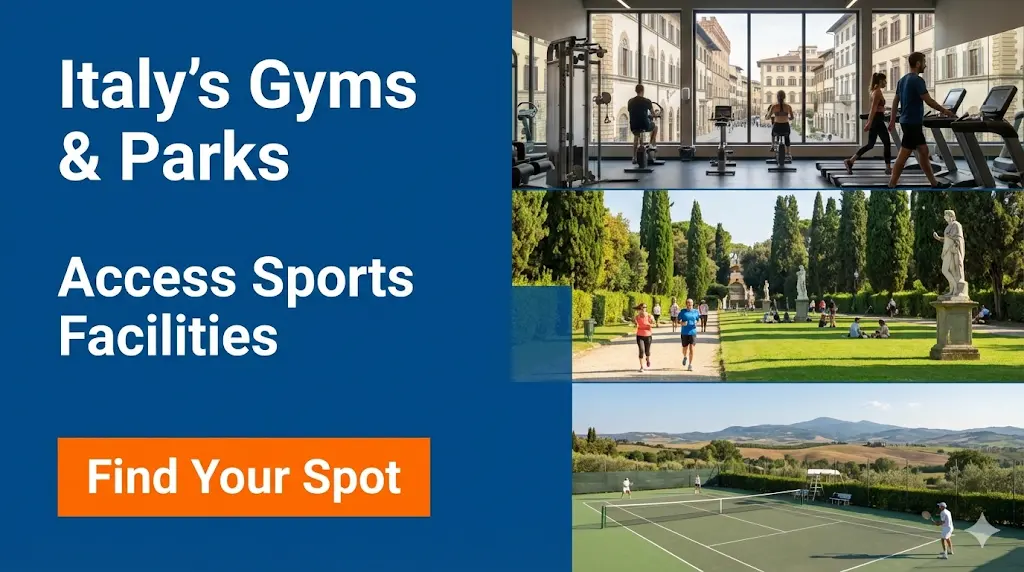
If you prefer to exercise under the Mediterranean sun, Italy’s major cities boast some of the most spectacular, historically rich public parks in Europe. Running in Italy is an incredibly popular pastime, and the vast urban green spaces provide an excellent sanctuary from the chaotic scooter and car traffic of the city streets.
Running in Rome
Rome is arguably one of the most picturesque cities in the world for outdoor jogging, offering routes that weave through ancient aqueducts and Renaissance estates.
- Villa Doria Pamphilj: Located just behind the Janiculum hill, this is Rome’s largest landscaped public park. It is considered a paradise for local runners, featuring broad, shaded avenues, challenging elevation changes, and magnificent pine-lined views. The internal loop is highly versatile, easily accommodating a moderate 5km or an extended 10km run.
- Villa Borghese: Sitting elegantly above the Piazza del Popolo, this heart-shaped park is perfect for a cultural jog. The paths are mostly flat and well-paved, weaving past art galleries, a serene pond featuring an Ionic temple, and the famed Pincio terrace.
- Parco degli Acquedotti: For a truly uniquely Roman experience, this park in the southeast of the city allows you to run on wide, flat dirt trails directly alongside the colossal, towering ruins of ancient Roman aqueducts.
Running in Milan
While Milan is known for its fast-paced business culture and dense urban layout, it maintains excellent green lungs for its residents.
- Parco Sempione: Located directly behind the imposing Sforzesco Castle, this is Milan’s most iconic central park. It is relatively compact, offering about 4 to 5 kilometers of winding, landscaped paths, making it ideal for a quick morning jog before work.
- Indro Montanelli Gardens: Also known as the Porta Venezia Gardens, this park offers excellent perimeter routes and is a favorite for evening runners seeking a nature break right in the historic center.
Running in Florence and Naples
In Florence, the Cascine Park (Parco delle Cascine) is the undisputed destination for runners. Stretching along the northern bank of the Arno River, it provides miles of flat, uninterrupted, tree-lined avenues. In Naples, the Via Caracciolo waterfront promenade offers a stunning, flat running route right along the sea, while the massive woodland trails of the Royal Capodimonte Forest offer shaded, hilly terrain for trail runners.
Hydration Tip: When running in major Italian cities, especially Rome and Milan, you do not need to carry a heavy water bottle. The cities are dotted with constantly flowing, highly regulated public drinking fountains (known famously as nasoni in Rome). The water is icy cold, incredibly clean, and free.
Municipal Sports Facilities and Public Pools
Beyond the free public parks, Italian municipalities (comuni) heavily subsidize organized sports facilities to promote civic health. These facilities include public swimming pools, dedicated athletics tracks, and multi-purpose sports centers.
In Milan, for example, the management of the vast majority of public pools and recreation centers is handled by a city-owned entity called Milanosport. Through their portal, residents can access impeccably maintained indoor and outdoor swimming pools, book tennis courts, and enroll in seasonal fitness courses at highly regulated, affordable prices. The city also directly manages iconic historic venues like the Civic Arena “Gianni Brera”, which features an immaculate 8-lane tartan athletics track open to the public for track and field training.
The Strict Rules of Italian Swimming Pools
Using a municipal or private public swimming pool (piscina) in Italy involves adhering to incredibly strict hygiene regulations that frequently shock foreign visitors.
- The Swimming Cap (La Cuffia): This is non-negotiable. You are legally required to wear a tight-fitting swimming cap (latex, silicone, or fabric) before entering the water in any public pool in Italy. Lifeguards will forcefully demand you exit the water if you are not wearing one.
- The Pre Swim Shower: You must shower thoroughly with soap in the locker room before entering the pool deck.
- Pool Deck Shoes: You cannot walk barefoot from the locker room to the pool edge. You must wear designated rubber flip-flops or slides (ciabatte) right up to the water’s edge.
To register for municipal facility access, you will usually be required to present your official Italian identification and your tax code. If you are still navigating your initial municipal paperwork, refer to Local Tax Registration: Codice Fiscale and ISEE to ensure you have the necessary documentation.
The Padel Craze and Court Booking Apps
If you want to socialize, network, and exercise simultaneously in Italy, you must learn about Padel. Over the last five years, Padel—a fast-paced racquet sport that blends elements of tennis and squash, played on an enclosed court—has exploded across the Italian peninsula. It is currently the fastest-growing amateur sport in the country.
Because it is relatively easy to learn and requires four players (playing doubles), Padel has become the premier after-work social activity for Italians of all ages. Tens of thousands of Padel courts have been built in sports clubs, retrofitted into old tennis centers, and established in dedicated indoor warehouses.
How to Book a Court
To facilitate this massive demand for Padel, tennis, and 5-a-side football (calcetto), the Italian market has heavily digitized court reservations. You rarely call a sports club to book a court anymore; you use dedicated mobile applications.
- Prenota il tuo Campo: This is a highly popular, localized Italian app dedicated to booking sports fields. You can search for nearby tennis courts, Padel courts, or beach volleyball setups, view real-time availability scoreboards, and lock in your reservation with a few clicks on your smartphone.
- Playtomic: While an international app, Playtomic dominates the Italian Padel and tennis scene. It allows you to search for available courts by geography and time.
- Playo: Another excellent resource for finding venues, booking courts, and locating trainers for sports ranging from badminton to football.
The brilliance of these apps is their social matching features. If you are an expat who wants to play Padel but does not know anyone in your new city, you can use these apps to join an “open match.” The app matches you with three other players of a similar skill level, allowing you to split the cost of the court (usually around €10 to €15 per person for a 90-minute session) and instantly meet locals. Most sports centers allow you to rent racquets for a nominal fee of €3 to €5, meaning you do not need to invest in expensive gear to try the sport.
Conclusion
Accessing gyms, parks, and sports facilities in Italy is an incredibly rewarding endeavor that quickly bridges the gap between feeling like a tourist and living like a local. While the initial bureaucratic requirement of securing a non-competitive medical certificate may seem like a frustrating hurdle, it underscores the country’s deep, institutional commitment to health and safety.
By understanding the tiered commercial gym market, familiarizing yourself with the strict hygiene etiquette of municipal pools, and embracing the vast, historic beauty of urban parks, you can seamlessly maintain your physical wellness. Furthermore, diving into the cultural phenomenon of sports like Padel through modern booking apps provides an unparalleled opportunity to build a social network in your new host country. Embrace the Italian dedication to an active lifestyle, respect the local facility rules, and you will find that staying fit in Italy is a joyous extension of the dolce vita.
References
Primary sources (official)
- Ministero della Salute (Ministry of Health) – Official health guidelines regarding the mandatory nature and clinical requirements of sports medical certificates: https://www.salute.gov.it/
- Comune di Milano (Municipality of Milan) – Official guidelines on accessing municipal sports facilities, the Gianni Brera Civic Arena, and Milanosport regulations: https://www.comune.milano.it/en/servizi/sport/impianti-sportivi-comunali-utilizzo-gratuito-per-eventi-e-iniziative
Other helpful sources
- Fit Certify – Italian Non-Competitive Sports Medical Certificate requirements and online processes: https://fitcertify.com/non-competitive-sports-medical-certificate-italy/
- Expats Living in Rome – Gym Options and Pricing Tiers in Italy’s Top Expat Cities: https://www.expatslivinginrome.com/gym-options-in-expat-cities-in-italy/
Disclaimer
The information provided in this article is for educational and informational purposes only and does not constitute official medical, legal, or financial advice. Italian municipal sports regulations, commercial gym pricing, and the specific clinical requirements for the Certificato Medico Sportivo are subject to frequent changes by local and national authorities. Always consult directly with a registered Italian medical professional or the administration desk of your chosen sports facility for the most current, personalized guidance before paying membership fees or undertaking new physical activities.