Renting vs Buying Furniture for Your Italian Home
Relocating to Italy brings the unique challenge of furnishing your new space. This comprehensive guide explores the pros and cons of renting versus buying furniture, analyzing costs, logistical hurdles, and the stark reality of Italian unfurnished apartments for expats.
Disclosure: This post may contain affiliate links. We may earn a commission at no extra cost to you if you make a purchase through these links. Read full disclosure.
Introduction to Renting vs Buying Furniture for Your Italian Home
In many parts of the world, particularly in North America and the United Kingdom, renting an apartment usually means moving into a space equipped with at least the basic necessities. You expect to find kitchen cabinets, a refrigerator, a stove, bathroom fixtures, and perhaps a washer and dryer. In Italy, the definition of an unfurnished apartment is drastically different and often comes as a profound shock to new arrivals. When you rent a traditional unfurnished apartment in Italy, you are generally renting a completely empty concrete shell.
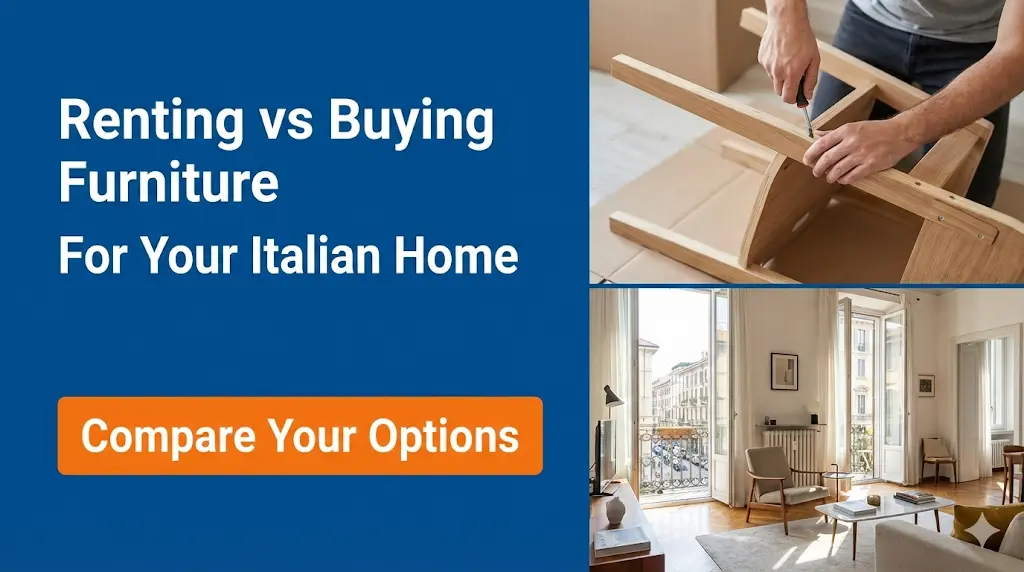
Faced with an entirely empty apartment, expatriates must make a critical decision: should you buy all new furniture to fill the space, or should you explore the growing trend of furniture rental services? This decision is not merely a matter of personal design preference. It involves complex financial calculations, an understanding of the length of your stay, and navigating the notoriously intricate logistical challenges of Italian city centers. Whether you are moving to Italy for a one-year corporate assignment or planning to stay indefinitely, the strategy you choose for furnishing your home will heavily impact your overall relocation budget and your stress levels during those crucial first few months.
To help you organize your broader relocation timeline before tackling the furniture dilemma, you may want to review our comprehensive Moving to Italy Checklist: Essential Tasks to ensure you have all your administrative priorities in order. In this exhaustive guide, we will break down the stark realities of the Italian rental market, explore the advantages and disadvantages of buying versus renting furniture, detail the hidden logistical costs of delivery and assembly, and provide a clear financial framework to help you make the best decision for your specific expatriate profile.
The Shocking Reality of Unfurnished Apartments in Italy
Before you can decide whether to rent or buy a sofa, you must fully understand what you are walking into when you sign an Italian residential lease. The Italian real estate market generally categorizes rental properties into three distinct levels of furnishing.
The first is Arredato, which means fully furnished. These apartments come with everything from beds and sofas to fully equipped kitchens and sometimes even cutlery and linens. These are highly sought after by students and short-term expats but are often priced at a premium and can feature outdated or heavily worn decor.
The second is Parzialmente Arredato, or partially furnished. This typically means the apartment includes a fully installed kitchen and bathroom fixtures, and perhaps large wardrobes built into the bedrooms, but the rest of the living spaces are empty.
The third, and by far the most common for long-term traditional leases, is Vuoto, which translates directly to “empty.” When an Italian real estate agent tells you an apartment is vuoto, they mean it literally. An empty apartment in Italy lacks kitchen cabinets, a sink, an oven, a refrigerator, and a dishwasher. It often lacks light fixtures, leaving only bare wires hanging from the ceiling. There are no bathroom mirrors, no shower curtains, and no closets.
Why does this system exist? The tradition stems from the Italian approach to long-term housing stability. Standard Italian rental contracts often last for four years, with an automatic renewal for another four years. Because families intend to stay in a property for a decade or more, they prefer to design, purchase, and install a custom kitchen that suits their exact culinary needs and aesthetic tastes. When they eventually move out, they dismantle the kitchen and take it with them to their next home.
For an expatriate, navigating the vuoto market can be incredibly intimidating. If you fall in love with an empty apartment, you are not just deciding where to buy a bed; you are taking on the role of a project manager for a minor home installation. To better understand how to navigate the property search and identify which type of apartment suits your needs, consult our guide on Finding Rental Apartments in Italy: Websites and Tips.
The Case for Buying Furniture in Italy
Purchasing your own furniture remains the most traditional route for both locals and long-term expatriates settling in Italy. The country is globally recognized as a powerhouse of interior design, offering everything from affordable flat-pack solutions to unparalleled luxury craftsmanship.
Advantages of Buying Furniture
The primary advantage of buying your furniture is absolute control over your environment. You can meticulously curate your living space to reflect your personal style, creating a true sanctuary in your new host country. If you have specific ergonomic needs, such as a high-quality orthopedic mattress or a specialized home office setup for remote work, purchasing allows you to invest in pieces that support your health and productivity.
Financially, buying is the most cost-effective solution for anyone planning to live in Italy for more than three years. Once the initial capital outlay is complete, you own the assets. When you eventually decide to leave the country, you have the option to sell the furniture on the thriving local second-hand market, recovering a portion of your initial investment.
Furthermore, buying gives you access to the incredible spectrum of Italian design. You can source unique, high-quality pieces that will last a lifetime. If you are interested in blending contemporary trends with classic Mediterranean aesthetics, take a look at our insights on Italian Home Decor: Modern and Traditional Styles.
Disadvantages of Buying Furniture
The most significant barrier to buying furniture is the massive upfront cost. Outfitting an entire two-bedroom apartment, especially if you must purchase and install a full kitchen and major household appliances, can easily drain ten to twenty thousand euros from your savings within your first month of arrival.
Additionally, buying furniture requires a massive investment of time. You must visit multiple showrooms, coordinate delivery schedules from different retailers, and spend countless hours assembling flat-pack furniture. In Italy, delivery timelines can be surprisingly long. While multinational retailers might deliver within a week, ordering a custom sofa or a modular kitchen from an Italian brand often involves lead times of six to ten weeks, leaving you living out of suitcases in an empty apartment while you wait.
Where to Buy Furniture in Italy
If you choose the purchasing route, the Italian market is stratified into three main tiers:
Budget and Flat-Pack Retailers IKEA is incredibly popular in Italy, with massive warehouse stores located on the outskirts of almost every major city. It is the go-to destination for expats who need to furnish a home quickly and affordably. Another local equivalent is Mondo Convenienza, an Italian chain famous for highly affordable, pre-designed modular kitchens and basic home furnishings. JYSK and Casa Shops also offer trendy, budget-friendly options.
Mid-Range and Contemporary Design If you want slightly higher quality without entering the luxury market, retailers like Maisons du Monde, Westwing, and Kave Home are excellent options. These brands offer stylish, contemporary pieces that elevate the aesthetic of your apartment.
Luxury and Artisan Craftsmanship For those with a higher budget, Italy is the ultimate destination for luxury furniture. Brands like Natuzzi, Poltrona Frau, and Cassina offer world-class leather goods and bespoke designs. Alternatively, exploring local artisan workshops in regions like Tuscany or Brianza allows you to commission custom, hand-crafted wooden dining tables and shelving units that double as heirloom art pieces.
The Case for Renting Furniture in Italy
Furniture rental, often referred to as furniture-as-a-service or subscription living, is a relatively new concept in the Italian market, but it is rapidly gaining traction among the expatriate community, multinational corporations, and highly mobile digital nomads.
How Furniture Rental Works
Instead of purchasing pieces individually, you subscribe to a service that provides curated furniture packages for a monthly fee. Companies operating in this space allow you to select individual items or entire room sets through an online catalog. You choose the duration of your lease, which can range from a few months to several years. The company then delivers the furniture, fully assembles it in your apartment, and arranges everything according to your floor plan. When your lease is up, or when you are ready to leave the country, the company returns to disassemble and remove everything, completely hassle-free.
Advantages of Renting Furniture
The most profound benefit of renting furniture is speed and extreme convenience. Relocating to a new country is already exhausting; managing utility setups, visa paperwork, and language barriers consumes massive amounts of energy. A furniture rental service eliminates the stress of interior design and logistics. You can walk into your apartment on day one, and within a few hours, a professional team transforms it into a fully habitable, beautifully styled home.
Flexibility is another major advantage. If you are on a fixed one-year or two-year corporate secondment, buying a household of furniture makes very little sense. You avoid the massive upfront capital expenditure, preserve your cash flow, and completely eliminate the anxiety of figuring out how to sell or dispose of a heavy sofa when it is time to repatriate.
Furthermore, many rental services allow you to swap items during your contract. If you transition to working from home and suddenly need a proper desk instead of a console table, you can easily upgrade your subscription.
Disadvantages of Renting Furniture
The primary drawback is the long-term mathematical cost. While the monthly payments seem affordable, if you end up staying in Italy for three or four years, the cumulative cost of renting will eventually surpass the cost of simply buying the furniture outright from a budget retailer like IKEA. At the end of your rental contract, you hold no equity in the items and have nothing to sell to recoup your costs.
Another significant limitation is the lack of personalization. Furniture rental companies typically offer curated collections designed to appeal to a broad, modern audience. While stylish, these collections are limited in color, fabric, and design variation. You will not be able to infuse the space with quirky, vintage Italian character through a rental catalog.
Finally, while furniture rental companies can easily supply beds, tables, and sofas, very few offer full kitchen cabinet installations. Because installing a kitchen in Italy requires custom plumbing and electrical work tailored to the specific dimensions of the room, you may still find yourself forced to purchase a kitchen outright even if you rent the rest of your furniture.
Logistical Challenges of Furnishing an Italian Home
Whether you decide to buy or rent, the physical act of getting furniture into an Italian apartment presents a unique set of infrastructural challenges that simply do not exist in modern North American or Australian suburbs.
The Zona a Traffico Limitato Restrictions Almost all major Italian cities, including Rome, Milan, Florence, and Bologna, utilize a Zona a Traffico Limitato (ZTL). These are restricted traffic zones covering the historic city centers where unauthorized vehicles are strictly prohibited from entering during specific hours. If your apartment is located inside a ZTL, standard delivery trucks cannot simply pull up to your front door. You or the delivery company must secure a temporary municipal permit to enter the zone, which often incurs extra fees and requires advance bureaucratic planning.
Narrow Streets and Historic Staircases Italian urban architecture is ancient. Many streets in the historic center are too narrow for commercial delivery vans to navigate. Furthermore, a significant percentage of residential buildings constructed before the mid-twentieth century do not have elevators (ascensori). If they do have an elevator, it is often a tiny, retrofitted glass cage that can barely fit two humans, let alone a king-sized mattress or a three-seater sofa. Moving heavy furniture up five flights of narrow, winding marble staircases is a grueling endeavor.
Delivery Tiers and The Autoscala When buying furniture in Italy, you must pay extreme attention to the delivery terms. Many retailers offer consegna al piano strada (delivery to the street level) as their default, cheapest option. This means the delivery drivers will drop the pallets of furniture on the sidewalk outside your building and drive away, leaving you to haul it up the stairs yourself. You must specifically pay a premium for consegna al piano (delivery to your specific floor).
If a piece of furniture is too large to fit up the staircase, you will need to hire an autoscala (an exterior freight elevator or hoist). This specialized truck parks on the street below your window, extends a mechanical ladder to your balcony, and hoists the furniture up the outside of the building. Hiring an autoscala requires municipal permits to block the public street and can add hundreds of euros to your delivery costs.
Financial Analysis Costs of Renting Versus Buying
To make an informed decision, it is essential to look at the concrete numbers. The total cost will heavily influence your overall financial planning for your new life abroad. To help contextualize these expenses within your broader lifestyle budget, be sure to read our breakdown of the Cost of Living in Italy 2026: Budgeting for Expats.
Below is a theoretical cost comparison for outfitting a standard two-bedroom apartment in Italy (excluding the kitchen installation, which is a highly variable separate cost). This scenario assumes furnishing a living room, dining area, master bedroom, and a second bedroom/home office.
| Furniture Strategy | Estimated Upfront Cost | Monthly Cost / Subscription | Total Cost for 12 Months | Total Cost for 36 Months |
| Buying Budget (e.g., IKEA, Mondo Convenienza) | €3,500 – €5,000 | €0 | €3,500 – €5,000 | €3,500 – €5,000 |
| Buying Mid-Range (e.g., Maisons du Monde) | €7,000 – €10,000 | €0 | €7,000 – €10,000 | €7,000 – €10,000 |
| Renting Premium Furniture Service | €150 – €300 (Delivery/Setup Fee) | €250 – €400 | €3,150 – €5,100 | €9,150 – €14,700 |
Note: The buying costs represent a permanent sunk cost, though you may recover 20% to 30% by selling the items later. The renting costs represent a total expenditure with no recoverable equity.
As the table illustrates, if you are staying in Italy for just one year, renting high-quality furniture costs roughly the same as buying low-quality, budget flat-pack furniture, but completely eliminates the stress of assembly and disposal. However, if your timeline stretches to three years or beyond, renting becomes mathematically inefficient, and buying mid-range furniture outright is the far superior financial strategy.
How to Decide Which Option Fits Your Expat Profile
Your specific lifestyle, employment contract, and patience for Italian bureaucracy should be the deciding factors in this debate. Here is how to approach the decision based on common expatriate profiles.
The Corporate Transferee
If you are moving to Italy on a fixed-term corporate contract lasting 12 to 24 months, and your company is providing a housing stipend, renting furniture is the optimal choice. Your primary goal is to minimize logistical distractions so you can focus on your new professional role. You do not want to spend your first three weekends in Milan navigating an IKEA warehouse or coordinating an autoscala delivery. A furniture subscription allows you to live in a beautifully designed space instantly, and when your contract ends, you simply hand the keys back and board your flight home.
The Digital Nomad
If you are a digital nomad moving to Italy on the new remote worker visa for six months to a year, you should actively avoid the vuoto apartment market entirely. Your best strategy is to spend slightly more on monthly rent to secure a fully arredato (furnished) apartment. If you absolutely fall in love with an unfurnished space in a perfect neighborhood, renting a basic furniture package is your only viable solution, as buying and subsequently trying to sell furniture after eight months is an incredibly poor use of your time.
The Long Term Resident or Buyer
If you are relocating to Italy indefinitely, starting a business, retiring, or purchasing a property outright, buying furniture is the only logical path. This is your permanent home. You will want to invest the time to source high-quality Italian mattresses, durable dining tables, and perhaps custom-built wardrobes that maximize the often-quirky dimensions of historic Italian architecture. While the initial setup will be expensive and logistically exhausting, the long-term financial savings and the emotional comfort of owning your environment are invaluable.
The Circular Economy Second Hand Furniture Market
There is a third, hybrid option that combines the financial benefits of buying with a lower initial capital outlay: the second-hand market. Historically, the Italian culture placed a very high premium on buying things brand new, and the concept of buying used furniture was somewhat frowned upon. However, driven by economic shifts and a growing commitment to sustainability and the circular economy, the second-hand furniture market in Italy is booming.
Platforms like Subito.it (the Italian equivalent of Craigslist or Gumtree) and Facebook Marketplace are flooded with expats and locals selling high-quality furniture, often at heavily discounted prices because they need to empty an apartment quickly at the end of a lease.
Additionally, physical consignment stores known as Il Mercatino dell’Usato are scattered throughout the country. These large warehouse stores sell everything from vintage armoires and antique chandeliers to practically brand-new modern sofas. Furnishing your home through the second-hand market requires patience, a willingness to rent a cargo van to handle the transport yourself, and the ability to negotiate in Italian, but it can result in a deeply personalized, highly eclectic home at a fraction of retail costs.
Conclusion
Deciding whether to rent or buy furniture for your Italian home is a pivotal step in your relocation journey. The infamous Italian vuoto apartment presents a blank canvas that can be both exhilarating and overwhelming. By carefully analyzing your anticipated length of stay, evaluating your available capital, and assessing your tolerance for the logistical hurdles of historic city centers, you can chart a clear path forward.
Renting furniture offers unparalleled convenience, speed, and flexibility, serving as the perfect temporary solution for corporate expats and short-term residents who wish to bypass the stress of delivery and assembly. Conversely, buying furniture allows for deep personalization, long-term financial efficiency, and the joy of permanently integrating authentic Italian design into your daily life. Whichever route you choose, the ultimate goal remains the same: creating a warm, comfortable sanctuary where you can retreat, recharge, and fully savor the incredible experience of living in Italy.
References
Primary sources official
- Agenzia delle Entrate (Italian Revenue Agency) – Information regarding standard residential lease contracts, including definitions of furnished and unfurnished property regulations: https://www.agenziaentrate.gov.it/portale/web/english
- Camera di Commercio (Italian Chamber of Commerce) – Data on Italian retail sectors, import regulations, and consumer goods markets: https://www.camcom.gov.it/
Other helpful sources
- Idealista – Understanding the different types of rental contracts in Italy (and what “vuoto” legally entails): https://www.idealista.it/en/news/property-for-rent-in-italy/2025/12/09/294744-understanding-the-different-types-of-rental-contracts-in-italy
- Lyght Living – Furniture Rental Services in Europe for Expats: https://lyght-living.com/
Disclaimer
The information provided in this article is for educational and informational purposes only and does not constitute official financial, real estate, or relocation advice. Furniture retail prices, rental subscription rates, and municipal ZTL delivery regulations in Italian cities are highly variable and subject to frequent changes. Always conduct your own independent research, obtain localized delivery quotes, and thoroughly review the terms and conditions of any rental lease or furniture subscription contract before making financial commitments.