Short-Term Rentals and Airbnb: Rules in Italy
Navigate Italy’s complex short-term rental landscape with our comprehensive guide. From securing your mandatory CIN code and complying with strict safety regulations to understanding the latest 2026 Cedolare Secca tax rates and city-specific Airbnb restrictions in Florence and Venice.
Disclosure: This post may contain affiliate links. We may earn a commission at no extra cost to you if you make a purchase through these links. Read full disclosure.
Introduction to Short-Term Rentals and Airbnb
In response to widespread concerns regarding tax evasion, unfair competition with traditional hotels, and the severe housing shortages plaguing historical city centers, the Italian government has implemented a sweeping series of regulatory overhauls. The landscape of short-term rentals (affitti brevi) has transformed dramatically, culminating in strict new nationwide laws that came into full enforcement between 2025 and 2026.
Operating an Airbnb in Italy today requires navigating a dense maze of national bureaucracy, stringent safety certifications, and aggressive tax enforcement. Furthermore, local municipalities—particularly highly pressured tourist hotspots like Florence, Rome, and Venice—have been granted the authority to impose their own zoning restrictions, nightly caps, and operational bans to combat overtourism. Ignorance of these laws is not accepted as an excuse; non-compliant hosts face massive financial penalties ranging into the thousands of euros, and digital platforms are legally obligated to remove unregistered listings.
Whether you are an established host looking to update your compliance portfolio or a prospective buyer analyzing the profitability of a holiday home investment, understanding this legal framework is paramount. This exhaustive guide will break down exactly what legally constitutes a short-term rental in Italy. We will thoroughly explore the new mandatory National Identification Code (CIN), detail the required fire and gas safety installations, and decode the complex tiered system of the Cedolare Secca tax regime. Finally, we will navigate the strict police reporting procedures and the evolving city-specific bans, equipping you with the knowledge to run your Italian rental property legally, safely, and profitably.
Defining a Short-Term Rental in Italy
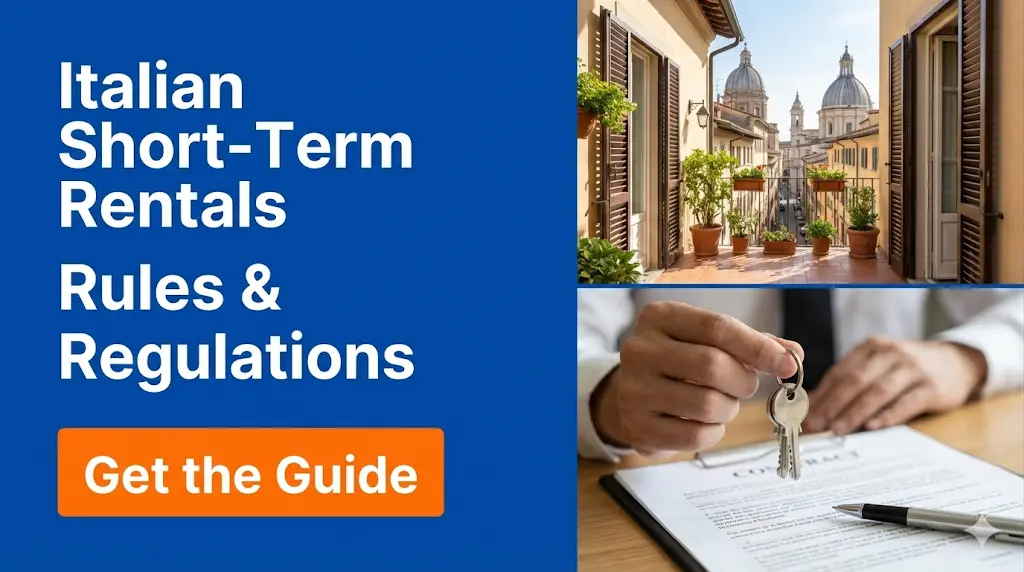
What differentiates a holiday let from a standard residential lease? In Italy, the legal definition of a short-term rental (locazione turistica or affitto breve) is any residential property rented to guests for a period strictly not exceeding 30 consecutive days.
If your guest stays for 30 days or less, the contract does not need to be formally registered with the Agenzia delle Entrate (the Italian Revenue Agency). This exemption drastically reduces the bureaucratic friction associated with standard long-term housing. Furthermore, properties classified as short-term rentals must fall within specific cadastral categories, typically A/1 through A/11, excluding A/10 (which is reserved for private offices and studios).
If a guest requests a stay of 31 days or longer, you immediately cross the legal threshold into traditional residential leasing. You lose the right to operate under the simplified short-term regulations and must register the lease with the state. If you plan on mixing short-term holiday lets with medium-term stays for international students or remote workers, you must understand the rigid legal frameworks governing these longer agreements. To avoid violating national housing laws, we highly recommend consulting our comprehensive breakdown in Italian Rental Contracts Explained: 3+2, 4+4, Transitorio.
The National Identification Code (CIN)
For years, Italian short-term rentals were governed by a fragmented, highly confusing system of regional codes. Lombardy required a CIR, Sardinia demanded a IUN, and other regions had entirely different acronyms. Recognizing the impossibility of enforcing tax compliance across such a disjointed system, the Italian Ministry of Tourism centralized the entire process.
As of the nationwide rollout, the absolute cornerstone of operating an Airbnb in Italy is the Codice Identificativo Nazionale (CIN).
What is the CIN?
The CIN is a unique, alphanumeric identification code assigned to every single residential unit used for short-term rentals or tourist accommodation in Italy. It links your specific property directly to the Banca Dati Strutture Ricettive (BDSR), which is the national database of accommodation facilities.
Who Needs It?
The CIN is universally mandatory. You must possess this code if you are renting out:
- Entire apartments or villas for less than 30 days.
- Single spare rooms within a shared accommodation.
- Bed & Breakfast rooms (specifically those operating without hotel-tier auxiliary services).
How to Apply for the CIN
Obtaining your CIN requires interacting with the Ministry of Tourism’s digital portal. To access the BDSR system, you must possess a recognized Italian digital identity, typically a SPID (Sistema Pubblico di Identità Digitale) or a CIE (Electronic Identity Card). Preparing this digital infrastructure is a vital part of your civic setup; to ensure you have the correct administrative prerequisites, review our guide on Local Tax Registration: Codice Fiscale and ISEE.
Once logged into the BDSR portal, you must verify your property’s cadastral data. Accuracy here is critical; submitting incorrect land registry codes, parcel numbers, or sub-numbers will cause your application to be rejected or stalled indefinitely. The registration process itself is free of charge, but the documentation must be flawless.
Displaying the Code and Penalties
Having the CIN is not enough; Italian law dictates exactly how it must be displayed.
- Online Representation: The CIN must be clearly visible in every single digital advertisement for your property. This includes listings on Airbnb, Booking.com, Expedia, and even social media posts on Facebook Marketplace or Instagram.
- Physical Display: The code must be physically displayed outside the building where the apartment is located (for example, on the intercom panel or a small plaque near the entrance), ensuring you comply with the building’s aesthetic condominium rules.
The penalties for ignoring the CIN mandate are intentionally severe. Renting a property without a CIN will result in fines ranging from €800 to an astronomical €8,000. Furthermore, if you possess the code but fail to display it correctly online or outside the property, you can be fined between €500 and €5,000. To enforce this, online travel agencies (OTAs) like Airbnb are now legally bound to verify the CIN and will aggressively delist and suspend any properties that fail to provide it.
Mandatory Safety and Compliance Regulations
In tandem with the tax tracking provided by the CIN, the Italian government introduced stringent new physical safety standards for all short-term rentals to protect tourists. A property cannot legally receive its CIN without the host formally self-certifying that these safety measures are actively in place.
Fire Extinguishers
Standard residential apartments are no longer exempt from fire safety protocols if they host paying guests. You are legally required to install at least one portable fire extinguisher for every 200 square meters of floor space. Crucially, if your rental property spans multiple levels, you must have at least one extinguisher on every single floor, regardless of the square footage. These extinguishers must meet specific commercial standards (typically 6kg+ capacity and UNI 9994-1 certified) and must be placed in highly visible, easily accessible locations.
Gas and Carbon Monoxide Detectors
To prevent tragic accidents, every property intended for short-term rental must be equipped with functioning combustible gas detectors (monitoring for methane or LPG leaks) and carbon monoxide (CO) detectors. These devices must feature audible alarms capable of reaching 85 decibels to guarantee they can wake a sleeping guest in an emergency. Hosts are legally obligated to test these alarms regularly (often monthly) to ensure the batteries and sensors are fully functional.
Electrical System Compliance
Your property’s electrical grid must comply with modern Italian safety standards (specifically DM 37/2008). You must possess a valid declaration of electrical compliance, which often requires professional recertification every two years.
Failure to install and maintain these vital safety devices is treated as a severe breach of hospitality law, carrying fines ranging from €600 to €6,000. As a host, highlighting these safety features in your listing description not only keeps you legally compliant but serves as a powerful marketing tool to reassure cautious international travelers.
Taxation: The Cedolare Secca and Business Status
Perhaps the most complex evolution in the Italian short-term rental market involves taxation. The Italian government has recognized the massive profits generated by multi-property operators and has restructured the tax code to differentiate between casual hosts and professional business operators.
If you are a private individual renting out property, you generally opt into the Cedolare Secca (flat tax) regime. This highly preferential system replaces the standard, progressive national income tax (IRPEF) and regional surtaxes, allowing you to pay a fixed percentage of your gross rental income. However, the rules surrounding this flat rate changed significantly leading into 2026.
The 2026 Tiered Tax Framework
The amount of tax you pay, and the legal status of your operation, is now strictly dictated by the number of properties you list on the short-term market.
- One Property: If you rent out a single property for short-term holiday lets, you are entitled to the highly favorable 21% flat tax rate (Cedolare Secca) on all your rental income.
- Two Properties: If you expand your portfolio to a second property, the tax rate on that second unit jumps to 26%. The landlord is granted the administrative freedom to decide which of the two properties is taxed at 21% and which is taxed at the punitive 26% rate when filing their annual tax return.
- Three or More Properties (Business Status): This is the most critical update for 2026. Previously, a host could manage up to four properties as a private individual. Anyone who rents out three or more properties for short-term stays is legally classified as operating an entrepreneurial business (in forma imprenditoriale).
The Implications of Business Status
Crossing the threshold into business status fundamentally changes your operational reality. You can no longer rely solely on the simple Cedolare Secca. You are legally required to open a Partita IVA (an Italian VAT number). You must issue formal electronic invoices to every guest, maintain complex accounting ledgers, and file a formal SCIA (Segnalazione Certificata di Inizio Attività) with your local municipality to declare your commercial hospitality business. While you may be eligible to join a specialized flat-rate business scheme (the Regime Forfettario), your bureaucratic burden increases exponentially.
To understand how this rental income impacts your broader financial obligations and how to navigate the Italian tax brackets, we strongly advise consulting our detailed breakdown of Understanding Italy’s Tax System: A Guide for Foreigners.
Table: Italian Short-Term Rental Tax & Compliance Framework (2026)
| Number of Properties | Tax Regime Applied | Legal Operational Status | Key Bureaucratic Requirements |
| 1 Property | 21% Flat Tax (Cedolare Secca) | Private Individual (Non-Professional) | CIN Code, Safety Devices, Police Registration. |
| 2 Properties | 21% on the first, 26% on the second | Private Individual (Non-Professional) | CIN Code, Safety Devices, Police Registration. |
| 3+ Properties | Progressive IRPEF & VAT obligations | Entrepreneurial Business (Forma Imprenditoriale) | Partita IVA, SCIA filing, Formal Invoicing, Accounting. |
Mandatory Police Registration and Tourist Taxes
Beyond national taxes and physical safety, operating an Airbnb in Italy involves two immediate, ongoing operational duties that must be executed every time a new guest checks in.
Alloggiati Web (Police Registration)
Driven by strict national anti-terrorism laws, the Italian State Police must know exactly who is sleeping in the country on any given night. As a host, you are legally required to collect the official identification details (passport or EU identity card data) of every single guest staying in your property.
You must submit this data electronically through the official police portal known as Alloggiati Web. The deadline for this submission is uncompromising: the data must be uploaded within exactly 24 hours of the guest’s arrival. If a guest is only staying for one night, the data must be submitted immediately upon check-in. Failing to transmit guest data to police authorities is a criminal offense, not just a municipal violation.
The Tourist Tax (Tassa di Soggiorno)
Almost all major Italian tourist destinations levy a municipal tourist tax (tassa di soggiorno) on overnight visitors. This tax is calculated per person, per night, usually up to a maximum number of consecutive nights (e.g., the first 5 nights of a stay). The rates vary drastically by city; for example, Venice charges between €3.50 and €5.00 per person per night, while smaller rural towns might charge only €1.00.
The host is legally responsible for collecting this tax from the guests and remitting it to the local municipal treasury on a regular basis (often quarterly). While major platforms like Airbnb and Booking.com have agreements in place to automatically collect and remit this tax on behalf of hosts in some major cities, the ultimate legal liability rests on your shoulders. You must always verify your specific standing with your local town hall.
City-Specific Restrictions and The Fight Against Overtourism
While the national government mandates the CIN and the tax brackets, local municipalities (comuni) have been granted immense power to dictate where and how short-term rentals operate within their borders. Driven by protests from locals who are being priced out of their historic neighborhoods, Italy’s most famous cities have implemented aggressive zoning restrictions. When preparing to launch a rental business, understanding these local ordinances is as critical as national law. For insights into how to interact with these local government offices, review Navigating Italian Bureaucracy: Comune and Prefettura.
Florence: Keybox Bans and Historic Freezes
Florence has taken some of the most dramatic steps in Italy to curb the explosion of holiday rentals. The city administration previously announced bans on the registration of any new short-term rental properties within its UNESCO-protected historic center (Centro Storico) to prevent the further exodus of local residents.
More recently, Florence launched a targeted attack on the aesthetics and anonymity of the Airbnb model by officially mandating the removal of all self-check-in keyboxes (lockboxes) attached to the exteriors of buildings in the historic center. Local activists had been vandalizing these lockboxes, claiming they represented the “death” of authentic Florence. Hosts who fail to remove these keyboxes face immediate municipal fines. The city argues that mandating in-person check-ins forces hosts to be more accountable and reduces the nuisance factor for neighboring residents.
Venice: Nights Caps and Thresholds
Venice, arguably the global poster child for overtourism, enforces strict regulations to preserve its fragile housing stock. The city has implemented threshold rules to differentiate between casual hosting and commercial extraction. If a property in Venice is rented out for short-term tourist stays for more than 120 days in a single calendar year, it triggers stricter regulatory treatment and may face reclassification. Furthermore, Venice strictly caps the number of properties an individual host can operate within the city limits without triggering heavy commercial licensing requirements.
Rome and Milan: Zoning and Minimum Stays
In major hubs like Rome and Milan, the focus is on zoning density and minimum stay durations. Rome requires all hosts to register on its specific SUAR portal (Sportello Unico per le Attività Ricettive) and enforces strict zoning regulations near major archaeological sites and the Vatican.
Furthermore, recent legislative pushes have introduced a mandatory two-night minimum stay for short-term rentals in the densely populated historic centers of major tourist cities (including Rome, Milan, Naples, and Bologna). This rule is designed to shift one-night transient guests back into traditional hotels and reduce the relentless daily turnover in residential apartment buildings.
Property Management Strategies for Expats
Given the overwhelming bureaucratic burden of managing safety certifications, communicating with the police via Alloggiati Web, and navigating municipal zoning bans, many expatriate investors choose to hire professional property management companies.
A specialized Italian property manager can act as your legal proxy. They will handle the grueling process of securing the CIN, arranging for professional technicians to install and certify your gas detectors, and organizing professional cleaning crews. Crucially, in cities like Florence where remote keybox check-ins are heavily scrutinized and restricted, property managers provide the necessary localized staff to conduct mandatory in-person meet-and-greets, verify guest passports, and collect the municipal tourist tax.
While a professional management firm typically charges a commission of 20% to 30% of your gross booking revenue, they insulate you from the severe financial penalties associated with administrative errors and allow you to operate a lucrative Italian investment property from anywhere in the world.
Conclusion
The era of the unregulated, casual Airbnb in Italy has definitively closed. The Italian government’s implementation of the mandatory National Identification Code (CIN), coupled with aggressive safety mandates and a heavily tiered Cedolare Secca tax structure, demands absolute professionalization from anyone operating in the hospitality sector. Simultaneously, the fierce pushback from municipalities like Florence and Venice against overtourism has created a highly localized patchwork of zoning bans and operational restrictions.
For expatriates and foreign investors, this stringent new reality should not be viewed purely as a deterrent, but rather as a filter. By embracing full legal compliance, installing the necessary fire and gas detectors, meticulously tracking your rental days, and respecting the cultural integrity of your chosen city, you elevate your property above the illegitimate competition. A legally flawless, highly safe, and professionally managed Italian holiday home remains one of the most rewarding investments available, allowing you to share the incomparable beauty of Italy with the world while building a sustainable, profitable enterprise.
References
Primary sources (official)
- Ministero del Turismo (Ministry of Tourism) – Official portal for the Banca Dati Strutture Ricettive (BDSR) and issuance of the National Identification Code (CIN): https://www.ministeroturismo.gov.it/
- Polizia di Stato – Official portal for the mandatory Alloggiati Web guest registration system: https://alloggiatiweb.poliziadistato.it/PortaleAlloggiati/
Other helpful sources
- CleanBnB – Short-term rentals: updated guide to 2026 regulations (Taxation, Business Status, and CIN compliance): https://www.cleanbnb.net/en/short-term-rental-guide/
- PriceLabs – Short-Term Rental Laws in Italy in 2025 (City-by-city overview, zoning rules, and remote check-in mandates): https://hello.pricelabs.co/short-term-rental-laws-in-italy/
Disclaimer
The information provided in this article is for educational and informational purposes only and does not constitute official legal, tax, or real estate advice. Italian national short-term rental laws, the Cedolare Secca tax brackets, and municipal zoning regulations (such as those in Florence and Venice) are highly complex and subject to frequent legislative amendments. Always consult with a licensed Italian commercialista (accountant), an attorney specializing in real estate law, and your local municipal office (Comune) to ensure full compliance before launching a short-term rental business.