Moving to Italy from Ireland: Sea Freight and Road Combinations
Oh, the thought of packing up your life in Ireland and transplanting it to the sunny shores of Italy! It sounds like a dream, doesn't it? But then the reality hits: how on earth do you get all your treasured possessions, from your granny's antique teapot to your kids' bicycles, across the Irish Sea, over mainland Europe, and safely into your new Italian casa? It’s a logistical puzzle that can feel utterly overwhelming, often leaving expats staring at maps and wondering if they should just sell everything. This guide is here to untangle that knot for you, specifically delving into the practicalities of combining sea freight with road transport, offering a sensible, cost-effective, and less stressful path for your big move, and showing you how Sirelo can be your guiding star in this complex process.
Disclosure: This post may contain affiliate links. We may earn a commission at no extra cost to you if you make a purchase through these links. Read full disclosure.
The Logistics Labyrinth: Why Combining Sea and Road Makes Sense (and Scares Everyone)
Moving from an island nation like Ireland to another peninsula in the Mediterranean like Italy presents unique challenges. You can’t just hop in a van and drive straight through. The journey inherently involves crossing water, and that's where the complexities often begin. The idea of entrusting your entire life's accumulation to a process that involves both ships and trucks can be daunting, bringing fears of lost items, exorbitant costs, or endless delays. It’s entirely valid to feel a bit overwhelmed by the sheer scale of it all!
The Irish Sea and Beyond: Understanding the Journey
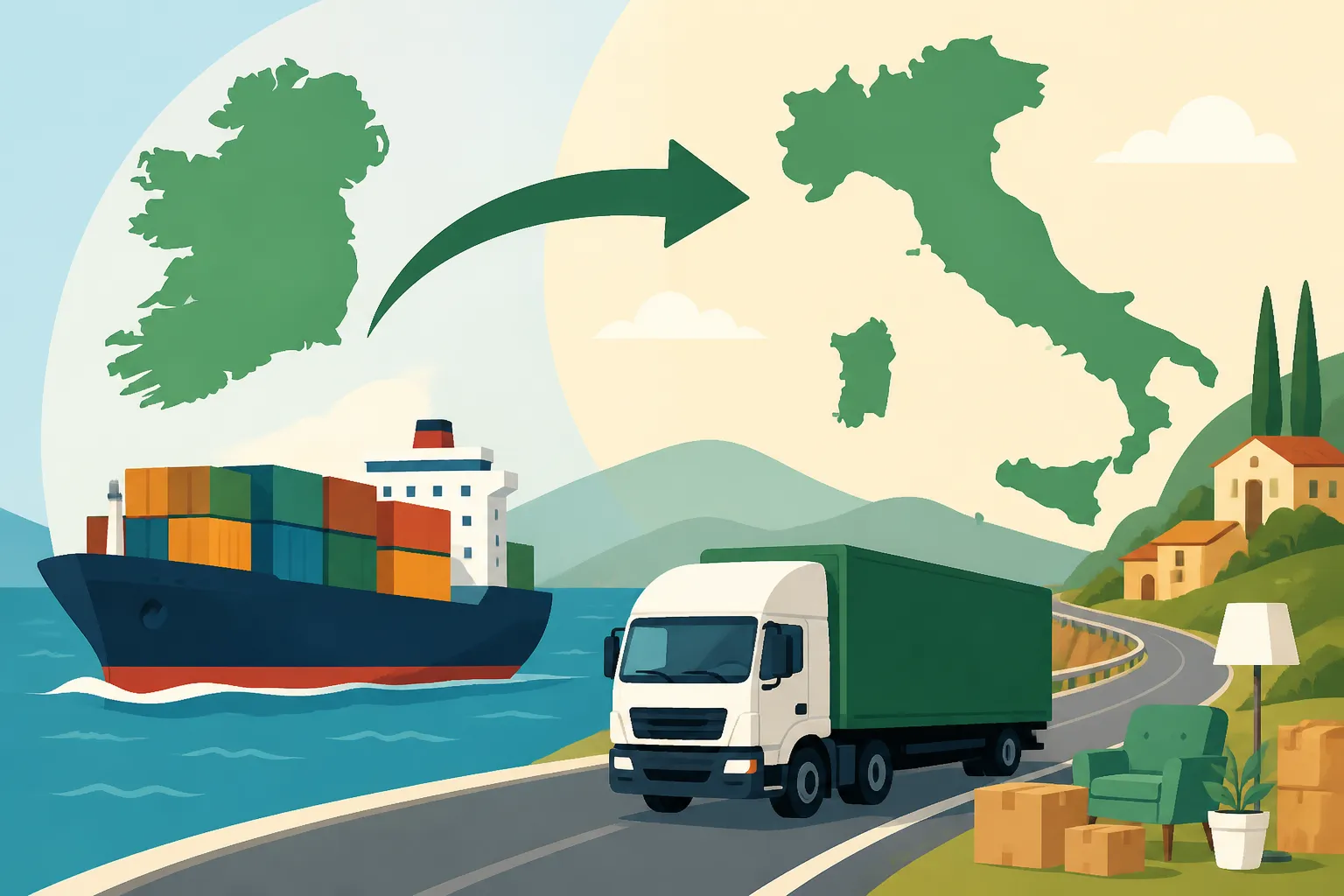
When you picture your belongings making their way from Cork or Dublin to, say, Florence or Puglia, it's a multi-stage affair. First, your items need to be picked up from your Irish home and transported to a port. From there, they'll embark on a sea journey, typically crossing the Irish Sea to the UK, or potentially directly to mainland Europe, before making their way further south. The sheer geographical distance means that a pure road transport solution isn't feasible or economical for larger household moves. Imagine the fuel costs, ferry crossings, and drivers' hours required for an unbroken road trip of thousands of kilometers! This is precisely why a hybrid approach, leveraging the strengths of both sea and road, becomes the most logical and often the most budget-friendly option. This blended strategy addresses the unique challenges of inter-island and inter-continental moving, giving you the best of both worlds.
Advantages of a Hybrid Approach for Your Move
Choosing a combination of sea freight and road transport isn't just about necessity; it comes with several distinct advantages that can make your move to Italy smoother and more manageable.
First and foremost, there's the cost-effectiveness. For larger volumes of goods, sea freight is almost always significantly cheaper per cubic meter than air freight or even dedicated road transport across such a long distance. Shipping a container, or a portion of one, by sea allows you to move most of your household items without breaking the bank. Think of all those big pieces of furniture, boxes of books, and kitchen appliances; they can travel economically by boat. This substantial saving on the bulk of your possessions can free up funds for other essential aspects of settling in, like budgeting for Italy: Cost of Living by City or even enjoying your first authentic Italian pizza upon arrival.
Secondly, you gain flexibility. While the sea leg handles the long, heavy haul, road transport provides the crucial "last mile" delivery. Your goods can arrive at a major Italian port (like Genoa, Livorno, or Naples) and then be seamlessly transferred to a truck for the final journey directly to your new home, even if it’s tucked away in a small village in Umbria or a bustling street in Milan. This avoids the headaches of having to arrange separate pickups from a port yourself, which, trust me, is a bureaucratic nightmare in Italy. Having a single moving company that manages both segments simplifies coordination immensely. Sirelo specializes in connecting you with movers who are experts in these integrated services, ensuring a streamlined process from start to finish. They act as your central point of contact, reducing the stress of coordinating different logistics providers across borders.
Lastly, while it might not be your primary concern, it's worth noting the environmental benefits. Sea freight generally has a lower carbon footprint per ton-mile compared to air or long-distance road transport. If sustainability is important to you, this hybrid method aligns better with eco-conscious moving. The reality is, moving internationally is a complex beast, and seeking professional assistance is key. That’s where a platform like Sirelo truly shines, allowing you to compare reputable moving companies that offer these very solutions, making the daunting task of comparing services, transit times, and costs far more manageable.
Navigating the Waters: Sea Freight Options from Ireland to Italy
Once you've decided that a sea and road combination is the way to go, the next step is understanding your sea freight options. This is where the size of your move really dictates the best path. No matter the scale, the goal is to make sure your belongings are packed securely and transported efficiently, ready for their onward journey by road to your chosen Italian destination.
Full Container Load (FCL) vs. Less Than Container Load (LCL)
When it comes to sea freight, you'll generally encounter two main options: Full Container Load (FCL) and Less Than Container Load (LCL). Understanding the difference is crucial for both cost and timing.
Full Container Load (FCL) means you get an entire shipping container dedicated solely to your belongings. These containers typically come in 20-foot (approx. 33 cubic meters) or 40-foot (approx. 67 cubic meters) sizes. This option is ideal if you're moving a substantial household – say, a three-bedroom house or larger – or if you have very bulky items that wouldn't fit well with other people's goods. The main advantage of FCL is speed and security. Since it's only your items in the container, there's no need to consolidate your shipment with others, which can lead to faster transit times. It also reduces the risk of misplacement or damage since your container isn't opened or handled until it reaches the destination port. The downside, of course, is the cost. You're paying for the entire container, even if you don't fill it to the brim. However, for a truly large move, it often works out to be the most efficient value. When you use Sirelo, you can specify the estimated volume of your move, and they'll help you find movers who offer competitive FCL rates, giving you a clear picture of what this comprehensive service entails.
Less Than Container Load (LCL), also known as groupage, is the more common choice for smaller moves, like a one or two-bedroom apartment, or if you're only taking selected items. With LCL, your belongings share space within a container with other people's shipments that are heading in the same general direction. The significant advantage here is cost-sharing: you only pay for the volume your goods occupy within the container, making it far more economical for smaller inventories. However, there are trade-offs. LCL shipments generally take longer because the container needs to be filled with other consignments before it can depart, and then at the destination port, it needs to be unloaded and sorted. There's also a slightly higher risk of delays due to customs inspections or issues with other shipments in the same container. Despite this, for many expats, LCL offers an excellent balance between cost and convenience. Many of the reputable movers you'll find through Sirelo are experts in managing LCL shipments, ensuring your goods are properly cataloged, packed, and tracked, minimizing potential headaches.
| Feature | Full Container Load (FCL) | Less Than Container Load (LCL) |
|---|---|---|
| Move Size | Large households (3+ bedrooms) or bulky items | Small to medium households (1-2 bedrooms), selected items |
| Cost | Higher overall, but good value per cubic meter for large volumes | Lower overall, as you only pay for space used |
| Transit Time | Generally faster, as no consolidation/deconsolidation needed | Slower, due to consolidation and sorting at ports |
| Security/Handling | Container sealed at origin, less handling | More handling as goods are loaded/unloaded with others |
| Flexibility | Less flexible for partial moves, but more control over schedule | More flexible for smaller volumes, but fixed schedules |
Key Ports and Shipping Routes
The journey your belongings will take from Ireland to Italy by sea typically involves a few key ports. In Ireland, major commercial ports like Dublin Port and Cork Port serve as primary departure points. These ports handle a significant volume of cargo traffic and have regular connections that facilitate international shipping.
From Ireland, a common route often involves crossing the Irish Sea to a major hub port in the United Kingdom, such as Felixstowe or Southampton. From there, containers are then transshipped onto larger vessels heading towards the Mediterranean. Alternatively, some services might offer direct or more consolidated routes that bypass the UK and head directly to mainland European ports like Rotterdam or Antwerp, before continuing south. The exact routing will depend on the shipping line and the mover you choose, but generally, they aim for efficiency and reliability.
Upon reaching Italy, your shipment will typically arrive at one of the country's main commercial ports. The most common entry points for cargo from Northern Europe include:
- Genoa (Genova): Located in Liguria, it's one of Italy's largest and busiest ports, serving Northern Italy and even parts of Central Europe. It's an excellent option for onward road transport to cities like Milan, Turin, and even Florence.
- Livorno: Also on the west coast in Tuscany, Livorno is another significant port, particularly for cargo heading to central Italy, including Rome and Tuscany itself.
- Naples (Napoli): Further south, Naples is a crucial port for shipments destined for Southern Italy, including regions like Campania, Puglia, and Sicily.
- Salerno: Near Naples, Salerno also plays a key role in supporting logistics for the southern regions.
The choice of arrival port will often be dictated by your final destination in Italy, as movers will aim to minimize the subsequent road journey, thus saving you time and money. Transit times for sea freight from Ireland to Italy can vary, usually ranging from 2-4 weeks, not including customs clearance or the final road delivery. Factors like the specific route, any transshipment points, and weather conditions can all influence the schedule. It's vital to discuss these timelines clearly with your chosen moving company, and platforms like Sirelo enable you to get detailed quotes that include estimated transit durations, helping you plan your arrival and settle-in period more effectively.
The Road Ahead: Italian Inland Transportation and Delivery
Once your treasured belongings have made their grand oceanic voyage and arrived at an Italian port, the journey isn't quite over. The final, and arguably most critical, leg is the road transport that takes everything from the bustling docks right to your doorstep. This stage, while seemingly straightforward, comes with its own set of Italian quirks and bureaucratic hurdles.
From Port to Your New Italian Home
Upon arrival at the Italian port, your container (or your portion of a shared container) will undergo customs clearance. Once cleared, your goods are typically transferred from the large shipping container to a road-worthy truck or van. This is where the expertise of your moving company really comes into play. They need to coordinate the pick-up from the port, which often requires specific permits and appointments, and then navigate Italy's road network.
Italian cities, especially the older ones, are famous for their narrow streets, historic centers (often designated as ZTLs, or Limited Traffic Zones, which require special permits to enter), and sometimes challenging access. If your new home is in a picturesque borgo perched on a hilltop, or an apartment in the heart of Rome's centro storico, the delivery vehicle might not be able to pull right up to your door. In such cases, your movers might use smaller vans for shuttle services or even hand-carry items for the final few meters. It’s crucial that the moving company you choose has a strong understanding of these local logistical challenges and can anticipate potential issues.
This final leg also includes the actual unloading, unpacking (if you've opted for that service), and placement of your furniture and boxes in your new home. Imagine having to lug a sofa up three flights of stairs in a historic building without a lift – not fun! A good international moving company, found easily through Sirelo, will discuss these potential access issues with you beforehand, ensuring they arrive prepared with the right equipment and manpower. They will offer services from basic curb-side delivery to full white-glove service, where they not only unload but also help with unpacking and even assembly. When you're busy with all the other aspects of settling in Italy: Daily Life Tips for Expats, having professionals handle the heavy lifting is invaluable.
Customs, Documentation, and Bureaucracy in Italy
Ah, Italian bureaucracy! It's legendary, and moving your household goods into the country is no exception. This is often the part that causes the most anxiety for expats, and rightfully so. Proper documentation is absolutely paramount for smooth customs clearance and to avoid delays or unexpected charges.
The core document you'll need is a detailed packing list or inventory of all your items. This needs to be comprehensive, clearly listing the contents of each box and any larger items, along with their estimated value. This isn't just a casual list; it's a legal document. You'll also need to provide personal identification, proof of your residency in Italy (such as your Permesso di Soggiorno or visa), and crucially, your Codice Fiscale, Italy's tax identification number. This number is your key to almost everything administrative in Italy, from signing a rental contract to, yes, clearing your imported goods. If you haven't secured one yet, you should prioritize How to Get a Codice Fiscale in Italy (and Why You Need One) as soon as possible.
For household goods being moved as part of a residency transfer, you typically apply for "duty-free" importation. This means you won't pay import duties and VAT, provided you meet certain conditions, such as having owned and used the items for at least six months and proving you are genuinely moving your residence to Italy. Your moving company will help you prepare the necessary customs declarations (e.g., Modello UNICO or DAU) and guide you through the process, but ultimately, the accuracy of your documentation rests with you.
You'll also need proof of your cambio di residenza (change of residency) from Ireland to Italy. This could involve your cancelled Irish residency, or documents proving you have established a new residence in Italy, such as a long-term rental contract or property purchase deeds. It's a dance between declaring your intention to move and proving you've done it. For a holistic view on your move, it's worth checking out resources like the Ultimate Guide to Visas and Immigration in Italy and how it ties into customs requirements.
The most common frustration here is the sheer volume of paperwork and the precise nature of Italian administrative requirements. One small error or omission can lead to significant delays and storage fees. This is precisely why engaging an experienced international mover, especially one vetted through a platform like Sirelo, is not just convenient but almost essential. They have the expertise to pre-empt common issues, complete the forms correctly, and communicate with Italian customs authorities on your behalf, significantly reducing your stress and helping you avoid common pitfalls when navigating Understanding Italy's Tax System: A Guide for Foreigners as it applies to your possessions.
Choosing Your Moving Partner: The Sirelo Advantage
After understanding the intricate dance between sea freight and road transport, and the formidable Italian bureaucracy, the most critical decision you'll make is choosing the right international moving company. This isn't just about finding someone to shift boxes; it's about entrusting your entire life to a team that understands the nuances of cross-continental moves. Many expats have horror stories of hidden fees, damaged goods, or interminable delays, often stemming from choosing the wrong provider. This is where platforms like Sirelo become an indispensable tool, acting as your trusted intermediary.
Vetting Moving Companies for International Moves
When you're faced with a long list of moving companies, how do you sort the reliable professionals from the less-than-stellar operators? Vetting is crucial, and it goes beyond just looking at the price tag.
First, experience is paramount. Look for companies with a proven track record in international removals, specifically from Ireland to Italy. This means they understand the shipping lanes, the relevant customs procedures for both EU and non-EU citizens (depending on their exact status and the current Brexit implications), and the logistical challenges within Italy itself. Do they have local partners or agents in Italy? This can make a huge difference for the "last mile" delivery.
Secondly, consider their insurance policies. Accidents happen, even with the most careful movers. Understand what type of transit insurance is offered and what it covers. Is it comprehensive? What are the deductibles? Don't skimp on insurance; it's a small investment for peace of mind.
Third, customer reviews and testimonials offer invaluable insight. What do previous customers say about their communication, professionalism, and adherence to timelines? Be wary of companies with overwhelmingly negative feedback or a complete lack of reviews.
Finally, assess the range of services offered. Do they provide packing services, disassembling and reassembling furniture, or temporary storage if your new home isn't ready immediately? For a move to Italy, particularly if you're bringing prescription medications, a company with experience in diverse needs is a plus. Thinking about your broader move, you might find more general advice on Moving to Italy Checklist: Essential Tasks helpful in pinpointing what services you truly need.
This entire vetting process can be incredibly time-consuming and confusing, but this is precisely where Sirelo steps in as your hero. Sirelo isn't a moving company itself; instead, it's a platform that connects you with pre-vetted, reputable international movers. They do much of the initial legwork for you, allowing you to focus on comparing the best options rather than sifting through endless, unverified providers. You can easily request quotes, compare services side-by-side, and read genuine reviews from other expats who have used these companies for similar moves, giving you confidence in your choice.
Getting Quotes and Making Your Decision
The process of securing quotes for an international move can feel like another bureaucratic hurdle, but Sirelo simplifies it dramatically. Instead of contacting multiple companies individually and repeating your details each time, you simply input your move information once on the Sirelo platform – your origin (Ireland), destination (Italy), estimated volume of goods, desired services, and ideal moving dates.
Once you submit your request, Sirelo matches you with several qualified international movers who specialize in the Ireland-to-Italy route. These companies then provide you with tailored quotes, outlining their proposed services, estimated costs, and transit times. This means you receive multiple, comparable offers directly to your inbox, saving you hours of research and phone calls.
When comparing these quotes, resist the temptation to simply choose the cheapest option. Look beyond the bottom line and carefully evaluate:
- What's included in the price? Are packing materials, customs clearance assistance, and basic insurance covered? What about terminal handling charges at the port or potential surcharges for difficult access at your Italian destination?
- Transit times: Is the estimated delivery window acceptable for your schedule?
- Customer service: How responsive and transparent is the company during the quoting process? Good communication upfront is often an indicator of good service throughout the move.
- Reviews and ratings: Leverage the feedback from other Sirelo users to get a clear picture of each mover's reliability.
Remember, a successful international move is an investment, not just an expense. The peace of mind that comes from knowing your belongings are in capable hands is priceless. By using Sirelo, you’re not just getting quotes; you’re gaining access to a curated network of trusted professionals who can handle the complexities of sea freight and road combinations, ensuring your move from Ireland to Italy is as smooth and stress-free as possible. This approach helps you make an informed decision, knowing you've thoroughly explored your options and chosen a mover that truly understands your needs, giving you more time to focus on important considerations like Choosing a Medico di Base (Family Doctor) in Italy or finding your perfect neighborhood.
Disclaimer
Please note that the information provided in this article is for general guidance only and may not cover every specific scenario or the latest regulatory changes. International moving, customs, and immigration laws are subject to frequent updates. It is highly recommended to consult with professional moving companies, legal advisors, and relevant governmental bodies in both Ireland and Italy for the most accurate and up-to-date information pertaining to your individual circumstances before making any decisions related to your move.