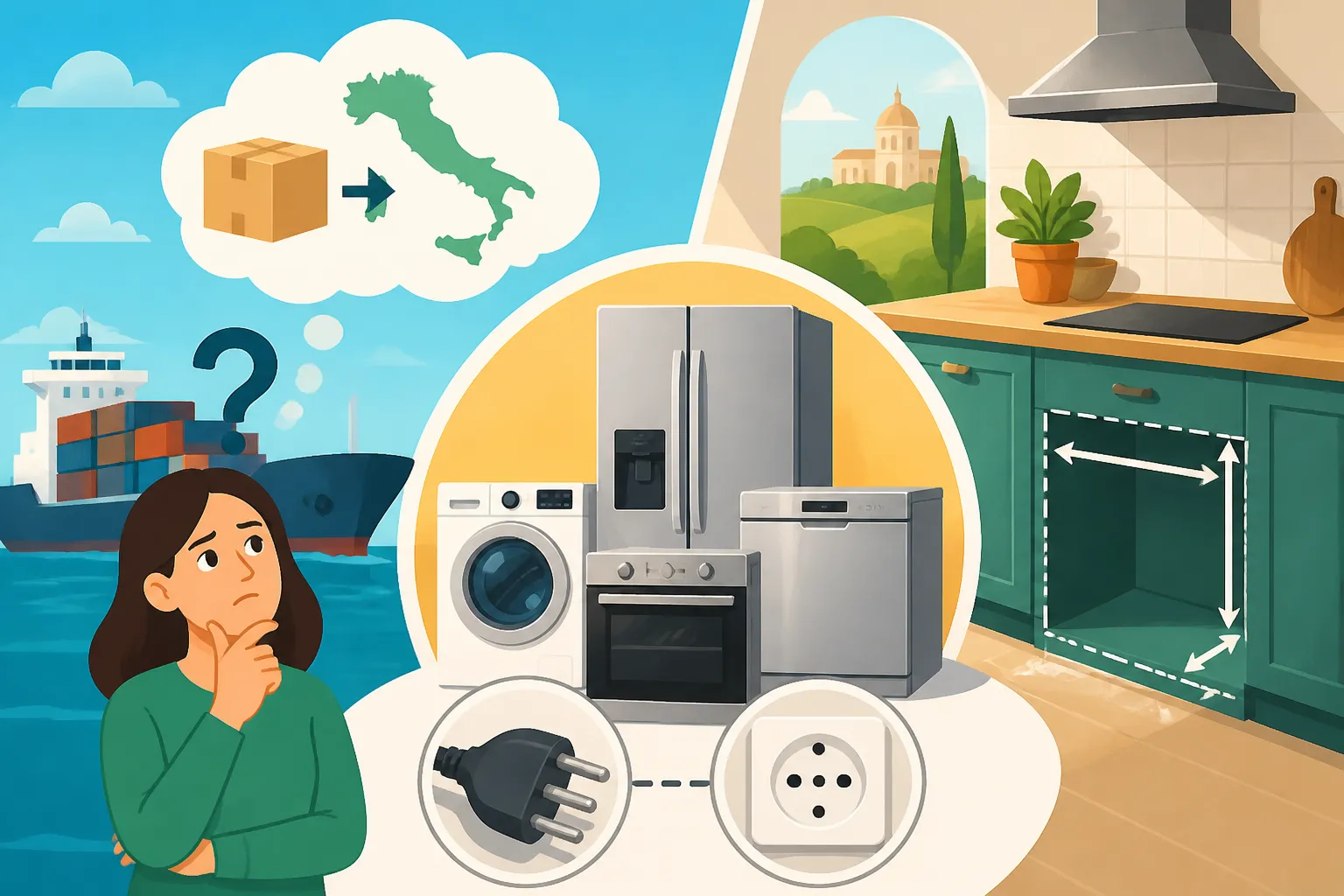
Should You Ship Appliances to Italy? Voltage, Plugs, and Kitchen Dimensions
Oh, the appliance conundrum! As if moving to Italy wasn't already a whirlwind of bureaucracy and cultural adjustments, you're faced with the daunting question of what to do with your beloved kitchen companions. Should you meticulously pack your American-sized fridge or your UK washing machine, hoping they'll find a new home in Italy? Or is it better to cut your losses, sell them off, and start fresh? This guide is here to walk you through the nitty-gritty of voltage, plugs, kitchen dimensions, and all the hidden pitfalls, helping you make the smartest decision for your move, especially when partnering with experienced movers like Sirelo.
Disclosure: This post may contain affiliate links. We may earn a commission at no extra cost to you if you make a purchase through these links. Read full disclosure.
The Great Appliance Dilemma: Ship or Sell?
When you’re preparing for a big move to a new country like Italy, especially from places like North America or the UK, the thought of bringing along your familiar household appliances can be comforting. After all, they’re paid for, you know how to use them, and they represent a little piece of home. However, what seems like a straightforward decision often turns into a complex, costly, and ultimately frustrating endeavor due to fundamental differences in electrical systems and standard housing designs. It’s a classic expat trap, one I’ve seen many friends fall into.
Understanding Voltage and Frequency Differences
Let's start with the basics: electricity. In North America, the standard voltage is 110-120V with a frequency of 60Hz. Most of your larger appliances, like refrigerators, washing machines, and even some kitchen aid mixers, are designed to operate within these specifications. Step foot in Italy, and you're entering a 220-240V, 50Hz world. This isn't just a minor tweak; it's a fundamental difference that can literally fry your electronics or cause them to run inefficiently, leading to premature breakdown.
Imagine bringing your state-of-the-art washing machine, expecting it to hum along perfectly, only to find it either won't turn on, or worse, starts smoking because it's receiving twice the voltage it was designed for. While you can buy step-down transformers, these are often large, heavy, and expensive. For a high-wattage appliance like a refrigerator or a dryer, you'd need a transformer that can handle a substantial load, which can cost hundreds of euros, take up precious space, and still be a point of failure. Plus, the frequency difference means motors designed for 60Hz might run slower or less efficiently on 50Hz, leading to wear and tear. This is particularly true for items with motors like blenders, vacuum cleaners, and microwaves, which might simply not perform as expected or overheat.
Plug Types and Adapters: More Than Just a Pin Change
Beyond voltage, the physical plugs and outlets are entirely different. Italy primarily uses Type F (Schuko) and Type L plugs and sockets. These are two or three-pin round plugs, starkly different from the flat-pronged Type A/B plugs found in North America or the chunky three-pronged Type G plugs common in the UK.
While travel adapters can bridge the gap for low-power electronics like phone chargers or hair straighteners, they are generally not suitable for high-wattage appliances. Why? Because these larger appliances draw a significant amount of current, and a standard travel adapter isn't built to handle that load. Using one for a washing machine or oven is a recipe for disaster – think blown fuses, damaged appliances, or even electrical fires. It’s crucial to understand that an adapter only changes the physical shape of the plug; it does not convert voltage. So, even if your adapter fits the wall socket, if the voltage isn't compatible, you're still in trouble. It’s a common misconception that often leads to avoidable damage.
The Hidden Costs and Headaches of Conversion
The decision to ship your appliances and then attempt to convert them isn't just about the upfront cost of shipping and buying transformers. There are numerous hidden costs and logistical headaches that often make it an uneconomical choice. First, the transformers themselves add weight and bulk to your shipment, increasing your moving costs. Then there’s the question of installation. An Italian electrician might be hesitant, or outright refuse, to install an appliance that requires a large transformer due to safety and liability concerns. They are trained for local standards, and a non-standard setup adds unnecessary risk.
Consider the ongoing energy consumption. Running appliances through transformers can be less energy-efficient, potentially increasing your electricity bills over time. And what about warranties? Any warranty you had on your appliance will almost certainly be voided the moment you modify it with a transformer or try to use it outside its intended electrical specifications. Should something break, you'd be on the hook for full repair costs, which, given the specialized nature of some repairs, can be exorbitant. All these factors combined mean that what seems like a cost-saving measure can quickly become a significant financial drain and a source of constant frustration. This is where services that help you compare moving options, such as Sirelo, become invaluable in helping you weigh these considerations.
Italian Kitchens: A Different World of Dimensions
Beyond the electrical intricacies, the physical space in Italian homes, particularly kitchens, presents another layer of challenges for foreign appliances. Italian kitchens are often designed with a specific aesthetic and functional layout in mind, which frequently means built-in appliances and standardized dimensions that might not align with what you're used to. This is where many expats hit a wall, literally, when their large American fridge or freestanding dishwasher simply won't fit the existing space.
Built-In vs. Freestanding Appliances: The Italian Preference
A significant difference you'll quickly notice in Italian kitchens is the prevalence of incasso (built-in) appliances. Dishwashers, ovens, and sometimes even refrigerators are often integrated seamlessly into the cabinetry, creating a sleek, uniform look. This contrasts sharply with the freestanding dominance in many other countries, especially North America, where appliances are typically standalone units that can be moved and replaced with relative ease.
If your current kitchen appliances are freestanding, they might stick out awkwardly or simply not fit into the designated gaps in an Italian kitchen designed for built-in models. For example, a standard American dishwasher is often wider than its Italian built-in counterpart, and its front panel isn't designed to have a matching kitchen cabinet door attached. Likewise, a freestanding refrigerator from abroad might be too wide or too deep for the specific nook left for a built-in fridge, or its door might open in a way that obstructs adjacent cabinets. Trying to force a freestanding appliance into a built-in space can lead to costly modifications to your kitchen cabinetry, which might not even be possible in a rented property, or it could just look entirely out of place, disrupting the flow of the entire room. When considering The Ultimate Guide to Renting and Buying a Home in Italy, it's vital to think about kitchen layouts from the start.
Standard Sizes for Ovens, Dishwashers, and Fridges
Italian kitchen standards dictate common dimensions for appliances, particularly built-in ones. Ovens are typically 60cm wide, as are most dishwashers. Refrigerators, especially built-in ones, also adhere to specific width, height, and depth measurements designed to integrate perfectly with modular kitchen units. Your American fridge, often a much wider, deeper, and taller "side-by-side" or "French door" model, will almost certainly not fit into the space allocated for a standard Italian fridge.
Even if you find a freestanding space, its sheer size might overwhelm a typically smaller Italian kitchen. Imagine trying to squeeze a large, double-door American fridge into a charming, compact Italian kitchen – it’s often an exercise in futility. Furthermore, the capacity and features might also differ. For instance, American ovens often come with larger capacities and self-cleaning features that are less common in standard Italian models. These dimensional disparities aren’t just aesthetic; they’re structural. They affect whether the appliance can be safely installed, if doors can open fully, and if necessary clearances for heat dissipation are maintained. Understanding these nuances is crucial before you even start packing, and it’s a strong argument for considering local purchases.
The Case of the Compact Washing Machine
Washing machines are another prime example where size truly matters in Italy. While you might be used to large capacity top-loaders or front-loaders, Italian washing machines, especially those designed for apartments, tend to be smaller, often front-loading models with capacities typically ranging from 6 to 9 kg. Space is at a premium in many Italian homes, and laundry areas might be tucked into a bathroom, a utility closet, or even a small corner of the kitchen.
Your larger machine might simply not fit through doorways, into the designated space, or under a countertop. Furthermore, many Italian apartments don't have separate utility rooms for laundry; instead, washing machines are frequently found in the bathroom or integrated into the kitchen setup. A large, bulky machine from abroad could easily dominate the space, making the room feel cramped and impractical. In some cases, you might even find lavasciuga, combined washer-dryer units, which are a clever space-saving solution but also emphasize the compact nature of Italian appliance expectations. This often leads expats to realize that shipping a large washing machine just isn't worth the hassle or the space it will inevitably consume.
Practicalities of Shipping and Installation
Deciding to ship your appliances isn't just about packing them up; it’s a complex logistical undertaking that involves significant planning, cost, and adherence to various international regulations. From finding the right moving company to navigating customs and ensuring proper installation in Italy, each step presents its own set of hurdles that can quickly turn your exciting move into a stressful ordeal.
Hiring Professional Movers with Experience in Italy
When it comes to international relocation, especially with delicate and heavy items like appliances, selecting the right moving company is paramount. You need movers who don't just know how to pack a box, but who understand the specific challenges of moving to Italy. This includes familiarity with Italian customs procedures, knowledge of common delivery limitations (like narrow streets or lack of elevators in older buildings), and expertise in handling fragile electronics. A generic moving company might offer a low quote, but without specialized experience, you could face delays, unexpected fees, or even damaged goods.
This is where a service like Sirelo becomes incredibly valuable. Sirelo helps you find and compare quotes from reputable international moving companies that have a proven track record for moves to Italy. They connect you with movers who are accustomed to dealing with the nuances of Italian logistics, ensuring that your belongings, including any appliances you choose to bring, are handled by professionals who know the ropes. They can advise on packing best practices for international transit, provide insurance options, and manage the shipping process, giving you peace of mind that your items are in capable hands. Choosing wisely here can save you immense stress and potential financial loss. For more insights, consider reading our guide on Choosing Movers for a Relocation to Italy.
Customs, Duties, and Import Regulations for Appliances
One of the most significant complexities of shipping appliances to Italy involves customs and import regulations. Italy, as part of the European Union, has strict rules regarding the importation of goods, and appliances are no exception. You'll need to prepare a detailed inventory of everything you're shipping, and these items may be subject to customs duties and VAT (Value Added Tax), especially if they are not considered "personal effects" or if you haven't lived outside the EU for a certain period.
The exact amount of duty and tax can vary depending on the age and declared value of your appliances. It's not uncommon for expats to be shocked by these unforeseen costs, which can add hundreds, if not thousands, of euros to your total moving bill. Furthermore, the customs clearance process itself can be lengthy and require specific documentation, including proof of residency, your Codice Fiscale, and a detailed packing list. Any discrepancies or missing paperwork can lead to significant delays, with your shipment held up in a warehouse, incurring storage fees. This bureaucratic maze can be incredibly frustrating to navigate on your own, making expert guidance invaluable. Understanding Italy's Tax System: A Guide for Foreigners will also shed light on potential fiscal implications.
Installation Challenges and Finding Skilled Help
Once your appliances have successfully cleared customs and arrived at your new Italian home, the next hurdle is installation. As discussed, the electrical differences are significant. Even if you've brought transformers, connecting them safely to Italian wiring requires expertise. Italian electrical systems often feature different wiring standards and breaker box configurations compared to what you might be used to.
You'll need a qualified, certified electrician (an elettricista) to handle the wiring for high-wattage appliances. Attempting to do it yourself, or relying on an unqualified handyman, is not only dangerous but also illegal and could void your home insurance. Finding an English-speaking electrician who is willing to install foreign appliances with transformers can be a challenge in itself, particularly in smaller towns. They might charge a premium for non-standard work due to the added complexity and liability. Furthermore, plumbing for dishwashers and washing machines might also differ, requiring specific connectors or modifications. All these installation steps add to the overall cost and logistical burden, reinforcing the argument for potentially buying local. For insights into connecting your new Italian home, check out our guide on How to Set Up Electricity in a New Italian Apartment.
The Economics of Buying New in Italy
After navigating the potential minefield of shipping appliances, many expats arrive at a critical juncture: is it actually cheaper and easier to simply buy new once you're settled in Italy? The answer, for a surprising number of people, is a resounding yes. While the initial thought of replacing perfectly good appliances might sting, a detailed financial and practical comparison often reveals that buying local makes far more sense in the long run.
Comparing Costs: Shipping vs. Local Purchase
Let’s talk numbers. The cost of shipping large, heavy appliances across continents can be substantial. This includes not just the freight cost, but also crating, insurance, customs duties, VAT, and any potential storage fees if there are delays. Then, factor in the price of high-quality step-down transformers for each appliance and the cost of professional electrical installation. When you tally up all these expenses, you might find that the total cost approaches, or even exceeds, the price of buying brand-new Italian-compatible appliances.
On the other hand, buying new in Italy means you immediately get appliances that are designed for the local electrical grid, fit standard kitchen dimensions, and come with local warranties. You avoid the stress of customs, the bulk of transformers, and the headache of finding specialized installers. While the initial outlay for new appliances can seem daunting, consider the value of peace of mind, seamless integration into your new home, and the avoidance of potential future repair costs on converted foreign appliances. This financial analysis should be a serious part of your budgeting when estimating the Cost of Living in Italy 2026: Budgeting for Expats. It's a key decision point where services like Sirelo can help you calculate overall moving costs accurately, allowing for a clearer comparison.
Energy Efficiency and Local Warranties
Modern Italian appliances are built to European energy efficiency standards, which are often stricter than those in other parts of the world. This means that a new washing machine or refrigerator purchased in Italy is likely to be more energy-efficient than an older model from your home country, especially if that model is running through a transformer. Over time, these energy savings can offset part of the initial purchase price, leading to lower monthly utility bills, an important consideration given Energy and Utility Costs in Italy: Monthly Expenses.
Furthermore, buying locally means you benefit from local consumer protection laws and manufacturer warranties. If an appliance breaks down within the warranty period, you have direct access to local service and support. Imagine trying to get a North American refrigerator repaired under warranty in Italy – it's virtually impossible. Repairs for foreign models often require importing parts, which can be time-consuming and expensive, and finding technicians familiar with non-European brands can be a nightmare. A local warranty provides invaluable security and convenience, ensuring that any issues can be addressed quickly and efficiently by service centers familiar with the product.
Where to Buy Appliances in Italy: From Big Box to Boutique
Italy offers a wide range of options for purchasing new appliances, catering to various budgets and preferences. You'll find large electronics and appliance retailers similar to big box stores in other countries. Chains like Unieuro, MediaWorld, and Euronics are prevalent across the country, offering a vast selection of brands, models, and price points. These stores often have sales, delivery services, and installation options, making the process relatively straightforward. Many also provide detailed product specifications, including dimensions and energy ratings, which are crucial for ensuring compatibility with your new Italian kitchen setup.
For those looking for more budget-friendly options, large hypermarkets like Esselunga, Coop, or Carrefour often have appliance sections, particularly for smaller items or entry-level models. Online retailers are also gaining popularity, with sites like Amazon.it and specialized appliance e-commerce platforms providing competitive prices and home delivery. If you're furnishing on a budget, consider second-hand options from local Facebook groups, expat forums, or even dedicated used appliance stores in larger cities. Lastly, don't overlook local independent appliance shops (negozi di elettrodomestici), especially in smaller towns. They might offer a more personalized service, expert advice, and sometimes even better deals, particularly during local sales. For general furnishing tips, our guide on Furnishing an Italian Apartment: Stores, Delivery, and Budget Tips could be quite helpful.
Making the Smart Decision: A Comprehensive Checklist
The "ship or sell" question for appliances is rarely black and white. It involves a careful evaluation of numerous factors, both practical and emotional. As an expat, you’re often juggling a lot, and this decision can feel overwhelming. But by breaking it down and considering all angles, you can arrive at a choice that saves you money, minimizes stress, and helps you settle into your new Italian life more smoothly.
Factors to Consider Before You Pack
Before you even think about putting a "for sale" sign on your fridge or boxing up your dishwasher, take a deep breath and go through this checklist:
- Voltage and Frequency Compatibility: Is your appliance 220-240V, 50Hz compatible? If not, are you prepared for the cost, size, and potential inefficiency of a transformer? For most North American appliances, this is a non-starter.
- Plug Type: Will your plugs match Italian Type F or L sockets, or will you need adapters (which, again, are only for low-power items and don't convert voltage)?
- Appliance Age and Condition: Is your appliance old, prone to issues, or nearing the end of its life cycle? If so, the cost of shipping and conversion will almost certainly outweigh its remaining value. Consider its "mileage" – a nearly new appliance might be worth the effort if compatible, but an aging one is definitely not.
- Dimensions: Does your appliance fit standard Italian kitchen spaces, especially if your new home has built-in cabinetry? Measure your current appliance and, crucially, get the dimensions of the spaces in your prospective Italian home (or general Italian standards). A large American fridge or a wider washing machine might simply not fit or make the space feel cramped.
- Shipping Costs: Get detailed quotes for shipping just your appliances. Compare this to the cost of buying new equivalents in Italy. Don't forget to factor in customs duties, VAT, and any required crating. Sirelo can help you gather multiple quotes to compare.
- Installation Costs and Availability: How much will it cost to have a qualified electrician install your foreign appliance with a transformer? Can you even find someone willing to do it safely and legally?
- Warranties and Repairs: Are you willing to forgo any remaining warranty? Are you prepared for the difficulty and expense of sourcing parts and finding technicians for a foreign brand in Italy?
- Sentimental Value: This is often the hardest one. If an appliance holds deep sentimental value (e.g., a grandmother's heirloom mixer, not a standard dishwasher), that might tip the scales. But be realistic about how much that sentiment is truly worth in terms of practical inconvenience and cost.
The Environmental and Ethical Considerations
Beyond the practicalities and economics, there's also an environmental and ethical lens through which to view this decision. Shipping large, heavy appliances across oceans contributes to carbon emissions. While this might seem like a drop in the ocean in the grand scheme of your move, it's worth acknowledging. If your appliances are nearing the end of their life, shipping them only to have them break down shortly after arrival means you've expended resources on shipping something that will soon become waste.
Conversely, selling or donating your functional appliances in your home country gives them a new life and reduces waste. When you buy new in Italy, you're investing in appliances designed for the local market, often with better energy efficiency ratings than older foreign models, which can lead to a smaller environmental footprint in your daily usage. This also supports the local economy. It's a small choice, perhaps, but one that aligns with a more sustainable approach to international relocation. Many expats find great joy in embracing local products and integrating more fully into their new community, and this can extend even to kitchen appliances.
Partnering with the Right Moving Service for a Seamless Transition
Ultimately, the goal is a smooth, stress-free move. Navigating international logistics, customs, and the unique challenges of Italian homes is a monumental task. This is precisely why partnering with the right moving service is not just a convenience, but a necessity.
A trusted moving partner like Sirelo doesn't just transport your goods; they provide invaluable guidance and support through every step of your relocation journey to Italy. They can help you:
- Compare reliable movers: Get quotes from pre-vetted international moving companies that specialize in moves to Italy, ensuring you find a service that understands the intricacies of your destination.
- Advise on appliance decisions: While they can't make the choice for you, experienced movers can offer insights into the practicalities and typical outcomes of shipping various appliances, based on their expertise.
- Navigate customs: They can provide crucial information and assistance with the complex customs documentation for Italy, helping to minimize delays and unexpected costs.
- Coordinate logistics: From packing to delivery, they streamline the entire process, allowing you to focus on other aspects of settling into your new Italian life, like Registering Residency in Italy (Residenza and Anagrafe) or understanding your Italian Rental Contracts Explained: 3+2, 4+4, Transitorio.
By utilizing a service like Sirelo, you empower yourself with information and connections, making the "ship or sell" decision for your appliances much clearer and the entire moving process significantly smoother. It’s about making informed choices that pave the way for a truly wonderful expat experience in Italy.
Here's a quick comparison to help solidify your thoughts:
| Appliance Feature/Consideration | Shipping from 110V/60Hz Country (e.g., USA) | Buying New in Italy (220-240V/50Hz) |
|---|---|---|
| Voltage & Frequency | Requires heavy, expensive step-down transformer; frequency mismatch affects motors. | Perfectly compatible with local grid. |
| Plug Type | Needs adapters (only for low-wattage, not voltage conversion) or wiring changes. | Fits local Type F/L sockets directly. |
| Dimensions | Often too wide/deep for standard Italian built-in or compact kitchen spaces. | Designed for Italian kitchen standards, including built-in options. |
| Shipping Costs | High, includes crating, freight, insurance, customs duties, VAT. | Zero. |
| Installation | Requires qualified electrician for transformer, complex wiring; might be hard to find. | Straightforward, standard installation by local technicians. |
| Warranty & Repairs | Warranty voided; difficult/expensive to find parts and service. | Full local warranty and easy access to service. |
| Energy Efficiency | Older models potentially less efficient; transformers add inefficiency. | Modern, energy-efficient models with EU ratings. |
| Resale Value | Very low to non-existent if trying to sell in Italy. | Standard resale value for used appliances. |
| Environmental Impact | High (long-distance transport, potential early obsolescence). | Lower (local purchase, better energy efficiency). |
| Convenience & Peace of Mind | High stress, potential issues, hidden costs. | Low stress, seamless integration, reliability. |
Disclaimer
Please remember that while I strive to provide accurate and up-to-date information based on my experience and available data, regulations and circumstances in Italy can change. This guide is for informational purposes only and does not constitute legal, financial, or professional moving advice. It is always recommended to consult with relevant Italian authorities, professional movers like those found through Sirelo, electricians, and tax advisors for advice specific to your individual situation before making any major decisions regarding your relocation and belongings.