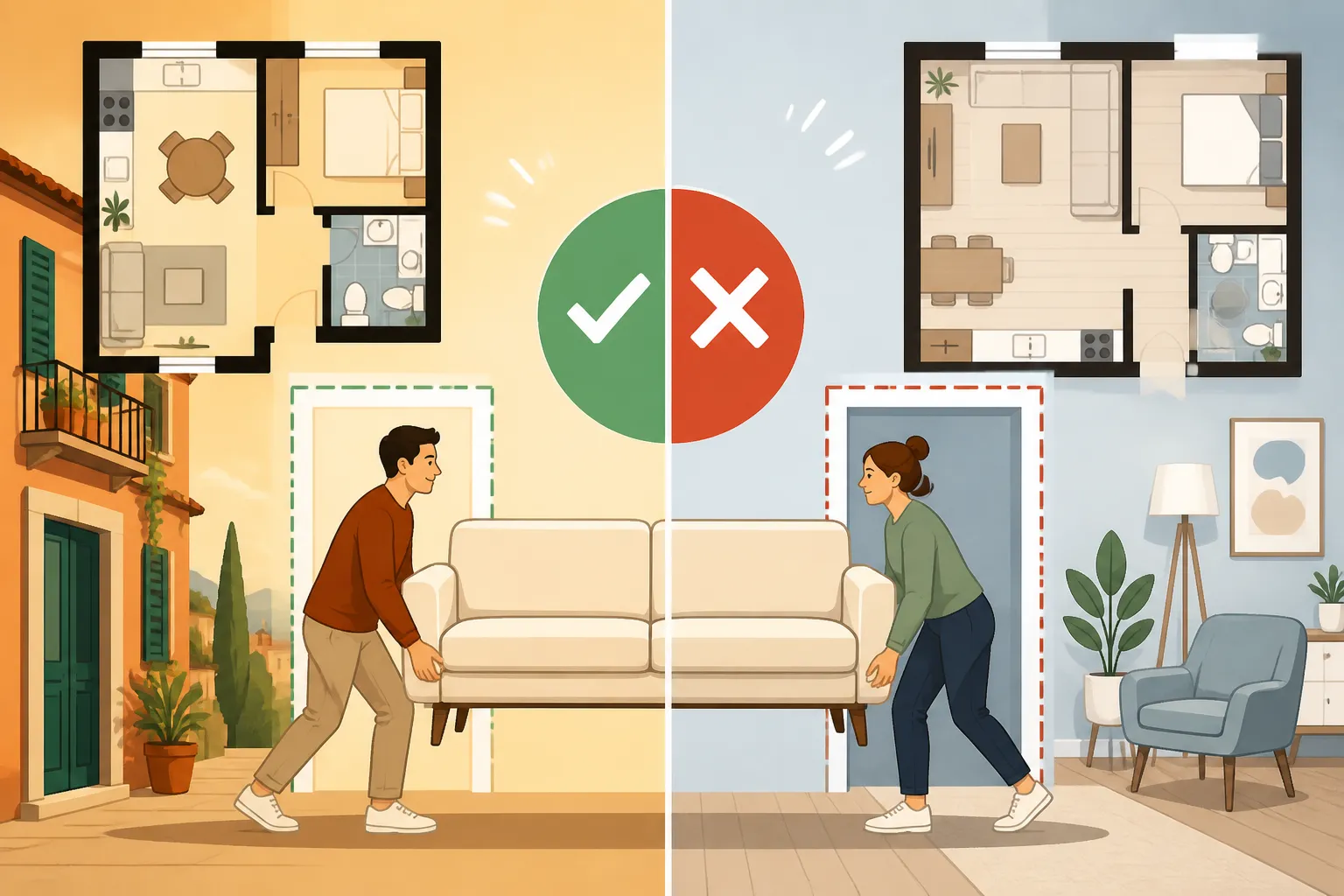
Will Your Furniture Fit? Italian Apartment Layouts vs Northern European Homes
Moving to Italy is an absolute dream for so many of us, but when you start picturing your beautiful antique armoire or your sprawling sectional sofa in your new Italian apartment, a cold dose of reality often hits. The charming, historic buildings we fall in love with often come with unique architectural quirks that can turn a simple furniture delivery into a logistical nightmare. This guide is here to help you understand those differences and, crucially, plan your move with expert assistance from services like Sirelo, ensuring your treasured belongings arrive safely and, more importantly, fit through the door.
Disclosure: This post may contain affiliate links. We may earn a commission at no extra cost to you if you make a purchase through these links. Read full disclosure.
The Great Downsize: Why Italian Apartments Feel Different
When you've grown accustomed to the more expansive layouts typical of Northern European or North American homes, stepping into an Italian apartment can feel like entering a different dimension. It's not just about square footage; it's about a fundamentally different approach to living space shaped by centuries of history and culture.
Historical and Cultural Influences on Italian Architecture
Italy's urban landscape is a tapestry woven over millennia. Many of its cities grew organically from medieval nuclei, meaning streets are narrow, buildings are tightly packed, and space has always been a precious commodity. Homes were often designed for multi-generational living within a compact footprint, necessitating functional separation rather than vast open spaces. Think of those charming, winding alleyways you adore in places like Florence or Rome; they weren't built with large delivery trucks or oversized furniture in mind.
Culturally, the emphasis was often on shared community spaces outside the home – the piazza, the local bar, the family trattoria – with private residences serving more as intimate, functional hubs for daily life. This philosophical difference translates directly into apartment design, where rooms tend to be distinct, purpose-specific, and often smaller than what you might be used to. You won't find many great rooms or expansive open-plan living areas in traditional Italian apartments; instead, you'll discover a series of smaller, often cozy rooms, each with its own role.
The Impact of Urban Planning and Population Density
Modern urban planning in Italy has, to some extent, continued this legacy of compact living. Even in newer developments outside historic centers, land value and population density often dictate designs that maximize space efficiency. This often means building upwards, with apartments stacked, and communal areas like stairwells and elevators (if they exist!) designed to be as space-saving as possible.
Contrast this with the sprawling suburbs and larger detached homes common in many Northern European countries or the Americas, where land is more plentiful and construction norms often allow for wider hallways, larger rooms, and dedicated service entrances. In Italy, especially in vibrant cities like Milan or Bologna, every square meter counts, leading to ingenious but often challenging layouts. Even when apartments boast high ceilings, the actual floor plan remains compact, creating a vertical feeling rather than an expansive horizontal one. It's a stark difference that can truly impact how your existing furniture fits into your new Italian life.
Navigating the Architectural Quirks: What to Expect Inside
Beyond the overall size, it's the specific architectural details of Italian apartments that can pose the biggest headaches for expats with furniture from larger homes. These quirks are charming when you're admiring them, but less so when you're trying to maneuver a king-sized mattress around a tight corner.
Room Dimensions and Layouts: A Tight Squeeze
You'll quickly notice that individual rooms in an Italian apartment are typically smaller and more compartmentalized. Kitchens, for instance, are often compact, designed for efficiency rather than expansive entertaining. You might find a separate dining room, or a dining area integrated into a smaller living room, but rarely a sprawling open-concept space. Bedrooms, while sometimes having high ceilings, tend to be narrower, making it a real challenge for wide beds, particularly American or Canadian king-sized models.
Living rooms are often more intimate, and built-in cupboards or niches might be common, which can reduce usable wall space for your existing bookshelves or media units. It’s not uncommon to find that a "three-room" apartment (a trilocale) refers to two bedrooms and a living room, with the kitchen being a separate, often tiny, space. This can make your existing, generously sized furniture feel utterly overwhelming in a typical Italian setting.
Doorways, Hallways, and Staircases: The Ultimate Obstacle Course
This is where many expat moving nightmares truly begin. Italian doorways are notoriously narrower and often shorter than what you might be used to. Forget wide entryways; many older buildings have doors barely wide enough for one person to pass comfortably. Hallways can be incredibly tight, winding, and sometimes have awkward angles or sudden steps. If you're eyeing a charming apartment in a historic center, prepare for the possibility of no elevator, or a tiny, antique elevator that barely fits one person and a suitcase, let alone a sofa.
Staircases in older palazzi can be magnificent, but they are often spiral, steep, and narrow. Moving a large wardrobe or a long dining table up several flights of these can be an absolute feat, often requiring specialized equipment or a dedicated team of movers who know the ropes. This is precisely why a professional moving service like Sirelo, with experience in Italian logistics, becomes invaluable. They can assess these challenges beforehand and plan accordingly, potentially saving you immense stress and costly damages. For a smooth transition, considering who you hire is paramount, as discussed in our guide on Choosing Movers for a Relocation to Italy.
Ceiling Heights and Built-in Elements
While many historic Italian buildings boast incredibly high ceilings, offering a sense of grandeur and airiness, this isn't universally true. Newer constructions or renovated attic apartments might have standard or even lower ceiling heights. More importantly, older homes often feature built-in closets (armadi a muro), shelving, or even small, often decorative, architectural elements that can interfere with where you plan to place your freestanding furniture.
These built-in features, while practical for storage or adding character, mean less flexible wall space. For example, a beautifully carved antique armadio might look perfect in a photoshopped image, but in reality, it might block a window, jut out into a narrow walkway, or be too tall for a room with a lower ceiling. Understanding these nuances before you commit to shipping your beloved furniture is a crucial step in settling into your new Italian life.
The Furniture Conundrum: Making Your Existing Pieces Work (or Not)
After navigating the initial shock of different layouts, the next big question for many expats is: what about my furniture? Deciding what to bring and what to leave behind is a truly personal, and often agonizing, process.
Assessing Your Current Furniture: The Reality Check
It's time to be brutally honest with yourself. Start by meticulously measuring every single piece of furniture you own that you're considering bringing. Don't just measure the length and width; measure the diagonal, the height, and check if it can be easily disassembled. Pay particular attention to large, monolithic items: your plush sectional sofa, that grand king-sized bed frame, the bulky dining room credenza, or that enormous American refrigerator.
Consider the dimensions of typical Italian counterparts. For instance, Italian beds are often slightly smaller than US sizes (a standard Italian matrimoniale is roughly a US queen, slightly wider but often shorter). Appliances are generally more compact, and washing machines are often top-loading or smaller front-loading units designed for bathroom or kitchen integration. If your furniture is custom-made or particularly large, it’s highly probable it simply won't fit without extreme measures, which brings us to the logistical hurdles. Remember, while sentimental value is priceless, the cost and stress of moving an ill-fitting item can quickly outweigh it.
The Practicalities of Moving Large Items to Italy
Moving to Italy is not just about packing boxes; it's about navigating unique logistical challenges. For anything larger than a standard chair, professional assessment is key. International moving specialists like Sirelo are experienced in handling these specific Italian hurdles. They can advise you on what items might require special handling, like disassembly and reassembly, or even crane services if your apartment is on an upper floor in a building with no suitable elevator or wide staircase.
Imagine this: your beautiful sofa arrives, only to find the staircase is too narrow, the doorway too low, and the building doesn't have an external access point for a crane. What then? You're left with an expensive item sitting on the street, and additional costs for temporary storage or disposal. These are the scenarios you want to avoid, and having a mover who understands the local context can make all the difference. When planning, also consider the general Cost of Living in Italy 2026: Budgeting for Expats, as unexpected moving expenses can quickly inflate your initial budget.
Common Problematic Items and Italian Alternatives
Let's get specific. Here's a table of common items that often pose problems and typical Italian solutions:
| Problematic Item (Northern European) | Typical Dimensions (Approx.) | Common Italian Issues | Italian Alternative/Solution |
|---|---|---|---|
| King-size Bed Frame (US/Canadian) | 193 x 203 cm (76 x 80 in) | Too wide for bedrooms/doorways | Italian Matrimoniale (160 x 190-200 cm), Queen (152 x 203 cm) or smaller, often platform beds or simpler frames. |
| Large Sectional Sofa | Varies widely, often 250-350+ cm long | Too long/wide for living rooms, narrow hallways, tight turns | Modular sofas, sofa beds (divano letto), smaller two or three-seater sofas. |
| Bulky Wardrobe/Armoire | Often deep (60+ cm), wide (150+ cm), tall (200+ cm) | Too deep for bedrooms, too wide for doorways, too tall for certain ceilings | Built-in wardrobes (armadi a muro), sleek sliding-door wardrobes, custom closets. |
| American-sized Refrigerator | 90+ cm wide, 175+ cm tall | Too wide for kitchen alcoves, too deep for compact kitchens, power outlet issues | Narrower, standard Italian refrigerators (60-70 cm wide), often integrated. |
| Large Dining Table (8+ chairs) | 200+ cm long | Too large for typical dining areas, difficult to maneuver | Extendable dining tables, smaller square/round tables. |
The good news is that Italy is a design powerhouse! You can find incredibly stylish, space-saving, and often modular furniture that perfectly suits smaller spaces. Embrace the opportunity to refresh your home's aesthetic with pieces that are both beautiful and functional for your new Italian life.
Strategies for Furnishing Your Italian Home
Once you've come to terms with the realities of Italian apartment layouts, the next step is to strategize how to actually furnish your new home. This isn't just about problem-solving; it's an opportunity to embrace new styles and smart solutions.
Embracing Italian Design: Functionality and Style
Italian design is renowned worldwide for a reason. It perfectly blends aesthetics with practicality, often creating pieces that are elegant, durable, and space-conscious. Instead of trying to force your oversized furniture into a compact Italian space, consider immersing yourself in the local design philosophy. Italian furniture makers have perfected the art of creating sleek lines, often with hidden storage and clever multi-functional elements.
You'll find an abundance of stylish options at local furniture stores, from independent boutiques to larger chains like IKEA (yes, they're in Italy!) or Mondo Convenienza, which cater to various budgets. Exploring these stores will give you a real sense of what works well in Italian homes. Think about light, airy pieces, perhaps with exposed legs, or wall-mounted shelving that frees up floor space. It’s a chance to curate a home that feels authentically Italian, blending seamlessly with your new surroundings. If you're looking for more guidance on where to shop, our post on Furnishing an Italian Apartment: Stores, Delivery, and Budget Tips can be a great resource.
The Art of Modular and Multi-functional Furniture
This is a game-changer for Italian apartment living. Modular furniture, which can be broken down into smaller components or reconfigured to fit different spaces, is your best friend. Think about:
- Sectional sofas that can be separated into individual chairs or two-seaters, allowing for easier movement and flexible arrangement.
- Extendable dining tables that can be compact for daily use and expanded only when guests arrive.
- Sofa beds (divano letto) that offer a comfortable seating area by day and a guest bed by night, eliminating the need for a dedicated guest room.
- Wall-mounted units for TVs, bookshelves, and storage, which keep floors clear and rooms feeling larger.
- Ottomans with hidden storage for blankets, magazines, or extra clutter.
These items not only solve the "fitting" problem but also allow you to maximize the utility of every square inch of your Italian home, making even the smallest spaces feel comfortable and organized. This approach is not just a compromise; it’s a smart way to live efficiently and stylishly.
When to Buy New vs. Shipping Old: A Cost-Benefit Analysis
This is perhaps the most significant decision you'll face. There's no single right answer, as it depends on sentimental value, the age and condition of your existing furniture, and your budget. Here’s a breakdown to help you weigh your options:
Shipping Your Existing Furniture:
- Pros: Sentimental value, known comfort, potentially higher quality if you own expensive pieces.
- Cons: High shipping costs (especially for large items), potential for damage, customs duties, the risk that items won't fit, and the added stress of logistics. Professional international movers like Sirelo can certainly mitigate the risk of damage and navigate customs, but the costs remain.
- Best for: Small, easily disassembled items, precious family heirlooms, or if you're moving a large container and have many items that will fit.
Buying New in Italy:
- Pros: Furniture designed for Italian spaces, no shipping stress, potentially faster setup, opportunity to embrace a fresh style, warranty/returns are local, and you can support local businesses.
- Cons: Initial outlay cost, potential language barrier during shopping, some initial time spent searching.
- Best for: Most large items (sofas, beds, wardrobes), appliances, and filling out your new home with pieces perfectly suited to its scale.
Consider the long-term. If you plan to stay in Italy for many years, investing in new, appropriate furniture locally might be more cost-effective and practical than repeatedly dealing with ill-fitting items or the expense of shipping them back out later. For budgeting, consider our guide on Cost of Living vs Salary: Budget Tips for Italy Expats when weighing these financial decisions.
Planning Your Move with Italian Layouts in Mind
Moving to Italy is an adventure, but like any adventure, it requires careful planning. For expats, this means a rigorous approach to your belongings, especially when dealing with the unique architectural characteristics of Italian homes.
Pre-Move Planning: Measurements Are Your Best Friend
You absolutely cannot overestimate the importance of precise measurements when moving to Italy. Before you even think about packing a single box of furniture, you need to have a clear understanding of your new apartment's dimensions. This means:
- Doorways: Measure width and height of every exterior door (building entrance, apartment entrance) and interior door.
- Hallways: Measure width, and note any tight corners, pillars, or obstacles.
- Staircases: Measure width, height between steps, and especially the clearance at landings and turns. If there's an elevator, measure its interior dimensions.
- Room Dimensions: Get accurate measurements of all rooms, paying attention to wall lengths, window placements, and any built-in features.
If you haven't physically seen the apartment, ask your landlord or real estate agent for detailed floor plans and photos, or even a video walkthrough with a tape measure. A virtual tour can only show so much; actual numbers are critical. Having these measurements on hand will allow you to compare them directly to your existing furniture and make informed decisions about what can realistically come with you.
Professional Movers: Why Expertise Matters in Italy
This is not the time to cut corners with an inexperienced moving company. Moving to Italy, especially from another country, is complex, and the unique challenges of Italian architecture demand a mover with specialized knowledge. Companies like Sirelo understand the nuances of international removals to Italy. They can provide:
- Pre-move surveys: Experienced surveyors can assess your belongings and compare them to your new home's specifications, identifying potential issues before they become real problems.
- Specialized equipment: From smaller, more agile moving vans that can navigate narrow Italian streets, to the potential need for external lifts or cranes to hoist furniture through windows or balconies, a good mover will have the right tools.
- Disassembly and reassembly services: They can expertly take apart large furniture pieces for transport and put them back together in your new home.
- Customs and bureaucratic navigation: Beyond just physical moving, they handle the necessary paperwork for international shipments, including customs clearance, which can be a minefield for the uninitiated.
Don't underestimate the value of this expertise. Trying to manage an international move of large items yourself, or with a general moving company unfamiliar with Italian specifics, can quickly turn into a nightmare of damaged goods, unexpected fees, and immense frustration. Invest in a reliable partner like Sirelo to ensure your cherished items are in capable hands from start to finish.
Local Resources for Furniture Assembly and Installation
Even if you buy new furniture in Italy, much of it often comes flat-packed, requiring assembly. And if you do bring some disassembled pieces from home, you'll need help putting them back together. While some larger furniture stores offer assembly services (often for an additional fee), it's good to know about local resources.
Many small towns and cities have independent handymen (artigiani or tuttofare) who specialize in furniture assembly and minor home installations. Your real estate agent, landlord, or even local expat groups on social media can be excellent sources for recommendations. Don't be shy about asking for help; Italians are generally very resourceful and often know someone for everything. This local support network can be invaluable for getting your new Italian home set up smoothly and making sure everything, big or small, finds its perfect place.
Disclaimer
The information provided in this guide is intended for general informational purposes only and does not constitute legal, financial, or professional advice. While we strive to provide accurate and up-to-date information, regulations and procedures in Italy can change. Always consult with relevant professionals, such as immigration lawyers, tax advisors, real estate agents, or moving companies like Sirelo, for advice tailored to your specific situation. We are not responsible for any actions taken based on the information provided herein.