Moving Into a Restored Rural Property in Italy: Access and Delivery Problems
Oh, the dream! A beautifully restored stone farmhouse nestled amongst olive groves, a charming casale tucked away in a tiny Umbrian village, or a rustic masseria with sweeping views of the Puglian countryside. It’s the very image that draws so many of us expats to Italy. But before you get lost in visions of sipping Aperol Spritz on your new patio, let’s talk about a very real, very un-romantic hurdle that can turn that dream into a logistical nightmare: actually getting your furniture and belongings into your new rural Italian haven. The narrow roads, the winding paths, the sheer inaccessibility – it's a unique challenge that requires foresight, patience, and often, specialized help. This guide is here to walk you through the surprising complexities of moving into a restored rural property in Italy, ensuring your transition is as smooth as possible, especially with the right moving partner like Sirelo by your side.
Disclosure: This post may contain affiliate links. We may earn a commission at no extra cost to you if you make a purchase through these links. Read full disclosure.
The Romantic Dream vs. The Rugged Reality: Understanding Rural Access in Italy
Italy’s charm often lies in its ancient, winding infrastructure, but that very charm can become your biggest headache when it comes to moving house. Forget wide, easy access roads that accommodate massive removal trucks; in rural Italy, every meter is a negotiation.
Narrow Roads and Historic Centers: When a Van Just Won't Fit
Imagine your average large international moving truck. Now imagine it trying to navigate the cobbled streets of a medieval Tuscan hill town like Cortona or a tiny village in the Marche region. It's often impossible. Many of these properties, even "restored rural" ones, are part of or very close to historic centers, which means strict regulations and physical limitations.
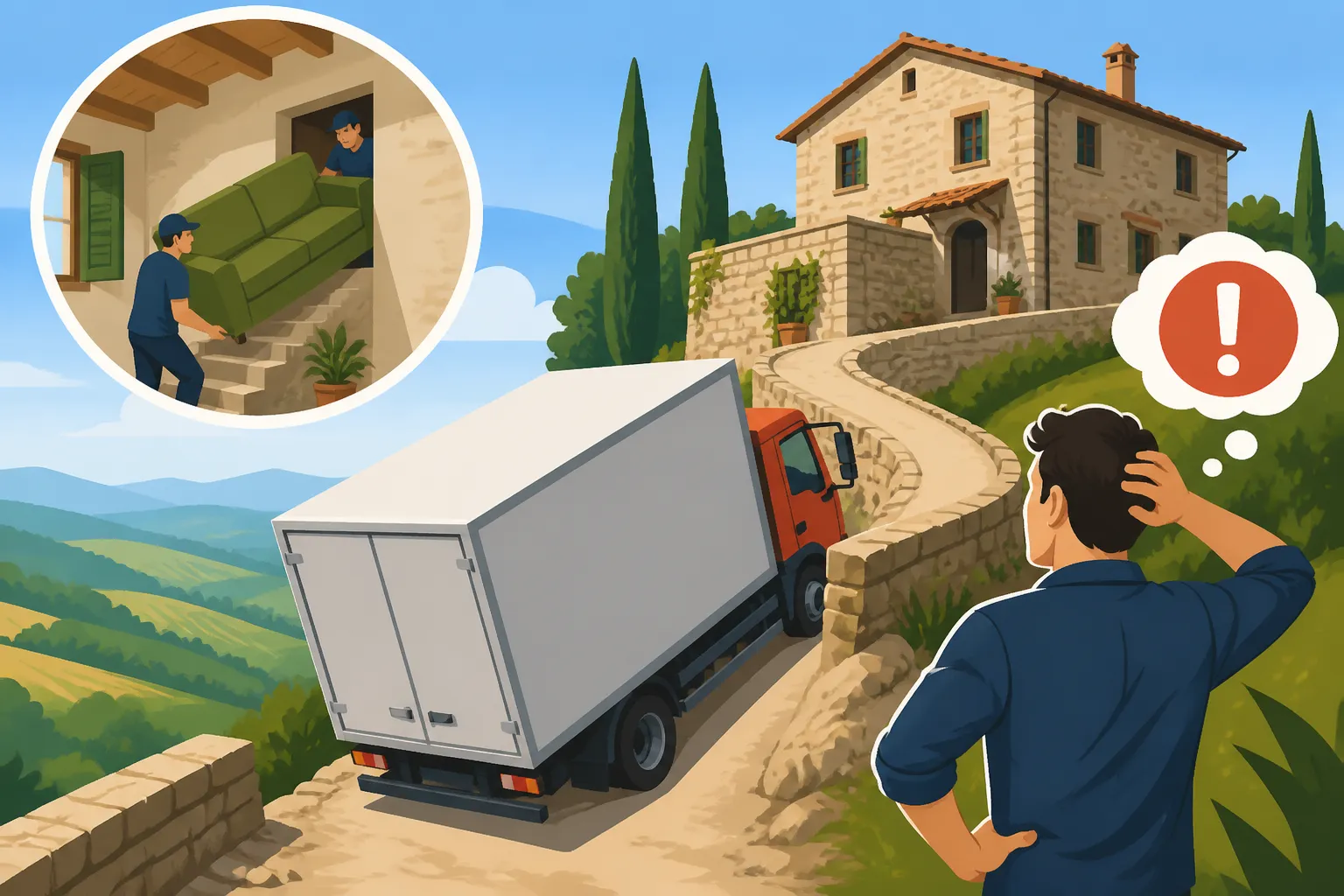
You'll encounter what are known as stradine (very small roads) or vicoli (alleys) that were designed for donkeys and carts, not modern vehicles. Even if the main road to the village is navigable, the turn-off to your specific property might be too tight, too steep, or simply too narrow for anything larger than a compact car. This isn't just an inconvenience; it can mean your carefully packed belongings simply cannot reach your doorstep directly. We're talking about situations where the truck might have to park a kilometer away, leaving you with a very long, very manual, and very expensive "last mile" transfer. Plus, don't forget the infamous ZTLs, or Limited Traffic Zones, common in many Italian towns, including smaller ones, which restrict vehicle access to certain areas during specific hours or for non-residents. Getting a temporary pass for a moving truck can be a bureaucratic adventure in itself.
Unpaved Tracks and Mountain Passes: The Last Mile Challenge
Beyond the charming, but restrictive, historic centers, many rural properties are genuinely remote. They might be at the end of a long, unpaved strada bianca (white road) that winds through fields, or up a steep, gravelly track in the foothills of the Dolomites or the Apennines. These roads can be challenging in good weather, but add rain, snow, or simply a poorly maintained surface, and you've got yourself a serious problem.
I've seen expats who bought their dream rustico in rural Sicily only to discover that the last three kilometers to their home were a deeply rutted, unlit dirt track, barely wide enough for one car, let alone a moving truck. Regular removal vans are simply not equipped for such terrain; they lack the ground clearance and robust suspension. You might need a specialized, smaller 4×4 vehicle to transport items from a staging point to your home. This adds layers of complexity, extra costs, and often, significant delays. It's crucial to understand that what looks like a minor dirt track on Google Maps can be an impassable obstacle course for a professional moving crew.
Navigating the Bureaucracy of Deliveries: Permits and Local Quirks
Beyond the physical limitations of the roads, Italy throws in its own special blend of administrative hurdles. Getting your large moving vehicle where it needs to go often involves navigating a complex, localized system of permits and permissions.
ZTLs and Temporary Parking Permits: The Paperwork Maze
Remember those ZTLs I mentioned? They're not just for tourists driving rental cars! Moving vehicles, especially large ones, are very much subject to these rules. If your property is within a ZTL or requires access through one, you'll need to apply for a temporary access permit from the local Comune (municipality). And let me tell you, this is not a one-size-fits-all process. The requirements, application forms, fees, and processing times can vary wildly from one Comune to another. One small town might let you email a request a week in advance, while another might require an in-person application with marca da bollo (tax stamps) and a detailed plan of your route, approved by the local traffic police, two months in advance.
Furthermore, even if you get through the ZTL, you might need a permit for occupying public land (occupazione di suolo pubblico) if your moving truck needs to block a road, even temporarily, or set up an external lift. This often involves more paperwork, more fees, and more waiting. It’s a uniquely Italian brand of bureaucracy that will test your patience. Many expats find great benefit from hiring a professional commercialista or local assistant to help with these processes, but a good moving company, especially one with Italian experience, should also be able to guide you. When planning your move, consider engaging a moving partner that understands these local nuances and can help you secure the necessary permits, or at least advise you on the exact steps. A network like Sirelo can connect you with movers who have this boots-on-the-ground knowledge.
Local Logistics and Liaison: The Importance of a Geometra or Local Contact
This is where local knowledge isn't just helpful, it's absolutely essential. If you’ve bought a restored rural property, chances are you've already worked with a geometra – a surveyor or technical expert who handles a lot of the planning and paperwork for property renovations and cadastral updates. This person can be an invaluable asset in coordinating your move. They know the local Comune office, they speak the language, and they understand the specific quirks of your property’s location. They might even know the local small-scale movers who specialize in the "last mile" transfer using smaller vehicles or specialized equipment.
Engaging a local contact to liaise with the moving company, the Comune, and any other local services can save you countless headaches. They can scout the route in person, confirm vehicle access, and even smooth over potential issues with neighbors who might not be thrilled about a massive truck blocking their ancient street. Their familiarity with the local dialect and customs can make all the difference in a situation where a simple misunderstanding could lead to significant delays. Many larger international moving companies will have partners on the ground, but for truly remote properties, a dedicated local go-between is often the key. It's about finding people who understand that in Italy, sometimes things move at their own pace, and a little personal connection can go a long way. This is also where a platform like Sirelo shines, as it helps you find reputable movers who often have these local connections or are part of larger networks with local expertise.
Strategies for a Smooth Move: Planning and Professional Help
Don't let your romantic vision turn into a logistical nightmare. Moving into a restored rural property in Italy is possible, and even enjoyable, with the right strategy and the right team.
Pre-Move Reconnaissance: Assessing the Terrain
This step is absolutely critical and often overlooked by eager new homeowners. Before you even sign a contract with a moving company, you need to conduct a thorough reconnaissance of your property's access.
- Visit with your potential mover: Ideally, fly back to Italy (or send a trusted local representative) with a representative from the moving company you're considering. Let them see the road, the gate, the driveway, and the actual entrance to your home. Photos and videos are good, but nothing beats an in-person assessment.
- Measure everything: Seriously, measure the width and height of the narrowest points on your access road, any gates, the property entrance, and especially your main doorframes and stairwells. This will help determine if an external lift is needed or if certain oversized furniture might need to be disassembled or left behind.
- Identify obstacles: Are there low-hanging tree branches? Steep inclines that could cause a large vehicle to bottom out? Tight corners that require multiple maneuvers? Any uneven ground where a lift might struggle to stabilize? Document these meticulously.
Having this detailed information upfront allows your chosen moving company to provide an accurate quote and plan, anticipating potential challenges rather than reacting to them on moving day. It also helps avoid costly surprises, like the need for special equipment or additional labor. This meticulous planning is key to a successful move, and a good moving platform like Sirelo can help you find companies that prioritize such detailed pre-move assessments.
Specialized Moving Services: When Regular Movers Won't Cut It
When you're dealing with challenging access, a standard moving company with large, one-size-fits-all trucks simply won't suffice. You need movers who understand the nuances of Italian rural properties and are equipped to handle them.
This often means working with a company that offers a trasbordo (transfer) service. This involves bringing your main shipment to a nearby, easily accessible depot or staging area. From there, your belongings are transferred to smaller, more agile vans – often custom-built for narrow Italian roads – which then complete the final leg of the journey to your home. In some cases, for particularly tricky access, companies might even use small forklift trucks or specialized external lifts to hoist furniture directly to an upper-floor window if the ground-level access is too difficult. Finding such specialized services can be daunting if you’re trying to do it yourself from abroad, or even locally with limited Italian.
This is precisely where platforms like Sirelo become invaluable. They connect you with a network of vetted international and local moving companies, many of whom specialize in moves to and within Italy, and are well-versed in handling these unique logistical challenges. Instead of cold-calling dozens of movers and trying to explain your strada bianca situation in broken Italian, you can leverage a service that understands these specific needs and can match you with appropriate, experienced professionals. They act as a bridge, ensuring you find movers who have the right equipment and expertise to get your precious belongings safely to your new, picturesque, but possibly hard-to-reach, home. Don't underestimate the peace of mind that comes from knowing your movers have tackled a dozen similar situations before.
Temporary Storage Solutions and Staging Areas
Sometimes, even with the best planning, direct, immediate delivery isn't feasible. Perhaps your property is still undergoing minor finishing touches, or the permits for road closure won't be ready on your ideal moving day. This is where temporary storage and strategic staging become crucial.
Your moving company might offer a secure, climate-controlled storage facility near your new home's region. This allows your main shipment to arrive in Italy and be safely held until all access issues are resolved and you're truly ready for delivery. This flexibility can be a lifesaver, preventing costly demurrage charges for trucks waiting idle or the headache of trying to reschedule an international shipment. Additionally, for the "last mile" transfer, a staging area – a safe, accessible spot where large trucks can offload onto smaller vehicles – is often necessary. This might be a village square, a local industrial estate, or even a designated parking lot a few kilometers from your property. Plan for this in advance, ensuring the staging area is secure and that the transfer process is efficiently managed to minimize handling and potential damage.
Working with a reputable moving service found through a platform like Sirelo ensures that these options are clearly communicated and integrated into your moving plan. They can advise on costs, logistics, and help you determine if temporary storage or a staging area is a necessary component of your specific move, giving you one less thing to worry about.
| Access Challenge | Description | Potential Solutions | Needed Equipment/Support |
|---|---|---|---|
| Narrow Village Roads | Stradine, vicoli in historic centers, tight turns. | "Last mile" transfer, shuttle service to property. | Smaller, specialized vans; local knowledge for routes. |
| Unpaved Tracks | Gravel, dirt roads, steep inclines, uneven surfaces. | 4×4 vans, robust smaller vehicles. | High-clearance vehicles, experienced drivers. |
| ZTL Restrictions | Limited Traffic Zones in towns, restricted hours. | Temporary Comune permits, timed access. | Application forms, marca da bollo, local liaison. |
| Steep Driveways/Steps | Inaccessible for standard dollies or manual carrying. | External furniture lifts, extra manual labor. | Specialized lift, larger crew, ropes/pulleys. |
| Long Distance from Road | Property set far back from where a large truck can park. | Multiple transfers, use of smaller utility vehicles. | Hand trucks, utility carts, local transfer services. |
| No Parking Space | No immediate parking for unloading, blocking public areas. | Temporary parking permit (occupazione suolo pubblico). | Local Comune application, traffic cones, signage. |
Moving Beyond the Move: Continued Access for Daily Life
The challenges don't just end on moving day. Living in a restored rural property in Italy means ongoing considerations for access and deliveries that will become part of your daily routine.
Utility Connections in Remote Areas
While not strictly about moving your physical belongings, the connection of utilities is often intertwined with access challenges. Getting technicians from electricity, gas, water, or internet providers to your remote casale can be just as difficult as getting a moving truck there. Roads that are problematic for a delivery van are equally problematic for a utility service vehicle. This means you might experience longer waiting times for initial connections or even for repairs.
You might find that fiber internet hasn't quite reached your idyllic valley yet, or that gas needs to be delivered by tanker for a GPL tank rather than via mains pipes. Patience is key here, and having local contacts who can nudge things along with providers like Enel for electricity or TIM for internet can make a huge difference. Just like with moving, understanding the limitations and exploring alternatives (like satellite internet) before you're living there can prevent frustration.
Regular Deliveries and Day-to-Day Logistics
Once you're settled in, life continues, and with it, the need for everyday deliveries. How will your weekly grocery order from Esselunga arrive if the delivery van can't reach your door? What about Amazon packages, or even regular postal mail?
For many remote properties, postal services might only deliver to a central village post office or a designated collection point. Parcel services like SDA, BRT, or GLS might attempt delivery but often leave a note for collection if access is difficult. It’s important to clarify these points with local services as soon as you can. You might need to make arrangements for a village pickup point, or find a trusted neighbor who receives parcels for you. This is part of embracing the rural Italian lifestyle – it often means a bit more effort for daily necessities, but it’s a trade-off many of us happily make for the peace and beauty of our surroundings. Remember that platforms like Sirelo are not just for your big initial move, but can also be a good resource for finding local logistics solutions as you settle in.
Moving into a restored rural property in Italy is an adventure, one filled with charm, beauty, and yes, its fair share of logistical puzzles. But with careful planning, local insights, and the right professional moving partners, it's an adventure that's absolutely worth taking. Don't let these unique Italian challenges deter you; instead, empower yourself by leveraging a platform like Sirelo to connect with movers who specialize in these niche, tricky relocations. They can transform what might seem like an insurmountable obstacle into a smooth transition to your dream Italian life.
Disclaimer
Please note that this guide provides general information based on common experiences of expats moving to Italy. Laws, regulations, and specific procedures, especially concerning local permits and access restrictions, can vary significantly between regions and individual municipalities (Comuni). It is always advisable to consult with legal professionals, local authorities, and experienced moving companies for advice tailored to your specific situation and location in Italy. We aim for accuracy, but information can change.