Coverage in Rural Italy: eSIM Networks in Puglia, Basilicata, and Calabria
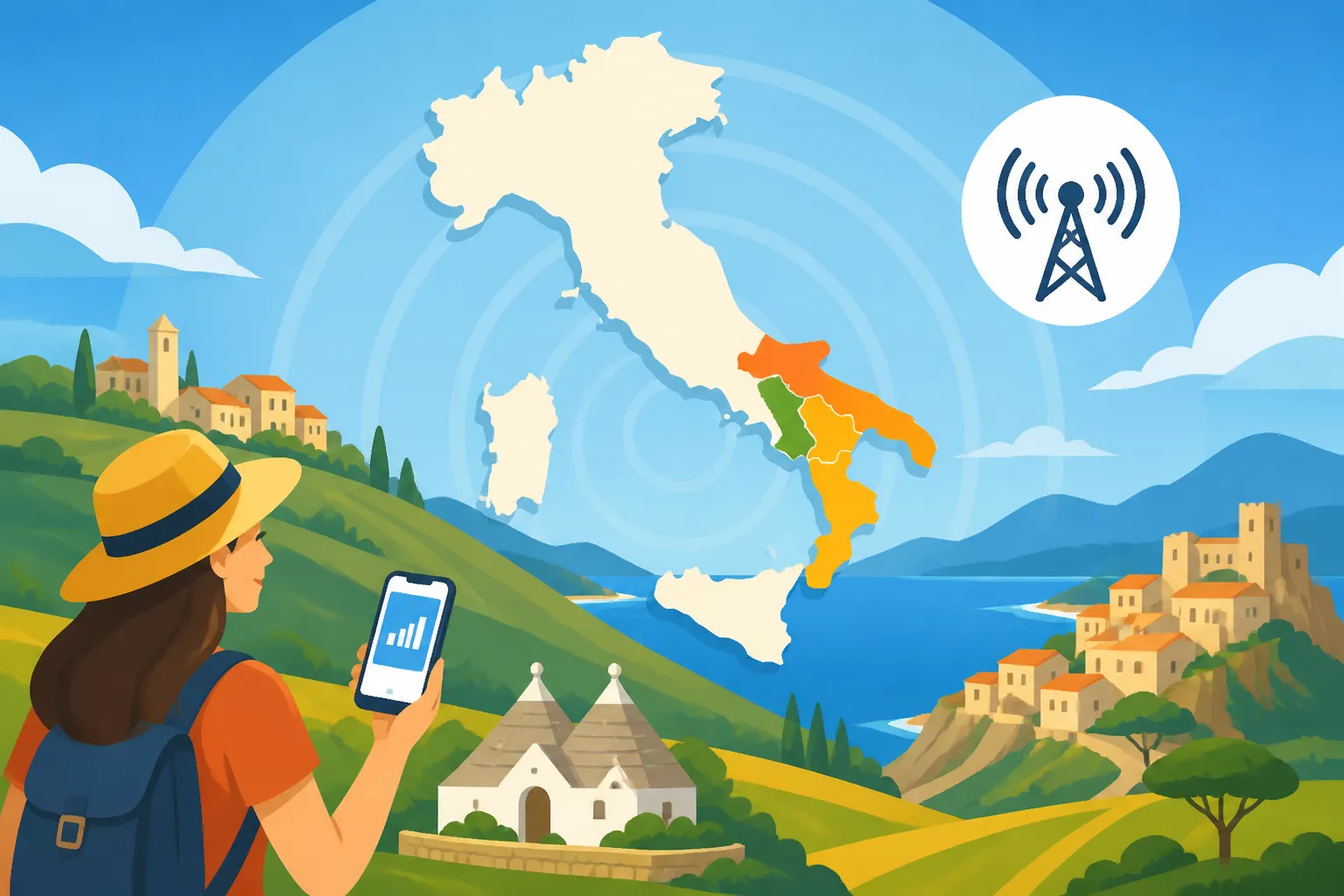
Oh, the romantic allure of Southern Italy! Imagine yourself winding through the sun-drenched hills of Puglia, exploring the ancient Sassi of Matera, or tracing the dramatic coastline of Calabria. It sounds idyllic, doesn't it? And it often is, until you try to load Google Maps to find that hidden agriturismo or send a quick WhatsApp to tell your loved ones you've arrived safely, only to find your phone stubbornly refusing to connect. The truth is, reliable mobile coverage in rural Southern Italy can be a real headache for expats and tourists alike, leading to frustration and lost opportunities. This guide is here to shed some light on the connectivity challenges and, more importantly, introduce you to a game-changing solution: eSIMs, with a special focus on how Airalo can keep you seamlessly connected, even in Italy's most remote, beautiful corners.
Disclosure: This post may contain affiliate links. We may earn a commission at no extra cost to you if you make a purchase through these links. Read full disclosure.
The Connectivity Conundrum in Southern Italy's Hidden Gems
Let's be honest, Italy is a country of contrasts. You can be in the heart of Milan with lightning-fast 5G, and then, a mere hour outside the city, struggle to load a simple webpage. This problem is exacerbated as you head south, where the landscapes are breathtaking, but the digital infrastructure often lags. For anyone relying on their phone for navigation, communication, or even just peace of mind, this can quickly turn a dream trip into a stress-filled scavenger hunt for a signal.
Why Rural Southern Italy is a Challenge for Connectivity
Picture it: Puglia with its rolling olive groves and whitewashed hilltop towns, Basilicata with its rugged mountains and deep ravines, or Calabria, stretching for miles with its dramatic coastal cliffs and dense, ancient forests. These are precisely the elements that make these regions so enchanting, but they're also the culprits behind spotty mobile coverage. The terrain itself acts as a natural barrier, blocking signals from reaching every nook and cranny. Many of these charming borghi (small villages) and masserie (traditional farmhouses) were built centuries ago, long before anyone even dreamed of cellular networks.
Furthermore, investment in telecommunications infrastructure tends to prioritize densely populated urban areas. Why spend millions running fiber optic cables and erecting cell towers in a remote mountain village of 500 residents when you could service a city of half a million? This isn't unique to Italy, of course, but it's a stark reality that impacts daily life for those who choose to live or travel off the beaten path here. You might find great service right outside a major city like Bari or Lecce, but once you start driving towards the Salento beaches, the Valle d'Itria, or the Sila mountains, those bars on your phone screen can quickly vanish. It's a truly exasperating experience, especially when you're trying to communicate vital information or simply looking up directions in a foreign language.
The Pitfalls of Traditional SIM Cards
Before eSIMs came along, our only real option was to navigate the labyrinthine world of traditional Italian physical SIM cards. For a visitor, this often meant a trip to a phone store, armed with your passport and Codice Fiscale (Italian tax code). Even for a short trip, you'd find yourself queuing, battling language barriers, and filling out paperwork. Then, if you were a non-EU citizen, you might even encounter stores reluctant to sell you a pay-as-you-go SIM without a long-term residency permit, or requiring more paperwork than you have on hand. It's enough to make you want to throw your phone into the nearest fountain!
And once you finally get one, you're tied to a single network provider. What if that provider has poor coverage in the exact rural area you're heading to? You're out of luck. You can't just magically switch to a different network. Plus, managing top-ups can be confusing, understanding data allowances in Italian is another hurdle, and then there's the hassle of keeping track of that tiny physical card. For expats who move frequently or tourists on a multi-country trip, a drawer full of defunct SIM cards from different countries is a common, albeit annoying, souvenir. This old-school approach just isn't built for the dynamic needs of modern travel, especially when you're exploring the more untamed beauty of Southern Italy.
The Promise of eSIM Technology
Enter the eSIM: a digital SIM card that's embedded directly into your phone. No more fiddling with tiny plastic cards, no more searching for a paperclip to open the SIM tray. The beauty of an eSIM is its sheer convenience and flexibility. You can buy a data plan online, activate it instantly, and get connected within minutes, all from the comfort of your couch or even your hotel room. Think about that: no more hunting for a phone store after a long flight, no more deciphering contracts in Italian, and no more worrying about losing your primary SIM card.
One of the most significant advantages of eSIMs, especially for challenging areas like Puglia, Basilicata, and Calabria, is the ability to easily switch providers or have multiple data plans active simultaneously. While a specific eSIM plan might piggyback on one network, the ease of adding another plan from a different provider if coverage is poor is a game-changer. It's like having a digital arsenal of connectivity options at your fingertips. This technological leap offers a much-needed breath of fresh air for those of us who just want to stay connected without the added stress of Italian bureaucracy or unreliable signals.
Navigating eSIM Networks for Seamless Travel in Puglia, Basilicata, and Calabria
Okay, so eSIMs sound great in theory, right? But how do they actually perform in the notoriously spotty regions of Southern Italy? This is where your choice of eSIM provider becomes crucial. You need a service that understands the nuances of local networks and offers robust, reliable coverage.
Airalo: Your Connectivity Hero for Southern Italy
When it comes to staying connected in Italy, especially in those less-trodden paths of Puglia, Basilicata, and Calabria, I genuinely believe Airalo is your connectivity hero. Why? Because Airalo doesn't just offer "an" Italian eSIM; it offers access to the strongest available networks in Italy, usually partnering with major players like TIM, Vodafone, and WindTre. This multi-network leverage is precisely what makes it so effective in areas where one provider might be weak. If TIM has a dead zone, Vodafone might pick up the slack, and Airalo often allows you to connect to whichever has the best signal.
Imagine you're driving through the scenic but remote Murgia landscape in Puglia, and suddenly your GPS loses signal. With a traditional SIM, you'd be stuck. But with an Airalo eSIM, you're tapping into the best available infrastructure, significantly increasing your chances of maintaining a stable connection. It's the digital equivalent of having multiple spare tires for your car – you're simply more prepared for whatever the road throws at you. Plus, the ease of purchase and installation means you can literally get connected before your flight even lands, or even while sipping an espresso at a café in Matera. This convenience alone is worth its weight in gold when you're navigating a foreign country. You can check out options like their 'Ciao Mobile' plan for Italy, which often gives you data coverage across the country, making it a perfect fit for a Southern Italian adventure.
Deep Dive into Regional Coverage
Let's break down how Airalo can keep you connected in each of these captivating southern regions, highlighting some specific challenges and solutions.
Puglia
Puglia is a diverse region, from the bustling port city of Bari and the baroque splendor of Lecce to the unique trulli houses of Alberobello and the pristine beaches of Salento. While major cities and popular coastal resorts generally have decent coverage, venturing into the rural heartland, the serene Valle d'Itria, or the wild Gargano Peninsula can test your patience. Areas with ancient architecture, like the historical centers of Ostuni or Martina Franca, often have thick stone walls that signals struggle to penetrate.
Airalo shines here by not relying on a single tower. For example, if you're exploring the quiet back roads between Monopoli and Polignano a Mare, where one operator might struggle, Airalo's ability to utilize different underlying Italian networks can keep you streaming music or finding that next charming masseria. When you're out near the crystal-clear waters of Torre dell'Orso, you'll still want to share those enviable photos, and with a robust Airalo plan, you're much more likely to do so without a hitch. This kind of flexibility is crucial in a region where connectivity can fluctuate significantly within just a few kilometers.
Basilicata
Basilicata is Italy's best-kept secret, known for its dramatic landscapes, the stunning Sassi di Matera, and the rugged beauty of the Lucanian Dolomites. Matera, a UNESCO World Heritage site, is particularly challenging. The ancient cave dwellings and deep ravines of the Sassi create a natural fortress that can make phone signals play hide-and-seek. Once you venture out into the mountainous interior, towards towns like Castelmezzano or Pietrapertosa, connectivity can become even more scarce.
This is precisely where the strength of an Airalo eSIM comes into its own. By dynamically connecting to the strongest signal available from its partner networks, Airalo gives you a far better chance of staying online. Imagine needing to confirm a reservation for a guided tour of the Sassi, or perhaps just letting family know you're safe after a hike through the Dolomiti Lucane. Having a reliable connection through Airalo means you're not left isolated in these truly unique, but often digitally isolated, locations. It’s about minimizing those moments of anxiety when you’re utterly dependent on your phone.
Calabria
Calabria, the toe of Italy's boot, is arguably the most wild and least developed of these three regions. Its vast mountainous areas, such as the Sila and Aspromonte national parks, combined with a lengthy, often remote coastline, present significant connectivity hurdles. Towns nestled high in the mountains or along secluded beaches can be digital black holes.
For those exploring Calabria's rugged beauty, perhaps driving along the stunning Costa degli Dei or discovering ancient Greek ruins, reliable data is not a luxury; it's a necessity for navigation and safety. An Airalo eSIM, with its robust connectivity, acts as a crucial safety net. It allows you to use your GPS without fear of losing signal mid-route, research opening hours for a local trattoria in a tiny village, or simply keep in touch with emergency services if you find yourself in a bind in a remote area. While no service can guarantee 100% coverage in every single dead spot, Airalo maximizes your chances of staying connected by leveraging Italy's primary mobile networks, which is often far better than being stuck with just one.
Setting Up Your Airalo eSIM: A Step-by-Step Guide
One of the greatest benefits of using Airalo is how straightforward it is to get started. Forget the queues and the paperwork; this is designed for the modern traveler.
- Check Your Device Compatibility: First things first, ensure your phone supports eSIM technology. Most newer smartphones (iPhone XS and later, many Samsung Galaxy models, Google Pixel 3 and later, etc.) are compatible. A quick search for "eSIM compatible phones" or checking your phone's settings will confirm this.
- Download the Airalo App: Head to your app store (Apple App Store or Google Play Store) and download the free Airalo app. This is your portal to purchasing and managing your eSIMs.
- Choose Your Plan: Open the app and search for "Italy" or "Europe" if you're visiting multiple countries. You'll see various data plans with different amounts of data (e.g., 1GB, 3GB, 5GB) and validity periods (e.g., 7 days, 15 days, 30 days). Select the plan that best fits your travel needs. Remember to consider how much you rely on data for maps, social media, and communication.
- Install the eSIM: Once you've purchased your plan, the app will guide you through the installation process. This usually involves either scanning a QR code or manually entering some details. It's surprisingly simple and usually takes just a couple of minutes. Make sure you have a stable Wi-Fi connection during installation.
- Activate Data: After installation, you'll need to enable your new eSIM for cellular data in your phone's settings. You can often label it "Travel SIM" or "Italy eSIM" to easily distinguish it from your primary SIM. Crucially, remember to turn on "Data Roaming" for the Airalo eSIM, as it operates as a roaming service, though without the exorbitant roaming fees you might be used to. This step is often overlooked and causes initial connectivity issues. Don't worry, it won't trigger roaming charges on your primary line if you've turned off data roaming for it.
And voilà! You're connected. It’s truly that simple, allowing you to focus on enjoying the beautiful Italian landscape rather than stressing about your phone signal. If you want to dive deeper into managing your connectivity options, you might find our guide on how to choose a cell phone plan in Italy helpful, even if you’re leaning towards an eSIM.
Real-World Scenarios and Practical Tips for eSIM Use
Having an eSIM like Airalo in rural Southern Italy isn't just about making calls; it's about empowering your entire travel experience. It minimizes those frustrating moments and maximizes your ability to explore freely.
Staying Connected on the Go
Think about those crucial moments where connectivity truly matters. You've just arrived in a tiny town in Basilicata, completely off the main tourist trail, and your pre-booked trattoria for dinner requires a quick call to confirm your arrival. Or you're trying to navigate the winding roads of Calabria using your phone's GPS, and suddenly the signal drops just as you're approaching a complicated intersection. These are the situations where a reliable Airalo eSIM proves its worth.
With a robust data connection, you can effortlessly use navigation apps like Google Maps or Waze, even in areas with less coverage, as they often cache maps temporarily. You can instantly translate a menu in a tiny local eatery, search for the opening hours of a specific museum in Lecce, or quickly book a last-minute B&B if your plans change. For those working remotely, even part-time, an Airalo connection offers the stability needed for checking emails or participating in a quick video call from an unexpected location. It truly transforms your experience from potentially stressful to delightfully spontaneous.
Troubleshooting Common eSIM Issues
While eSIMs are generally straightforward, sometimes technology can be a bit finicky. Don't panic if your Airalo eSIM doesn't connect instantly. Here are a few common troubleshooting tips:
- Check Data Roaming: As mentioned, ensure "Data Roaming" is enabled for your eSIM profile in your phone's settings. This is often the culprit for initial connection problems.
- APN Settings: Occasionally, you might need to manually set the Access Point Name (APN). Airalo usually provides this information in their app or via email. Navigate to your cellular settings, find your eSIM, and look for APN settings to enter the correct details (e.g., "globaldata").
- Restart Your Phone: The age-old tech advice, but it often works wonders. A simple restart can force your phone to search for available networks and properly activate the eSIM.
- Check Network Selection: In some areas, particularly rural ones, your phone might try to connect to a weaker network. Go to your cellular settings, select your eSIM, and try to manually select a network (e.g., TIM, Vodafone, WindTre) to see if one has a stronger signal.
- Contact Airalo Support: If all else fails, Airalo has a responsive customer support team available through their app or website. They can help diagnose the issue specific to your device and location. Remember, you can often reach them using Wi-Fi if your data isn't working.
Maximizing Your Data Plan
Nobody wants to run out of data in the middle of a picturesque countryside drive! Here are a few ways to make the most of your Airalo data plan:
- Monitor Your Usage: The Airalo app allows you to easily track your data consumption. Keep an eye on it to avoid unexpected depletion.
- Utilize Wi-Fi Whenever Possible: When you're at your hotel, apartment, or a café, jump on their Wi-Fi. This saves your eSIM data for when you truly need it on the go.
- Download Offline Maps: Before heading to a potentially low-coverage area, download offline maps for that region in Google Maps or similar apps. This is a lifesaver for navigation when signals are scarce.
- Pre-download Entertainment: If you rely on streaming services, download movies, TV shows, or music to your device before leaving a strong Wi-Fi connection.
- Top Up with Airalo: If you find yourself needing more data, Airalo makes it incredibly easy to purchase a top-up directly through their app. No need to find a store; just a few taps and you're good to go. This flexibility is a huge advantage over traditional physical SIMs.
Making the Switch: Why Airalo is the Smart Choice for Southern Italy
For expats and travelers alike, living or visiting Italy means embracing its beautiful complexities – from the charming chaos of its cities to the serene, often digitally disconnected, beauty of its rural heartlands. While traditional solutions often add to the frustration, innovative services like Airalo genuinely streamline the experience.
Cost-Effectiveness and Transparency
One of the most appealing aspects of using an Airalo eSIM is the clear, upfront pricing. You buy a data package for a specific amount of data and a specific duration. There are no hidden fees, no unexpected activation charges, and no baffling monthly bills in Italian. This transparency is a huge relief, especially for those budgeting their travel expenses. Traditional local SIMs might seem cheap initially, but the complications of topping up, understanding different rates, and potentially getting locked into a plan with a poor signal can quickly add up in frustration and unexpected costs. With Airalo, you know exactly what you're paying for, and the ability to top up only when needed puts you in complete control.
Moreover, if you're traveling across Europe, a regional eSIM from Airalo can cover multiple countries, saving you the hassle and expense of buying a new SIM in each destination. This is particularly advantageous for those exploring beyond Italy's borders, allowing for seamless travel from Puglia into, say, Greece or Croatia, without ever changing a physical card.
Freedom and Flexibility
The freedom an eSIM like Airalo offers is truly unparalleled. You maintain your primary phone number for calls and texts (if you choose), while using the eSIM purely for data. This means friends and family can still reach you on your familiar number, but you're paying local data rates, not exorbitant international roaming fees. For short trips, you can get a week's worth of data. For longer stays, you can opt for a month-long plan, and then easily extend or top up as needed.
This flexibility is a game-changer for those spontaneous road trips through Basilicata or last-minute changes to your itinerary in Calabria. You're not locked into a long-term contract or a specific network's coverage limitations. If you decide to spend an extra week exploring the beautiful Gargano coast and run low on data, a few taps in the Airalo app and you're instantly recharged. This adaptability is precisely what modern expats and tourists need in a country that often requires a flexible approach.
Essential for Expats and Digital Nomads
For those making Italy their temporary or permanent home, or for the growing number of digital nomads working from scenic locations, reliable connectivity is absolutely non-negotiable. While an Airalo eSIM might not replace a long-term home internet connection, it serves as an indispensable tool for mobile data. It's perfect for those initial weeks or months when you're still navigating the process of setting up broadband internet in your Italian home, or for ensuring you always have a backup connection during power outages or fixed-line issues, which aren't uncommon in some rural Italian areas.
Furthermore, for digital nomads who might base themselves in different Italian regions throughout the year, Airalo offers unparalleled convenience. You don't need to visit a new phone store every time you move from Puglia to Tuscany. Just purchase a new local plan through the app and you're connected. This ease of use helps you bypass much of the local bureaucracy that can bog down even simple tasks like getting a basic SIM card. For more on navigating those administrative hurdles, check out our guide on how to get a Codice Fiscale in Italy (and why you need one), which is essential for many official tasks.
Ultimately, while the rustic charm of rural Italy is undeniable, the ability to stay connected is a modern necessity. Airalo provides a reliable, user-friendly, and flexible solution that significantly reduces the stress of mobile connectivity, allowing you to fully immerse yourself in the beauty and culture of Southern Italy. Whether you're a tourist exploring ancient ruins or an expat settling into a new life, having a strong, dependable data connection is key to a smooth and enjoyable experience.
| Feature | Traditional Physical SIM (Local Italian) | Airalo eSIM (Italy) |
|---|---|---|
| Purchase Process | In-store, requires passport/Codice Fiscale, language barrier, paperwork, queuing | Online via app, instant download, no paperwork, no language barrier, no queuing |
| Activation | Physical insertion, potential delay | Instant digital activation |
| Device Required | Unlocked phone with physical SIM tray | eSIM-compatible unlocked phone |
| Coverage | Tied to one specific network provider; can be spotty in rural areas | Leverages major local networks (TIM, Vodafone, WindTre) for best available signal; dynamic selection |
| Flexibility | Fixed plan, difficult to switch providers or top up remotely | Easy to switch plans, top up anytime/anywhere via app, multi-country options |
| Cost | Potentially low initial cost, but can have hidden fees or confusing top-up structures | Transparent, upfront pricing; no hidden fees; pay-as-you-go data |
| Management | Physical card to keep track of, in-store support | All managed through an intuitive mobile app |
| Best For | Long-term, single-network commitment for locals | Short-term travel, expats needing flexible data, multi-country trips, remote rural areas |
Disclaimer
Please note that while every effort has been made to provide accurate and up-to-date information, telecommunications services, network coverage, and regulatory requirements can change. Always check the latest information directly with service providers and official sources. Coverage can also vary based on specific location, device, and network congestion.