Diving in Sardinia and the Aeolian Islands: Depth Limits and Chamber Costs
Oh, the sheer thrill of plunging into the azure depths of Italy! There's nothing quite like exploring the Mediterranean underwater, especially around places like Sardinia or the mystical Aeolian Islands. But let's be real, us veteran expats know that even the most exhilarating adventures carry a sliver of risk. The last thing you want is to be caught off guard by a diving incident, particularly when it comes to understanding depth limits, emergency protocols, and the often-staggering costs of hyperbaric chamber treatment. This guide is here to unravel all those complexities, giving you the peace of mind to dive into Italy's marine wonders, backed by the robust protection of travel insurance like SafetyWing.
Disclosure: This post may contain affiliate links. We may earn a commission at no extra cost to you if you make a purchase through these links. Read full disclosure.
The Underwater Wonderland of Sardinia and the Aeolian Islands
Italy’s coastline might be famous for its picturesque villages and sun-drenched beaches, but beneath the surface lies an equally captivating world. For divers, Sardinia and the Aeolian Islands offer some of the most spectacular underwater experiences you can imagine.
Sardinia's Submerged Treasures
Sardinia, with its rugged coastline and crystal-clear waters, is a diver's paradise. The island boasts an incredible array of dive sites, from vibrant reefs teeming with marine life to ancient shipwrecks that tell tales of centuries past. Picture yourself gliding through schools of barracuda, spotting groupers lurking in rocky crevices, or perhaps even encountering a friendly dolphin or a majestic manta ray if you're lucky.
One of the most renowned areas is the Maddalena Archipelago National Park in the north. Here, the granite seabed creates dramatic underwater landscapes, adorned with colorful gorgonians and sponges. Sites like the Secca di Spargi are famous for their healthy coral, diverse fish species, and even occasional encounters with larger pelagics. Further south, the waters around Capo Testa offer stunning visibility and interesting rock formations, while the Gulf of Orosei on the eastern coast is a graveyard for historical shipwrecks, providing a fascinating glimpse into naval history amidst thriving marine ecosystems. The variety here is astounding, whether you're a beginner exploring shallow reefs or an experienced diver seeking deeper wrecks.
Aeolian Islands: Volcanic Depths and Marine Biodiversity
Now, if you're looking for something truly unique, the Aeolian Islands off the coast of Sicily are an absolute must. These seven volcanic islands, a UNESCO World Heritage site, offer an otherworldly diving experience that blends the raw power of geology with abundant marine biodiversity. Imagine diving near active volcanoes, where the seabed is sculpted by ancient lava flows and fumaroles release streams of gas, creating a surreal underwater spectacle.
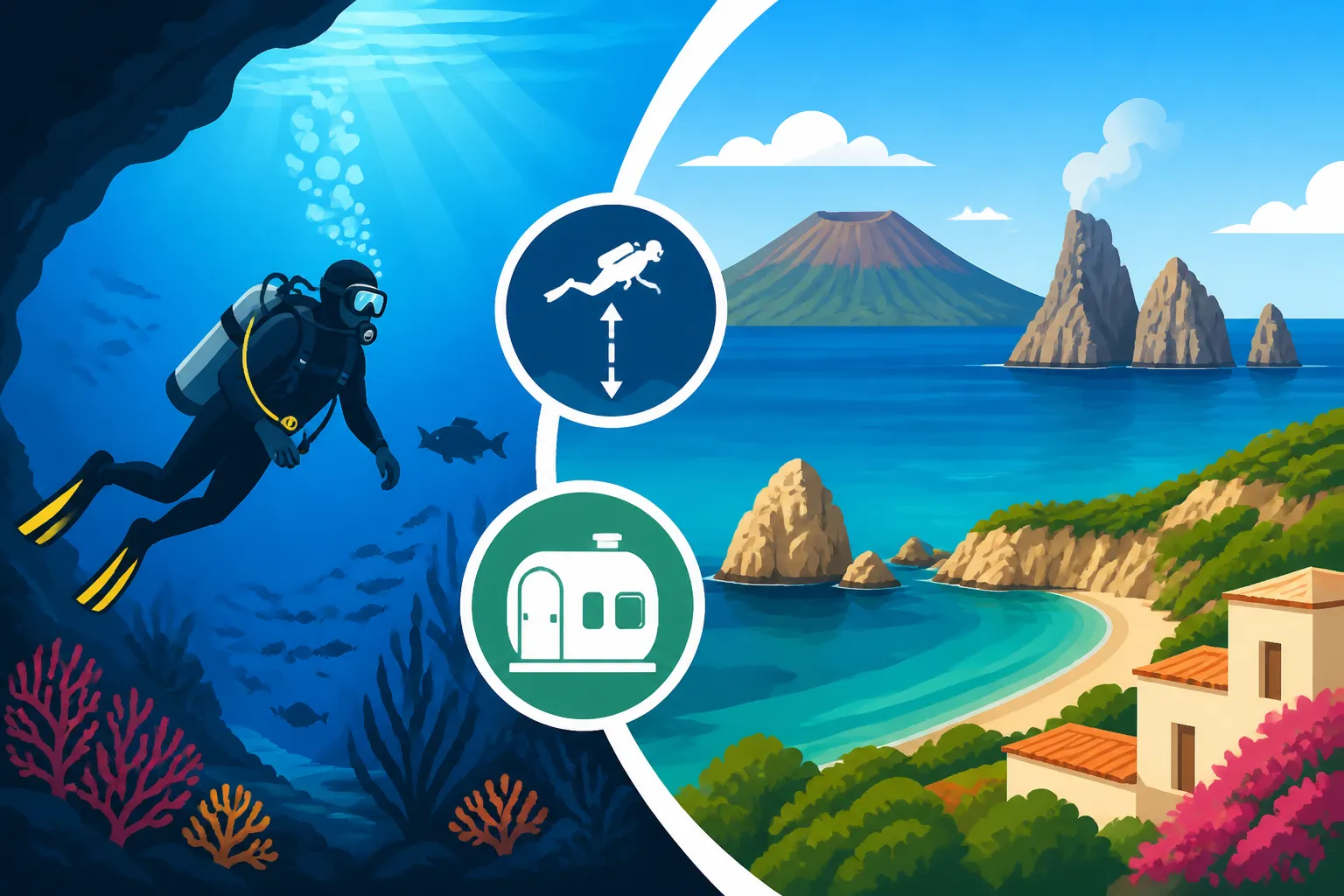
Stromboli, with its continuously active volcano, offers night dives where you can witness underwater eruptions illuminating the darkness—a truly unforgettable sight. Around Panarea, you'll find submerged volcanic vents and ancient hydrothermal activity, creating unique environments for marine life. The waters surrounding Lipari and Vulcano also present fascinating geological features, including underwater caves and canyons that house a diverse range of Mediterranean species, from vibrant nudibranchs to octopus, moray eels, and tuna. The volcanic origin of these islands means steep drop-offs, dramatic walls, and an exhilarating sense of adventure that's hard to find anywhere else.
Understanding Depth Limits and Decompression Protocols in Italy
Diving, while incredible, demands respect for its inherent risks. Understanding and strictly adhering to depth limits and decompression protocols isn't just a suggestion; it's a matter of safety, and in Italy, dive centers are incredibly strict about these rules.
Recreational Diving Limits
For recreational divers, depth limits are primarily determined by your certification level. These limits are universal across most diving agencies (PADI, SSI, NAUI, etc.) and are rigorously enforced by Italian dive operators.
- Open Water Diver (OWD): This is your entry-level certification, typically limiting you to a maximum depth of 18 meters (60 feet). This depth allows you to explore most shallow reefs and enjoy the vibrant colors of marine life, which are most vivid closer to the surface.
- Advanced Open Water Diver (AOWD): Once you've gained more experience and completed specific adventure dives, you can achieve your AOWD certification, extending your limit to 30 meters (100 feet). This opens up a whole new world, including many shallower wrecks and deeper sections of reefs.
- Deep Diver Specialty: For those who truly love the deep blue, a specialized Deep Diver certification pushes your recreational limit to 40 meters (130 feet). This is generally the absolute maximum for recreational diving. Beyond this, the risks increase significantly, and specialized training and equipment are required.
It's crucial to always dive within your certification limits and, more importantly, within the limits recommended by your local dive center. They know the local conditions, currents, and specific site characteristics far better than anyone. Never push your limits or feel pressured to go deeper than you're comfortable with. Your dive computer is your best friend here, always trust its readings and adhere to its warnings.
Technical Diving and Advanced Certifications
For a select few, the call of the deep extends beyond recreational limits. Technical diving involves specialized training, gases (like trimix), and equipment to safely explore depths well beyond 40 meters, or to conduct complex decompression dives. This isn't just "deeper recreational diving"; it's an entirely different discipline with significantly higher risks and far more stringent protocols.
If you are a certified technical diver, Italy offers some incredible deep wrecks and cave systems that can only be accessed with these advanced qualifications. However, finding operators that cater to technical diving specifically for tourists might require more research, as many focus on recreational outings. You'll need to demonstrate your certifications, dive logs, and potentially undergo an evaluation dive. The margin for error is much smaller, and the consequences of a mistake are far more severe. This is where having comprehensive insurance that specifically covers technical diving (often an add-on) becomes absolutely non-negotiable.
Decompression Sickness (DCS) and Its Prevention
Decompression Sickness, or "the bends," is the diver's worst nightmare. It occurs when nitrogen absorbed into the body tissues at depth forms bubbles during ascent if the pressure reduction is too rapid. These bubbles can then cause various symptoms, from mild joint pain to paralysis, brain damage, or even death.
Preventing DCS is paramount and relies on strict adherence to established protocols:
- Slow Ascents: Always ascend slowly, typically no faster than 18 meters per minute, allowing your body to off-gas nitrogen gradually.
- Safety Stops: A mandatory 3-minute stop at 5 meters (15 feet) at the end of every dive is a crucial safety measure, even if your dive computer doesn't explicitly demand it for no-decompression dives.
- Dive Computer Use: Modern dive computers calculate your nitrogen loading in real-time and provide clear ascent rates and mandatory decompression stops if you exceed no-decompression limits. Rely on it!
- Surface Intervals: Allow sufficient time between dives for nitrogen to off-gas. Longer and more conservative surface intervals are always better.
- Hydration and Fitness: Being well-hydrated and physically fit contributes to better off-gassing and reduces DCS risk.
- Avoid Flying After Diving: Allow at least 18-24 hours after multiple dives (or a single dive exceeding no-decompression limits) before flying or ascending to high altitudes, as the pressure change can trigger DCS.
Even with meticulous planning, accidents can happen. If you suspect DCS, immediate action is critical.
Emergency Procedures and Hyperbaric Chamber Costs in Italy
Let's talk about the worst-case scenario. It's a sobering thought, but understanding what to do in a diving emergency, knowing where the hyperbaric chambers are, and facing the financial implications head-on can make all the difference. This is where you realize how essential a proper travel medical insurance like SafetyWing truly is.
What to Do in a Diving Emergency
In any diving emergency, whether it's an injury, equipment malfunction, or suspected DCS, swift and calm action is vital.
- Prioritize Safety: Ensure your own safety and the safety of your buddy first.
- Signal and Assist: If underwater, use standard hand signals to communicate distress. If on the surface, signal for help from the boat or shore. Provide immediate first aid if you are trained and it's safe to do so.
- Contact Dive Center/Emergency Services: Your dive center will have a robust emergency plan in place. Follow their instructions. In Italy, the universal emergency number is Emergency Medical Numbers in Italy (112, 118, 1500). Call 112 (general emergency) or 118 (medical emergencies) for immediate medical assistance. Be prepared to provide your location, the nature of the emergency, and your contact information. If you're near a larger town, you might even find Where to Find English-Speaking Doctors and Clinics who can guide you.
- Manage the Casualty: Keep the injured diver comfortable, administer oxygen if available and you're trained, and monitor their condition. For suspected DCS, lie the diver down, provide oxygen, and transport them to the nearest hyperbaric chamber as quickly and safely as possible.
Locating Hyperbaric Chambers in Sardinia and Near the Aeolian Islands
Hyperbaric chambers are specialized facilities that treat DCS by recompressing the diver in a controlled environment, forcing nitrogen bubbles back into solution, and then slowly decompressing them. Access to one is critical for a full recovery from serious DCS.
In Sardinia, you're fortunate to have hyperbaric oxygen therapy centers. The main ones are located in:
- Olbia: At the Ospedale Giovanni Paolo II. This is particularly convenient if you're diving in the Maddalena Archipelago or along the northeastern coast.
- Cagliari: At the Ospedale Civile di Cagliari. This would serve divers in the southern part of the island.
For divers exploring the Aeolian Islands, the closest major hyperbaric chambers would typically be on mainland Sicily:
- Messina: At the Azienda Ospedaliera Universitaria "G. Martino". This is usually the primary destination given its proximity to the Aeolian ferry routes.
- Palermo: At the Ospedale Civico di Cristina e Benfratelli.
Reaching these chambers quickly is paramount. This often involves emergency boat transfers from remote dive sites, followed by an ambulance or even an air ambulance, depending on the severity and location. These are not trivial logistics, and certainly not cheap.
The Staggering Cost of Hyperbaric Treatment and Medical Evacuation
Let's not sugarcoat it: a diving emergency can be incredibly expensive. Hyperbaric chamber treatment, while life-saving, comes with a hefty price tag. A single session can cost anywhere from €500 to several thousand euros, and multiple sessions are often required. That’s just the chamber itself. Add to that the costs of:
- Emergency Medical Services: Ambulance fees, initial hospital consultations, diagnostic tests (like MRI or CT scans), and any stabilization treatment before chamber transport. These can quickly accumulate to hundreds or even thousands of euros. If you're an EU resident with an EHIC, some of this might be covered by the public system, but don't count on full coverage or expedited private transport.
- Medical Evacuation: This is often the biggest cost. Transporting an injured diver from a remote island in the Aeolians or a distant Sardinian cove to a hyperbaric chamber can require specialized boats, helicopters, or even fixed-wing air ambulances. These services can easily run into tens of thousands of euros, sometimes even exceeding €50,000 or more, especially for international air ambulance services. This is not something your How to Register for Italian Healthcare (SSN) as a Foreigner or basic travel insurance is likely to cover adequately.
The financial burden of hyperbaric treatment and evacuation can be astronomical, underscoring the vital protection offered by comprehensive insurance such as SafetyWing. It’s a harsh reality, but an important one to face when planning adventurous activities. You're exploring a beautiful country, and knowing your back is covered means you can truly relax.
Securing Your Dive Trip with Comprehensive Travel Insurance: Why SafetyWing is Your Best Bet
After all that talk about depth limits and emergency costs, you might be thinking, "Whoa, maybe I should just stick to snorkeling!" But that's not the point. The point is to be prepared. Diving in Italy is an unforgettable experience, and with the right precautions, it’s also incredibly safe. The most crucial precaution, beyond your dive skills, is ensuring you have the right safety net.
The Critical Role of Dive-Specific Insurance
Many travelers mistakenly believe their standard travel insurance policy will cover them for anything and everything, including a diving accident. Unfortunately, this is often not the case. Standard policies frequently have exclusions for "adventure sports" or specific clauses about depth limits. If you suffer a diving-related injury, such as decompression sickness, and your policy doesn't explicitly cover it, you could be left footing those eye-watering bills we just discussed.
While your Healthcare in Italy: An Expats' Guide and the associated Obtaining the Italian Health Card (Tessera Sanitaria) might cover some basics if you're a resident, it certainly won't cover emergency airlifts from a remote island to a specialized hyperbaric chamber, nor will basic travel insurance. This is precisely why a plan like SafetyWing is crucial. It understands the needs of adventurous travelers and expats, providing a safety net that genuinely covers the unexpected. It’s about more than just a scraped knee; it’s about catastrophic medical events that can turn your dream trip into a financial nightmare.
SafetyWing: Tailored Protection for Adventurous Expats and Travelers
This is where SafetyWing truly shines as the hero of your Italian diving adventure. SafetyWing is designed with adventurous travelers and digital nomads in mind, offering exceptional coverage for unforeseen medical emergencies, including those arising from diving accidents. What makes SafetyWing stand out is its comprehensive approach to emergency medical treatment and evacuation, precisely what you’d need in a diving incident.
- Emergency Medical Coverage: SafetyWing provides robust coverage for unexpected illnesses and injuries, which can include diving accidents. This means visits to doctors, hospital stays, and prescription medications are covered, offering significant relief if you need immediate care. If you're a foreigner, navigating Cost of Healthcare in Italy: What Expats Need to Know can be tricky, and SafetyWing simplifies this by handling the financial aspect.
- Emergency Medical Evacuation: This is the absolute game-changer for divers. As we discussed, getting from a remote dive site to a hyperbaric chamber can require costly air or sea ambulance services. SafetyWing covers eligible emergency medical evacuations, ensuring you get the critical care you need without the crippling expense. With SafetyWing, you're not just getting coverage; you're getting peace of mind, knowing that the potentially crippling costs of hyperbaric chamber treatments or an emergency medical transfer are managed.
- Flexibility and Affordability: Unlike many rigid insurance policies, SafetyWing offers flexible, subscription-based coverage that you can start, stop, or extend as needed. This is ideal whether you're on a short diving holiday or planning a longer stay as an expat. It’s budget-friendly without compromising on essential coverage, making it accessible for a wide range of travelers.
- Worldwide Coverage: While we're focusing on Italy, SafetyWing is a global solution, meaning your coverage travels with you, even if your diving adventures take you to other corners of the world.
Choosing SafetyWing means you're investing in your safety and financial security, allowing you to fully immerse yourself in the incredible underwater world of Sardinia and the Aeolian Islands without that nagging worry in the back of your mind. It’s a vital component of your Italy relocation checklist: visa, housing, tax, health, etc. for peace of mind.
Navigating Claims and Ensuring Peace of Mind
Let's face it, dealing with insurance claims can be a headache, especially in a foreign country. However, choosing SafetyWing means you have a reliable partner should the unexpected happen. Their process is designed to be straightforward, and their customer support is accessible. They understand the nuances of international travel and medical emergencies, making the process smoother than dealing with traditional, often bureaucratic, local insurance providers. Knowing that you have a clear pathway to claim assistance allows you to focus on your recovery, rather than getting lost in paperwork.
Remember, a diving adventure should be about the wonder of the ocean, the thrill of discovery, and the joy of being alive. Don't let the thought of unexpected medical bills dampen your spirit; invest in a plan like SafetyWing and dive in with confidence, knowing you're protected. After all, the Mediterranean awaits!
Disclaimer
The information provided in this guide is for general informational purposes only and does not constitute medical, legal, or financial advice. While we strive to provide accurate and up-to-date information, regulations, costs, and procedures in Italy can change. Always consult with certified diving professionals, medical experts, legal counsel, and insurance providers for personalized advice. Ensure you thoroughly read and understand your insurance policy's terms and conditions, especially concerning adventure sports and specific activities like diving, before undertaking any trip or activity.