Public vs Private Health Insurance in Italy
Discover the key differences between public and private health insurance in Italy. This comprehensive guide helps expats navigate the SSN, understand voluntary registration costs, evaluate private insurance premiums, and choose the best healthcare coverage for their relocation.
Disclosure: This post may contain affiliate links. We may earn a commission at no extra cost to you if you make a purchase through these links. Read full disclosure.
Introduction to Public vs Private Health Insurance in Italy
The Italian healthcare landscape is characterized by a dual system: a robust, universally accessible public healthcare network that runs parallel to a highly efficient and modern private healthcare sector. For expatriates, retirees, and digital nomads moving to Italy, deciding which system to use—or how to effectively combine the two—is one of the most critical decisions to make.
In many countries, public healthcare is viewed merely as a safety net for those who cannot afford private insurance. In Italy, however, the public system is the backbone of the nation’s health, utilized by the vast majority of the population, including the wealthy. It is designed to provide comprehensive care from the cradle to the grave. At the same time, the private sector thrives by offering solutions to the public system’s most notable shortcomings, primarily related to convenience, speed, and comfort.
For an expat, the choice between public and private care often comes down to specific medical needs, language barriers, budget, and geographical location. This guide will provide an exhaustive deep dive into the differences between public and private healthcare in Italy. We will explore the framework of the national health service, the benefits and drawbacks of private medical facilities, how costs differ between the two, and practical advice on navigating emergency situations. By the end of this article, you will be fully equipped to make informed decisions about your health and wellbeing in the Bel Paese.
The Public Healthcare System Servizio Sanitario Nazionale
To understand the differences between the two systems, one must first understand the foundation of Italian medical care. The public healthcare system in Italy is called the Servizio Sanitario Nazionale (SSN). Established in 1978, the SSN was built on the principle of universal coverage, meaning that healthcare is considered a fundamental human right.
Administration and Regional Disparities
While the central Ministry of Health in Rome outlines the national health plan and guarantees a minimum standard of care, the SSN is highly decentralized. It is administered at the regional level by local health authorities known as Azienda Sanitaria Locale (ASL) or Azienda Unità Sanitaria Locale (AUSL).
This decentralization is a crucial factor for expats to understand because it leads to significant regional disparities in the quality of public healthcare infrastructure. Generally speaking, the northern and central regions of Italy, such as Lombardy, Veneto, Emilia-Romagna, and Tuscany, boast world-class public hospitals and highly efficient services. In contrast, some southern regions face systemic funding challenges, which can result in older facilities and longer waiting times for treatments, prompting many to rely heavier on private care.
Accessing the SSN as an Expat
Access to the public system is not automatically granted simply by stepping foot in Italy; you must register. Registration is generally divided into two categories: mandatory and voluntary.
If you hold a work visa and are employed by an Italian company, or if you are self-employed and paying Italian taxes, your registration is mandatory and inherently free at the point of access. Your contributions are deducted directly from your income taxes (typically around 7.5% of gross income, split between you and your employer). You are fully integrated into the system just like an Italian citizen. If you are an EU citizen arriving with an S1 form, you are also entitled to free SSN enrollment.
On the other hand, if you are a student, a retiree on an Elective Residence Visa, or an au pair, you must apply for voluntary registration (iscrizione volontaria). This requires paying an annual lump-sum fee to your regional ASL. If you are preparing for this bureaucratic step, you can find a detailed breakdown of the required documentation in our guide on How to Register for Italian Healthcare (SSN) as a Foreigner.
The Costs of Voluntary Registration
The costs for voluntary enrollment were significantly updated by the Italian government for 2024 and 2025, which represents a major budget consideration for non-working expats. The fees are strictly tied to the calendar year (January 1st to December 31st) and cannot be prorated, meaning you pay the full amount whether you join in January or October.
- Students: The flat rate is €700 per year.
- Au Pairs: The flat rate is €1,200 per year.
- Elective Residence Visa and Retirees: The baseline minimum is €2,000 per year for individuals with a global gross income up to €31,924. If your income is between €31,924 and €51,646, you pay the €2,000 base plus 4% on the exceeding amount. The maximum cap is €2,788.87 per year.
The Ticket Sanitario System
While the SSN is often described as “free,” it is more accurate to describe it as highly subsidized. Hospitalizations, treatments requiring surgery, and visits to your assigned General Practitioner (Medico di Base) or pediatrician are entirely free of charge. However, for diagnostic tests (like blood work or MRIs) and specialist consultations, patients must pay a co-pay known as a “Ticket Sanitario”.
The cost of this ticket is legally capped and is very affordable. Recent standardizations have set the national flat rate for a first-time specialist visit at €25, with follow-up visits costing €17.90. Diagnostic imaging and tests are capped per prescription at €36.15 in most regions, though a few regions (like Lazio and Campania) cap it at €46.20. Furthermore, specific vulnerable populations, such as pregnant women, young children from low-income households, seniors over 65 with low incomes, and individuals with registered chronic diseases, are entirely exempt from paying the ticket.
The Private Healthcare Sector in Italy
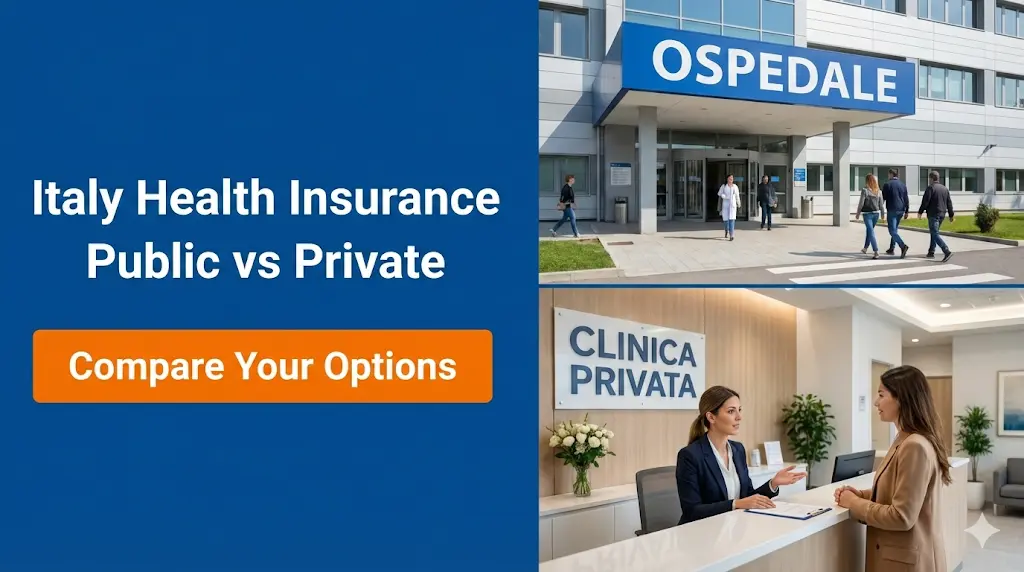
Running alongside the SSN is a thriving private healthcare sector. Private medicine in Italy encompasses independent medical clinics, state-of-the-art diagnostic centers, and luxury private hospitals known as “cliniche private” or “case di cura”.
Why Choose Private Healthcare?
If the public system is so highly regarded medically and so inexpensive, why do so many Italians and expats spend money on private healthcare? The answer lies almost entirely in efficiency, choice, and comfort.
The most significant pain point of the Italian public healthcare system is the waiting list (lista di attesa). Due to high demand and budget constraints, non-urgent medical procedures and specialist visits in the public sector can take months to schedule. For example, if you need a routine dermatology check-up or an ultrasound for a nagging but non-life-threatening pain, you might wait 30 to 180 days. In the private sector, you can often secure an appointment in 1 to 7 days.
Freedom of Choice and Language
In the private sector, you have complete autonomy over your healthcare journey. You do not need a referral from a General Practitioner to see a private specialist. Furthermore, you can research and choose the exact doctor you want to see based on their credentials.
For expatriates, the language barrier is a significant source of anxiety in medical situations. In the public SSN, you are assigned a doctor based on your residential address, and there is absolutely no guarantee that your GP or the nurses at a public hospital will speak English. The private sector actively caters to the international community, making it much easier to find English-speaking providers. If you are struggling to locate medical professionals who can communicate in your native language, you can explore our resources on Finding Doctors and Hospitals in Italy.
The Concept of Intramoenia
Italy has a unique mechanism that bridges the gap between public and private care, known as “Intramoenia” (literally “within the walls”). Many of the country’s top medical specialists work primarily for public hospitals. However, the state allows these public doctors to offer private, paid consultations outside of their regular public hours, often within the exact same public hospital building.
If you choose the Intramoenia route, you pay a private fee to bypass the public waiting list and guarantee that you are seen by that specific renowned specialist, rather than whichever public doctor happens to be on shift. It is a highly popular middle-ground for patients who want top-tier expertise without navigating entirely separate private clinic networks.
Private Health Insurance Options for Expats
If you opt to use the private sector, paying out-of-pocket for every visit can quickly become expensive. A private specialist consultation usually ranges from €100 to €250, and diagnostic imaging like an MRI can cost between €100 and €300. A private hospital stay for surgery can easily run from €5,000 to €12,000 or more. To dive deeper into budgeting for these expenses, read our breakdown on the Cost of Healthcare in Italy: What Expats Need to Know.
To mitigate these costs, many expats purchase private health insurance. There are two main types to consider:
Local Italian Health Insurance
These policies are offered by domestic Italian insurance companies and banks. They are designed to supplement the public SSN. They often cover the costs of private specialist visits, private hospital room upgrades, and diagnostic tests at accredited clinics. They are generally stable and predictable, with premiums ranging from €800 to €2,000 per year, depending on the local private network. They are excellent for residents who live in Italy permanently and want to enhance their public coverage.
International Expat Health Insurance
Offered by global providers like Cigna, Allianz Care, AXA, and April International, these policies are highly popular among expats and digital nomads. They offer comprehensive coverage that works globally and often features English-language support, direct billing, and emergency medical evacuation.
Premium international policies typically range from €3,000 to €7,000 per year. They are particularly useful for expats who split their time between Italy and their home country, or for those navigating their first year in Italy before their official SSN residency is finalized. In fact, providing proof of comprehensive private health insurance is a mandatory requirement for securing an Elective Residence Visa before you even arrive.
Key Differences Public vs Private Healthcare
To make an informed decision about your healthcare strategy in Italy, it is essential to compare the two systems across several critical parameters.
Quality of Facilities and Comfort
Medically speaking, the quality of care, surgical precision, and medical technology in top-tier public university hospitals (Policlinici) are equal to, and sometimes superior to, private hospitals. Many of Italy’s most complex and groundbreaking surgeries take place in the public sector.
However, the non-medical amenities differ drastically. Public hospitals are functional and practical. If you are admitted to a public hospital, you will likely be placed in a shared ward with two to four other patients, sharing a bathroom. Private hospitals offer a hotel-like experience. You will have a private, single-occupancy room, an en-suite bathroom, better culinary options, and flexible visiting hours for your family.
Dental Care
This is one area where the public system falls significantly short. Dental care is largely excluded from the standard SSN coverage. Public dental services are usually reserved for severe emergencies, children, or individuals with specific severe vulnerabilities. Therefore, for routine cleanings, cavities, orthodontics, and cosmetic dentistry, both Italians and expats rely almost exclusively on private dentists, paying entirely out of pocket unless they have a specific private insurance add-on.
Tax Deductions for Medical Expenses
A unique financial aspect of Italian healthcare is that out-of-pocket medical expenses—whether public co-pays or private doctor fees—can offer tax benefits. You can deduct medical expenses on your Italian tax return at a rate of 19%, but only for the portion that exceeds €129.11. Importantly, to qualify for this deduction, the payment must be made using a traceable method (like a credit card or bank transfer), and you must keep the receipt featuring your tax code. Note that private health insurance premiums themselves are generally not tax-deductible in Italy.
Emergency Care The Great Equalizer
While the choice between public and private care is relevant for routine and elective medicine, the landscape changes entirely in the face of a true emergency.
In Italy, the universal emergency number is 112. If you are involved in a severe car accident, suffer a heart attack, or experience any life-threatening trauma, you will be taken to the Pronto Soccorso (Emergency Room) of a public hospital. Private clinics and luxury hospitals in Italy generally do not have the massive trauma infrastructure required to handle critical, life-or-death emergencies.
Emergency care in Italy is exceptional, fast, and completely free of charge for anyone requiring life-saving intervention, regardless of their visa status, nationality, or whether they possess a health card. The public emergency rooms operate on a strict color-coded triage system, prioritizing patients based on the severity of their condition.
However, if you visit the public ER for a non-urgent issue (classified as a “white code”), you will face massive wait times and a €25 co-pay. For a more detailed understanding of how to navigate these high-stress situations, we recommend reading our dedicated guide on Emergency Medical Services in Italy: 112 and Hospitals.
Comparison Table Public vs Private Healthcare in Italy
| Feature / Aspect | Public Healthcare (SSN) | Private Healthcare |
| Funding / Cost | Tax-funded or Voluntary Annual Fee (€700-€2,788). | Out-of-pocket or Private Insurance Premiums (€800-€7,000). |
| Wait Times | Can be long (30-180 days) for non-urgent care. | Immediate or very short waiting periods (1-7 days). |
| Choice of Doctor | Assigned GP; limited choice of public specialists. | Complete freedom to choose any doctor or clinic. |
| Referrals | Required from a GP for all specialist visits. | Not required; direct booking available. |
| Hospital Rooms | Shared wards (2-4 beds typical). | Private, single-occupancy rooms. |
| Language | English is not guaranteed; mostly Italian. | High availability of English-speaking staff. |
| Emergency Trauma | Free, world-class 24/7 Pronto Soccorso access. | Directed to public ERs; private clinics rarely handle major trauma. |
The Hybrid Approach Which Should Expats Choose
Ultimately, you do not have to choose just one system. The most effective, balanced healthcare strategy for expats living in Italy is a hybrid approach.
Register for the public Servizio Sanitario Nazionale to secure your structural safety net. The SSN is invaluable for handling severe chronic illnesses, complex hospitalizations, maternity care, and emergency trauma, where the costs in the private sector would be astronomical. It is a system built on solidarity and ensures you will never be bankrupted by a medical tragedy.
Simultaneously, you can budget for out-of-pocket private expenses or invest in a supplementary Italian private health insurance policy. Use the private sector strategically for convenience: when you need to see a dermatologist quickly, when you want a private room to recover from a minor surgery, when you require dental work, or when you simply want the comfort of explaining your symptoms to a doctor in fluent English.
Conclusion
The differences between public and private healthcare in Italy reflect the broader nuances of Italian society: a deep commitment to social welfare balanced with a growing demand for modernization and convenience. The public Servizio Sanitario Nazionale remains one of the greatest achievements of the Italian state, offering universally accessible, high-quality medical care that ensures the foundational health of the population. Meanwhile, the private sector provides a necessary alternative for those willing to pay for speed, comfort, and linguistic ease.
As an expatriate, understanding the strengths and limitations of both systems is the key to maintaining your health and sanity abroad. By registering for the public system, utilizing private care strategically, and understanding how to navigate emergency situations, you can create a customized healthcare plan that perfectly suits your lifestyle. Italy offers a wonderful quality of life, and with the right medical knowledge in hand, you can fully embrace the beauty of your new home with total peace of mind.
References
Primary sources (official)
- Ministero della Salute (Ministry of Health): The official portal for the Italian government outlining national health policies, the SSN framework, and LEA (Essential Levels of Care). https://www.salute.gov.it/
- Agenzia delle Entrate: Official government site providing information on acquiring the Codice Fiscale, which is mandatory for registering for the public healthcare system. https://www.agenziaentrate.gov.it/
Other helpful sources
- Impatria: Detailed breakdowns of healthcare options for expats, covering the 2024/2025 SSN voluntary contribution fees and private insurance comparisons. https://impatria.com/en/magazine/
- Properstar Italy: An extensive real estate and living guide for expatriates offering detailed guides on navigating the Italian healthcare system and regional public health differences. https://www.properstar.in/
Disclaimer
The information provided in this article is intended for general informational and educational purposes only and does not constitute medical, legal, or financial advice. Healthcare regulations, SSN voluntary registration fees, ticket sanitario limits, and private medical costs in Italy are subject to frequent changes by national and regional authorities. Always consult directly with the Italian Ministry of Health, your local Azienda Sanitaria Locale (ASL), or a qualified insurance professional to verify your specific eligibility, visa requirements, and coverage options before making healthcare decisions.