Eye Care in Italy: Optometrists and Ophthalmologists
Navigate the Italian vision care system with ease. This guide explains the differences between optometrists, ophthalmologists, and opticians in Italy, detailing public healthcare coverage, private eye exam costs, acquiring prescription glasses, and handling sudden ocular emergencies.
Disclosure: This post may contain affiliate links. We may earn a commission at no extra cost to you if you make a purchase through these links. Read full disclosure.
Introduction to Eye Care in Italy
The Italian healthcare system operates on a hybrid model, combining a robust national public network with a thriving, highly accessible private sector. This structural duality extends directly into the fields of ophthalmology and optometry. For expatriates and long-term travelers, deciphering which professional to see—and whether the state health service will cover the bill—is often the first major hurdle when seeking vision care. In Italy, the strict dividing line between medical eye care, such as treating diseases like glaucoma or cataracts, and functional vision correction, such as getting a prescription for nearsightedness, dictates where you go and how much you pay out of pocket.
Furthermore, the local terminology can be a significant stumbling block for newcomers. In North America or the United Kingdom, you might use the terms “optician” and “optometrist” interchangeably in casual conversation. However, under Italian law, an oculista, an optometrista, and an ottico have strictly defined roles, distinct educational backgrounds, and rigid legal limitations on what they are permitted to do. Mistaking one for the other can lead to frustrating delays in getting the right treatment.
This comprehensive guide will break down the entire eye care ecosystem in Italy. We will explore the precise roles of each vision specialist, examine what the public health system covers versus what you must pay for privately, detail the average costs of private eye exams, and explain the steps to take in a medical eye emergency. By the end of this article, you will have the knowledge and confidence to protect your eyesight and keep your vision sharp while enjoying your new life abroad. For a broader understanding of how to establish your foundational medical access in the country, you should also review our comprehensive Healthcare in Italy: An Expats’ Guide.
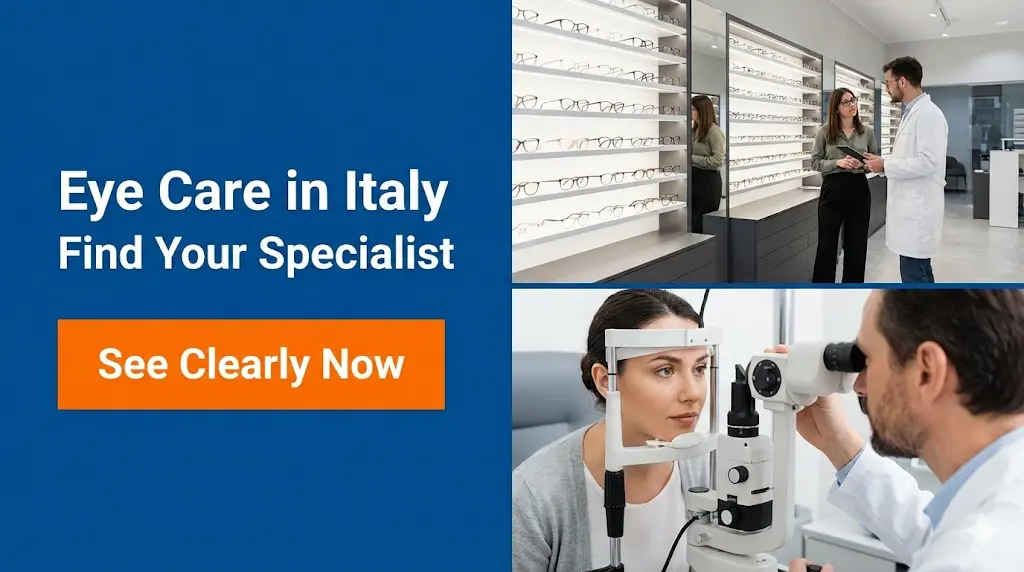
Decoding Italian Eye Care Professionals
To get the right help, you must make an appointment with the right professional. The Italian healthcare system divides eye care into medical, functional, and commercial sectors. Knowing exactly who does what is the key to navigating the system efficiently.
The Ophthalmologist
In Italy, the ophthalmologist is known as the Oculista or Medico Oftalmologo. This professional is a fully qualified medical doctor who has completed medical school and subsequently undertaken years of specialized residency training in ophthalmology.
Because they are medical doctors, the oculista is the absolute highest authority on eye care in Italy. They are authorized to perform comprehensive eye health examinations, diagnose complex ocular diseases such as cataracts, glaucoma, and macular degeneration, and prescribe pharmacological treatments like antibiotic eye drops or oral medications. Furthermore, the oculista is the only professional legally permitted to perform eye surgery, including laser vision correction (LASIK) and cataract removals.
If you are experiencing eye pain, sudden vision loss, flashes of light, floaters, or symptoms of an infection like conjunctivitis, you must seek out an oculista. They also identify systemic health conditions that manifest in the eyes, such as high cholesterol, hypertension, and diabetes.
The Optometrist
The Optometrista in Italy holds a very different role than an optometrist in the United States or the UK. In Italy, optometrists are highly trained professionals who specialize in measuring vision (refraction) and determining the exact optical correction needed to achieve perfect sight. They undergo specific university-level training to test visual acuity, depth perception, and color blindness.
You visit an optometrista when your vision is blurry, when you are having trouble reading, or when you need a prescription for glasses and contact lenses. However, the crucial difference in Italy is that the vast majority of optometrists are not medical doctors, and therefore, they are strictly prohibited from prescribing medications or treating ocular diseases. If an Italian optometrist spots a medical anomaly during your vision test, they are legally obligated to refer you to an oculista for a medical diagnosis.
The Optician
The Ottico is the commercial and technical expert of the Italian vision care world. After completing a specific post-secondary diploma, the ottico is licensed to manufacture, assemble, and dispense corrective eyewear.
When you walk into a glasses shop in Italy, the person helping you select frames, measuring your pupillary distance, and fitting the physical lenses into your chosen eyewear is the ottico. They are trained to read the complex prescriptions written by the oculista or the optometrista and translate those numbers into physical, customized glasses. While an ottico cannot diagnose diseases, some who have completed additional training as an ottico optometrista can perform basic vision tests specifically for the purpose of selling you glasses or contact lenses.
The Orthoptist
You may also encounter an Ortottista, an allied health professional who holds a three-year university degree in orthoptics and ophthalmic assistance. They act as the specialized clinical assistant to the oculista. The ortottista focuses heavily on evaluating ocular motility, treating strabismus (crossed eyes), and managing amblyopia (lazy eye), particularly in children. They conduct the diagnostic machinery tests in the clinic before the oculista reviews the final medical report.
Public Eye Care Coverage Under the Italian Health System
Once you are a registered resident in Italy, you gain access to the Servizio Sanitario Nazionale (SSN), the state-funded public healthcare network. The SSN operates on the principle of providing essential medical care to everyone, but its coverage of eye care is highly specific and strictly limited to medical necessity.
What the State Healthcare Covers
The public health system focuses on preventing and treating diseases rather than simply correcting poor vision. Once you are enrolled in the SSN, you are fully covered for emergency eye trauma at public hospitals. Furthermore, if you develop a medical eye condition—such as a detached retina, severe glaucoma, or advanced cataracts—the necessary specialist consultations, diagnostic imaging, and subsequent surgeries are covered by the state.
To access a public oculista for a non-emergency issue, you cannot simply call the hospital and book an appointment. You must first visit your assigned public General Practitioner. If your GP determines that an eye specialist is medically necessary, they will issue a formal referral, historically known as a “red prescription”. You then use this referral to book an appointment through the centralized public booking system.
Co Payments and The Ticket Sanitario
While public healthcare is heavily subsidized, it is not always entirely free at the point of use. For specialist visits to a public oculista or for diagnostic eye imaging, you will likely be required to pay a small co-payment known as the Ticket Sanitario. This fee is regulated by the regional government and generally ranges from €20 to €50 for a specialist visit. Certain vulnerable populations, such as young children from low-income families or seniors with specific chronic illnesses, are exempt from paying this ticket.
What the Public System Does Not Cover
This is where many expatriates experience a culture shock: the Italian SSN generally does not cover routine vision checks for healthy adults, nor does it subsidize the cost of eyeglasses or contact lenses. Unless your need for glasses is tied to a severe medical disability or trauma, vision correction is viewed as a private, out-of-pocket expense. Furthermore, elective cosmetic procedures, such as LASIK surgery to eliminate the need for glasses, are entirely excluded from public coverage.
Navigating Private Eye Care in Italy
Because the public system does not cover eyeglasses and often suffers from long waiting lists for non-urgent specialist appointments, the vast majority of Italians and expatriates rely heavily on the private sector for their routine vision needs.
The Advantages of Private Clinics
Choosing a private oculista or a private eye clinic offers significant benefits for expatriates. First and foremost is the speed of access. While a public appointment for a routine eye check might take months to secure, a private clinic can usually accommodate you within a few days, or even on the same day.
Secondly, the private sector is highly responsive to the international community. Finding an English-speaking oculista in a public hospital is a matter of pure luck, but private clinics in major cities like Rome, Milan, and Florence actively advertise their bilingual medical staff. Being able to clearly explain your symptoms in your native language removes a massive layer of stress from the medical experience. If you need help broadening your overall medical network, our resource on Finding Doctors and Hospitals in Italy provides excellent strategies for locating multilingual professionals.
Utilizing Private Health Insurance
To manage the costs of private eye care, many expatriates choose to invest in supplementary private health insurance. While basic Italian private insurance policies often focus on hospitalizations, premium international expat insurance plans frequently offer optional “vision and dental” add-ons. These comprehensive policies can reimburse you for the cost of private eye exams, designer frames, and contact lenses, making the private route incredibly financially viable.
Estimated Costs for Eye Care in Italy
Budgeting for your visual health is an important part of your relocation planning. While private medical care in Italy is generally much more affordable than in the United States, it still represents a tangible out-of-pocket expense. To help you plan, refer to the following table outlining the estimated costs of common eye care services across both the public and private sectors in Italy.
| Eye Care Service | Sector | Estimated Cost Range |
| Emergency ER Visit (Red/Orange Code) | Public | Free for all patients. |
| Specialist Consultation (Oculista) | Public (SSN) | €20 – €50 (Ticket Sanitario co-pay). |
| Private Eye Doctor Visit (Oculista) | Private | €70 – €200. |
| Routine Vision Test (Optometrista) | Private Shop | €0 – €40 (Often free if buying glasses). |
| Standard Prescription Glasses | Private Shop | €100 – €400 (Varies heavily by designer brand). |
| Cataract Surgery | Private Clinic | €3,000 – €6,000 per eye. |
Note: Prices in private clinics can fluctuate based on the geographical region, with northern metropolitan hubs like Milan generally charging higher fees than clinics in southern Italy or rural towns. If you are currently structuring your long-term budget, you can find a more comprehensive financial breakdown in our guide: Cost of Healthcare in Italy: What Expats Need to Know.
Purchasing Glasses and Contact Lenses
Buying glasses in Italy is a distinct retail experience. If you simply need a cheap pair of basic reading glasses to help you look at a restaurant menu, you can easily purchase non-prescription magnifiers at any standard Italian pharmacy or even some large supermarkets. However, if you have astigmatism, myopia, or require complex progressive lenses, you must visit a dedicated optical store, known as an Ottica.
Where to Buy Eyewear
Italy is globally famous for its eyewear manufacturing, home to massive industry conglomerates like Luxottica. As a result, you will find high-quality optical shops everywhere, ranging from historic, independent family-owned boutiques to large corporate chains. Prominent high-street chains include Salmoiraghi e Viganò, Fielmann, and GrandVision.
These larger stores are highly convenient because they almost always have a qualified optometrist working on-site. You can walk in, request a vision test, and immediately order your new glasses in a single visit. For standard, single-vision prescriptions, large stores with on-site lens stock can sometimes cut and assemble your glasses in under an hour, though more complex prescriptions may take a few days to a week to arrive.
The Language Barrier During Eye Tests
If you choose to have your eyes tested by an optometrist in an ottica, be prepared for the language barrier. Eye tests require active communication. The optometrist will flip through various lenses and ask you, “Meglio uno o meglio due?” (Better one or better two?). If you do not speak Italian, it is highly recommended to seek out a large store in a tourist-heavy city center where the staff is more likely to speak English, or bring an Italian-speaking friend to help translate. Alternatively, you can book a comprehensive vision test with an English-speaking private oculista beforehand, and simply bring the written prescription paper directly to the optician.
Buying Contact Lenses
Contact lenses (lenti a contatto) are widely available in Italy. If you already know your exact prescription parameters and your preferred brand, you can usually walk into any ottica and purchase replacement boxes over the counter without needing to show a formal, signed prescription document. Many optical shops also stock specialized contact lens solutions, which are notably absent from standard Italian pharmacies.
Handling Eye Emergencies
Eye emergencies can be incredibly frightening. If you experience sudden vision loss, a chemical splash in the eye, severe ocular trauma, or an excruciatingly painful infection, you must bypass the standard clinics and opticians and head straight to an emergency room.
The Pronto Soccorso Oculistico
In major Italian cities, large public hospitals operate specialized emergency departments dedicated entirely to eye trauma, known as a Pronto Soccorso Oculistico or Pronto Soccorso Oftalmico.
When you arrive, you will be processed through the same triage system used in general medical emergency rooms. A nurse will evaluate the severity of your eye trauma and assign you a color code (Red for immediate life or sight-threatening danger, Orange for high urgency, Green for minor urgency, and White for non-urgent issues).
If you are assigned a Red or Orange code, you will be seen by an emergency ophthalmologist almost immediately. However, if you visit the emergency room for a mild case of dry eye or a lost contact lens (a White code), you will be placed at the very bottom of the waiting list, which can result in hours of waiting, and you will likely be charged a ticket co-pay for misusing emergency resources. If you are ever unsure of whether to call an ambulance or go to the hospital yourself, familiarize yourself with our guide on Emergency Medical Services in Italy: 112 and Hospitals.
Pediatric Eye Care in Italy
If you are relocating with a family, pediatric eye care is a vital consideration. Unlike adult vision care, the Italian SSN places a very strong emphasis on early childhood vision screening.
Children under the age of 14 are covered by the public system for comprehensive eye exams. Pediatricians in Italy (pediatra di libera scelta) routinely perform basic vision tracking during early childhood wellness checks. If the pediatrician suspects an issue, such as a lazy eye or early-onset myopia, they will issue a referral for the child to see a public oculista or an ortottista. Because clear vision is essential for educational development, ensuring your child is registered with the SSN early in your relocation process guarantees they receive these vital developmental screenings without steep private costs.
Financial Perks Tax Deductions for Vision Care
One of the most beneficial, yet frequently overlooked, aspects of living and working legally in Italy is the ability to deduct medical expenses on your annual Italian tax return (Dichiarazione dei Redditi).
The Italian government allows registered taxpayers to deduct 19% of their out-of-pocket medical expenses, provided the total exceeds a base threshold of €129.11 during the fiscal year. Crucially, this deduction applies not only to medical visits with an oculista but also to the purchase of prescription eyeglasses and contact lenses at an optical store.
To legally claim this 19% deduction, you must strictly follow two rules. First, you must pay for your glasses or your eye exam using a traceable payment method, such as a credit card or a debit card (Bancomat); cash payments are not eligible for the deduction. Second, you must present your Italian health card (which features your Codice Fiscale tax number) to the cashier before you pay. The cashier will scan your card and print your tax code directly onto your official receipt. This customized receipt is known as a scontrino parlante (a “talking receipt”), and it is the only document the tax authority will accept as proof of your medical purchase.
Conclusion
Managing your eye care in Italy is a straightforward process once you understand the specialized roles within the medical system. The key to success is knowing your terminology: visit an oculista for diseases, surgeries, and medical diagnoses; consult an optometrista for precise vision testing and contact lens fittings; and head to an ottico to purchase your physical frames and lenses.
While the realization that the public SSN does not cover routine adult eyeglasses may require a slight adjustment to your budget, the exceptional quality of Italian private eye clinics, the relatively affordable consultation fees, and the world-class craftsmanship of Italian eyewear more than make up for it. By utilizing digital platforms to find English-speaking specialists, exploring private insurance add-ons, and meticulously keeping your scontrino parlante for tax deductions, you can navigate the Italian vision care landscape with absolute clarity. Protect your eyesight, embrace the local medical culture, and ensure you never miss a single detail of the beautiful country surrounding you.
References
Primary sources (official)
- Ministero della Salute (Italian Ministry of Health): Official regulatory guidelines detailing the LEA (Essential Levels of Care) and the specific limitations of public SSN coverage regarding elective vision correction. https://www.salute.gov.it/
- Agenzia delle Entrate (Italian Revenue Agency): Official tax code documentation outlining the requirements for the scontrino parlante and the 19% tax deduction for medical and optical expenses. https://www.agenziaentrate.gov.it/
Other helpful sources
- Feather Insurance: Comprehensive guide detailing the Italian healthcare system, Ticket Sanitario co-payments, and exclusions for eyeglasses and contact lenses. https://feather-insurance.com/en-it/blog/health-insurance-italy-guide
- Lenstore Italy: Detailed breakdown of the professional differences, educational backgrounds, and legal limitations between an Ottico, Optometrista, and Oftalmologo in Italy. https://www.lenstore.it/
Disclaimer
The information provided in this article is for educational and informational purposes only and does not constitute official medical, legal, or financial advice. Healthcare regulations, SSN coverage exemptions, private consultation fees, and Italian tax deduction laws are subject to frequent changes by national and regional authorities. Always consult directly with a licensed Italian medical professional (oculista) regarding any eye pain, trauma, or sudden changes in vision. If you are experiencing a severe ocular emergency, proceed immediately to the nearest Pronto Soccorso or dial 112.