Choosing an Internet and Phone Provider in Italy
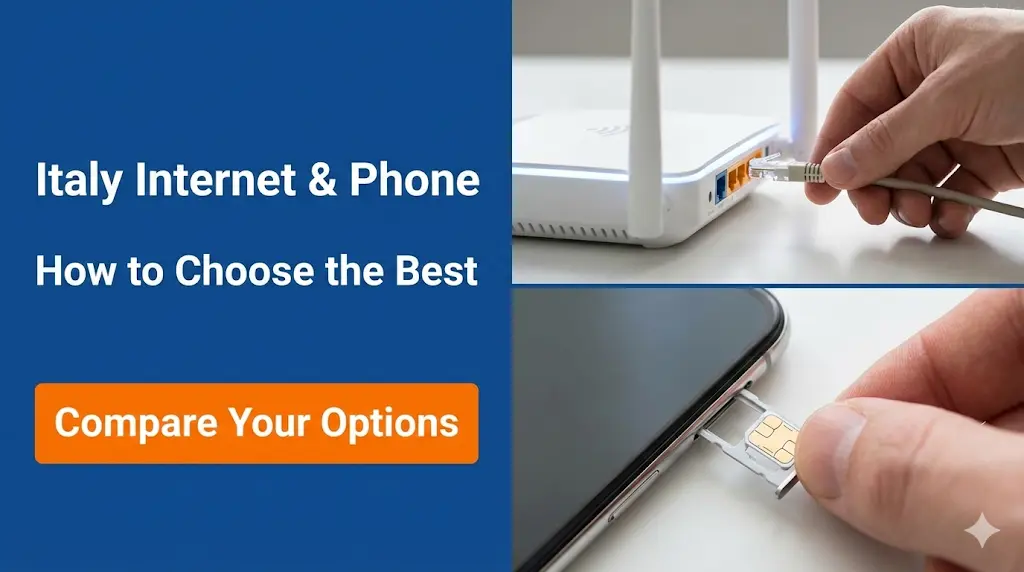
Navigate Italy’s telecommunications market with confidence. This comprehensive guide breaks down the best home broadband and mobile phone providers, comparing TIM, Vodafone, WindTre, and Iliad. Learn about connection costs, essential documentation, prepaid SIM card requirements, and installation timelines.
Disclosure: This post may contain affiliate links. We may earn a commission at no extra cost to you if you make a purchase through these links. Read full disclosure.
Introduction
Many expatriates arrive in Italy with preconceived notions about the country’s technological infrastructure. Because Italy is so famous for its ancient architecture and deeply preserved historical centers, newcomers often mistakenly assume that the telecommunications network might be similarly antiquated. The reality is quite the opposite. Italy boasts one of the most competitive, affordable, and rapidly modernizing telecommunications markets in the entire European Union. The vast majority of the population enjoys access to high-speed 4G networks, and 5G coverage is heavily expanding across major metropolitan areas such as Rome, Milan, and Naples.
However, navigating the Italian market as a foreigner presents a unique set of challenges. The sheer volume of providers, the nuanced differences between traditional network operators and virtual networks, and the rigid bureaucratic requirements necessary to sign a basic contract can be overwhelming. Furthermore, the vocabulary of Italian telecommunications—understanding the difference between a ricaricabile and an abbonamento, or navigating the distinctions between FTTH and FTTC home broadband—requires a specialized local knowledge base.
This extensive guide is designed to dismantle those barriers and serve as your ultimate roadmap to getting connected in Italy. We will thoroughly evaluate the major mobile network operators—TIM, Vodafone, WindTre, and Iliad—comparing their network speeds, geographical coverage, and overall value. We will also explore the process of outfitting your apartment with high-speed fiber broadband, outlining the average monthly costs, the specific legal documents you need to present, and the potential installation delays you should anticipate. If you are coordinating a broader household setup, you can seamlessly pair the advice in this guide with our insights on Setting Up Utilities (Electricity, Gas, Water) in Italy to ensure your entire home infrastructure is fully operational upon your arrival.
The Italian Telecommunications Landscape
Before diving into specific brand names and contract types, it is highly beneficial to understand the economic environment of the Italian telecommunications sector. The market is defined by fierce, relentless competition. Over the past several years, intense price wars initiated by new market entrants have driven consumer costs down to unprecedented levels.
For expatriates arriving from North America or the United Kingdom, the cost of mobile data and home broadband in Italy will likely come as a pleasant shock. Italy offers some of the absolute cheapest mobile data plans in Europe, with average costs hovering around a mere €0.11 per gigabyte of data. It is entirely common to secure a mobile plan offering 150 to 200 gigabytes of high-speed monthly data, alongside unlimited domestic calling, for less than €15 a month. This incredible affordability is a massive asset when you are meticulously planning the Cost of Living in Italy 2026: Budgeting for Expats.
Alongside mobile advancements, Italy has been aggressively investing in upgrading its fixed-line infrastructure. Massive national initiatives led by wholesale network operators like Open Fiber and FiberCop have brought gigabit-speed fiber optics to cities and provincial towns alike. While historical city centers—where digging trenches through protected ancient streets is strictly prohibited—still present logistical challenges, the overarching quality of Italian internet access is exceptionally high.
The Major Mobile Network Operators
The Italian mobile market is built upon the infrastructure of four primary Mobile Network Operators (MNOs). These are the companies that physically own and maintain the cellular towers, radio spectrum, and core network architecture across the country. Choosing the right provider depends entirely on where you intend to live and how you plan to use your device.
Vodafone Italia
Vodafone is widely regarded as the premium provider in the Italian market, highly favored by corporate professionals, digital nomads, and expats who demand uncompromising speed and reliability. In extensive independent testing, Vodafone consistently dominates performance metrics. It has been recognized as the fastest overall mobile network, offering average 5G download speeds exceeding 230 to 241 Mbps.
Furthermore, Vodafone excels in offering the most consistent user experience and the best performance for demanding applications like high-definition video streaming and mobile gaming. Its rural 5G coverage is also highly rated. While its monthly plans are slightly more expensive than budget competitors—typically ranging from €14.99 to €39.99—the premium is well worth it for heavy data users. Notably, Vodafone also provides dedicated customer support channels in English, which is a massive advantage for new arrivals. A potential market shift to watch is the ongoing integration following the merger transaction between Fastweb and Vodafone, which aims to create an even stronger converged mobile and fixed-line powerhouse.
WindTre
WindTre was born from a massive merger between two former competitors, Wind and 3 Italia, solidifying its position as a dominant force in the market. According to recent data, WindTre holds the largest overall market share in Italy at approximately 24.6%.
The primary strength of WindTre lies in its sheer availability and expansive coverage footprint. Independent analyses regularly show that WindTre users spend the largest proportion of their time successfully connected to a 4G or 5G signal across the country. If you are planning an extensive road trip through the Italian peninsula or settling in a more remote, mountainous, or rural region, WindTre frequently offers the most robust and consistent signal. Their monthly plans range from €12.99 to €39.99, and they frequently offer excellent promotional discounts for individuals under the age of 30.
TIM (Telecom Italia Mobile)
TIM is the historic, legacy telecommunications provider of Italy. As the oldest and most established operator, it possesses an incredibly deep and resilient physical infrastructure, making its 4G network highly stable in almost every corner of the country, including remote islands and deep countryside valleys.
While TIM has historically trailed slightly behind Vodafone in peak 5G availability, it remains a powerhouse for overall fixed and mobile integration. TIM frequently scores top marks for specific metrics, such as 5G upload speeds and excellent performance for over-the-top voice applications. TIM also offers excellent youth plans, specifically targeting users under 25, with standard plans starting around €14.99 per month. Like Vodafone, TIM often provides English-speaking support staff in its larger urban retail stores.
Iliad Italia
Iliad is the disruptive newcomer that completely permanently altered the Italian telecommunications landscape. Entering the market in 2018, this French-owned operator built its brand on absolute pricing transparency, aggressive cost-cutting, and a strict “no hidden fees” policy.
Iliad is famous for its low-cost monthly plans, which range from €7.99 to €13.99. For example, a standard €13.99 plan frequently includes a massive 150GB to 300GB of data, alongside unlimited domestic calling and unique perks like unlimited international minutes to dozens of overseas countries. While Iliad relies partially on its own growing infrastructure and partially on roaming agreements with WindTre, its performance in major metropolitan areas like Rome, Milan, and Naples is outstanding. It is the undisputed king of budget-friendly, high-volume data plans.
Mobile Virtual Network Operators (MVNOs)
Alongside the four main MNOs, Italy boasts one of the most vibrant Mobile Virtual Network Operator (MVNO) markets in Europe. MVNOs are smaller companies that do not own their own physical radio towers; instead, they lease excess network capacity from Vodafone, TIM, or WindTre and resell it to consumers at deeply discounted rates.
Some of the most popular MVNOs include:
- Ho. Mobile: Owned by and operates on the Vodafone network. It offers the reliability of Vodafone at a fraction of the cost, though download speeds are often capped at 30 Mbps or 60 Mbps.
- Kena Mobile: Owned by and operates on the TIM network, offering simple, low-cost bundles.
- Very Mobile: Operates on the WindTre network, known for highly aggressive online promotional pricing.
- PosteMobile: Operated by the Italian postal service, this is one of the oldest and most widely used MVNOs, running on the Vodafone network.
- CoopVoce: Run by the Coop supermarket chain, operating on the TIM network.
For an expatriate seeking to minimize monthly expenses, MVNOs represent incredible value. Because they utilize the exact same physical towers as the premium brands, the rural and urban coverage is generally identical. The primary trade-off is the implementation of artificial speed caps and a lack of physical retail stores for customer support, requiring you to manage your account entirely via mobile apps.
Choosing a Mobile Plan: Prepaid vs. Contract
When you walk into an Italian mobile shop, you will be faced with two fundamental administrative pathways for your mobile service: the Abbonamento (contract) and the Ricaricabile (prepaid or pay-as-you-go). Understanding the cultural preference here is critical.
The Ricaricabile (Prepaid) System
In many Western countries, “prepaid” phones are associated with temporary burners or low-quality service. In Italy, the ricaricabile is the absolute gold standard and the preferred choice for the vast majority of the population.
A modern Italian prepaid plan functions effectively like a rolling monthly subscription without the legal rigidity of a long-term contract. You purchase a bundle (for example, 100GB of data and unlimited calls for €9.99). Every month, on the anniversary of your activation, the provider deducts €9.99 from your SIM card’s internal credit balance. You “top up” (fare una ricarica) this balance online, via your banking app, or in cash at any local tobacco shop (tabaccheria) or supermarket.
If you forget to top up and your balance hits zero, your outbound service is temporarily frozen, but you do not accrue massive debt, nor are you sent to collections. The moment you add credit, the bundle reactivates. This flexibility makes it the safest and most highly recommended option for expatriates, international students, and digital nomads.
The Abbonamento (Postpaid Contract)
An abbonamento is a formal, legally binding post-paid contract. These are generally required only if you are purchasing a highly expensive smartphone (like the latest iPhone) directly from the carrier and paying for it in monthly installments over 24 or 30 months.
To secure an abbonamento, the bureaucracy is severe. You cannot simply use a credit card; you must provide an Italian bank account IBAN so the provider can establish a direct debit (SDD) mandate to automatically withdraw the funds. Breaking an abbonamento before the contract term expires will result in steep financial penalties and the immediate acceleration of any remaining device installment payments.
Airport Kiosks vs. City Center Stores
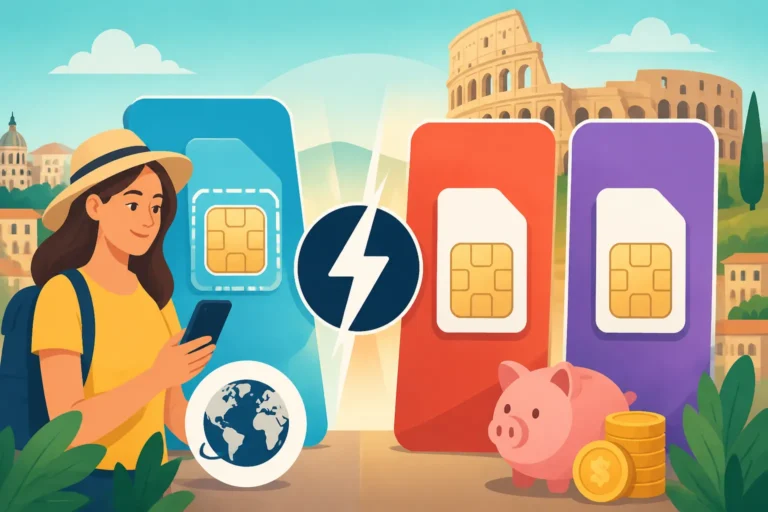
A vital tip for new arrivals: avoid purchasing your permanent physical SIM card at major airport arrival halls if possible. Kiosks at airports like Rome Fiumicino or Milan Malpensa specialize in heavily marked-up “tourist packages.” You can easily spend €30 to €60 for a 30-day SIM card at the airport. If you wait until you reach the city center and visit a standard retail store, you can secure the exact same network access and massive data allowances for an initial cost of just €15 to €25 (which covers the SIM card fee, the activation fee, and the first month of service).
If you require immediate connectivity upon landing to order a taxi or navigate to your hotel, purchasing a digital eSIM from providers like Airalo, Holafly, or Yesim before you board your flight is a highly efficient, cost-effective stopgap.
European Union Data Roaming
One of the greatest legal benefits of securing an Italian SIM card is the European Union’s “Roam Like at Home” legislation. When you travel from Italy to France, Germany, Spain, or any other EU member state, your Italian SIM card will continue to work seamlessly without incurring exorbitant daily international roaming fees.
However, you must read the fine print regarding your data allowance. While your domestic calls and texts remain unlimited across the EU, your domestic data allowance is usually capped when roaming. For example, a Vodafone or WindTre plan that offers 200GB of data inside Italy might legally restrict your EU roaming data to 20GB or 25GB per month. Iliad plans generally offer slightly lower EU roaming allowances, hovering around 9GB to 13GB depending on the specific tier.
Setting Up Home Internet (Broadband and Fiber)
Equipping your Italian apartment with a dedicated home internet line is a separate, slightly more involved process. The speed and quality of the home broadband you can secure are entirely dictated by the physical infrastructure wired into your specific street and building.
Types of Fixed-Line Connections
When checking coverage on a provider’s website, you will encounter three main acronyms:
- FTTH (Fiber to the Home): This is the ultimate gold standard. The fiber optic cable runs directly from the street straight into your living room router. It offers unparalleled stability and blazing-fast download speeds ranging from 1 Gbps to 2.5 Gbps.
- FTTC (Fiber to the Cabinet): This is a hybrid technology. The fiber optic cable runs to the green telecommunications cabinet on your street corner, but the final connection from the street to your apartment relies on older copper telephone wiring. Speeds here are highly dependent on your distance from the cabinet, generally maxing out at 100 Mbps or 200 Mbps.
- ADSL: This is the oldest technology, relying entirely on legacy copper phone lines. It is increasingly rare in urban centers but still prevalent in remote rural areas, generally offering maximum speeds of around 20 Mbps.
Top Home Broadband Providers
The major players in the fixed broadband space overlap significantly with the mobile market. Fastweb is historically renowned for its pioneering fiber-optic network and frequently ranks at the top for broadband video experience and peak upload speeds. Vodafone is a powerhouse, frequently recognized as the most reliable broadband provider in Italy with exceptional consistent quality scores. WindTre and TIM also provide massive, nationwide home broadband coverage, with TIM offering superb on-demand video streaming metrics.
Additionally, Sky Wifi has emerged as a dominant force in the fiber sector. Originally a satellite television company, Sky now offers home broadband and consistently wins awards for the consistency of experience over FTTH connections. Iliad has also recently entered the fixed-line market, offering incredibly cheap FTTH plans (around €15.99 a month for its existing mobile customers or €23.99 for non-mobile customers) featuring a custom-built, highly aesthetic router.
Monthly Costs and Installation Timelines
The average cost of a premium home broadband connection in Italy is remarkably affordable, generally ranging between €20 and €30 per month. Many companies offer “convergence” deals; if you bundle your home fiber connection with your mobile phone SIM card under the same provider, you will receive substantial monthly discounts and often unlimited data on your mobile device.
The installation process requires patience. Once you sign the contract, it typically takes anywhere from one to three weeks for the line to be activated. If you are ordering an FTTH connection for an apartment that has never had fiber before, a technician will need to physically visit the premises to snake the delicate fiber optic cable through the building’s internal conduits.
Essential Requirements Documentation and Bureaucracy
Whether you are walking into a Vodafone store for a prepaid SIM card or ordering a Fastweb fiber connection online, the Italian anti-terrorism and anti-money laundering laws require strict identity verification. You cannot purchase connectivity anonymously.
To successfully establish your telecommunications accounts, you must prepare a comprehensive dossier containing:
- Valid Identification: A current passport is the universally accepted standard for non-EU citizens. A foreign driver’s license is frequently rejected by retail staff.
- The Codice Fiscale: This is the absolute linchpin of Italian bureaucracy. The Codice Fiscale is a 16-character alphanumeric tax identification code. You literally cannot type your name into a provider’s contract database without it. If you do not have one yet, you must immediately read our guide on Why Codice Fiscale Is Essential for Foreigners in Italy to secure it before attempting to buy a phone plan.
- Proof of Address: For home broadband installations, you must provide the exact, official address of your property, including the floor and apartment number. Sometimes, a copy of the registered lease or property deed is requested to prove you have the legal right to install cables on the premises.
- An Italian IBAN (For Contracts): If you are signing a post-paid abbonamento or setting up a monthly direct debit for your home fiber, you will almost certainly need an Italian bank account or a strictly SEPA-compliant European IBAN to authorize the automatic withdrawals. For a seamless strategy on acquiring this, review How to Open a Bank Account in Italy: Requirements and Tips.
Comparison Table of Major Italian Providers
To help you synthesize the vast array of options, use this quick-reference table to compare the strengths of the major telecommunications companies operating in Italy.
| Provider | Primary Network Strength | Ideal Customer Profile | Est. Prepaid Mobile Cost | Home Broadband Offered? |
| Vodafone | Fastest 5G speeds, highest reliability. | High-data users, digital nomads, premium speed seekers. | €14.99 – €19.99 | Yes (Top-tier FTTH) |
| WindTre | Best 5G availability, largest market share. | Rural residents, frequent travelers across Italy. | €12.99 – €24.99 | Yes |
| TIM | Legacy infrastructure, solid 5G uploads. | Users seeking established stability and rural connectivity. | €14.99 – €19.99 | Yes |
| Iliad | Extreme budget pricing, transparent terms. | Budget-conscious expats, students, major city residents. | €7.99 – €13.99 | Yes (Very affordable) |
| Fastweb | Exceptional fixed-line broadband video experience. | Home office workers, gamers, streamers. | Varies (often bundled) | Yes (Premium FTTH) |
Conclusion
Securing your internet and mobile phone services in Italy is an exercise in balancing incredible technological value with distinct bureaucratic protocols. While the necessity of producing a Codice Fiscale and decoding the nuances of Italian prepaid billing cycles might initially feel foreign, the ultimate reward is access to one of the fastest and most affordable telecommunications networks in the world.
By avoiding the inflated prices of airport tourist kiosks, leveraging the flexibility of the ricaricabile system, and meticulously comparing fiber-optic tariffs for your new apartment, you can establish a flawless digital connection. Armed with a reliable Italian mobile plan and a blazing-fast home router, you are fully equipped to navigate local transit, translate menus, handle your professional remote work, and seamlessly share the magic of your new Mediterranean life with the rest of the world.
References
Primary sources (official)
- AGCOM (Autorità per le Garanzie nelle Comunicazioni) – The Communications Regulatory Authority website detailing consumer rights and service standards: https://www.agcom.it/
- Agenzia delle Entrate – Official information regarding the issuance and requirement of the Codice Fiscale: https://www.agenziaentrate.gov.it/portale/web/english
Other helpful sources
- Opensignal – Italy Fixed Broadband Experience Report (November 2024): https://insights.opensignal.com/reports/2024/11/italy/fixed-broadband-experience
- Opensignal – Italy Mobile Network Experience Report: https://insights.opensignal.com/reports/2023/05/italy/mobile-network-experience
Disclaimer
The information provided in this article is for educational and informational purposes only and does not constitute official legal, financial, or consumer advice. Telecommunications tariffs, network speeds, roaming regulations, and administrative requirements in Italy are subject to frequent changes by the providers and national regulators. Always consult directly with the official retail stores or websites of Italian internet and mobile providers to verify the most current pricing, coverage maps, and contractual terms before signing any service agreements.