Setting Up Utilities (Electricity, Gas, Water) in Italy
Moving to Italy is exciting, but organizing your household utilities can be complex. This comprehensive guide explains how to set up electricity, gas, and water, detailing required documents, activation processes, average monthly costs, and navigating the Italian free energy market.
Disclosure: This post may contain affiliate links. We may earn a commission at no extra cost to you if you make a purchase through these links. Read full disclosure.
Introduction
Navigating the utility landscape in a foreign country is universally challenging, but the Italian system presents its own unique set of administrative quirks, specific terminology, and regional variations. Unlike in some nations where a single quick phone call can activate all your basic services simultaneously, setting up utilities in Italy often involves dealing with multiple private companies, municipal authorities, and a mountain of required documentation. To complicate matters further, the Italian energy sector has recently undergone a massive structural transformation, transitioning consumers from a state-protected pricing model into a highly competitive free market.
Understanding exactly how to approach this process is vital for a smooth transition. If you misinterpret the physical status of your home’s meters, you could end up waiting weeks in the dark for a technician to arrive. If you do not understand the standard limits on electrical power draw, you might find yourself constantly tripping the circuit breaker every time you attempt to use the oven and the washing machine at the same time. Furthermore, failing to formally transfer accounts can leave you legally liable for the previous tenant’s unpaid bills or subject to sudden disconnections.
This extensive guide is meticulously designed to demystify the entire process of setting up your household infrastructure in Italy. We will thoroughly explain the critical differences between the various types of connection requests—specifically the voltura, subentro, and allacciamento. We will guide you through the modern Italian energy market, outline the precise documents you need to gather, and provide a clear breakdown of the average costs you should expect to pay. By equipping yourself with this knowledge, you can bypass the common expat pitfalls, expedite your move-in process, and quickly transform your new Italian property into a comfortable, fully functioning home.
Understanding the Italian Energy Market Landscape
To make informed decisions about your household expenses, you must first understand how the Italian energy sector operates. Historically, the distribution and pricing of electricity and gas in Italy were strictly controlled by the state through the national regulatory authority, ARERA (Autorità di Regolazione per Energia Reti e Ambiente). This system was known as the Mercato Tutelato, or the protected market.
The Transition to the Free Market Over the past decade, Italy has gradually liberalized its energy sector to align with broader European Union directives. As of 2024 and fully extending into 2026, the protected market has been largely phased out for standard domestic consumers. Unless you meet specific vulnerability criteria (such as being over the age of 75, possessing certified medical disabilities, or living in emergency housing), you are now required to operate within the Mercato Libero, or the free market.
In the free market, you have the absolute right to choose your electricity and gas supplier from dozens of competing private companies. While the physical infrastructure—the power lines, underground gas pipes, and the meters attached to your home—remains owned and maintained by local distributors (like E-Distribuzione or Italgas), the actual energy you consume is purchased from a retail sales company. Major players in this space include Enel Energia, Eni Plenitude, A2A, Edison, and Iren, alongside numerous smaller, specialized providers focusing on green and renewable energy.
Choosing the Right Tariff This competitive landscape means that providers constantly offer different tariff structures to attract customers. You will generally encounter two types of plans:
- Fixed Rate Plans: These tariffs lock in the price of the energy commodity for a specific duration, typically twelve or twenty-four months. This shields you from unpredictable spikes in global energy wholesale prices, making budgeting significantly easier.
- Variable Rate Plans: These tariffs fluctuate monthly based on the wholesale energy market index (such as the PUN for electricity and the PSV for gas). While they can be cheaper when global energy costs dip, they expose you to high volatility during winter or geopolitical crises.
Before committing to a provider, it is highly recommended to use online comparison tools to evaluate the best available rates in your specific region.
The Three Types of Utility Activations
The single most important factor dictating how quickly and easily you can set up your utilities is the current status of the meters in your new home. In Italy, there are three distinct administrative procedures for connecting services. You must identify which scenario applies to your property, as using the wrong terminology will instantly derail your application.
1. Voltura (Name Change) A voltura is the absolute best-case scenario for a new renter or buyer. This applies when the utility meters are physically present, active, and energy is actively flowing into the apartment, but the contract is currently registered in the name of the previous tenant or the previous property owner.
With a voltura, you are simply requesting that the existing active contract be transferred into your name without any interruption to the energy supply. The process is entirely administrative. You do not need to wait for a technician to visit your home. When performing a voltura, it is crucial to take a meter reading on the exact day you take possession of the property to ensure you are not billed for the previous occupant’s usage. The cost of a voltura is generally around 50 to 80 euros in administrative fees, and the process is usually completed within a few days.
2. Subentro (Reactivation) A subentro is necessary when the previous occupant formally canceled their energy contracts and the supplier deactivated the meters. The physical hardware is present in your home, but the flow of electricity or gas has been shut off.
To restore service, you must contact a supplier and request a reactivation. Legally, electricity providers have up to seven working days to turn the power back on, though with modern smart meters, this is often done remotely and much faster. Gas reactivation takes longer, legally up to twelve working days, and almost always requires a certified technician to physically visit the property to remove a safety seal from the gas valve. The costs for a subentro are similar to a voltura, but the wait time requires careful planning before you move in.
3. Allacciamento (New Connection) An allacciamento (or simply allaccio) is the most complex, expensive, and time-consuming procedure. This applies if you are moving into a brand-new construction or a previously abandoned property that has never been connected to the national energy or gas grid.
This process requires the distributor to physically lay new cables or pipes, install new meter boxes, and connect your property to the main lines. You must request a formal quote, which can cost hundreds or even thousands of euros depending on the structural complexity of the excavation. Furthermore, the timeframe can range from fifteen working days for very simple connections to over sixty working days for complex infrastructural work.
Gathering Your Required Documents
Italian bureaucracy is notoriously rigorous, and utility companies demand a precise set of documents before they will initiate any contract or activation. Regardless of which provider you choose, you must prepare the following dossier.
- Personal Identification: A valid passport or an Italian identity card.
- The Codice Fiscale: This is your unique, alphanumeric Italian tax identification number. You cannot legally sign a utility contract without it. If you have not yet obtained this crucial piece of paperwork, you must prioritize it immediately. You can learn exactly how to acquire it by reading our dedicated post on Why Codice Fiscale Is Essential for Foreigners in Italy.
- Proof of Legal Occupancy: Recent anti-squatting laws require you to prove you have the legal right to live in the home. You must provide a copy of your officially registered rental lease or your property purchase deed (rogito).
- Meter Identification Codes: You cannot simply give the provider your street address. You must provide the unique serial numbers for your specific meters. For electricity, this is the POD (Punto di Prelievo), a 14-character code starting with “IT”. For gas, this is the PDR (Punto di Riconsegna), a 14-digit numerical code. These codes can be found on the previous occupant’s old bills or by pressing the buttons on the digital meter display until the codes appear.
- Bank Details: If you wish to set up automatic direct debit payments, you will need to provide your Italian or SEPA-compliant IBAN.
Setting Up Electricity in Your Home
Electricity (luce) is the foundation of your domestic life. Once you have your documents ready, you can contact your chosen provider online, over the phone, or in person at a local retail branch.
Understanding Power Limits (Potenza Impegnata) One of the most surprising aspects of Italian electricity is the strictly enforced limit on household power consumption. When you sign a contract, you are assigned a specific power threshold, known as the potenza impegnata.
The standard default limit for a normal residential home in Italy is just 3 kilowatts (kW). To put this into perspective, if you attempt to run the washing machine, the dishwasher, and an electric kettle at the exact same time, you will almost certainly exceed this 3 kW limit. When this happens, the master switch on your meter will immediately trip, cutting off all power to your apartment until you unplug an appliance and manually reset the switch.
If you are moving into a large villa, if your home relies entirely on electric induction stoves and heat pumps rather than gas, or if you simply have high energy demands, a 3 kW limit will be incredibly frustrating. You can easily request an upgrade to 4.5 kW or 6 kW from your provider. However, be aware that requesting higher power limits will permanently increase the fixed monthly network distribution charges on your bill.
Setting Up the Gas Supply
Gas (gas metano) remains the primary energy source for cooking, hot water, and winter heating in the vast majority of Italian homes. Many major providers offer “dual fuel” contracts, allowing you to bundle your electricity and gas together for convenience and occasional discounts.
Mains Gas vs. Rural Cylinders If you live in a city or a well-connected suburban area, your home will be connected to the municipal mains gas network. You simply activate the supply via a voltura or subentro as described above.
However, if you have purchased a farmhouse deep in the countryside, you may not have access to mains gas. In rural areas, homes rely on outdoor gas tanks (bomboloni) filled with GPL, or smaller, replaceable gas cylinders (bombole) for cooking. In this scenario, you do not deal with a national provider; you arrange for periodic deliveries from a specialized local fuel company.
Safety Certifications and Inspections Gas carries significant safety risks, and the Italian government enforces strict regulations regarding boiler maintenance. If you are completing a new allacciamento (new connection), you must have a certified plumber or technician issue a declaration of conformity (Allegato I/40) proving your internal pipes and boiler meet all legal safety standards before the gas company will turn on the supply.
Furthermore, Italian law requires that your home’s gas boiler (caldaia) undergo mandatory maintenance and emissions testing every one to two years, depending on the region and the specific type of boiler. As a tenant, paying for this annual boiler inspection is typically your legal responsibility, while replacing a broken boiler falls to the landlord. To better understand your maintenance liabilities as an expat renter, refer to The Ultimate Guide to Renting and Buying a Home in Italy.
Managing Water Supply and Waste Disposal
Unlike electricity and gas, the water supply (acqua) and garbage collection (rifiuti) in Italy are strictly managed by local municipal authorities or regional public consortiums. You cannot choose your water provider; it is dictated entirely by your geographic location.
Activating the Water Supply The procedure for water depends heavily on your housing type. If you are renting an independent house or a villa, you must contact the local municipal water company (such as ACEA in Rome, Publiacqua in Florence, or MM in Milan) to arrange a voltura or subentro in your name.
However, if you are renting an apartment in a multi-unit building, it is highly likely that the building operates on a single, centralized master water meter. In this very common scenario, you do not need to set up a personal water contract at all. The building administrator pays the massive master water bill, divides the cost among the apartments based on square footage or the number of occupants, and bills you directly through your monthly condominium fees (spese condominiali).
The Garbage Tax (TARI) Waste disposal in Italy is not billed as a standard utility; it is levied as a municipal tax known as the TARI (Tassa sui Rifiuti). You are legally required to register with your local town hall (Comune) within a few months of moving in to declare your occupancy for garbage collection. The TARI is calculated based on the square meterage of your property and the number of people living there, and it is usually billed once or twice a year.
Internet and Telecommunications
Setting up internet and a mobile phone plan is typically the fastest and least bureaucratic part of settling into your new Italian home. Italy has excellent telecommunications infrastructure, and the market is highly competitive, leading to some of the cheapest mobile data and home broadband rates in Western Europe.
Major national providers include TIM, Vodafone, Fastweb, WindTre, and Iliad. If you live in an urban center, you will likely have access to high-speed Fiber-to-the-Home (FTTH) connections. In more rural or historic locations, you might be limited to standard ADSL or fixed wireless access.
To set up a home internet contract, you simply need your passport, your Codice Fiscale, and your Italian bank IBAN. Once you sign the contract, the provider will schedule a technician to visit your home to install the router, a process that generally takes one to two weeks. If you need a deeper dive into managing the holistic costs of moving, studying, and working, explore Cost of Living in Italy 2026: Budgeting for Expats to keep your broader finances on track.
Average Utility Costs in Italy for 2026
Budgeting accurately for utilities is crucial for expats. While prices fluctuate based on global markets, seasonal usage, and regional taxes, you can use the following table to estimate your monthly financial obligations for a standard 70 to 85 square meter apartment.
| Utility Service | Estimated Monthly Cost (2026) | Notes and Variables |
| Electricity | €70 – €120 | Heavily dependent on summer air conditioning use and power limit upgrades. |
| Gas (Winter) | €80 – €130 | Costs spike significantly from November to March due to central heating demands. |
| Water Supply | €20 – €50 | Often included in building condominium fees; very affordable nationally. |
| Home Internet | €25 – €40 | Fiber optic broadband; often includes a free router with a 24-month contract. |
| Waste Tax (TARI) | €12 – €25 (billed annually at €150-€300) | Calculated by square footage and household size; paid directly to the municipality. |
Understanding Your Bills and Payment Methods
When your utility bills (bollette) begin arriving, they can appear incredibly dense and confusing. An Italian electricity or gas bill is divided into several sections: the actual cost of the energy commodity you consumed, fixed network transportation and meter management fees, state system charges to fund renewable energy initiatives, and substantial government taxes (excise duties and VAT).
The TV License Fee (Canone RAI) One charge that frequently surprises expats is the Italian television license fee, known as the Canone RAI. To ensure compliance, the government legally embedded this tax directly into residential electricity bills. It costs roughly €70 per year and is automatically broken down into small monthly installments added to your electricity total. If you do not own a television or a device capable of receiving broadcasts, you must submit a formal declaration to the Revenue Agency to be exempted; otherwise, you must pay it.
How to Pay The most efficient and secure way to pay your utility bills is to set up a direct debit (addebito diretto) using your Italian or SEPA-compliant bank account. The funds will be automatically withdrawn on the due date, ensuring you never miss a payment and incur late fees. Furthermore, many providers waive the initial security deposit required during contract signing if you opt for direct debit.
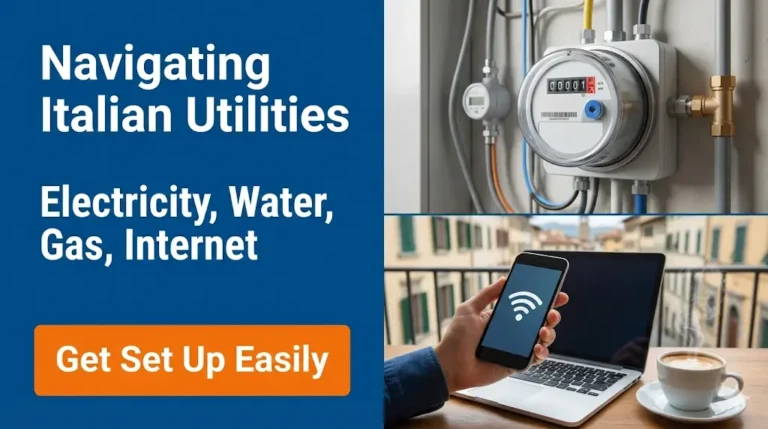
If you prefer not to automate payments, you can pay your bills manually. Every bill comes with a standardized payment slip (usually a PagoPA code or a bollettino postale). You can pay these slips online through your banking app, physically at any post office, or at your local tobacco shop (tabaccheria) for a small convenience fee of around two euros. If you are looking to understand the broader ecosystem of managing your home and the associated legalities of long-term stays, review Navigating Italian Utilities: Electricity, Water, Gas, Internet for further comprehensive insights into local protocols.
Conclusion
Setting up your utilities in Italy requires navigating a unique blend of modern digital systems and deeply traditional bureaucratic procedures. While the terminology—such as voltura, subentro, and the Mercato Libero—may initially seem intimidating, the process follows a highly logical and structured path. By acting proactively, gathering your essential documents like the Codice Fiscale and meter codes in advance, and carefully assessing the physical status of the connections in your new home, you can completely avoid the stress of moving into a dark, unheated apartment.
Taking the time to compare tariffs in the free market and establishing automated direct debits will not only save you money but also free you from ongoing administrative headaches. Once the contracts are signed and the services are activated, you can finally turn your focus toward the truly rewarding aspects of expatriate life: exploring your new neighborhood, mastering the local language, and enjoying the unmatched beauty of Italy.
References
Primary sources (official)
- ARERA (Italian Regulatory Authority for Energy, Networks, and Environment) – Guidelines on the free market and consumer rights: https://www.arera.it/en/
- Agenzia delle Entrate – Information on acquiring the Codice Fiscale and paying the Canone RAI: https://www.agenziaentrate.gov.it/portale/web/english
Other helpful sources
- Enel Energia – Detailed guides on Voltura vs. Subentro procedures: https://www.enel.it/en-us/assistenza/luce-gas/voltura
- Expatica Italy – Setting up utilities in Italy: water, gas, and electricity: https://www.expatica.com/it/living/household/utilities-in-italy-81481/
Disclaimer
The information provided in this article is for educational and informational purposes only and does not constitute official legal, financial, or tax advice. Italian utility regulations, energy market tariffs, municipal waste taxes, and administrative procedures are highly subject to change at both the national and local levels. Always conduct your own independent research and consult directly with your chosen utility providers or the Italian regulatory authority (ARERA) for the most current and personalized guidance regarding your specific domestic setup.